
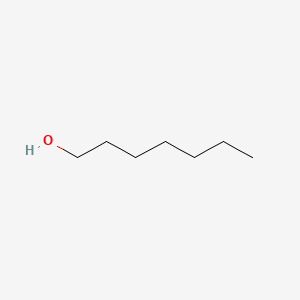
CAS 111-70-6PubChem CID 8129
Heptanol
Watery colorless liquid with a weak alcohol odor. Floats on water. (USCG, 1999) — CAMEO Chemicals
- IUPAC name
- heptan-1-ol
- Molecular formula
- C7H16O
- Molecular weight
- 116.20 g/mol
- Exact mass
- 116.120115130 Da
- XLogP3
- 2.7
- Topological polar surface area
- 20.2 Ų
- Hydrogen-bond donors
- 1
- Hydrogen-bond acceptors
- 1
- Covalent units
- 1
- Defined stereocentres
- 0
Also known as
1-HEPTANOLHeptyl alcoholn-HeptanolEnanthic alcoholHydroxy heptaneHydroxyheptaneHexyl carbinolC7 alcohol
16 more reported names
Pri-n-heptyl alcoholHeptyl alcohol, primary1-heptyl alcoholFEMA Number 2548Heptyl alcohol (natural)HSDB 1077heptanol-1HEPTYL ALCOHOL, N-EINECS 203-897-9BRN 1731686AI3-15363FEMA 2548NSC-37031-HEPTANOL [MI]n-C7H15OH1-HEPTANOL [HSDB]
External database identifiers
- ChEBI:CHEBI:43003
- ChEMBL:CHEMBL273459
- EPA DTXSID:DTXSID8021937
- PubMed:23113299
- PubMed:23112846
- PubMed:22777069
- PubMed:22701113
- PubMed:22685432
- PubMed:22648522
- PubMed:22613982
- PubMed:22605975
- PubMed:22577485
- PubMed:22563443
- PubMed:22553418
- PubMed:22541817
Evidence from additional scientific databases
NIH PubChem PUG-View
Exact identifier match8129
Attributed physical-property, hazard, environmental and use annotations.
- Autoignition Temperature: 275 °C Source: ILO-WHO International Chemical Safety Cards (ICSCs)
- Boiling Point: 349 °F at 760 mmHg (USCG, 1999) Source: CAMEO Chemicals
- Boiling Point: 175.8 °C at 760 mm Hg Source: Hazardous Substances Data Bank (HSDB)
- Boiling Point: BP: 155.6 °C at 400 mm Hg; 136.6 °C at 200 mm Hg; 119.5 °C at 100 mm Hg; ... 85.8 °C at 20 mm Hg; 74.7 °C at 10 mm Hg; 64.3 °C at 5 mm Hg; 42.4deg C at 1.0 mm Hg Source: Hazardous Substances Data Bank (HSDB)
- Boiling Point: 175.00 to 176.00 °C. @ 760.00 mm Hg Source: Human Metabolome Database (HMDB)
- Boiling Point: 175 °C Source: ILO-WHO International Chemical Safety Cards (ICSCs)
- Boiling Point: 175 °C Source: Joint FAO/WHO Expert Committee on Food Additives (JECFA)
- Boiling Point: 175.8 °C @760 [mm Hg] Source: PAC Chemical Database, U.S. Department of Energy
- Color/Form: Colorless liquid Source: Hazardous Substances Data Bank (HSDB)
- Density: 0.822 at 68 °F (USCG, 1999) - Less dense than water; will float Source: CAMEO Chemicals
- Density: 0.8219 at 20 °C/4 °C Source: Hazardous Substances Data Bank (HSDB)
- Density: 0.82 g/cm³ Source: ILO-WHO International Chemical Safety Cards (ICSCs)
- Density: Relative density of the vapour/air-mixture at 20 °C (air = 1): 1.01 Source: ILO-WHO International Chemical Safety Cards (ICSCs)
- Density: 0.820-1.824 Source: Joint FAO/WHO Expert Committee on Food Additives (JECFA)
- Density: 0.824 @ 20°C Source: PAC Chemical Database, U.S. Department of Energy
- Flash Point: 170 °F (USCG, 1999) Source: CAMEO Chemicals
- Flash Point: 76.6 °C Source: Haz-Map, Information on Hazardous Chemicals and Occupational Diseases
- Flash Point: 71 °C Source: Hazardous Substances Data Bank (HSDB)
- Flash Point: 70 °C c.c. Source: ILO-WHO International Chemical Safety Cards (ICSCs)
- LogP: Log Kow = 2.62 Source: Hazardous Substances Data Bank (HSDB)
- LogP: 2.62 Source: Human Metabolome Database (HMDB)
- LogP: 2.62 Source: ILO-WHO International Chemical Safety Cards (ICSCs)
- Melting Point: -29 °F (USCG, 1999) Source: CAMEO Chemicals
- Melting Point: -34.6 °C Source: Hazardous Substances Data Bank (HSDB)
- Melting Point: -34.1 °C Source: Human Metabolome Database (HMDB)
- Melting Point: -34 °C Source: ILO-WHO International Chemical Safety Cards (ICSCs)
- Melting Point: -34.6 °C Source: PAC Chemical Database, U.S. Department of Energy
- Odor: Fragrant Source: Hazardous Substances Data Bank (HSDB)
- Odor: FAINT, AROMATIC, FATTY Source: Hazardous Substances Data Bank (HSDB)
- Physical Description: Watery colorless liquid with a weak alcohol odor. Floats on water. (USCG, 1999) Source: CAMEO Chemicals
- Physical Description: Liquid Source: EPA Chemical Data Reporting (CDR)
- Physical Description: Colorless fragrant liquid; [Hawley] Source: Haz-Map, Information on Hazardous Chemicals and Occupational Diseases
- Physical Description: Liquid Source: Human Metabolome Database (HMDB)
- Physical Description: COLOURLESS LIQUID WITH CHARACTERISTIC ODOUR. Source: ILO-WHO International Chemical Safety Cards (ICSCs)
- Physical Description: colourless liquid/citrus odour Source: Joint FAO/WHO Expert Committee on Food Additives (JECFA)
- Refractive Index: Index of refraction: 1.4249 at 20 degC/D Source: Hazardous Substances Data Bank (HSDB)
- Refractive Index: 1.423-1.427 Source: Joint FAO/WHO Expert Committee on Food Additives (JECFA)
- Solubility: Miscible with alcohol, ether Source: Hazardous Substances Data Bank (HSDB)
- Solubility: 1.0 g/L of water at 18 °C; 2.85 g/L of water at 100 °C; 5.15 g/L of water at 130 °C Source: Hazardous Substances Data Bank (HSDB)
- Solubility: In water, 1,670 mg/L at 25 °C Source: Hazardous Substances Data Bank (HSDB)
- Solubility: 1740 ppm (wt) at 25 °C Source: Hazardous Substances Data Bank (HSDB)
- Solubility: Slightly soluble in carbon tetrachloride; soluble in ethanol, ether Source: Hazardous Substances Data Bank (HSDB)
- Solubility: 1.67 mg/mL at 25 °C Source: Human Metabolome Database (HMDB)
- Solubility: Solubility in water, g/100ml at 20 °C: 0.1 Source: ILO-WHO International Chemical Safety Cards (ICSCs)
- Solubility: slightly soluble in water; miscible with alcohol, ether, most fixed oils Source: Joint FAO/WHO Expert Committee on Food Additives (JECFA)
- Solubility: 1 ml in 2 ml 60% alcohol (in ethanol) Source: Joint FAO/WHO Expert Committee on Food Additives (JECFA)
- Vapor Pressure: 0.21 [mmHg] Source: Haz-Map, Information on Hazardous Chemicals and Occupational Diseases
- Vapor Pressure: 0.2163 mm Hg at 25 °C Source: Hazardous Substances Data Bank (HSDB)
- Vapor Pressure: Vapor pressure, Pa at 20 °C: 15 Source: ILO-WHO International Chemical Safety Cards (ICSCs)
- Vapor Pressure: 0.2163 [mm Hg] @25 °C Source: PAC Chemical Database, U.S. Department of Energy
- Viscosity: 7.4 centapoise at 20 °C Source: Hazardous Substances Data Bank (HSDB)
- Exposure Routes: The substance can be absorbed into the body by inhalation of its vapour and by ingestion. Source: ILO-WHO International Chemical Safety Cards (ICSCs)
- First Aid: Flush all affected parts with plenty of water. (USCG, 1999) Source: CAMEO Chemicals
- Signal: Warning Source: European Chemicals Agency (ECHA)
- GHS Hazard Statements: H319 (94.5%): Causes serious eye irritation [Warning Serious eye damage/eye irritation] Source: European Chemicals Agency (ECHA)
- Precautionary Statement Codes: P264+P265, P280, P305+P351+P338, and P337+P317 (click each P-code to see the statement) Source: European Chemicals Agency (ECHA)
- ECHA C&L Notifications Summary: Aggregated GHS information provided per 1619 reports by companies from 10 notifications to the ECHA C&L Inventory.; Information may vary between notifications depending on impurities, additives, and other factors. The percentage value in parenthesis indicates the notified classification ratio from companies that provide hazard codes. Only hazard codes with percentage values above 10% are shown. For more detailed information, please visit ECHA C&L website. Source: European Chemicals Agency (ECHA)
- Signal: Warning Source: NITE-CMC
- GHS Hazard Statements: H227: Combustible liquid [Warning Flammable liquids]; H315: Causes skin irritation [Warning Skin corrosion/irritation]; H319: Causes serious eye irritation [Warning Serious eye damage/eye irritation] Source: NITE-CMC
- Precautionary Statement Codes: P210, P264, P264+P265, P280, P302+P352, P305+P351+P338, P321, P332+P317, P337+P317, P362+P364, P370+P378, P403, and P501 (click each P-code to see the statement) Source: NITE-CMC
- Signal: Warning Source: Hazardous Chemical Information System (HCIS), Safe Work Australia
- GHS Hazard Statements: H319: Causes serious eye irritation [Warning Serious eye damage/eye irritation] Source: Hazardous Chemical Information System (HCIS), Safe Work Australia
- Precautionary Statement Codes: P264+P265, P280, P305+P351+P338, and P337+P317 (click each P-code to see the statement) Source: Hazardous Chemical Information System (HCIS), Safe Work Australia
- Environmental Bioconcentration: An estimated BCF of 21 was calculated for 1-heptanol(SRC), using a log Kow of 2.62(1) and a regression-derived equation(2). According to a classification scheme(3), this BCF suggests the potential for bioconcentration in aquatic organisms is low(SRC). Source: Hazardous Substances Data Bank (HSDB)
- Environmental Fate: TERRESTRIAL FATE: Based on a classification scheme(1), an estimated Koc value of 74(SRC), determined from a water solubility of 1670 mg/L(2) and a regression-derived equation(3), indicates that 1-heptanol is expected to have high mobility in soil(SRC). Volatilization of 1-heptanol from moist soil surfaces is expected to be an important fate process(SRC) given a Henry's Law constant of 1.88X10⁻⁵ atm-cu m/mole(4). 1-Heptanol is not expected to volatilize from dry soil surfaces(SRC) based upon a vapor pressure of 0.216 mm Hg(5). 1-Heptanol has been demonstrated to be readily biodegradable in aerobic screening tests(6-10) and therefore should biodegrade in soil(SRC). Source: Hazardous Substances Data Bank (HSDB)
- Environmental Fate: AQUATIC FATE: Based on a classification scheme(1), an estimated Koc value of 74(SRC), determined from a water solubility of 1670 mg/L(2) and a regression-derived equation(3), indicates that 1-heptanol is expected to adsorb to suspended solids and sediment(SRC). Volatilization from water surfaces is expected(3) based upon a Henry's Law constant of 1.88X10⁻⁵ atm-cu m/mole(4). Using this Henry's Law constant and an estimation method(3), volatilization half-lives for a model river and model lake are 2.2 days and 20 days, respectively(SRC). According to a classification scheme(5), an estimated BCF of 21(SRC), from its log Kow of 2.62(6) and a regression-derived equation(7), suggests the potential for bioconcentration in aquatic organisms is low(SRC). 1-Heptanol has been demonstrated to be readily biodegradable in aerobic screening tests(8-12) and therefore should biodegrade in water(SRC). Source: Hazardous Substances Data Bank (HSDB)
- Environmental Fate: ATMOSPHERIC FATE: According to a model of gas/particle partitioning of semivolatile organic compounds in the atmosphere(1), 1-heptanol, which has a vapor pressure of 0.216 mm Hg at 25 °C(2), is expected to exist solely as a vapor in the ambient atmosphere. Vapor-phase 1-heptanol is degraded in the atmosphere by reaction with photochemically-produced hydroxyl radicals(SRC); the half-life for this reaction in air is estimated to be 28 hours(SRC), calculated from its rate constant of 1.36X10⁻¹¹ cu cm/molecule-sec at 25 °C(3). Source: Hazardous Substances Data Bank (HSDB)
- Industry Uses: Intermediate Source: EPA Chemical Data Reporting (CDR)
- Sources/Uses: Used as an organic intermediate, solvent, and additive in cosmetics, fragrances, and flavoring agents; [HSDB] Source: Haz-Map, Information on Hazardous Chemicals and Occupational Diseases
- Uses: In the United States, practically the whole production is processed further to phthalates or adipates, used as plasticizers. ... The alcohol mixtures are used as solvents or solubilizers in the paint and printing ink sector, as components in textile auxiliaries and pesticides, for hormone extraction, and in the surfactant field as foam boosters or antifrothing agents. /C7 alcohol mixtures/ Source: Hazardous Substances Data Bank (HSDB)
- Uses: Food additive Source: Hazardous Substances Data Bank (HSDB)
- Uses: Org intermediate, solvent, cosmetic formulations Source: Hazardous Substances Data Bank (HSDB)
- Uses: /1-Heptanol/ has little commercial value except in fragrances and as an artificial flavoring agent. Source: Hazardous Substances Data Bank (HSDB)
Mapped by: Existing checksum-valid CAS to unique PubChem CID match. Retrieved: 2026-08-31. Open source record
Scientific classifications and hazard annotations provide context and do not replace the market-specific regulatory decision shown above.
Additional source coverage and match status
| Source | Result | Checked |
|---|---|---|
| NIH PubChem PUG-View | Exact match | 2026-08-31 |
A recorded no-match is useful evidence that the source was checked; it is not a claim that the substance does not exist elsewhere.
Retrieved from NIH PubChem on 2026-08-31 by checksum-valid CAS matching. Chemical properties do not replace the regulatory decision on this page.