
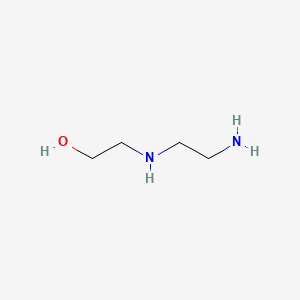
N-(2-Hydroxyethyl)ethylenediamine
Aminoethylethanolamine appears as a clear colorless liquid with an ammonia-like odor. Corrosive to tissue. Combustible, but may be difficult to ignite. Less dense than water. Vapors heavier than air. Toxic oxides of nitrogen produced during combustion. Used to make other chemicals. — CAMEO Chemicals
- IUPAC name
- 2-(2-aminoethylamino)ethanol
- Molecular formula
- C4H12N2O
- Molecular weight
- 104.15 g/mol
- Exact mass
- 104.094963011 Da
- XLogP3
- -1.7
- Topological polar surface area
- 58.3 Ų
- Hydrogen-bond donors
- 3
- Hydrogen-bond acceptors
- 3
- Covalent units
- 1
- Defined stereocentres
- 0
Also known as
16 more reported names
External database identifiers
Evidence from additional scientific databases
NIH PubChem PUG-View
Attributed physical-property, hazard, environmental and use annotations.
- Autoignition Temperature: 695 °F (USCG, 1999) Source: CAMEO Chemicals
- Autoignition Temperature: 695 °F (368 °C) Source: Hazardous Substances Data Bank (HSDB)
- Boiling Point: 460 to 464 °F at 760 mmHg (NTP, 1992) Source: CAMEO Chemicals
- Boiling Point: 238-40 °C Source: Hazardous Substances Data Bank (HSDB)
- Boiling Point: BP: 243.7 °C Source: Hazardous Substances Data Bank (HSDB)
- Boiling Point: 460-464 °F Source: Occupational Safety and Health Administration (OSHA)
- Boiling Point: 243 °C @760 [mm Hg] Source: PAC Chemical Database, U.S. Department of Energy
- Color/Form: COLORLESS LIQ Source: Hazardous Substances Data Bank (HSDB)
- Density: 1.028 at 77 °F (USCG, 1999) - Denser than water; will sink Source: CAMEO Chemicals
- Density: 1.0254 at 25 °C Source: Hazardous Substances Data Bank (HSDB)
- Density: 1.028 Source: Occupational Safety and Health Administration (OSHA)
- Density: 1.03 @25 °C Source: PAC Chemical Database, U.S. Department of Energy
- Dissociation Constants: pKa= 7.21 Source: Hazardous Substances Data Bank (HSDB)
- Flash Point: 216 °F (NTP, 1992) Source: CAMEO Chemicals
- Flash Point: 132 °C Source: Haz-Map, Information on Hazardous Chemicals and Occupational Diseases
- Flash Point: 132 °C (CLOSED CUP) Source: Hazardous Substances Data Bank (HSDB)
- Flash Point: 216 °F Source: Occupational Safety and Health Administration (OSHA)
- Melting Point: -33 °C Source: PAC Chemical Database, U.S. Department of Energy
- Odor: MILD AMMONIACAL ODOR Source: Hazardous Substances Data Bank (HSDB)
- Physical Description: Aminoethylethanolamine appears as a clear colorless liquid with an ammonia-like odor. Corrosive to tissue. Combustible, but may be difficult to ignite. Less dense than water. Vapors heavier than air. Toxic oxides of nitrogen produced during combustion. Used to make other chemicals. Source: CAMEO Chemicals
- Physical Description: CBI; Liquid Source: EPA Chemical Data Reporting (CDR)
- Physical Description: A clear colorless liquid with an ammonia-like odor; [CAMEO] Source: Haz-Map, Information on Hazardous Chemicals and Occupational Diseases
- Physical Description: A clear colorless liquid with an ammonia-like odor. Source: Occupational Safety and Health Administration (OSHA)
- Refractive Index: INDEX OF REFRACTION: 1.4861 @ 20 °C/D Source: Hazardous Substances Data Bank (HSDB)
- Solubility: greater than or equal to 100 mg/mL at 70 °F (NTP, 1992) Source: CAMEO Chemicals
- Solubility: VERY SOL IN WATER, ALCOHOL, ACETATE Source: Hazardous Substances Data Bank (HSDB)
- Vapor Pressure: less than 0.01 mmHg at 68 °F (NTP, 1992) Source: CAMEO Chemicals
- Vapor Pressure: 0.000819 [mmHg] Source: Haz-Map, Information on Hazardous Chemicals and Occupational Diseases
- Vapor Pressure: 8.19X10⁻⁴ mm Hg at 25 °C Source: Hazardous Substances Data Bank (HSDB)
- Vapor Pressure: <0.01 mmHg Source: Occupational Safety and Health Administration (OSHA)
- Vapor Pressure: 0.01 [mm Hg] @20 °C Source: PAC Chemical Database, U.S. Department of Energy
- First Aid: EYES: First check the victim for contact lenses and remove if present. Flush victim's eyes with water or normal saline solution for 20 to 30 minutes while simultaneously calling a hospital or poison control center. Do not put any ointments, oils, or medication in the victim's eyes without specific instructions from a physician. IMMEDIATELY transport the victim after flushing eyes to a hospital even if no symptoms (such as redness or irritation) develop.; SKIN: IMMEDIATELY flood affected skin with water while removing and isolating all contaminated clothing. Gently wash all affected skin areas thoroughly with soap and water. If symptoms such as redness or irritation develop, IMMEDIATELY call a physician and be prepared to transport the victim to a hospital for treatment.; INHALATION: IMMEDIATELY leave the contaminated area; take deep breaths of fresh air. If symptoms (such as wheezing, coughing, shortness of breath, or burning in the mouth, throat, or chest) develop, call a physician and be prepared to transport the victim to a hospital. Provide proper respiratory protection to rescuers entering an unknown atmosphere. Whenever possible, Self-Contained Breathing Apparatus (SCBA) shou Source: CAMEO Chemicals
- Signal: Danger Source: Regulation (EC) No 1272/2008 of the European Parliament and of the Council
- GHS Hazard Statements: H314: Causes severe skin burns and eye damage [Danger Skin corrosion/irritation]; H317: May cause an allergic skin reaction [Warning Sensitization, Skin]; H360Df: May damage the unborn child; Suspected of damaging fertility [Danger Reproductive toxicity] Source: Regulation (EC) No 1272/2008 of the European Parliament and of the Council
- Precautionary Statement Codes: P203, P260, P261, P264, P272, P280, P301+P330+P331, P302+P352, P302+P361+P354, P304+P340, P305+P354+P338, P316, P318, P321, P333+P317, P362+P364, P363, P405, and P501 (click each P-code to see the statement) Source: Regulation (EC) No 1272/2008 of the European Parliament and of the Council
- Signal: Danger Source: European Chemicals Agency (ECHA)
- GHS Hazard Statements: H290 (13.6%): May be corrosive to metals [Warning Corrosive to Metals]; H314 (99.4%): Causes severe skin burns and eye damage [Danger Skin corrosion/irritation]; H317 (> 99.9%): May cause an allergic skin reaction [Warning Sensitization, Skin]; H318 (19%): Causes serious eye damage [Danger Serious eye damage/eye irritation]; H335 (17.8%): May cause respiratory irritation [Warning Specific target organ toxicity, single exposure; Respiratory tract irritation]; H360 (99.8%): May damage fertility or the unborn child [Danger Reproductive toxicity] Source: European Chemicals Agency (ECHA)
- Precautionary Statement Codes: P203, P234, P260, P261, P264, P264+P265, P271, P272, P280, P301+P330+P331, P302+P352, P302+P361+P354, P304+P340, P305+P354+P338, P316, P317, P318, P319, P321, P333+P317, P362+P364, P363, P390, P403+P233, P405, P406, and P501 (click each P-code to see the statement) Source: European Chemicals Agency (ECHA)
- ECHA C&L Notifications Summary: Aggregated GHS information provided per 3278 reports by companies from 41 notifications to the ECHA C&L Inventory. Each notification may be associated with multiple companies.; Information may vary between notifications depending on impurities, additives, and other factors. The percentage value in parenthesis indicates the notified classification ratio from companies that provide hazard codes. Only hazard codes with percentage values above 10% are shown. For more detailed information, please visit ECHA C&L website. Source: European Chemicals Agency (ECHA)
- GHS Hazard Statements: H402: Harmful to aquatic life [Hazardous to the aquatic environment, acute hazard]; H412: Harmful to aquatic life with long lasting effects [Hazardous to the aquatic environment, long-term hazard] Source: NITE-CMC
- Precautionary Statement Codes: P273, and P501 (click each P-code to see the statement) Source: NITE-CMC
- Signal: Danger Source: NITE-CMC
- GHS Hazard Statements: H314: Causes severe skin burns and eye damage [Danger Skin corrosion/irritation]; H317: May cause an allergic skin reaction [Warning Sensitization, Skin]; H318: Causes serious eye damage [Danger Serious eye damage/eye irritation]; H334: May cause allergy or asthma symptoms or breathing difficulties if inhaled [Danger Sensitization, respiratory]; H360: May damage fertility or the unborn child [Danger Reproductive toxicity]; H373: May causes damage to organs through prolonged or repeated exposure [Warning Specific target organ toxicity, repeated exposure]; H402: Harmful to aquatic life [Hazardous to the aquatic environment, acute hazard]; H412: Harmful to aquatic life with long lasting effects [Hazardous to the aquatic environment, long-term hazard] Source: NITE-CMC
- Precautionary Statement Codes: P203, P233, P260, P261, P264, P264+P265, P271, P272, P273, P280, P284, P301+P330+P331, P302+P352, P302+P361+P354, P304+P340, P305+P354+P338, P316, P317, P318, P319, P321, P333+P317, P342+P316, P362+P364, P363, P403, P405, and P501 (click each P-code to see the statement) Source: NITE-CMC
- NFPA Health Rating: 2 - Materials that, under emergency conditions, can cause temporary incapacitation or residual injury. Source: Hazardous Substances Data Bank (HSDB)
- NFPA Fire Rating: 1 - Materials that must be preheated before ignition can occur. Materials require considerable preheating, under all ambient temperature conditions, before ignition and combustion can occur. Source: Hazardous Substances Data Bank (HSDB)
- NFPA Instability Rating: 0 - Materials that in themselves are normally stable, even under fire conditions. Source: Hazardous Substances Data Bank (HSDB)
- Environmental Bioconcentration: Based upon an estimated log Kow of -1.39(1), the BCF for aminoethyl ethanolamine can be estimated to be 0.05 from a recommended regression-derived equation(2,SRC). This estimated BCF value indicates that bioconcentration in aquatic organisms is not important. Aminoethyl ethanolamine is miscible in water(3) which also indicates that bioconcentration is not important(SRC). Source: Hazardous Substances Data Bank (HSDB)
- Environmental Fate: TERRESTRIAL FATE: The results of one biodegradation screening study have indicated that aminoethyl ethanolamine biodegrades readily(1); therefore, biodegradation may be an important transformation process in soil(SRC). Aminoethyl ethanolamine has a pKa of 7.21(2) that indicates it can exist in both the protonated and neutral forms in environmental media; neutral aminoethyl ethanolamine is expected to leach readily. However, the mobility of protonated aminoethyl ethanolamine in soil can not be predicted without additional experimental data(SRC). Source: Hazardous Substances Data Bank (HSDB)
- Environmental Fate: AQUATIC FATE: The results of one biodegradation screening study have indicated that aminoethyl ethanolamine biodegrades readily(1); therefore, biodegradation may be an important transformation process in water. Aquatic bioconcentration and volatilization are not expected to be important because of the high solubility of aminoethyl ethanolamine(SRC). Source: Hazardous Substances Data Bank (HSDB)
- Environmental Fate: ATMOSPHERIC FATE: Based upon a vapor pressure of 8.19X10⁻⁴ mm Hg at 25 °C(1), aminoethyl ethanolamine is expected to exist primarily in the vapor-phase in the ambient atmosphere(2,SRC). It will degrade rapidly in the atmosphere by the vapor-phase reaction with photochemically produced hydroxyl radicals with an estimated half-life of 3.3 hr(3,SRC). Aminoethyl ethanolamine is miscible with water(4), therefore, physical removal from air by wet deposition (dissolution in clouds, rainfall, etc) is possible(SRC). Source: Hazardous Substances Data Bank (HSDB)
- Industry Uses: Intermediate; Corrosion inhibitor; pH regulating agent; Processing aids not otherwise specified; CBI Source: EPA Chemical Data Reporting (CDR)
- Sources/Uses: Used as a chemical intermediate, textile finishing compound, and additive to oils in metal cutting; [HSDB] Occupational asthma reported in solderer and cable jointer; [Malo] Source: Haz-Map, Information on Hazardous Chemicals and Occupational Diseases
- Industrial Processes with risk of exposure: Metal Machining [Category: Heat or Machine]; Soldering [Category: Heat or Machine]; Semiconductor Manufacturing [Category: Industry]; Textiles (Printing, Dyeing, or Finishing) [Category: Industry] Source: Haz-Map, Information on Hazardous Chemicals and Occupational Diseases
- Uses: CHEM INT FOR CHELATING AGENTS, DETERGENTS & EMULSIFIERS, CORROSION INHIBITORS, MINING CHEMICALS, GASOLINE STABILIZERS, DYEING ASSISTANTS, MODIFYING AGENTS (TEXTILES), 2,4-D HERBICIDE SALTS, OILS USED IN TEXTILE PROCESSING, OILS USED IN METAL CUTTING, AND GAS PROCESSING CHEMICALS Source: Hazardous Substances Data Bank (HSDB)
- Uses: TEXTILE FINISHING CMPD (ANTIFUMING AGENTS, DYESTUFFS, CATIONIC SURFACTANTS); RESINS, RUBBER PRODUCTS; INSECTICIDES, CERTAIN MEDICINALS Source: Hazardous Substances Data Bank (HSDB)
Mapped by: Existing checksum-valid CAS to unique PubChem CID match. Retrieved: 2026-08-31. Open source record
Scientific classifications and hazard annotations provide context and do not replace the market-specific regulatory decision shown above.
Additional source coverage and match status
| Source | Result | Checked |
|---|---|---|
| NIH PubChem PUG-View | Exact match | 2026-08-31 |
A recorded no-match is useful evidence that the source was checked; it is not a claim that the substance does not exist elsewhere.
Retrieved from NIH PubChem on 2026-09-02 by checksum-valid CAS matching. Chemical properties do not replace the regulatory decision on this page.