
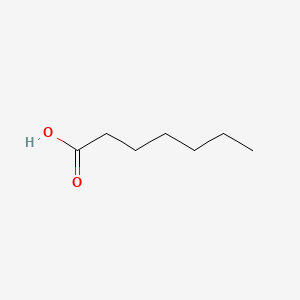
Heptanoic Acid
Heptanoic acid is a C7, straight-chain fatty acid that contributes to the odour of some rancid oils. Used in the preparation of esters for the fragrance industry, and as an additive in cigarettes. It has a role as a plant metabolite. It is a straight-chain saturated fatty acid and a medium-chain fatty acid. It is a conjugate acid of a heptanoate. — ChEBI
- IUPAC name
- heptanoic acid
- Molecular formula
- C7H14O2
- Molecular weight
- 130.18 g/mol
- Exact mass
- 130.099379685 Da
- XLogP3
- 2.5
- Topological polar surface area
- 37.3 Ų
- Hydrogen-bond donors
- 1
- Hydrogen-bond acceptors
- 2
- Covalent units
- 1
- Defined stereocentres
- 0
Also known as
16 more reported names
External database identifiers
- ChEBI:CHEBI:45571
- ChEMBL:CHEMBL320358
- EPA DTXSID:DTXSID2021600
- PubMed:23064772
- PubMed:22966436
- PubMed:22842328
- PubMed:22817936
- PubMed:22479594
- PubMed:22433058
- PubMed:22426893
- PubMed:22361263
- PubMed:22330144
- PubMed:22268394
- PubMed:22260920
- PubMed:22253964
Evidence from additional scientific databases
NIH PubChem PUG-View
Attributed physical-property, hazard, environmental and use annotations.
- Autoignition Temperature: 380 °C Source: Hazardous Substances Data Bank (HSDB)
- Autoignition Temperature: 255 °C Source: ILO-WHO International Chemical Safety Cards (ICSCs)
- Boiling Point: 432 to 473 °F at 760 mmHg (NTP, 1992) Source: CAMEO Chemicals
- Boiling Point: 222.2 °C Source: Hazardous Substances Data Bank (HSDB)
- Boiling Point: 222.00 to 223.00 °C. @ 760.00 mm Hg Source: Human Metabolome Database (HMDB)
- Boiling Point: 223 °C Source: ILO-WHO International Chemical Safety Cards (ICSCs)
- Boiling Point: 223 °C Source: Joint FAO/WHO Expert Committee on Food Additives (JECFA)
- Boiling Point: 222.2 °C @760 [mm Hg] Source: PAC Chemical Database, U.S. Department of Energy
- Color/Form: CLEAR OILY LIQUID Source: Hazardous Substances Data Bank (HSDB)
- Density: 0.92 at 68 °F (USCG, 1999) - Less dense than water; will float Source: CAMEO Chemicals
- Density: 0.9181 at 20 °C/4 °C Source: Hazardous Substances Data Bank (HSDB)
- Density: Relative density (water = 1): 0.9 Source: ILO-WHO International Chemical Safety Cards (ICSCs)
- Density: 0.915-0.920 (20 °C/20 °C) Source: Joint FAO/WHO Expert Committee on Food Additives (JECFA)
- Density: 0.918 @25 °C Source: PAC Chemical Database, U.S. Department of Energy
- Dissociation Constants: pKa = 4.4 at 25 °C Source: Hazardous Substances Data Bank (HSDB)
- Dissociation Constants: pKa = 4.893 at 25 °C Source: Hazardous Substances Data Bank (HSDB)
- Dissociation Constants: pKa = 4.8 at 25 °C Source: Hazardous Substances Data Bank (HSDB)
- Flash Point: greater than 235 °F (NTP, 1992) Source: CAMEO Chemicals
- Flash Point: 110 °C (open cup) ... 118 °C (closed cup) Source: Hazardous Substances Data Bank (HSDB)
- Flash Point: near 200 °F Source: Hazardous Substances Data Bank (HSDB)
- Flash Point: >110 °C c.c. Source: ILO-WHO International Chemical Safety Cards (ICSCs)
- LogP: log Kow = 2.42 Source: Hazardous Substances Data Bank (HSDB)
- LogP: 2.42 Source: Human Metabolome Database (HMDB)
- LogP: 2.42 (estimated) Source: ILO-WHO International Chemical Safety Cards (ICSCs)
- Melting Point: 16 °F (NTP, 1992) Source: CAMEO Chemicals
- Melting Point: -7.17 °C Source: Hazardous Substances Data Bank (HSDB)
- Melting Point: -7.5 °C Source: Human Metabolome Database (HMDB)
- Melting Point: -7.5 °C Source: ILO-WHO International Chemical Safety Cards (ICSCs)
- Odor: Disagreeable, rancid odor; faint tallow-like odor when spectroscopically pure. Source: Hazardous Substances Data Bank (HSDB)
- Physical Description: Heptanoic acid appears as a colorless liquid with a pungent odor. Less dense than water and poorly soluble in water. Hence floats on water. Very corrosive. Contact may likely burn skin, eyes, and mucous membranes. May be toxic by ingestion, inhalation and skin absorption. Flash point near 200 °F. Source: CAMEO Chemicals
- Physical Description: Liquid; Liquid; Other Solid Source: EPA Chemical Data Reporting (CDR)
- Physical Description: Clear oily liquid with an unpleasant odor; [Hawley] Clear colorless liquid; [MSDSonline] Source: Haz-Map, Information on Hazardous Chemicals and Occupational Diseases
- Physical Description: Liquid Source: Human Metabolome Database (HMDB)
- Physical Description: CLEAR OILY LIQUID. Source: ILO-WHO International Chemical Safety Cards (ICSCs)
- Physical Description: colourless oily liquid/ disagreeable rancid, sour, fatty odour Source: Joint FAO/WHO Expert Committee on Food Additives (JECFA)
- Refractive Index: Index of refraction: 1.42162 at 20 °C/D; index of refraction: 1.4289 at 15 °C/D Source: Hazardous Substances Data Bank (HSDB)
- Refractive Index: 1.421-1.425 Source: Joint FAO/WHO Expert Committee on Food Additives (JECFA)
- Solubility: 1 to 10 mg/mL at 73 °F (NTP, 1992) Source: CAMEO Chemicals
- Solubility: Solubility in water = 0.2419 g/100 mL water at 15 °C; soluble in ethanol, ether, DMF, dimethyl sulfoxide. Source: Hazardous Substances Data Bank (HSDB)
- Solubility: SOL IN ACETONE, NITRIC ACID Source: Hazardous Substances Data Bank (HSDB)
- Solubility: Slightyl soluble in carbon tetrachloride; soluble in acetone Source: Hazardous Substances Data Bank (HSDB)
- Solubility: In water, 2.82X10+3 mg/L at 25 °C Source: Hazardous Substances Data Bank (HSDB)
- Solubility: 2.82 mg/mL Source: Human Metabolome Database (HMDB)
- Solubility: Solubility in water, g/100ml at 15 °C: 0.242 Source: ILO-WHO International Chemical Safety Cards (ICSCs)
- Solubility: slightly soluble in water; soluble in alcohol, ether, acetone, nitric acid, and dimethyl sulfoxide Source: Joint FAO/WHO Expert Committee on Food Additives (JECFA)
- Solubility: (in ethanol) Source: Joint FAO/WHO Expert Committee on Food Additives (JECFA)
- Vapor Pressure: 1 mmHg at 172 °F ; 100 mmHg at 320 °F; 760 mmHg at 430.7 °F (NTP, 1992) Source: CAMEO Chemicals
- Vapor Pressure: 0.01 [mmHg] Source: Haz-Map, Information on Hazardous Chemicals and Occupational Diseases
- Vapor Pressure: 1.07X10⁻² mm Hg at 25 °C Source: Hazardous Substances Data Bank (HSDB)
- Vapor Pressure: Vapor pressure, Pa at 20 °C: 1.3 Source: ILO-WHO International Chemical Safety Cards (ICSCs)
- Vapor Pressure: 0.0056 [mm Hg] @25 °C Source: PAC Chemical Database, U.S. Department of Energy
- Viscosity: 3.40 cP at 30 °C; 0.82 cP at 120 °C Source: Hazardous Substances Data Bank (HSDB)
- Viscosity: 4.8 mm²/s at 20 °C Source: ILO-WHO International Chemical Safety Cards (ICSCs)
- Carcinogen Classification: No indication of carcinogenicity to humans (not listed by IARC). Source: Toxin and Toxin Target Database (T3DB)
- Exposure Routes: The substance can be absorbed into the body by inhalation of its aerosol. Source: ILO-WHO International Chemical Safety Cards (ICSCs)
- First Aid: EYES: First check the victim for contact lenses and remove if present. Flush victim's eyes with water or normal saline solution for 20 to 30 minutes while simultaneously calling a hospital or poison control center. Do not put any ointments, oils, or medication in the victim's eyes without specific instructions from a physician. IMMEDIATELY transport the victim after flushing eyes to a hospital even if no symptoms (such as redness or irritation) develop.; SKIN: IMMEDIATELY flood affected skin with water while removing and isolating all contaminated clothing. Gently wash all affected skin areas thoroughly with soap and water. IMMEDIATELY call a hospital or poison control center even if no symptoms (such as redness or irritation) develop. IMMEDIATELY transport the victim to a hospital for treatment after washing the affected areas.; INHALATION: IMMEDIATELY leave the contaminated area; take deep breaths of fresh air. If symptoms (such as wheezing, coughing, shortness of breath, or burning in the mouth, throat, or chest) develop, call a physician and be prepared to transport the victim to a hospital. Provide proper respiratory protection to rescuers entering an unknown atmosphere. Whene Source: CAMEO Chemicals
- Signal: Danger Source: Regulation (EC) No 1272/2008 of the European Parliament and of the Council
- GHS Hazard Statements: H314: Causes severe skin burns and eye damage [Danger Skin corrosion/irritation] Source: Regulation (EC) No 1272/2008 of the European Parliament and of the Council
- Precautionary Statement Codes: P260, P264, P280, P301+P330+P331, P302+P361+P354, P304+P340, P305+P354+P338, P316, P321, P363, P405, and P501 (click each P-code to see the statement) Source: Regulation (EC) No 1272/2008 of the European Parliament and of the Council
- Signal: Danger Source: European Chemicals Agency (ECHA)
- GHS Hazard Statements: H314 (100%): Causes severe skin burns and eye damage [Danger Skin corrosion/irritation]; H318 (28.4%): Causes serious eye damage [Danger Serious eye damage/eye irritation]; H335 (26.8%): May cause respiratory irritation [Warning Specific target organ toxicity, single exposure; Respiratory tract irritation] Source: European Chemicals Agency (ECHA)
- Precautionary Statement Codes: P260, P261, P264, P264+P265, P271, P280, P301+P330+P331, P302+P361+P354, P304+P340, P305+P354+P338, P316, P317, P319, P321, P363, P403+P233, P405, and P501 (click each P-code to see the statement) Source: European Chemicals Agency (ECHA)
- ECHA C&L Notifications Summary: Aggregated GHS information provided per 2402 reports by companies from 17 notifications to the ECHA C&L Inventory. Each notification may be associated with multiple companies.; Information may vary between notifications depending on impurities, additives, and other factors. The percentage value in parenthesis indicates the notified classification ratio from companies that provide hazard codes. Only hazard codes with percentage values above 10% are shown. For more detailed information, please visit ECHA C&L website. Source: European Chemicals Agency (ECHA)
- Signal: Danger Source: NITE-CMC
- GHS Hazard Statements: H314: Causes severe skin burns and eye damage [Danger Skin corrosion/irritation]; H318: Causes serious eye damage [Danger Serious eye damage/eye irritation]; H336: May cause drowsiness or dizziness [Warning Specific target organ toxicity, single exposure; Narcotic effects] Source: NITE-CMC
- Precautionary Statement Codes: P260, P261, P264, P264+P265, P271, P280, P301+P330+P331, P302+P361+P354, P304+P340, P305+P354+P338, P316, P317, P319, P321, P363, P403+P233, P405, and P501 (click each P-code to see the statement) Source: NITE-CMC
- Signal: Danger Source: Hazardous Chemical Information System (HCIS), Safe Work Australia
- GHS Hazard Statements: H314: Causes severe skin burns and eye damage [Danger Skin corrosion/irritation] Source: Hazardous Chemical Information System (HCIS), Safe Work Australia
- Environmental Bioconcentration: An estimated BCF of 3 was calculated in fish for heptanoic acid(SRC), using a log Kow of 2.42(1) and a regression-derived equation(2). According to a classification scheme(3), this BCF suggests the potential for bioconcentration in aquatic organisms is low(SRC). Source: Hazardous Substances Data Bank (HSDB)
- Environmental Fate: TERRESTRIAL FATE: Based on a classification scheme(1), an estimated Koc value of 490 for the free acid(SRC), determined from a log Kow of 2.42(2) and a regression-derived equation(3), indicates that undissociated heptanoic acid is expected to have moderate mobility in soil(SRC). The pKa of heptanoic acid is 4.8(4), indicating that this compound will exist almost entirely in anion form in the environment and anions generally do not adsorb more strongly to soils containing organic carbon and clay than their neutral counterparts(5). Volatilization of heptanoic acid from moist soil is not expected to be an important fate process because the acid is in the anion form and anions do not volatilize(SRC). Heptanoic acid is not expected to volatilize from dry soil surfaces(SRC) based upon a vapor pressure of 1.07X10⁻² mm Hg(5). Total organic carbon removal of 96% observed for heptanoic acid using a non-acclimated activated sludge(6), suggesting that biodegradation is an important environmental fate process in soil(SRC). Source: Hazardous Substances Data Bank (HSDB)
- Environmental Fate: AQUATIC FATE: Based on a classification scheme(1), an estimated Koc value of 490 for the free acid(SRC), determined from a log Kow of 2.42(2) and a regression-derived equation(3), indicates that undissociated heptanoic acid is expected to adsorb to suspended solids and sediment(SRC). A pKa of 4.8(4) indicates heptanoic acid will exist almost entirely in the anion form at pH values of 5 to 9 and therefore volatilization from water surfaces is not expected to be an important fate process(5). According to a classification scheme(6), an estimated BCF of 3(SRC), from its log Kow(2) and a regression-derived equation(7), suggests the potential for bioconcentration in aquatic organisms is low(SRC). Heptanoic acid, present at an initial concentration of 500 ppm, was biodegraded 24.6, 36.1, and 49.2% of its theoretical BOD after 72 hours using activated sludge(8), indicating biodegradation may be an important fate process in aqueous environments(SRC). Source: Hazardous Substances Data Bank (HSDB)
- Environmental Fate: ATMOSPHERIC FATE: According to a model of gas/particle partitioning of semivolatile organic compounds in the atmosphere(1), heptanoic acid, which has a vapor pressure of 1.07X10⁻² mm Hg at 25 °C(2), is expected to exist solely as a vapor in the ambient atmosphere. Vapor-phase heptanoic acid is degraded in the atmosphere by reaction with photochemically-produced hydroxyl radicals(SRC); the half-life for this reaction in air is estimated to be 2.3 days(SRC), calculated from its rate constant of 6.9X10⁻¹² cu cm/molecule-sec at 25 °C(SRC) that was derived using a structure estimation method(3). Heptanoic acid does not contain chromophores that absorb at wavelengths >290 nm and therefore is not expected to be susceptible to direct photolysis by sunlight(4). Source: Hazardous Substances Data Bank (HSDB)
- Industry Uses: Solvent; Lubricating agent; Heat transferring agent; Intermediate Source: EPA Chemical Data Reporting (CDR)
- Sources/Uses: Found in fusel oils; [Merck Index] Used to make special lubricants for aircraft and brake fluids; Also used as a fragrance, flavoring agent, and alkyd resin comonomer; [HSDB] Present in some plants and rancid oils; [CHEMINFO] Source: Haz-Map, Information on Hazardous Chemicals and Occupational Diseases
- Uses: Organic synthesis; production of special lubricants for aircraft and brake fluids Source: Hazardous Substances Data Bank (HSDB)
- Uses: SYNTHETIC FLAVORING INGREDIENT Source: Hazardous Substances Data Bank (HSDB)
- Uses: CHEM INT FOR POLYOL ESTERS FOR LUBE OILS Source: Hazardous Substances Data Bank (HSDB)
- Uses: CHEM INT FOR METAL SALTS USED IN PLASTICS MFR & GREASES Source: Hazardous Substances Data Bank (HSDB)
- Uses: For more Uses (Complete) data for HEPTANOIC ACID (7 total), please visit the HSDB record page. Source: Hazardous Substances Data Bank (HSDB)
- Uses: This is an endogenously produced metabolite found in the human body. It is used in metabolic reactions, catabolic reactions or waste generation. Source: Toxin and Toxin Target Database (T3DB)
Mapped by: Existing checksum-valid CAS to unique PubChem CID match. Retrieved: 2026-08-31. Open source record
Scientific classifications and hazard annotations provide context and do not replace the market-specific regulatory decision shown above.
Additional source coverage and match status
| Source | Result | Checked |
|---|---|---|
| NIH PubChem PUG-View | Exact match | 2026-08-31 |
A recorded no-match is useful evidence that the source was checked; it is not a claim that the substance does not exist elsewhere.
Retrieved from NIH PubChem on 2026-08-31 by checksum-valid CAS matching. Chemical properties do not replace the regulatory decision on this page.