
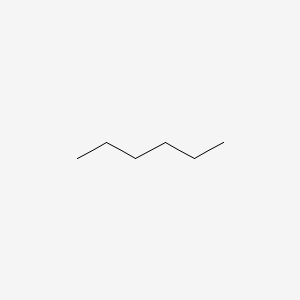
Hexane
Hexane is an unbranched alkane containing six carbon atoms. It has a role as a non-polar solvent and a neurotoxin. It is a volatile organic compound and an alkane. — ChEBI
- IUPAC name
- hexane
- Molecular formula
- C6H14
- Molecular weight
- 86.18 g/mol
- Exact mass
- 86.109550447 Da
- XLogP3
- 3.9
- Topological polar surface area
- 0.0 Ų
- Hydrogen-bond donors
- 0
- Hydrogen-bond acceptors
- 0
- Covalent units
- 1
- Defined stereocentres
- 0
Also known as
16 more reported names
External database identifiers
- ChEBI:CHEBI:29021
- ChEMBL:CHEMBL15939
- EPA DTXSID:DTXSID0021917
- PubMed:33064461
- PubMed:30503853
- PubMed:28115069
- PubMed:28003437
- PubMed:26410608
- PubMed:23740543
- PubMed:23680158
- PubMed:23353815
- PubMed:23124557
- PubMed:23122161
- PubMed:23122155
- PubMed:23120914
Evidence from additional scientific databases
NIH PubChem PUG-View
Attributed physical-property, hazard, environmental and use annotations.
- Autoignition Temperature: 437 °F (USCG, 1999) Source: CAMEO Chemicals
- Autoignition Temperature: 437 °F (225 °C) Source: Hazardous Substances Data Bank (HSDB)
- Autoignition Temperature: 225 °C Source: ILO-WHO International Chemical Safety Cards (ICSCs)
- Boiling Point: 156 °F at 760 mmHg (NTP, 1992) Source: CAMEO Chemicals
- Boiling Point: 68.73 °C Source: Hazardous Substances Data Bank (HSDB)
- Boiling Point: 68.70 °C. @ 760.00 mm Hg Source: Human Metabolome Database (HMDB)
- Boiling Point: 69 °C Source: ILO-WHO International Chemical Safety Cards (ICSCs)
- Boiling Point: 156 °F Source: Occupational Safety and Health Administration (OSHA)
- Boiling Point: 68.73 °C @760 [mm Hg] Source: PAC Chemical Database, U.S. Department of Energy
- Boiling Point: 156 °F Source: The National Institute for Occupational Safety and Health (NIOSH)
- Color/Form: Liquid Source: Hazardous Substances Data Bank (HSDB)
- Color/Form: Colorless, very volatile liquid Source: Hazardous Substances Data Bank (HSDB)
- Density: 0.659 at 68 °F (USCG, 1999) - Less dense than water; will float Source: CAMEO Chemicals
- Density: 0.6606 g/cu cm at 25 °C Source: Hazardous Substances Data Bank (HSDB)
- Density: Relative density (water = 1): 0.7 Source: ILO-WHO International Chemical Safety Cards (ICSCs)
- Density: 0.66 Source: Occupational Safety and Health Administration (OSHA)
- Density: 0.6606 @25 °C Source: PAC Chemical Database, U.S. Department of Energy
- Density: 0.66 Source: The National Institute for Occupational Safety and Health (NIOSH)
- Flash Point: -9.4 °F (NTP, 1992) Source: CAMEO Chemicals
- Flash Point: -7 °F Source: Haz-Map, Information on Hazardous Chemicals and Occupational Diseases
- Flash Point: -7 °F (-22 °C) (Closed cup) Source: Hazardous Substances Data Bank (HSDB)
- Flash Point: -22 °C c.c. Source: ILO-WHO International Chemical Safety Cards (ICSCs)
- Flash Point: -7 °F Source: Occupational Safety and Health Administration (OSHA)
- Flash Point: -7 °F Source: The National Institute for Occupational Safety and Health (NIOSH)
- LogP: log Kow = 3.90 Source: Hazardous Substances Data Bank (HSDB)
- LogP: 3.90 Source: Human Metabolome Database (HMDB)
- LogP: 3.9 Source: ILO-WHO International Chemical Safety Cards (ICSCs)
- Melting Point: -139 °F (NTP, 1992) Source: CAMEO Chemicals
- Melting Point: -95.35 °C Source: Hazardous Substances Data Bank (HSDB)
- Melting Point: -93.5 °C Source: Human Metabolome Database (HMDB)
- Melting Point: -95 °C Source: ILO-WHO International Chemical Safety Cards (ICSCs)
- Melting Point: -139 °F Source: Occupational Safety and Health Administration (OSHA)
- Melting Point: -95.35 °C Source: PAC Chemical Database, U.S. Department of Energy
- Melting Point: -219 °F Source: The National Institute for Occupational Safety and Health (NIOSH)
- Odor: Gasoline-like odor Source: Hazardous Substances Data Bank (HSDB)
- Physical Description: N-hexane is a clear colorless liquids with a petroleum-like odor. Flash points -9 °F. Less dense than water and insoluble in water. Vapors heavier than air. Used as a solvent, paint thinner, and chemical reaction medium. Source: CAMEO Chemicals
- Physical Description: Gas Vapor; Liquid; Liquid; Large Crystals Source: EPA Chemical Data Reporting (CDR)
- Physical Description: Colorless liquid with a gasoline-like odor; [NIOSH] Source: Haz-Map, Information on Hazardous Chemicals and Occupational Diseases
- Physical Description: Liquid Source: Human Metabolome Database (HMDB)
- Physical Description: VOLATILE COLOURLESS LIQUID WITH CHARACTERISTIC ODOUR. Source: ILO-WHO International Chemical Safety Cards (ICSCs)
- Physical Description: Colorless liquid with a gasoline-like odor. Source: Occupational Safety and Health Administration (OSHA)
- Physical Description: Colorless liquid with a gasoline-like odor. Source: The National Institute for Occupational Safety and Health (NIOSH)
- Refractive Index: Index of refraction: 1.3727 at 25 °C Source: Hazardous Substances Data Bank (HSDB)
- Solubility: less than 1 mg/mL at 61.7 °F (NTP, 1992) Source: CAMEO Chemicals
- Solubility: In water, 9.5 mg/L at 25 °C Source: Hazardous Substances Data Bank (HSDB)
- Solubility: 9.5 to 13 mg/L at 20 °C in distilled water, 75.5 mg/L at 20 °C in salt water Source: Hazardous Substances Data Bank (HSDB)
- Solubility: Very soluble in ethanol; soluble in ethyl ether, chloroform Source: Hazardous Substances Data Bank (HSDB)
- Solubility: Miscible with alcohol, chloroform, and ether Source: Hazardous Substances Data Bank (HSDB)
- Solubility: 0.0095 mg/mL at 25 °C Source: Human Metabolome Database (HMDB)
- Solubility: Solubility in water, g/100ml at 20 °C: 0.0013 (practically insoluble) Source: ILO-WHO International Chemical Safety Cards (ICSCs)
- Solubility: 0.002% Source: The National Institute for Occupational Safety and Health (NIOSH)
- Vapor Pressure: 120 mmHg at 68 °F ; 180 mmHg at 77 °F (NTP, 1992) Source: CAMEO Chemicals
- Vapor Pressure: 153.0 [mmHg] Source: Haz-Map, Information on Hazardous Chemicals and Occupational Diseases
- Vapor Pressure: Vapor pressure: 120 mm Hg at 20 °C, 190 mm Hg at 30 °C Source: Hazardous Substances Data Bank (HSDB)
- Vapor Pressure: 153 mm Hg at 25 °C Source: Hazardous Substances Data Bank (HSDB)
- Vapor Pressure: Vapor pressure, kPa at 20 °C: 17 Source: ILO-WHO International Chemical Safety Cards (ICSCs)
- Vapor Pressure: 124 mmHg Source: Occupational Safety and Health Administration (OSHA)
- Vapor Pressure: 75 [mm Hg] @9.8000000000000007 °C Source: PAC Chemical Database, U.S. Department of Energy
- Vapor Pressure: 124 mmHg Source: The National Institute for Occupational Safety and Health (NIOSH)
- Viscosity: 0.377 cP at 15 °C Source: Hazardous Substances Data Bank (HSDB)
- Viscosity: 3.26X10⁻⁴ Pa-s at 20 °C Source: Hazardous Substances Data Bank (HSDB)
- Viscosity: 1.4 mm²/s Source: ILO-WHO International Chemical Safety Cards (ICSCs)
- Carcinogen Classification: Hexane is found in gasoline, which is possibly carcinogenic to humans (Group 2B). (L135) Source: Toxin and Toxin Target Database (T3DB)
- Exposure Routes: The substance can be absorbed into the body by inhalation of its vapour and by ingestion. Source: ILO-WHO International Chemical Safety Cards (ICSCs)
- Exposure Routes: inhalation, ingestion, skin and/or eye contact Source: The National Institute for Occupational Safety and Health (NIOSH)
- Exposure Routes: Oral (L175) ; inhalation (L175) ;dermal (L175) Source: Toxin and Toxin Target Database (T3DB)
- First Aid: EYES: First check the victim for contact lenses and remove if present. Flush victim's eyes with water or normal saline solution for 20 to 30 minutes while simultaneously calling a hospital or poison control center. Do not put any ointments, oils, or medication in the victim's eyes without specific instructions from a physician. IMMEDIATELY transport the victim after flushing eyes to a hospital even if no symptoms (such as redness or irritation) develop.; SKIN: IMMEDIATELY flood affected skin with water while removing and isolating all contaminated clothing. Gently wash all affected skin areas thoroughly with soap and water. If symptoms such as redness or irritation develop, IMMEDIATELY call a physician and be prepared to transport the victim to a hospital for treatment.; INHALATION: IMMEDIATELY leave the contaminated area; take deep breaths of fresh air. If symptoms (such as wheezing, coughing, shortness of breath, or burning in the mouth, throat, or chest) develop, call a physician and be prepared to transport the victim to a hospital. Provide proper respiratory protection to rescuers entering an unknown atmosphere. Whenever possible, Self-Contained Breathing Apparatus (SCBA) shou Source: CAMEO Chemicals
- ERG2024, Guide 128 (Hexanes): General First Aid:; · Call 911 or emergency medical service.; · Ensure that medical personnel are aware of the material(s) involved, take precautions to protect themselves and avoid contamination.; · Move victim to fresh air if it can be done safely.; · Administer oxygen if breathing is difficult.; · If victim is not breathing:; -- DO NOT perform mouth-to-mouth resuscitation; the victim may have ingested or inhaled the substance.; -- If equipped and pulse detected, wash face and mouth, then give artificial respiration using a proper respiratory medical device (bag-valve mask, pocket mask equipped with a one-way valve or other device).; -- If no pulse detected or no respiratory medical device available, provide continuous compressions. Conduct a pulse check every two minutes or monitor for any signs of spontaneous respirations.; · Remove and isolate contaminated clothing and shoes.; · For minor skin contact, avoid spreading material on unaffected skin.; · In case of contact with substance, remove immediately by flushing skin or eyes with running water for at least 20 minutes.; · For severe burns, immediate medical attention is required.; · Effects of exposure (inhalation, ingestion, Source: Emergency Response Guidebook (ERG)
- First Aid: (General first aid procedures); Eye: Irrigate immediately - If this chemical contacts the eyes, immediately wash (irrigate) the eyes with large amounts of water, occasionally lifting the lower and upper lids. Get medical attention immediately.; Skin: Soap wash immediately - If this chemical contacts the skin, immediately wash the contaminated skin with soap and water. If this chemical penetrates the clothing, immediately remove the clothing, wash the skin with soap and water, and get medical attention promptly.; Breathing: Respiratory support; Swallow: Medical attention immediately - If this chemical has been swallowed, get medical attention immediately. Source: The National Institute for Occupational Safety and Health (NIOSH)
- Signal: Danger Source: Regulation (EC) No 1272/2008 of the European Parliament and of the Council
- GHS Hazard Statements: H225: Highly Flammable liquid and vapor [Danger Flammable liquids]; H304: May be fatal if swallowed and enters airways [Danger Aspiration hazard]; H315: Causes skin irritation [Warning Skin corrosion/irritation]; H336: May cause drowsiness or dizziness [Warning Specific target organ toxicity, single exposure; Narcotic effects]; H361f ***: Suspected of damaging fertility [Warning Reproductive toxicity]; H372: Causes damage to organs through prolonged or repeated exposure [Danger Specific target organ toxicity, repeated exposure]; H411: Toxic to aquatic life with long lasting effects [Hazardous to the aquatic environment, long-term hazard] Source: Regulation (EC) No 1272/2008 of the European Parliament and of the Council
- Precautionary Statement Codes: P203, P210, P233, P240, P241, P242, P243, P260, P261, P264, P270, P271, P273, P280, P301+P316, P302+P352, P303+P361+P353, P304+P340, P318, P319, P321, P331, P332+P317, P362+P364, P370+P378, P391, P403+P233, P403+P235, P405, and P501 (click each P-code to see the statement) Source: Regulation (EC) No 1272/2008 of the European Parliament and of the Council
- Note: This chemical does not meet GHS hazard criteria for < 0.1% (2 of 4001) of reports. Source: European Chemicals Agency (ECHA)
- Signal: Danger Source: European Chemicals Agency (ECHA)
- GHS Hazard Statements: H225 (98.2%): Highly Flammable liquid and vapor [Danger Flammable liquids]; H304 (98.2%): May be fatal if swallowed and enters airways [Danger Aspiration hazard]; H315 (98.1%): Causes skin irritation [Warning Skin corrosion/irritation]; H319 (11.5%): Causes serious eye irritation [Warning Serious eye damage/eye irritation]; H336 (97.4%): May cause drowsiness or dizziness [Warning Specific target organ toxicity, single exposure; Narcotic effects]; H361 (93.7%): Suspected of damaging fertility or the unborn child [Warning Reproductive toxicity]; H373 (95.4%): May causes damage to organs through prolonged or repeated exposure [Warning Specific target organ toxicity, repeated exposure]; H411 (99.9%): Toxic to aquatic life with long lasting effects [Hazardous to the aquatic environment, long-term hazard] Source: European Chemicals Agency (ECHA)
- Precautionary Statement Codes: P203, P210, P233, P240, P241, P242, P243, P260, P261, P264, P264+P265, P271, P273, P280, P301+P316, P302+P352, P303+P361+P353, P304+P340, P305+P351+P338, P318, P319, P321, P331, P332+P317, P337+P317, P362+P364, P370+P378, P391, P403+P233, P403+P235, P405, and P501 (click each P-code to see the statement) Source: European Chemicals Agency (ECHA)
- ECHA C&L Notifications Summary: Aggregated GHS information provided per 4001 reports by companies from 80 notifications to the ECHA C&L Inventory. Each notification may be associated with multiple companies.; Reported as not meeting GHS hazard criteria per 2 of 4001 reports by companies.; There are 79 notifications provided by 3999 of 4001 reports by companies with hazard statement code(s).; Information may vary between notifications depending on impurities, additives, and other factors. The percentage value in parenthesis indicates the notified classification ratio from companies that provide hazard codes. Only hazard codes with percentage values above 10% are shown. For more detailed information, please visit ECHA C&L website. Source: European Chemicals Agency (ECHA)
- Note: This chemical does not meet GHS hazard criteria for 0.4% (1 of 224) of reports. Source: European Chemicals Agency (ECHA)
- GHS Hazard Statements: H225 (53.1%): Highly Flammable liquid and vapor [Danger Flammable liquids]; H304 (36.6%): May be fatal if swallowed and enters airways [Danger Aspiration hazard]; H315 (79.5%): Causes skin irritation [Warning Skin corrosion/irritation]; H317 (46.9%): May cause an allergic skin reaction [Warning Sensitization, Skin]; H319 (17.4%): Causes serious eye irritation [Warning Serious eye damage/eye irritation]; H336 (36.6%): May cause drowsiness or dizziness [Warning Specific target organ toxicity, single exposure; Narcotic effects]; H361 (36.6%): Suspected of damaging fertility or the unborn child [Warning Reproductive toxicity]; H373 (27.7%): May causes damage to organs through prolonged or repeated exposure [Warning Specific target organ toxicity, repeated exposure]; H411 (32.6%): Toxic to aquatic life with long lasting effects [Hazardous to the aquatic environment, long-term hazard]; H412 (46.4%): Harmful to aquatic life with long lasting effects [Hazardous to the aquatic environment, long-term hazard] Source: European Chemicals Agency (ECHA)
- Precautionary Statement Codes: P203, P210, P233, P240, P241, P242, P243, P260, P261, P264, P264+P265, P271, P272, P273, P280, P301+P316, P302+P352, P303+P361+P353, P304+P340, P305+P351+P338, P318, P319, P321, P331, P332+P317, P333+P317, P337+P317, P362+P364, P370+P378, P391, P403+P233, P403+P235, P405, and P501 (click each P-code to see the statement) Source: European Chemicals Agency (ECHA)
- ECHA C&L Notifications Summary: Aggregated GHS information provided per 224 reports by companies from 14 notifications to the ECHA C&L Inventory. Each notification may be associated with multiple companies.; Reported as not meeting GHS hazard criteria per 1 of 224 reports by companies.; There are 13 notifications provided by 223 of 224 reports by companies with hazard statement code(s).; Information may vary between notifications depending on impurities, additives, and other factors. The percentage value in parenthesis indicates the notified classification ratio from companies that provide hazard codes. Only hazard codes with percentage values above 10% are shown. For more detailed information, please visit ECHA C&L website. Source: European Chemicals Agency (ECHA)
- Health Effects: Hexane mainly affects the nervous system. It causes degeneration of the peripheral nervous system (and eventually the central nervous system), starting with damage to the nerve axons. Exposure to hexane may also damage the lungs and reproductive system. (L977, L978) Source: Toxin and Toxin Target Database (T3DB)
- NFPA Health Rating: 0 - Materials that, under emergency conditions, would offer no hazard beyond that of ordinary combustible materials. Source: Hazardous Substances Data Bank (HSDB)
- NFPA Fire Rating: 3 - Liquids and solids that can be ignited under almost all ambient temperature conditions. Materials produce hazardous atmospheres with air under almost all ambient temperatures or, though unaffected by ambient temperatures, are readily ignited under almost all conditions. Source: Hazardous Substances Data Bank (HSDB)
- NFPA Instability Rating: 0 - Materials that in themselves are normally stable, even under fire conditions. Source: Hazardous Substances Data Bank (HSDB)
- Target Organs: Neurological (Nervous System), Respiratory (From the Nose to the Lungs) Source: Agency for Toxic Substances and Disease Registry (ATSDR)
- Target Organs: Nervous Source: EPA Integrated Risk Information System (IRIS)
- Target Organs: Eyes, skin, respiratory system, central nervous system, peripheral nervous system Source: The National Institute for Occupational Safety and Health (NIOSH)
- Toxicity Summary: IDENTIFICATION: n-Hexane is a straight chain saturated hydrocarbon obtained from certain petroleum fractions after various thermal or catalytic cracking steps. Commercial hexane may contain from 20%-85& n-Hexane and various amounts of hexane isomer, 2-methylpentane, 3-methylpentane, 2-3-dimethylbutene, cyclopentane, cyclohexane and small quantities of pentane and heptane isomers, acetone, methyl ethyl ketone, dichloromethane and trichloroethylene. Trace amounts of benzene may be present. N-Hexane is a colorless liquid and solubility in water is low. It is miscible with alcohol, chloroform and ether. Main uses are: rubber and adhesive solvent in shoe factories; extraction of soybean oil, callous seed oil and flaxseed oil. It is used in the pharmaceutical and cosmetic industries and is a cleaning agent for textiles, furniture and leather products. N-Hexane is also used for: determination of the refractive index of minerals, filling for thermometers and denaturant. HUMAN EXPOSURE: The target organs are: central nervous system and peripheral nervous system, respiratory system, heart, skin and eyes. Chemical pneumonia can occur after ingestion and and aspiration to the lungs. CNS depres Source: Hazardous Substances Data Bank (HSDB)
- Toxicity Summary: Hexane's toxicity is caused by it neurotoxic metabolite, 2,5-hexanedione. It damages the central and peripheral nervous system by causing axonal swelling and degeneration. 2,5-Hexanedione also reacts with lysine side-chain amino groups in axonal cytoskeletal proteins to form pyrroles. This results in neurofilament cross-linking and loss of function. (L175) Source: Toxin and Toxin Target Database (T3DB)
- Environmental Bioconcentration: An estimated BCF of 170 was calculated in fish for n-hexane(SRC), using a log Kow of 3.90(1) and a regression-derived equation(2). According to a classification scheme(3), this BCF suggests the potential for bioconcentration in aquatic organisms is high(SRC), provided the compound is not metabolized by the organism(SRC). Source: Hazardous Substances Data Bank (HSDB)
- Environmental Fate: TERRESTRIAL FATE: Based on a classification scheme(1), an estimated Koc value of 130(SRC), determined from a structure estimation method(2), indicates that n-hexane is expected to have high mobility in soil(SRC). Volatilization of n-hexane from moist soil surfaces is expected to be an important fate process(SRC) given an estimated Henry's Law constant of 1.80 atm-cu m/mole(SRC), based upon its vapor pressure, 153 mm Hg(3), and water solubility, 9.5 mg/L(4). n-Hexane is expected to volatilize from dry soil surfaces(SRC) based upon its vapor pressure(3). Utilizing the Japanese MITI test, 100% of the Theoretical BOD was reached in 4 weeks(5) suggesting that biodegradation is an important environmental fate process in soil(SRC). Source: Hazardous Substances Data Bank (HSDB)
- Environmental Fate: AQUATIC FATE: Based on a classification scheme(1), an estimated Koc value of 130(SRC), determined from a structure estimation method(2), indicates that n-hexane is not expected to adsorb to suspended solids and sediment(SRC). Volatilization from water surfaces is expected(3) based upon an estimated Henry's Law constant of 1.80 atm-cu m/mole(SRC), derived from its vapor pressure, 153 mm Hg(4), and water solubility, 9.6 mg/L(5). Using this Henry's Law constant and an estimation method(3), volatilization half-lives for a model river and model lake are 2.7 hours and 3.7 days, respectively(SRC). According to a classification scheme(6), an estimated BCF of 170(SRC), from its log Kow of 3.90(7) and a regression-derived equation(8), suggests the potential for bioconcentration in aquatic organisms is high, provided the compound is not metabolized by the organism(SRC). Utilizing the Japanese MITI test, 100% of the Theoretical BOD was reached in 4 weeks(9) suggesting that biodegradation is an important environmental fate process in water(SRC). Source: Hazardous Substances Data Bank (HSDB)
- Environmental Fate: ATMOSPHERIC FATE: According to a model of gas/particle partitioning of semivolatile organic compounds in the atmosphere(1), n-hexane, which has a vapor pressure of 153 mm Hg at 25 °C(2), is expected to exist solely as a vapor in the ambient atmosphere. Vapor-phase n-hexane is degraded in the atmosphere by reaction with photochemically-produced hydroxyl radicals(SRC); the half-life for this reaction in air is estimated to be 24 hours(SRC), calculated from its rate constant of 5.61X10⁻¹² cu cm/molecule-sec at 25 °C(3). n-Hexane does not contain chromophores that absorb at wavelengths >290 nm(4) and, therefore, is not expected to be susceptible to direct photolysis by sunlight(SRC). Source: Hazardous Substances Data Bank (HSDB)
- Consumer Uses: Intermediate; Propellants, non-motive (blowing agents); Laboratory chemicals; Not Known or Reasonably Ascertainable; Monomers; Fuel; Fuel agents; Solvent; Flavoring and nutrient; Lubricating agent Source: EPA Chemical Data Reporting (CDR)
- Industry Uses: Intermediate; Propellants, non-motive (blowing agents); Laboratory chemicals; Not Known or Reasonably Ascertainable; Soil amendments (fertilizers); Monomers; Fuel agents; Fuel; Solvent; Flavoring and nutrient; Other; Lubricating agent Source: EPA Chemical Data Reporting (CDR)
- Uses: The main use of hexane is as a solvent to extract edible oils from seed and vegetable crops (e.g., soybeans, peanuts, corn). Hexane is also used as a cleaning agent (degreaser) in the printing industry. Source: EPA Hazardous Air Pollutants
- Sources/Uses: Used as a solvent, especially in the adhesive and shoe industries; abused by glue sniffers for its euphoric effects; [LaDou, p. 430] Used in shoe and furniture manufacture to dissolve glue; also used in adhesive tape manufacturing; [Sullivan, p. 1211] Fuels made from petroleum contain n-hexane. Modern blends of US gasoline contain about 3% n-hexane. [ATSDR ToxProfiles] Used as a solvent for vegetable oils, polymers, and paints; [Hawley] Used as a degreaser by vehicle repair technicians in a commercially available aerosol containing toluene, acetone, and hexane (50% n-hexane); [Reference #2] Used for determining refractive index of minerals, filling for thermometers (instead of mercury), for calibrations, as reaction medium for polymerizations and pharmaceutical manufacture, alcohol denaturant, as cleaning agent in textile, furniture, and leather industries, and as laboratory reagent; [HSDB] Source: Haz-Map, Information on Hazardous Chemicals and Occupational Diseases
- Industrial Processes with risk of exposure: Textiles (Fiber & Fabric Manufacturing) [Category: Industry]; Painting (Solvents) [Category: Paint]; Working with Glues and Adhesives [Category: Other]; Leather Tanning and Processing [Category: Industry] Source: Haz-Map, Information on Hazardous Chemicals and Occupational Diseases
- Activities with risk of exposure: Leather crafting [Category: Hobbies]; Painting [Category: Hobbies]; Sculpturing plastics [Category: Hobbies] Source: Haz-Map, Information on Hazardous Chemicals and Occupational Diseases
- Uses: Determining refractive index of minerals; filling for thermometers instead of mercury, usually with a blue or red dye; extraction solvent for oilseed processing. Source: Hazardous Substances Data Bank (HSDB)
- Uses: Solvent, especially for vegetable oils; low temperature thermometers; calibrations; polymerization reaction medium; paint diluent; alcohol denaturant. Source: Hazardous Substances Data Bank (HSDB)
- Uses: It is used for the extraction of vegetable oils (e.g., from soybeans), as a solvent in chemical reactions (e.g., for coordination complex catalyzed polymerization of olefins) and in adhesive formulations. Source: Hazardous Substances Data Bank (HSDB)
- Uses: Reaction medium in manufacture of pharmaceuticals; component of numerous formulated products. Source: Hazardous Substances Data Bank (HSDB)
- Uses: For more Uses (Complete) data for N-HEXANE (8 total), please visit the HSDB record page. Source: Hazardous Substances Data Bank (HSDB)
- Uses: Pure n-hexane is used in laboratories. Most of the n-hexane used in industry is mixed with similar chemicals called solvents. The major use for solvents containing n-hexane is to extract vegetable oils from crops such as soybeans. These solvents are also used as cleaning agents in the printing, textile, furniture, and shoemaking industries. Certain kinds of special glues used in the roofing and shoe and leather industries also contain n-hexane. Several consumer products contain n-hexane, such as gasoline, quick-drying glues used in various hobbies, and rubber cement. (L175) Source: Toxin and Toxin Target Database (T3DB)
Mapped by: Existing checksum-valid CAS to unique PubChem CID match. Retrieved: 2026-08-31. Open source record
Scientific classifications and hazard annotations provide context and do not replace the market-specific regulatory decision shown above.
Additional source coverage and match status
| Source | Result | Checked |
|---|---|---|
| NIH PubChem PUG-View | Exact match | 2026-08-31 |
A recorded no-match is useful evidence that the source was checked; it is not a claim that the substance does not exist elsewhere.
Retrieved from NIH PubChem on 2026-08-31 by checksum-valid CAS matching. Chemical properties do not replace the regulatory decision on this page.