
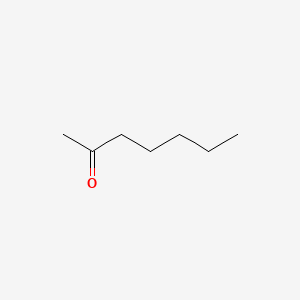
2-Heptanone
N-amyl methyl ketone appears as a clear colorless liquid. Flash point 126 °F. Less dense than water and only slightly soluble in water. Hence floats on water. Vapors heavier than air. Density 6.8 lb / gal. Used as a synthetic flavoring and in perfumes. — CAMEO Chemicals
- IUPAC name
- heptan-2-one
- Molecular formula
- C7H14O
- Molecular weight
- 114.19 g/mol
- Exact mass
- 114.104465066 Da
- XLogP3
- 2.0
- Topological polar surface area
- 17.1 Ų
- Hydrogen-bond donors
- 0
- Hydrogen-bond acceptors
- 1
- Covalent units
- 1
- Defined stereocentres
- 0
Also known as
16 more reported names
External database identifiers
- ChEBI:CHEBI:5672
- ChEMBL:CHEMBL18893
- EPA DTXSID:DTXSID5021916
- PubMed:23091624
- PubMed:23049998
- PubMed:22967641
- PubMed:22953186
- PubMed:22948412
- PubMed:22902884
- PubMed:22563480
- PubMed:22558344
- PubMed:22438717
- PubMed:22434453
- PubMed:22403649
- PubMed:22364569
Evidence from additional scientific databases
NIH PubChem PUG-View
Attributed physical-property, hazard, environmental and use annotations.
- Autoignition Temperature: 739 °F (USCG, 1999) Source: CAMEO Chemicals
- Autoignition Temperature: 740 °F (393 °C) Source: Hazardous Substances Data Bank (HSDB)
- Autoignition Temperature: 393 °C Source: ILO-WHO International Chemical Safety Cards (ICSCs)
- Boiling Point: 300 °F at 760 mmHg (USCG, 1999) Source: CAMEO Chemicals
- Boiling Point: 151.5 °C at 760 mm Hg; 111 °C at 21 mm Hg Source: Hazardous Substances Data Bank (HSDB)
- Boiling Point: 149.00 to 150.00 °C. @ 760.00 mm Hg Source: Human Metabolome Database (HMDB)
- Boiling Point: 151 °C Source: ILO-WHO International Chemical Safety Cards (ICSCs)
- Boiling Point: 151 °C Source: Joint FAO/WHO Expert Committee on Food Additives (JECFA)
- Boiling Point: 305 °F Source: Occupational Safety and Health Administration (OSHA)
- Boiling Point: 151.05 °C @760 [mm Hg] Source: PAC Chemical Database, U.S. Department of Energy
- Boiling Point: 305 °F Source: The National Institute for Occupational Safety and Health (NIOSH)
- Color/Form: Colorless to white liquid Source: Hazardous Substances Data Bank (HSDB)
- Density: 0.82 (USCG, 1999) - Less dense than water; will float Source: CAMEO Chemicals
- Density: 0.8324 at 0 °C/4 °C; 0.8197 at 15 °C/4 °C; 0.8068 at 30 °C/4 °C Source: Hazardous Substances Data Bank (HSDB)
- Density: Bulk density = 6.8 lb/gal Source: Hazardous Substances Data Bank (HSDB)
- Density: Relative density (water = 1): 0.8 Source: ILO-WHO International Chemical Safety Cards (ICSCs)
- Density: 0.814-0.819 Source: Joint FAO/WHO Expert Committee on Food Additives (JECFA)
- Density: 0.81 Source: Occupational Safety and Health Administration (OSHA)
- Density: 0.811 @ 20°C Source: PAC Chemical Database, U.S. Department of Energy
- Density: 0.81 Source: The National Institute for Occupational Safety and Health (NIOSH)
- Flash Point: 102 °F (USCG, 1999) Source: CAMEO Chemicals
- Flash Point: 39 °C Source: Haz-Map, Information on Hazardous Chemicals and Occupational Diseases
- Flash Point: 102 °F (39 °C) (Closed cup) Source: Hazardous Substances Data Bank (HSDB)
- Flash Point: 117 °F (Open cup) Source: Hazardous Substances Data Bank (HSDB)
- Flash Point: 39 °C Source: ILO-WHO International Chemical Safety Cards (ICSCs)
- Flash Point: 102 °F Source: Occupational Safety and Health Administration (OSHA)
- Flash Point: 102 °F Source: The National Institute for Occupational Safety and Health (NIOSH)
- LogP: log Kow = 1.98 Source: Hazardous Substances Data Bank (HSDB)
- LogP: 1.98 Source: Human Metabolome Database (HMDB)
- Melting Point: -31 °F (USCG, 1999) Source: CAMEO Chemicals
- Melting Point: -35.5 °C Source: Hazardous Substances Data Bank (HSDB)
- Melting Point: -35 °C Source: Human Metabolome Database (HMDB)
- Melting Point: -35.5 °C Source: ILO-WHO International Chemical Safety Cards (ICSCs)
- Melting Point: -32 °F Source: Occupational Safety and Health Administration (OSHA)
- Melting Point: -35 °C Source: PAC Chemical Database, U.S. Department of Energy
- Melting Point: -32 °F Source: The National Institute for Occupational Safety and Health (NIOSH)
- Odor: Penetrating fruity odor Source: Hazardous Substances Data Bank (HSDB)
- Odor: CHARACTERISTIC BANANA, SLIGHTLY SPICY ODOR Source: Hazardous Substances Data Bank (HSDB)
- Odor: Banana-like fruity odor Source: Hazardous Substances Data Bank (HSDB)
- Physical Description: N-amyl methyl ketone appears as a clear colorless liquid. Flash point 126 °F. Less dense than water and only slightly soluble in water. Hence floats on water. Vapors heavier than air. Density 6.8 lb / gal. Used as a synthetic flavoring and in perfumes. Source: CAMEO Chemicals
- Physical Description: CBI; Liquid Source: EPA Chemical Data Reporting (CDR)
- Physical Description: Colorless to white liquid with a banana-like, fruity odor; [NIOSH] Source: Haz-Map, Information on Hazardous Chemicals and Occupational Diseases
- Physical Description: Liquid Source: Human Metabolome Database (HMDB)
- Physical Description: COLOURLESS LIQUID WITH CHARACTERISTIC ODOUR. Source: ILO-WHO International Chemical Safety Cards (ICSCs)
- Physical Description: colourless, mobile liquid with a fruity, spicy odour Source: Joint FAO/WHO Expert Committee on Food Additives (JECFA)
- Physical Description: Colorless to white liquid with a banana-like, fruity odor. Source: Occupational Safety and Health Administration (OSHA)
- Physical Description: Colorless to white liquid with a banana-like, fruity odor. Source: The National Institute for Occupational Safety and Health (NIOSH)
- Refractive Index: Index of refraction: 1.41156 at 15 °C/D, 1.40729 at 25 °C/D Source: Hazardous Substances Data Bank (HSDB)
- Refractive Index: INDEX OF REFRACTION: 1.4088 AT 20 °C/D; MAX ABSORPTION (METHYL ALCOHOL): 274 NM (LOG E= 1.34); SADTLER REF NUMBER: 340 (IR, PRISM) Source: Hazardous Substances Data Bank (HSDB)
- Refractive Index: 1.405-1.411 Source: Joint FAO/WHO Expert Committee on Food Additives (JECFA)
- Solubility: 0.4 % (NIOSH, 2024) Source: CAMEO Chemicals
- Solubility: Soluble in alcohol and ether Source: Hazardous Substances Data Bank (HSDB)
- Solubility: 0.43% (by wt) in water Source: Hazardous Substances Data Bank (HSDB)
- Solubility: Miscible with organic solvents Source: Hazardous Substances Data Bank (HSDB)
- Solubility: In water, 4.28X10+3 mg/L at 25 °C Source: Hazardous Substances Data Bank (HSDB)
- Solubility: 4.3 mg/mL at 25 °C Source: Human Metabolome Database (HMDB)
- Solubility: Solubility in water: poor Source: ILO-WHO International Chemical Safety Cards (ICSCs)
- Solubility: miscible with alcohol and ether; 1 ml in 250 ml water Source: Joint FAO/WHO Expert Committee on Food Additives (JECFA)
- Solubility: (in ethanol) Source: Joint FAO/WHO Expert Committee on Food Additives (JECFA)
- Solubility: 0.4% Source: The National Institute for Occupational Safety and Health (NIOSH)
- Vapor Pressure: 3 mmHg (NIOSH, 2024) Source: CAMEO Chemicals
- Vapor Pressure: 3.85 [mmHg] Source: Haz-Map, Information on Hazardous Chemicals and Occupational Diseases
- Vapor Pressure: 3.85 mm Hg at 25 °C Source: Hazardous Substances Data Bank (HSDB)
- Vapor Pressure: Vapor pressure, kPa at 25 °C: 0.2 Source: ILO-WHO International Chemical Safety Cards (ICSCs)
- Vapor Pressure: 3 mmHg Source: Occupational Safety and Health Administration (OSHA)
- Vapor Pressure: 7.5 [mm Hg] @36 °C Source: PAC Chemical Database, U.S. Department of Energy
- Vapor Pressure: 3 mmHg Source: The National Institute for Occupational Safety and Health (NIOSH)
- Viscosity: 0.77 cP Source: Hazardous Substances Data Bank (HSDB)
- Exposure Routes: The substance can be absorbed into the body by inhalation of its vapour. Source: ILO-WHO International Chemical Safety Cards (ICSCs)
- Exposure Routes: inhalation, ingestion, skin and/or eye contact Source: The National Institute for Occupational Safety and Health (NIOSH)
- First Aid: Excerpt from NIOSH Pocket Guide for Methyl (n-amyl) ketone:; Eye: IRRIGATE IMMEDIATELY - If this chemical contacts the eyes, immediately wash (irrigate) the eyes with large amounts of water, occasionally lifting the lower and upper lids. Get medical attention immediately.; Skin: SOAP WASH - If this chemical contacts the skin, wash the contaminated skin with soap and water.; Breathing: FRESH AIR - If a person breathes large amounts of this chemical, move the exposed person to fresh air at once. Other measures are usually unnecessary.; Swallow: MEDICAL ATTENTION IMMEDIATELY - If this chemical has been swallowed, get medical attention immediately. (NIOSH, 2024) Source: CAMEO Chemicals
- ERG2024, Guide 127 (n-Amyl methyl ketone): General First Aid:; · Call 911 or emergency medical service.; · Ensure that medical personnel are aware of the material(s) involved, take precautions to protect themselves and avoid contamination.; · Move victim to fresh air if it can be done safely.; · Administer oxygen if breathing is difficult.; · If victim is not breathing:; -- DO NOT perform mouth-to-mouth resuscitation; the victim may have ingested or inhaled the substance.; -- If equipped and pulse detected, wash face and mouth, then give artificial respiration using a proper respiratory medical device (bag-valve mask, pocket mask equipped with a one-way valve or other device).; -- If no pulse detected or no respiratory medical device available, provide continuous compressions. Conduct a pulse check every two minutes or monitor for any signs of spontaneous respirations.; · Remove and isolate contaminated clothing and shoes.; · For minor skin contact, avoid spreading material on unaffected skin.; · In case of contact with substance, remove immediately by flushing skin or eyes with running water for at least 20 minutes.; · For severe burns, immediate medical attention is required.; · Effects of exposure (inhalation, ingestion, Source: Emergency Response Guidebook (ERG)
- ERG2024, Guide 127 (Methyl amyl ketone): General First Aid:; · Call 911 or emergency medical service.; · Ensure that medical personnel are aware of the material(s) involved, take precautions to protect themselves and avoid contamination.; · Move victim to fresh air if it can be done safely.; · Administer oxygen if breathing is difficult.; · If victim is not breathing:; -- DO NOT perform mouth-to-mouth resuscitation; the victim may have ingested or inhaled the substance.; -- If equipped and pulse detected, wash face and mouth, then give artificial respiration using a proper respiratory medical device (bag-valve mask, pocket mask equipped with a one-way valve or other device).; -- If no pulse detected or no respiratory medical device available, provide continuous compressions. Conduct a pulse check every two minutes or monitor for any signs of spontaneous respirations.; · Remove and isolate contaminated clothing and shoes.; · For minor skin contact, avoid spreading material on unaffected skin.; · In case of contact with substance, remove immediately by flushing skin or eyes with running water for at least 20 minutes.; · For severe burns, immediate medical attention is required.; · Effects of exposure (inhalation, ingestion, Source: Emergency Response Guidebook (ERG)
- First Aid: (General first aid procedures); Eye: Irrigate immediately - If this chemical contacts the eyes, immediately wash (irrigate) the eyes with large amounts of water, occasionally lifting the lower and upper lids. Get medical attention immediately.; Skin: Soap wash - If this chemical contacts the skin, wash the contaminated skin with soap and water.; Breathing: Fresh air; Swallow: Medical attention immediately - If this chemical has been swallowed, get medical attention immediately. Source: The National Institute for Occupational Safety and Health (NIOSH)
- Signal: Warning Source: Regulation (EC) No 1272/2008 of the European Parliament and of the Council
- GHS Hazard Statements: H226: Flammable liquid and vapor [Warning Flammable liquids]; H302: Harmful if swallowed [Warning Acute toxicity, oral]; H332: Harmful if inhaled [Warning Acute toxicity, inhalation] Source: Regulation (EC) No 1272/2008 of the European Parliament and of the Council
- Precautionary Statement Codes: P210, P233, P240, P241, P242, P243, P261, P264, P270, P271, P280, P301+P317, P303+P361+P353, P304+P340, P317, P330, P370+P378, P403+P235, and P501 (click each P-code to see the statement) Source: Regulation (EC) No 1272/2008 of the European Parliament and of the Council
- Note: This chemical does not meet GHS hazard criteria for < 0.1% (2 of 3241) of reports. Source: European Chemicals Agency (ECHA)
- Signal: Warning Source: European Chemicals Agency (ECHA)
- GHS Hazard Statements: H226 (> 99.9%): Flammable liquid and vapor [Warning Flammable liquids]; H302 (> 99.9%): Harmful if swallowed [Warning Acute toxicity, oral]; H332 (> 99.9%): Harmful if inhaled [Warning Acute toxicity, inhalation]; H336 (11%): May cause drowsiness or dizziness [Warning Specific target organ toxicity, single exposure; Narcotic effects] Source: European Chemicals Agency (ECHA)
- Precautionary Statement Codes: P210, P233, P240, P241, P242, P243, P261, P264, P270, P271, P280, P301+P317, P303+P361+P353, P304+P340, P317, P319, P330, P370+P378, P403+P233, P403+P235, P405, and P501 (click each P-code to see the statement) Source: European Chemicals Agency (ECHA)
- ECHA C&L Notifications Summary: Aggregated GHS information provided per 3241 reports by companies from 27 notifications to the ECHA C&L Inventory. Each notification may be associated with multiple companies.; Reported as not meeting GHS hazard criteria per 2 of 3241 reports by companies.; There are 26 notifications provided by 3239 of 3241 reports by companies with hazard statement code(s).; Information may vary between notifications depending on impurities, additives, and other factors. The percentage value in parenthesis indicates the notified classification ratio from companies that provide hazard codes. Only hazard codes with percentage values above 10% are shown. For more detailed information, please visit ECHA C&L website. Source: European Chemicals Agency (ECHA)
- Signal: Warning Source: NITE-CMC
- GHS Hazard Statements: H226: Flammable liquid and vapor [Warning Flammable liquids]; H302: Harmful if swallowed [Warning Acute toxicity, oral]; H320: Causes eye irritation [Warning Serious eye damage/eye irritation]; H335: May cause respiratory irritation [Warning Specific target organ toxicity, single exposure; Respiratory tract irritation]; H336: May cause drowsiness or dizziness [Warning Specific target organ toxicity, single exposure; Narcotic effects] Source: NITE-CMC
- Precautionary Statement Codes: P210, P233, P240, P241, P242, P243, P261, P264, P264+P265, P270, P271, P280, P301+P317, P303+P361+P353, P304+P340, P305+P351+P338, P319, P330, P337+P317, P370+P378, P403+P233, P403+P235, P405, and P501 (click each P-code to see the statement) Source: NITE-CMC
- GHS Hazard Statements: H226: Flammable liquid and vapor [Warning Flammable liquids]; H302: Harmful if swallowed [Warning Acute toxicity, oral]; H305: May be harmful if swallowed and enters airways [Warning Aspiration hazard]; H315: Causes skin irritation [Warning Skin corrosion/irritation]; H320: Causes eye irritation [Warning Serious eye damage/eye irritation]; H335: May cause respiratory irritation [Warning Specific target organ toxicity, single exposure; Respiratory tract irritation]; H336: May cause drowsiness or dizziness [Warning Specific target organ toxicity, single exposure; Narcotic effects] Source: NITE-CMC
- NFPA Health Rating: 1 - Materials that, under emergency conditions, can cause significant irritation. Source: Hazardous Substances Data Bank (HSDB)
- NFPA Fire Rating: 2 - Materials that must be moderately heated or exposed to relatively high ambient temperatures before ignition can occur. Materials would not under normal conditions form hazardous atmospheres with air, but under high ambient temperatures or under moderate heating could release vapor in sufficient quantities to produce hazardous atmospheres with air. Source: Hazardous Substances Data Bank (HSDB)
- NFPA Instability Rating: 0 - Materials that in themselves are normally stable, even under fire conditions. Source: Hazardous Substances Data Bank (HSDB)
- Target Organs: Eyes, skin, respiratory system, central nervous system, peripheral nervous system Source: The National Institute for Occupational Safety and Health (NIOSH)
- Toxicity Summary: The existing information was reviewed by the independent Expert Panel for Fragrance Safety and supports the use of 2-Heptanone as described in this fragrance ingredient safety assessment. Data show that it is not genotoxic and provide a calculated Margin of Exposure (MOE) greater than 100 for the repeated dose toxicity and reproductive toxicity endpoints. Data show that there are no safety concerns for skin sensitization under the current declared levels of use. 2-Heptanone is not expected to be photoirritating/photoallergenic based on evaluation of the ultraviolet/visible (UV/Vis) spectra. The local respiratory toxicity endpoint was evaluated using the read-across analog 4-methyl-2-pentanone, with a calculated MOE greater than 100. Source: Pertti (Bert) Hakkinen's Toxicology and Other Annotations
- Environmental Bioconcentration: An estimated BCF of 7 was calculated for 2-heptanone(SRC), using a log Kow of 1.98(1) and a regression-derived equation(2). According to a classification scheme(3), this BCF suggests the potential for bioconcentration in aquatic organisms is low(SRC). Source: Hazardous Substances Data Bank (HSDB)
- Environmental Fate: TERRESTRIAL FATE: Based on a classification scheme(1), an estimated Koc value of 280(SRC), determined from a log Kow of 1.98(2) and a regression-derived equation(3), indicates that 2-heptanone is expected to have moderate mobility in soil(SRC). Volatilization of 2-heptanone from moist soil surfaces is expected to be an important fate process(SRC) given a Henry's Law constant of 1.69X10⁻⁴ atm-cu m/mole(4). 2-Heptanone is expected to volatilize from dry soil surfaces(SRC) based upon a vapor pressure of 3.85 mm Hg(5). Screening studies indicate that 2-heptanone is likely to biodegrade in aquatic systems under aerobic conditions(6-9). Source: Hazardous Substances Data Bank (HSDB)
- Environmental Fate: AQUATIC FATE: Based on a classification scheme(1), an estimated Koc value of 280(SRC), determined from a log Kow of 1.98(2) and a regression-derived equation(3), indicates that 2-heptanone is not expected to adsorb to suspended solids and sediment(SRC). Volatilization from water surfaces is expected(3) based upon a Henry's Law constant of 1.69X10⁻⁴ atm-cu m/mole(4). Using this Henry's Law constant and an estimation method(3), volatilization half-lives for a model river and model lake are 4.8 hours and 6 days, respectively(SRC). According to a classification scheme(5), an estimated BCF of 7(SRC), from its log Kow(2) and a regression-derived equation(6), suggests the potential for bioconcentration in aquatic organisms is low(SRC). Screening studies indicate that 2-heptanone is likely to biodegrade in aquatic systems under aerobic conditions(7-10). Source: Hazardous Substances Data Bank (HSDB)
- Environmental Fate: ATMOSPHERIC FATE: According to a model of gas/particle partitioning of semivolatile organic compounds in the atmosphere(1), 2-heptanone, which has a vapor pressure of 3.85 mm Hg at 25 °C(2), is expected to exist solely as a vapor in the ambient atmosphere. Vapor-phase 2-heptanone is degraded in the atmosphere by reaction with photochemically-produced hydroxyl radicals(SRC); the half-life for this reaction in air is estimated to be 1.4 days(SRC), calculated from its rate constant of 1.17X10⁻¹¹ cu cm/molecule-sec at 25 °C(3). Although 2-heptanone has the potential of being removed from the atmosphere by direct photochemical degradation(4), the rate of this process is not expected to be able to compete with atmospheric removal by the reaction with hydroxyl radicals(SRC). Source: Hazardous Substances Data Bank (HSDB)
- Consumer Uses: Solvent; Sealant (barrier); Diluent; Not Known or Reasonably Ascertainable Source: EPA Chemical Data Reporting (CDR)
- Industry Uses: Solvent; Other; Fuel; Cleaning agent; Sealant (barrier); Not Known or Reasonably Ascertainable Source: EPA Chemical Data Reporting (CDR)
- Sources/Uses: Used as a solvent for resins and lacquers, a fragrance for cosmetics, and a flavor for foods; [HSDB] Source: Haz-Map, Information on Hazardous Chemicals and Occupational Diseases
- Industrial Processes with risk of exposure: Painting (Solvents) [Category: Paint]; Plastic Composites Manufacturing [Category: Industry] Source: Haz-Map, Information on Hazardous Chemicals and Occupational Diseases
- Uses: Industrial solvent; solvent for synthetic resin finishes; fragrance ingredient in creams, lotions, perfumes, soaps & detergents; flavor ingredient in foods; inert reaction medium Source: Hazardous Substances Data Bank (HSDB)
- Uses: Solvent for nitrocellulose lacquers. Source: Hazardous Substances Data Bank (HSDB)
- Uses: Blue cheese flavor Source: Hazardous Substances Data Bank (HSDB)
- Uses: In perfumery as constituent of artificial carnation oils; as industrial solvent Source: Hazardous Substances Data Bank (HSDB)
- Uses: Methyl n-amyl ketone is used as a solvent in metal roll coatings and in synthetic resin finishes and lacquers, as a flavoring agent, and in perfumes. Source: Hazardous Substances Data Bank (HSDB)
Mapped by: Existing checksum-valid CAS to unique PubChem CID match. Retrieved: 2026-08-31. Open source record
Scientific classifications and hazard annotations provide context and do not replace the market-specific regulatory decision shown above.
Additional source coverage and match status
| Source | Result | Checked |
|---|---|---|
| NIH PubChem PUG-View | Exact match | 2026-08-31 |
A recorded no-match is useful evidence that the source was checked; it is not a claim that the substance does not exist elsewhere.
Retrieved from NIH PubChem on 2026-08-31 by checksum-valid CAS matching. Chemical properties do not replace the regulatory decision on this page.