
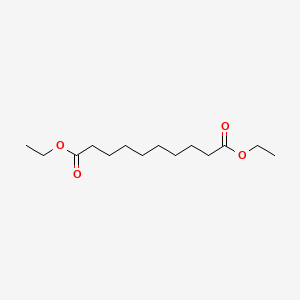
- IUPAC name
- diethyl decanedioate
- Molecular formula
- C14H26O4
- Molecular weight
- 258.35 g/mol
- Exact mass
- 258.18310931 Da
- XLogP3
- 3.5
- Topological polar surface area
- 52.6 Ų
- Hydrogen-bond donors
- 0
- Hydrogen-bond acceptors
- 4
- Covalent units
- 1
- Defined stereocentres
- 0
Also known as
Ethyl sebacateDecanedioic acid, diethyl esterBisoflex DESSebacic acid, diethyl esterSebacic acid diethyl ester1,10-diethyl decanedioateFEMA No. 2376I41B9FJK6V
16 more reported names
NSC-8911RefChem:133443203-764-5Diethyl 1,10-decanedioateEthyl sebacate (VAN)Diethyl 1,8-octanedicarboxylateNSC 8911Decanedioic acid, 1,10-diethyl esterDECANEDIOIC ACID,DIETHYL ESTERdiethyl decane-1,10-dioateDecanedioic Acid Diethyl EsterEINECS 203-764-5UNII-I41B9FJK6VBRN 1790779AI3-01970Diethyl sebecate
External database identifiers
- ChEBI:CHEBI:172099
- ChEMBL:CHEMBL1884461
- EPA DTXSID:DTXSID0021915
- PubMed:22139757
- PubMed:21509392
- PubMed:19727485
- PubMed:18433909
- PubMed:18322681
- PubMed:16930240
- PubMed:16459781
- PubMed:16221607
- PubMed:15769158
- PubMed:15751010
- PubMed:15059111
- PubMed:12476874
Evidence from additional scientific databases
NIH PubChem PUG-View
Exact identifier match8049
Attributed physical-property, hazard, environmental and use annotations.
- Boiling Point: 302.00 to 305.00 °C. @ 760.00 mm Hg Source: Human Metabolome Database (HMDB)
- Boiling Point: 302 °C Source: Joint FAO/WHO Expert Committee on Food Additives (JECFA)
- Density: 0.960-0.965 Source: Joint FAO/WHO Expert Committee on Food Additives (JECFA)
- Melting Point: 5 °C Source: Human Metabolome Database (HMDB)
- Physical Description: Colorless to yellowish liquid; [Merck Index] Clear colorless liquid; [Sigma-Aldrich MSDS] Source: Haz-Map, Information on Hazardous Chemicals and Occupational Diseases
- Physical Description: Liquid Source: Human Metabolome Database (HMDB)
- Physical Description: colourless to yellow liquid with faint but pleasant winey-fruity odour resembling that of quince and melon Source: Joint FAO/WHO Expert Committee on Food Additives (JECFA)
- Refractive Index: 1.434-1.440 Source: Joint FAO/WHO Expert Committee on Food Additives (JECFA)
- Solubility: 0.08 mg/mL at 20 °C Source: Human Metabolome Database (HMDB)
- Solubility: miscible in alcohol, ether, other organic solvents, most fixed oils; insoluble in water Source: Joint FAO/WHO Expert Committee on Food Additives (JECFA)
- Solubility: (in ethanol) Source: Joint FAO/WHO Expert Committee on Food Additives (JECFA)
- Note: This chemical does not meet GHS hazard criteria for 2.6% (38 of 1462) of reports. Source: European Chemicals Agency (ECHA)
- GHS Hazard Statements: H411 (94.8%): Toxic to aquatic life with long lasting effects [Hazardous to the aquatic environment, long-term hazard] Source: European Chemicals Agency (ECHA)
- Precautionary Statement Codes: P273, P391, and P501 (click each P-code to see the statement) Source: European Chemicals Agency (ECHA)
- ECHA C&L Notifications Summary: Aggregated GHS information provided per 1462 reports by companies from 5 notifications to the ECHA C&L Inventory.; Reported as not meeting GHS hazard criteria per 38 of 1462 reports by companies.; There are 4 notifications provided by 1424 of 1462 reports by companies with hazard statement code(s).; Information may vary between notifications depending on impurities, additives, and other factors. The percentage value in parenthesis indicates the notified classification ratio from companies that provide hazard codes. Only hazard codes with percentage values above 10% are shown. For more detailed information, please visit ECHA C&L website. Source: European Chemicals Agency (ECHA)
- Cosmetic Ingredient Review Finding(s): Safe in the present practices of use and concentration. Ingredient, concentration, and use information are available in documents discoverable at https://cir-reports.cir-safety.org Source: Cosmetic Ingredient Review (CIR)
- Cosmetic Ingredient Review Link: CIR ingredient: Diethyl Sebacate Source: Cosmetic Ingredient Review (CIR)
- Sources/Uses: Used to make alkyd and polyester resins, non-migrating plasticizers, polyester rubbers, and polyamide synthetic fibers; [Merck Index] Used as a flavoring agent; [FDA] Source: Haz-Map, Information on Hazardous Chemicals and Occupational Diseases
- Industrial Processes with risk of exposure: Textiles (Fiber & Fabric Manufacturing) [Category: Industry] Source: Haz-Map, Information on Hazardous Chemicals and Occupational Diseases
Mapped by: Existing checksum-valid CAS to unique PubChem CID match. Retrieved: 2026-08-31. Open source record
Scientific classifications and hazard annotations provide context and do not replace the market-specific regulatory decision shown above.
Additional source coverage and match status
| Source | Result | Checked |
|---|---|---|
| NIH PubChem PUG-View | Exact match | 2026-08-31 |
A recorded no-match is useful evidence that the source was checked; it is not a claim that the substance does not exist elsewhere.
Retrieved from NIH PubChem on 2026-08-31 by checksum-valid CAS matching. Chemical properties do not replace the regulatory decision on this page.