
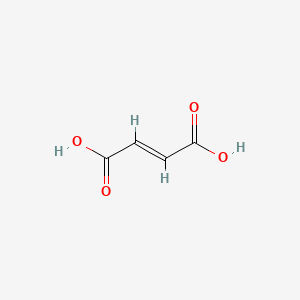
Fumaric Acid
Fumaric acid appears as a colorless crystalline solid. The primary hazard is the threat to the environment. Immediate steps should be taken to limit spread to the environment. Combustible, though may be difficult to ignite. Used to make paints and plastics, in food processing and preservation, and for other uses. — CAMEO Chemicals
- IUPAC name
- (E)-but-2-enedioic acid
- Molecular formula
- C4H4O4
- Molecular weight
- 116.07 g/mol
- Exact mass
- 116.01095860 Da
- XLogP3
- -0.3
- Topological polar surface area
- 74.6 Ų
- Hydrogen-bond donors
- 2
- Hydrogen-bond acceptors
- 4
- Covalent units
- 1
- Defined stereocentres
- 0
Also known as
16 more reported names
External database identifiers
- ChEBI:CHEBI:18012
- ChEBI:CHEBI:22958
- ChEMBL:CHEMBL503160
- EPA DTXSID:DTXSID3021518
- PubMed:29968805
- PubMed:21170321
- PubMed:12121650
- PubMed:1799950
- PubMed:6761
Evidence from additional scientific databases
NIH PubChem PUG-View
Attributed physical-property, hazard, environmental and use annotations.
- Autoignition Temperature: 1364 °F (USCG, 1999) Source: CAMEO Chemicals
- Autoignition Temperature: 1364 °F (powder) Source: Hazardous Substances Data Bank (HSDB)
- Autoignition Temperature: 375 °C (powder) Source: ILO-WHO International Chemical Safety Cards (ICSCs)
- Boiling Point: 329 °F at 1.7 mmHg ; sublimes (NTP, 1992) Source: CAMEO Chemicals
- Boiling Point: 522 °C Source: DrugBank
- Boiling Point: Sublimes at 200 °C Source: Hazardous Substances Data Bank (HSDB)
- Color/Form: Needles, monoclinic prisms or leaflets from water Source: Hazardous Substances Data Bank (HSDB)
- Color/Form: Colorless crystals Source: Hazardous Substances Data Bank (HSDB)
- Color/Form: WHITE CRYSTALLINE POWDER Source: Hazardous Substances Data Bank (HSDB)
- Density: 1.635 at 68 °F (USCG, 1999) - Denser than water; will sink Source: CAMEO Chemicals
- Density: 1.635 g/cu cm at 20 °C Source: Hazardous Substances Data Bank (HSDB)
- Density: IT HAS AN EXTREMELY LOW RATE OF MOISTURE ABSORPTION; BULK DENSITY: 32.6 LB/CU FT; STANDARD FREE ENERGY OF ANION FORMATION: -144.41 @ 25 °C; BUFFERING INDEX 3.46 Source: Hazardous Substances Data Bank (HSDB)
- Density: Density (at 20 °C): 1.64 g/cm³ Source: ILO-WHO International Chemical Safety Cards (ICSCs)
- pKa: 3.03 (at 18 °C) Source: DrugBank
- Dissociation Constants: pKa1 = 3.03; pKa2 = 4.44 at 18 °C Source: Hazardous Substances Data Bank (HSDB)
- Dissociation Constants: pKa1 = 3.03; pKa2 = 4.54 at 25 °C Source: Hazardous Substances Data Bank (HSDB)
- Flash Point: 273 °C (open cup) Source: Hazardous Substances Data Bank (HSDB)
- Flash Point: 230 °C (closed cup) Source: Hazardous Substances Data Bank (HSDB)
- Flash Point: 273 °C Source: ILO-WHO International Chemical Safety Cards (ICSCs)
- LogP: 0.46 Source: DrugBank
- LogP: log Kow = 0.46 Source: Hazardous Substances Data Bank (HSDB)
- LogP: 0.46 Source: Human Metabolome Database (HMDB)
- LogP: 0.46 (estimated) Source: ILO-WHO International Chemical Safety Cards (ICSCs)
- Melting Point: 572 to 576 °F (NTP, 1992) Source: CAMEO Chemicals
- Melting Point: 287 dec °C Source: DrugBank
- Melting Point: 286-302 °C (closed capillary, rapid heating) Source: EU Food Improvement Agents
- Melting Point: 287 °C decomposes Source: Hazardous Substances Data Bank (HSDB)
- Melting Point: 549 °C Source: Human Metabolome Database (HMDB)
- Odor: Odorless Source: Hazardous Substances Data Bank (HSDB)
- Physical Description: Fumaric acid appears as a colorless crystalline solid. The primary hazard is the threat to the environment. Immediate steps should be taken to limit spread to the environment. Combustible, though may be difficult to ignite. Used to make paints and plastics, in food processing and preservation, and for other uses. Source: CAMEO Chemicals
- Physical Description: Liquid; Other Solid; Dry Powder; CBI; Large Crystals Source: EPA Chemical Data Reporting (CDR)
- Physical Description: White crystalline powder or granules Source: EU Food Improvement Agents
- Physical Description: Colorless or white odorless solid; [HSDB] White crystalline solid; [MSDSonline] Source: Haz-Map, Information on Hazardous Chemicals and Occupational Diseases
- Physical Description: Solid Source: Human Metabolome Database (HMDB)
- Physical Description: ODOURLESS COLOURLESS CRYSTALLINE POWDER. Source: ILO-WHO International Chemical Safety Cards (ICSCs)
- Physical Description: white odourless granules or leafy crystals; virtually odourless with tart acid taste Source: Joint FAO/WHO Expert Committee on Food Additives (JECFA)
- Solubility: less than 1 mg/mL at 72 °F (NTP, 1992) Source: CAMEO Chemicals
- Solubility: 7000 mg/L (at 25 °C) Source: DrugBank
- Solubility: Soluble in ethanol, concentrated sulfuric acid; slightly soluble in ethyl ether, acetone Source: Hazardous Substances Data Bank (HSDB)
- Solubility: Soluble in alcohol 5.76 g/100 g at 30 °C. Insoluble in chloroform and benzene Source: Hazardous Substances Data Bank (HSDB)
- Solubility: in 100 g 95% alcohol at 30 °C: 5.76g; in 100 g acetone at 30 °C: 1.72 g; in 100 g ether at 25 °C: 0.72 g Source: Hazardous Substances Data Bank (HSDB)
- Solubility: Almost insoluble in olive oil, ... carbon tetrachloride, xylene, ... molten camphor, liquid ammonia. Source: Hazardous Substances Data Bank (HSDB)
- Solubility: In water, 7X10⁻³ mg/L at 25 °C Source: Hazardous Substances Data Bank (HSDB)
- Solubility: 7.0 mg/mL Source: Human Metabolome Database (HMDB)
- Solubility: Solubility in water, g/100ml at 25 °C: 0.63 (poor) Source: ILO-WHO International Chemical Safety Cards (ICSCs)
- Solubility: insoluble to slightly soluble in water; soluble in alcohol; slightly soluble in oils. Source: Joint FAO/WHO Expert Committee on Food Additives (JECFA)
- Solubility: (in ethanol) Source: Joint FAO/WHO Expert Committee on Food Additives (JECFA)
- Vapor Pressure: 0.000154 [mmHg] Source: Haz-Map, Information on Hazardous Chemicals and Occupational Diseases
- Vapor Pressure: 1.54X10⁻⁴ mm Hg at 25 °C Source: Hazardous Substances Data Bank (HSDB)
- pH: 3,0-3,2 (0,05 % solution at 25 °C) Source: EU Food Improvement Agents
- Carcinogen Classification: Not listed by IARC. Has been implicated in oncogenesis (A15088, A15092). Source: Toxin and Toxin Target Database (T3DB)
- Exposure Routes: Endogenous, ingestion, contact (skin and eyes) Source: Toxin and Toxin Target Database (T3DB)
- First Aid: EYES: First check the victim for contact lenses and remove if present. Flush victim's eyes with water or normal saline solution for 20 to 30 minutes while simultaneously calling a hospital or poison control center. Do not put any ointments, oils, or medication in the victim's eyes without specific instructions from a physician. IMMEDIATELY transport the victim after flushing eyes to a hospital even if no symptoms (such as redness or irritation) develop.; SKIN: IMMEDIATELY flood affected skin with water while removing and isolating all contaminated clothing. Gently wash all affected skin areas thoroughly with soap and water. If symptoms such as redness or irritation develop, IMMEDIATELY call a physician and be prepared to transport the victim to a hospital for treatment.; INHALATION: IMMEDIATELY leave the contaminated area; take deep breaths of fresh air. If symptoms (such as wheezing, coughing, shortness of breath, or burning in the mouth, throat, or chest) develop, call a physician and be prepared to transport the victim to a hospital. Provide proper respiratory protection to rescuers entering an unknown atmosphere. Whenever possible, Self-Contained Breathing Apparatus (SCBA) shou Source: CAMEO Chemicals
- Signal: Warning Source: Regulation (EC) No 1272/2008 of the European Parliament and of the Council
- GHS Hazard Statements: H319: Causes serious eye irritation [Warning Serious eye damage/eye irritation] Source: Regulation (EC) No 1272/2008 of the European Parliament and of the Council
- Precautionary Statement Codes: P264+P265, P280, P305+P351+P338, and P337+P317 (click each P-code to see the statement) Source: Regulation (EC) No 1272/2008 of the European Parliament and of the Council
- Note: This chemical does not meet GHS hazard criteria for 0.4% (13 of 3331) of reports. Source: European Chemicals Agency (ECHA)
- Signal: Warning Source: European Chemicals Agency (ECHA)
- GHS Hazard Statements: H319 (99.6%): Causes serious eye irritation [Warning Serious eye damage/eye irritation] Source: European Chemicals Agency (ECHA)
- Precautionary Statement Codes: P264+P265, P280, P305+P351+P338, and P337+P317 (click each P-code to see the statement) Source: European Chemicals Agency (ECHA)
- ECHA C&L Notifications Summary: Aggregated GHS information provided per 3331 reports by companies from 12 notifications to the ECHA C&L Inventory.; Reported as not meeting GHS hazard criteria per 13 of 3331 reports by companies.; There are 11 notifications provided by 3318 of 3331 reports by companies with hazard statement code(s).; Information may vary between notifications depending on impurities, additives, and other factors. The percentage value in parenthesis indicates the notified classification ratio from companies that provide hazard codes. Only hazard codes with percentage values above 10% are shown. For more detailed information, please visit ECHA C&L website. Source: European Chemicals Agency (ECHA)
- GHS Hazard Statements: H402: Harmful to aquatic life [Hazardous to the aquatic environment, acute hazard] Source: NITE-CMC
- Precautionary Statement Codes: P273, and P501 (click each P-code to see the statement) Source: NITE-CMC
- Signal: Warning Source: NITE-CMC
- GHS Hazard Statements: H319: Causes serious eye irritation [Warning Serious eye damage/eye irritation] Source: NITE-CMC
- Health Effects: Acute exposure to fumaric acid can cause skin redness (skin contact), cough or sore throat (inhalation), abdominal cramps, nausea and diarrhea (ingestion). Chronically high levels of fumaric acid are associated with at least 3 inborn errors of metabolism including: 2-Ketoglutarate dehydrogenase complex deficiency, Fumarase deficiency and Pyruvate carboxylase deficiency. Fumarase deficiency causes encephalopathy, severe mental retardation, unusual facial features, brain malformation, and epileptic seizures. High intracellular fumaric acid levels are associated with the development of renal cancer, leiomyomata, renal cysts, and tumors. Source: Toxin and Toxin Target Database (T3DB)
- Cosmetic Ingredient Review Finding(s): Safe in the present practices of use and concentration. Ingredient, concentration, and use information are available in documents discoverable at https://cir-reports.cir-safety.org Source: Cosmetic Ingredient Review (CIR)
- Toxicity Summary: Acute Toxicity: Fumarate is also an endogenous electrophile and reacts spontaneously with cysteine residues in proteins by a Michael addition reaction to form S-(2-succinyl) cysteine, a process termed succination. Lachrymators such as fumarate are thought to act by attacking sulfhydryl functional groups in enzymes. One of the most probable protein targets is the TRPA1 ion channel that is expressed in sensory nerves (trigeminal nerve) of the eyes, nose, mouth and lungs. Chronic Toxicity: Fumarate is increasingly being identified as an oncometabolite. Fumarase or fumarate hydratase (FH) is a tumor suppressor, whose mutation is associated with the development of leiomyomata, renal cysts, and tumors. Loss of FH enzymatic activity results in accumulation of intracellular fumarate which has been proposed to act as a competitive inhibitor of 2-oxoglutarate-dependent oxygenases including the hypoxia-inducible factor (HIF) hydroxylases, thus activating oncogenic HIF pathways. Mitochondrial dysfunction is also associated with FH deficiency. Fumarate hydratase-deficient cells and tumors have been shown to accumulate fumarate to very high levels with multiple consequences including the activat Source: Toxin and Toxin Target Database (T3DB)
- Environmental Bioconcentration: An estimated BCF of 3 was calculated in fish for fumaric acid(SRC), using a log Kow of 0.46(1) and a regression-derived equation(2). According to a classification scheme(3), this BCF suggests the potential for bioconcentration in aquatic organisms is low(SRC). Source: Hazardous Substances Data Bank (HSDB)
- Environmental Fate: TERRESTRIAL FATE: Based on a classification scheme(1), an estimated Koc value of 7(SRC), determined from a structure estimation method(2), indicates that fumaric acid is expected to have very high mobility in soil(SRC). The pKa values of fumaric acid are 3.03 and 4.54(3), indicating that this compound will exist almost entirely in anion form in the environment and anions generally do not adsorb more strongly to soils containing organic carbon and clay than their neutral counterparts(4). Volatilization of fumaric acid from moist soil surfaces is not expected to be an important fate process(SRC) given its pKa(3). Fumaric acid is not expected to volatilize from dry soil surfaces(SRC) based upon a vapor pressure of 1.54X10⁻⁴ mm Hg(5). Using a Warburg respirometer and a sewage inoculum, 5 day Theoretical BODs of 57-70% were reported(6), suggesting that biodegradation may be an important environmental fate process in soil(SRC). Source: Hazardous Substances Data Bank (HSDB)
- Environmental Fate: AQUATIC FATE: Based on a classification scheme(1), an estimated Koc value of 7(SRC), determined from a structure estimation method(2), indicates that fumaric acid is not expected to adsorb to suspended solids and sediment(SRC). A pKa values of 3.03 and 4.54(3) indicate fumaric acid will exist almost entirely in the anion form at pH values of 5 to 9 and therefore volatilization from water surfaces is not expected to be an important fate process(4). According to a classification scheme(5), an estimated BCF of 3(SRC), from its log Kow of 0.46(6) and a regression-derived equation(7), suggests the potential for bioconcentration in aquatic organisms is low(SRC). Fumaric acid is not expected to undergo hydrolysis in the environment due to the lack of functional groups that hydrolyze under environmental conditions(8). The rate constant for the aqueous reaction of fumaric acid with photochemically produced hydroxyl radicals (pH 4.5-10) is 6.0X10+9/M-sec(9); using a hydroxyl radical concentration of 3X10-17 M in brightly sunlit natural water(10), the half-life would be 45 days(SRC). The half-life of fumaric acid in various natural waters ranged from 1-15 days using river die-away studies, in Source: Hazardous Substances Data Bank (HSDB)
- Environmental Fate: ATMOSPHERIC FATE: According to a model of gas/particle partitioning of semivolatile organic compounds in the atmosphere(1), fumaric acid, which has a vapor pressure of 1.54X10⁻⁴ mm Hg at 25 °C(2), will exist in both the vapor and particulate phases in the ambient atmosphere. Vapor-phase fumaric acid is degraded in the atmosphere by reaction with photochemically-produced hydroxyl radicals and ozone(SRC); the half-lives for these reactions in air are estimated to be 7 hours and 6 days(SRC), calculated from rate constants of 5.3X10⁻¹¹ cu cm/molecule-sec(3) and 1.8X10⁻¹⁸ cu cm/molecule-sec(4), respectively. Particulate-phase fumaric acid may be removed from the air by wet or dry deposition(SRC). Fumaric acid does not absorb UV light above 290 nm in methanol, acidic methanol, or basic methanol solution(5) and therefore is not expected to be susceptible to direct photolysis by sunlight(SRC). Source: Hazardous Substances Data Bank (HSDB)
- Consumer Uses: Not Known or Reasonably Ascertainable; Flavoring and nutrient; Dispersing agent Source: EPA Chemical Data Reporting (CDR)
- Industry Uses: Dispersing agent; Flavoring and nutrient; Binder; Other; Processing aids not otherwise specified; Monomers; Fixing agent (mordant); Filler; Not Known or Reasonably Ascertainable; Emulsifier; Intermediate Source: EPA Chemical Data Reporting (CDR)
- Cosmetic Ingredient Review Link: CIR ingredient: Fumaric Acid Source: Cosmetic Ingredient Review (CIR)
- Sources/Uses: An essential biochemical in the cellular respiration of plants and animals; [Merck Index] Used as a fortifier (paper size resins, unsaturated polyester resins, and alkyd surface coating resins), food antioxidant, dye mordant, and medication; Also used in dentifrices (stain remover) and to make other chemicals; [HSDB] Used in rosin esters and adducts, drying oils, printing inks, and foods (acidulant and flavoring agent); [Hawley] Source: Haz-Map, Information on Hazardous Chemicals and Occupational Diseases
- Industrial Processes with risk of exposure: Pulp and Paper Processing [Category: Industry]; Painting (Pigments, Binders, and Biocides) [Category: Paint]; Textiles (Printing, Dyeing, or Finishing) [Category: Industry] Source: Haz-Map, Information on Hazardous Chemicals and Occupational Diseases
- Uses: For fumaric acid (USEPA/OPP Pesticide Code: 051201) there are 0 labels match. /SRP: Not registered for current use in the U.S., but approved pesticide uses may change periodically and so federal, state and local authorities must be consulted for currently approved uses./ Source: Hazardous Substances Data Bank (HSDB)
- Uses: Fumaric acid is used primarily in liquid pharmaceutical preparations as an acidulant and flavoring agent. Fumaric acid may be included as the acid part of effervescent tablet formulations, although this use is limited as the compound has an extremely low solubility in water. It is also used as a chelating agent which exhibits synergism when used in combination with other true antioxidants. In the design of novel pelletized formulations manufactured by extrusion-spheronization, fumaric acid was used to aid spheronization, favoring the production of fine pellets. It has also been investigated as an alternative filler to lactose in pellets. Fumaric acid has been investigated as a lubricant for effervescent tablets, and copolymers of fumaric acid and sebacic acid have been investigated as bioadhesive microspheres. It has also been used in film-coated pellet formulations as an acidifying agent and also to increase drug solubility. Fumaric acid is also used as a food additive at concentrations up to 3600 ppm, and as a therapeutic agent in the treatment of psoriasis and other skin disorders. Source: Hazardous Substances Data Bank (HSDB)
- Uses: Reported uses; Table: Reported uses (ppm): (Flavor and Extract Manufacturers' Association) [Table#2022] Source: Hazardous Substances Data Bank (HSDB)
- Uses: Fortifier in paper size resins, unsaturated polyester resins, and alkyd surface coating resins; miscellaneous applications; acidulant in gelatin desserts and dry beverage powders; chemical intermediate for plasticizers including dibutyl fumarate. Source: Hazardous Substances Data Bank (HSDB)
- Uses: For more Uses (Complete) data for Fumaric acid (9 total), please visit the HSDB record page. Source: Hazardous Substances Data Bank (HSDB)
- Uses: Use (kg; approx.) in Germany (2009): >1000; Consumption (g per capita; approx.) in Germany (2009): 0.0122; Calculated removal (%): 92.1 Source: NORMAN Suspect List Exchange
- Uses: Fumaric acid is naturally produced by the body, however for industrial applications it is synthesized chemically. Fumaric acid is used to impart a tart taste to processed foods. It is also used as an antifungal agent in boxed foods such as cake mixes and flours, as well as tortillas. Fumaric acid is also added to bread to increase the porosity of the final baked product. It is used to impart a sour taste to sourdough and rye bread. In cake mixes, it is used to maintain a low pH and prevent clumping of the flours used in the mix. In fruit drinks, fumaric acid is used to maintain a low pH which, in turn, helps to stabilize flavor and color. Fumaric acid also prevents the growth of E. coli in beverages when used in combination with sodium benzoate. When added to wines, fumaric acid helps to prevent further fermentation and yet maintain low pH and eliminate traces of metallic elements. In this fashion, it helps to stabilize the taste of wine. Fumaric acid can also be added to dairy products, sports drinks, jams, jellies and candies. Fumaric acid helps to break down bonds between gluten proteins in wheat and helps to create a more pliable dough. Fumaric acid is used in paper sizing, pri Source: Toxin and Toxin Target Database (T3DB)
Mapped by: Existing checksum-valid CAS to unique PubChem CID match. Retrieved: 2026-08-31. Open source record
Scientific classifications and hazard annotations provide context and do not replace the market-specific regulatory decision shown above.
Additional source coverage and match status
| Source | Result | Checked |
|---|---|---|
| NIH PubChem PUG-View | Exact match | 2026-08-31 |
A recorded no-match is useful evidence that the source was checked; it is not a claim that the substance does not exist elsewhere.
Retrieved from NIH PubChem on 2026-08-31 by checksum-valid CAS matching. Chemical properties do not replace the regulatory decision on this page.