
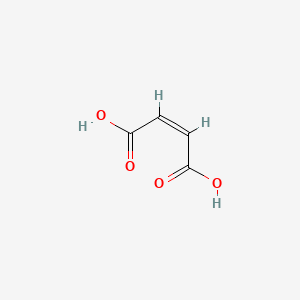
Maleic Acid
Maleic acid is a butenedioic acid in which the double bond has cis- (Z)-configuration. It has a role as a mouse metabolite, a plant metabolite and an algal metabolite. It is a conjugate acid of a maleate and a maleate(1-). — ChEBI
- IUPAC name
- (Z)-but-2-enedioic acid
- Molecular formula
- C4H4O4
- Molecular weight
- 116.07 g/mol
- Exact mass
- 116.01095860 Da
- XLogP3
- -0.3
- Topological polar surface area
- 74.6 Ų
- Hydrogen-bond donors
- 2
- Hydrogen-bond acceptors
- 4
- Covalent units
- 1
- Defined stereocentres
- 0
Also known as
16 more reported names
External database identifiers
- ChEBI:CHEBI:18300
- ChEMBL:CHEMBL539648
- EPA DTXSID:DTXSID8021517
- PubMed:28160606
- PubMed:26386312
- PubMed:15141213
- PubMed:14685229
- PubMed:9039272
- PubMed:5331
Evidence from additional scientific databases
NIH PubChem PUG-View
Attributed physical-property, hazard, environmental and use annotations.
- Boiling Point: 275 °F at 760 mmHg (decomposes) (NTP, 1992) Source: CAMEO Chemicals
- Color/Form: Monoclinic prisms from water Source: Hazardous Substances Data Bank (HSDB)
- Color/Form: White crystals from water, alcohol and benzene Source: Hazardous Substances Data Bank (HSDB)
- Color/Form: Colorless crystals Source: Hazardous Substances Data Bank (HSDB)
- Density: 1.59 at 68 °F (USCG, 1999) - Denser than water; will sink Source: CAMEO Chemicals
- Density: 1.590 g/cu cm at 20 °C Source: Hazardous Substances Data Bank (HSDB)
- Density: Relative density (water = 1): 1.59 Source: ILO-WHO International Chemical Safety Cards (ICSCs)
- Density: 1.59 @ 20°C Source: PAC Chemical Database, U.S. Department of Energy
- pKa: 1.83 Source: DrugBank
- Dissociation Constants: pKa1 = 1.94, pKa2 = 6.22 at 25 °C (OECD Guideline 105) Source: Hazardous Substances Data Bank (HSDB)
- Flash Point: 127 °C Source: ILO-WHO International Chemical Safety Cards (ICSCs)
- LogP: -0.48 Source: DrugBank
- LogP: log Kow = -0.48 Source: Hazardous Substances Data Bank (HSDB)
- LogP: -0.48 Source: Human Metabolome Database (HMDB)
- LogP: -0.5 Source: ILO-WHO International Chemical Safety Cards (ICSCs)
- Melting Point: 266 to 268 °F (NTP, 1992) Source: CAMEO Chemicals
- Melting Point: 130.5 °C Source: DrugBank
- Melting Point: 132.5 °C (OECD Guideline 102 (Melting point / Melting Range)) Source: Hazardous Substances Data Bank (HSDB)
- Melting Point: Converted in part into the much higher-melting fumaric acid (MP: 287 °C) when heated to a temp slightly above the MP. Source: Hazardous Substances Data Bank (HSDB)
- Melting Point: 130.5 °C Source: Human Metabolome Database (HMDB)
- Melting Point: 131 °C Source: ILO-WHO International Chemical Safety Cards (ICSCs)
- Odor: Faint acidulous odor Source: Hazardous Substances Data Bank (HSDB)
- Physical Description: Maleic acid is a colorless crystalline solid having a faint odor. It is combustible though it may take some effort to ignite. It is soluble in water. It is used to make other chemicals and for dyeing and finishing naturally occurring fibers. Source: CAMEO Chemicals
- Physical Description: Dry Powder; Dry Powder; Large Crystals; Liquid Source: EPA Chemical Data Reporting (CDR)
- Physical Description: Colorless or white solid; [HSDB] White crystalline powder; [MSDSonline] Source: Haz-Map, Information on Hazardous Chemicals and Occupational Diseases
- Physical Description: Solid Source: Human Metabolome Database (HMDB)
- Physical Description: WHITE CRYSTALS. Source: ILO-WHO International Chemical Safety Cards (ICSCs)
- Solubility: greater than or equal to 100 mg/mL at 66 °F (NTP, 1992) Source: CAMEO Chemicals
- Solubility: 441000 mg/L (at 25 °C) Source: DrugBank
- Solubility: In water, 788 g/L at 25 °C, 3926 g/L at 97.5 °C Source: Hazardous Substances Data Bank (HSDB)
- Solubility: 79.000 lb/100 lb water at 77 °F Source: Hazardous Substances Data Bank (HSDB)
- Solubility: In water, 441,000 mg/L at 25 °C Source: Hazardous Substances Data Bank (HSDB)
- Solubility: Freely soluble in alcohol; soluble in acetone, glacial acetic acid; slightly soluble in ether; practically insoluble in benzene Source: Hazardous Substances Data Bank (HSDB)
- Solubility: For more Solubility (Complete) data for MALEIC ACID (7 total), please visit the HSDB record page. Source: Hazardous Substances Data Bank (HSDB)
- Solubility: 441 mg/mL at 25 °C Source: Human Metabolome Database (HMDB)
- Solubility: Solubility in water, g/100ml at 25 °C: 78 (soluble) Source: ILO-WHO International Chemical Safety Cards (ICSCs)
- Vapor Pressure: Negligible (NTP, 1992) Source: CAMEO Chemicals
- Vapor Pressure: 0.0000359 [mmHg] Source: Haz-Map, Information on Hazardous Chemicals and Occupational Diseases
- Vapor Pressure: 1.34X10⁻⁵ mm Hg at 25 °C (OECD Guideline 104 (Vapor Pressure Curve)) Source: Hazardous Substances Data Bank (HSDB)
- Vapor Pressure: Vapor pressure, Pa at 25 °C: 0.0048 Source: ILO-WHO International Chemical Safety Cards (ICSCs)
- Vapor Pressure: 0.0000359 [mm Hg] @25 °C Source: PAC Chemical Database, U.S. Department of Energy
- Carcinogen Classification: No indication of carcinogenicity to humans (not listed by IARC). Source: Toxin and Toxin Target Database (T3DB)
- Exposure Routes: The substance can be absorbed into the body by inhalation and by ingestion. Source: ILO-WHO International Chemical Safety Cards (ICSCs)
- First Aid: EYES: First check the victim for contact lenses and remove if present. Flush victim's eyes with water or normal saline solution for 20 to 30 minutes while simultaneously calling a hospital or poison control center. Do not put any ointments, oils, or medication in the victim's eyes without specific instructions from a physician. IMMEDIATELY transport the victim after flushing eyes to a hospital even if no symptoms (such as redness or irritation) develop.; SKIN: IMMEDIATELY flood affected skin with water while removing and isolating all contaminated clothing. Gently wash all affected skin areas thoroughly with soap and water. If symptoms such as redness or irritation develop, IMMEDIATELY call a physician and be prepared to transport the victim to a hospital for treatment.; INHALATION: IMMEDIATELY leave the contaminated area; take deep breaths of fresh air. IMMEDIATELY call a physician and be prepared to transport the victim to a hospital even if no symptoms (such as wheezing, coughing, shortness of breath, or burning in the mouth, throat, or chest) develop. Provide proper respiratory protection to rescuers entering an unknown atmosphere. Whenever possible, Self-Contained Breathing Ap Source: CAMEO Chemicals
- Signal: Warning Source: Regulation (EC) No 1272/2008 of the European Parliament and of the Council
- GHS Hazard Statements: H302: Harmful if swallowed [Warning Acute toxicity, oral]; H315: Causes skin irritation [Warning Skin corrosion/irritation]; H317: May cause an allergic skin reaction [Warning Sensitization, Skin]; H319: Causes serious eye irritation [Warning Serious eye damage/eye irritation]; H335: May cause respiratory irritation [Warning Specific target organ toxicity, single exposure; Respiratory tract irritation] Source: Regulation (EC) No 1272/2008 of the European Parliament and of the Council
- Precautionary Statement Codes: P261, P264, P264+P265, P270, P271, P272, P280, P301+P317, P302+P352, P304+P340, P305+P351+P338, P319, P321, P330, P332+P317, P333+P317, P337+P317, P362+P364, P403+P233, P405, and P501 (click each P-code to see the statement) Source: Regulation (EC) No 1272/2008 of the European Parliament and of the Council
- Note: This chemical does not meet GHS hazard criteria for 0.2% (3 of 1974) of reports. Source: European Chemicals Agency (ECHA)
- Signal: Warning Source: European Chemicals Agency (ECHA)
- GHS Hazard Statements: H302 (98.7%): Harmful if swallowed [Warning Acute toxicity, oral]; H312 (20%): Harmful in contact with skin [Warning Acute toxicity, dermal]; H315 (93.8%): Causes skin irritation [Warning Skin corrosion/irritation]; H317 (99.3%): May cause an allergic skin reaction [Warning Sensitization, Skin]; H319 (92.3%): Causes serious eye irritation [Warning Serious eye damage/eye irritation]; H335 (96.1%): May cause respiratory irritation [Warning Specific target organ toxicity, single exposure; Respiratory tract irritation] Source: European Chemicals Agency (ECHA)
- Precautionary Statement Codes: P261, P264, P264+P265, P270, P271, P272, P280, P301+P317, P302+P352, P304+P340, P305+P351+P338, P317, P319, P321, P330, P332+P317, P333+P317, P337+P317, P362+P364, P403+P233, P405, and P501 (click each P-code to see the statement) Source: European Chemicals Agency (ECHA)
- ECHA C&L Notifications Summary: Aggregated GHS information provided per 1974 reports by companies from 67 notifications to the ECHA C&L Inventory. Each notification may be associated with multiple companies.; Reported as not meeting GHS hazard criteria per 3 of 1974 reports by companies.; There are 66 notifications provided by 1971 of 1974 reports by companies with hazard statement code(s).; Information may vary between notifications depending on impurities, additives, and other factors. The percentage value in parenthesis indicates the notified classification ratio from companies that provide hazard codes. Only hazard codes with percentage values above 10% are shown. For more detailed information, please visit ECHA C&L website. Source: European Chemicals Agency (ECHA)
- Signal: Danger Source: European Chemicals Agency (ECHA)
- GHS Hazard Statements: H315 (100%): Causes skin irritation [Warning Skin corrosion/irritation]; H317 (83.3%): May cause an allergic skin reaction [Warning Sensitization, Skin]; H318 (77.8%): Causes serious eye damage [Danger Serious eye damage/eye irritation]; H319 (22.2%): Causes serious eye irritation [Warning Serious eye damage/eye irritation]; H335 (22.2%): May cause respiratory irritation [Warning Specific target organ toxicity, single exposure; Respiratory tract irritation] Source: European Chemicals Agency (ECHA)
- Precautionary Statement Codes: P261, P264, P264+P265, P271, P272, P280, P302+P352, P304+P340, P305+P351+P338, P305+P354+P338, P317, P319, P321, P332+P317, P333+P317, P337+P317, P362+P364, P403+P233, P405, and P501 (click each P-code to see the statement) Source: European Chemicals Agency (ECHA)
- ECHA C&L Notifications Summary: Aggregated GHS information provided per 18 reports by companies from 4 notifications to the ECHA C&L Inventory. Each notification may be associated with multiple companies.; Information may vary between notifications depending on impurities, additives, and other factors. The percentage value in parenthesis indicates the notified classification ratio from companies that provide hazard codes. Only hazard codes with percentage values above 10% are shown. For more detailed information, please visit ECHA C&L website. Source: European Chemicals Agency (ECHA)
- Cosmetic Ingredient Review Finding(s): Safe in the present practices of use and concentration. Ingredient, concentration, and use information are available in documents discoverable at https://cir-reports.cir-safety.org Source: Cosmetic Ingredient Review (CIR)
- Toxicity Summary: IDENTIFICATION AND USE: Maleic acid forms colorless or white crystals. It is used for manufacturing of artificial resins, dyeing and finishing wool, and for preparing the maleate salts of antihistamines and similar drugs. HUMAN EXPOSURE AND TOXICITY: A 20% aqueous solution produced a mild and reversible skin irritation in humans. Lower concentrations (< 5%) are sufficient to produce serious ocular irritation in human subjects. Neat maleic acid is reported to be a severe irritant to the mucous membranes of humans. In vitro, maleic acid produced highly significant alterations in the physical state of human erythrocyte membrane proteins. ANIMAL STUDIES: Single intravenous application of 400 or 200 mg/kg bw maleic acid to male rats via jugular venous catheter caused immediate injury in the kidneys which progressed to extensive necrosis by 24 hr after administration. In dogs the intravenous administration of maleic acid (50 mg/kg) increased sodium, potassium, and phosphate excretion. Maleic acid may enhance anaphylactic histamine release from guinea pig lung by its metabolic utilization in the tricarboxylic acid cycle. Kidney damage has been observed as a systemic toxic action of maleic Source: Hazardous Substances Data Bank (HSDB)
- Environmental Bioconcentration: The BCF of maleic acid in fish (golden ide) was measured as <10 after 3 days of exposure(1). According to a classification scheme(2), this BCF suggests the potential for bioconcentration in aquatic organisms is low(SRC). The BCF in algae (Chorella fusca) was 11 after a 24 hour exposure period(1). Source: Hazardous Substances Data Bank (HSDB)
- Environmental Fate: TERRESTRIAL FATE: Based on a classification scheme(1), an estimated Koc value of 7(SRC), determined from a structure estimation method(2), indicates that maleic acid is expected to have very high mobility in soil(SRC). The pKa values of maleic acid are 1.94 and 6.22(3), indicating that this compound will exist almost entirely in anion from in the environment and anions generally do not adsorb more strongly to soils containing organic carbon and clay than their neutral counterparts(4). Volatilization of maleic acid from moist soil surfaces is not expected to be an important fate process(SRC) given an estimated Henry's Law constant of 1.4X10⁻¹² atm-cu m/mole(SRC), using a fragment constant estimation method(2). Maleic acid is not expected to volatilize from dry soil surfaces(SRC) based upon a vapor pressure of 1.34X10⁻⁵ mm Hg at 25 °C(3). Results of several screening tests indicate that maleic acid is readily biodegradable(3,5), and therefore, biodegradation is expected to be an important fate process in soil(SRC). Maleic acid reached 87% of its theoretical BOD in 2 weeks in the Japanese MITI test(5). Source: Hazardous Substances Data Bank (HSDB)
- Environmental Fate: AQUATIC FATE: Based on a classification scheme(1), an estimated Koc value of 7(SRC), determined from a structure estimation method(2), indicates that maleic acid is not expected to adsorb to suspended solids and sediment(SRC). Volatilization from water surfaces is not expected(3) based upon an estimated Henry's Law constant of 1.4X10⁻¹² atm-cu m/mole(SRC), developed using a fragment constant estimation method(2). The pKa values of 1.94 and 6.22(4) indicate maleic acid will exist almost entirely in anion form at pH values of 5 to 9 and ionization could attenuate potential volatilization from water surfaces(SRC). Although almost entirely in anion form, acids have been shown to have effective Henry's Law constants under environmental conditions(5). According to a classification scheme(6), a BCF of <10 measured in fish (golden ide)(7) suggests the potential for bioconcentration in aquatic organisms is low. Results of several screening tests indicate that maleic acid is readily biodegradable(4,8) and, therefore, biodegradation is expected to be an important fate process in water(SRC). Maleic acid reached 87% of its theoretical BOD in 2 weeks in the Japanese MITI test(8). Maleic acid is Source: Hazardous Substances Data Bank (HSDB)
- Environmental Fate: ATMOSPHERIC FATE: According to a model of gas/particle partitioning of semivolatile organic compounds in the atmosphere(1), maleic acid, which has a vapor pressure of 1.34X10⁻⁵ mm Hg at 25 °C(2) will exist in both the vapor and particulate phases in the ambient atmosphere. Vapor-phase maleic acid is degraded in the atmosphere by reaction with photochemically-produced hydroxyl radicals(SRC); the half-life for this reaction in air is estimated to be 2 days(SRC), calculated from its rate constant of 7.95X10⁻¹² cu cm/molecule-sec at 25 °C(SRC) that was derived using a structure estimation method(3). Vapor-phase maleic acid is also degraded in the atmosphere by reaction with ozone(SRC); the half-life for this reaction in air is estimated to be 13 days(SRC), calculated from its rate constant of 8.8X10⁻¹⁹ cu cm/molecule-sec at 25 °C(SRC) that was derived using a structure estimation method(3). Maleic acid has been detected in numerous atmospheric aerosol samples(4-6). Particulate-phase maleic acid may be removed from the air by wet and dry deposition(SRC). The UV spectrum of maleic acid in water(7) indicates that the compound does not absorb at wavelengths >290 nm and, therefore, is not e Source: Hazardous Substances Data Bank (HSDB)
- Consumer Uses: Binder; Not Known or Reasonably Ascertainable; Corrosion inhibitor Source: EPA Chemical Data Reporting (CDR)
- Industry Uses: Intermediate; Not Known or Reasonably Ascertainable; Corrosion inhibitor; Emulsifier; Binder; Insulators Source: EPA Chemical Data Reporting (CDR)
- Cosmetic Ingredient Review Link: CIR ingredient: Maleic Acid Source: Cosmetic Ingredient Review (CIR)
- Sources/Uses: Used to make alkyd and polyester resins, surface coatings, lubricant additives, plasticizers, copolymers, drugs, and agricultural chemicals; Also used to retard rancidity of oils and to dye and finish textiles (wool, cotton, and silk); [HSDB] Source: Haz-Map, Information on Hazardous Chemicals and Occupational Diseases
- Industrial Processes with risk of exposure: Textiles (Printing, Dyeing, or Finishing) [Category: Industry] Source: Haz-Map, Information on Hazardous Chemicals and Occupational Diseases
- Uses: Manufacture of artificial resins; to retard rancidity of fats and oils in 1:10,000 (these are said to keep 3 times longer than those without the acid); dyeing and finishing wool, cotton, and silk; preparing the maleate salts of antihistamines and similar drugs. Source: Hazardous Substances Data Bank (HSDB)
- Uses: Organic synthesis (malic, succinic, aspartic, tartaric, propionic, lactic, malonic and acrylic acids); dyeing and finishing of cotton, wool and silk; preservative for oils and fats. Source: Hazardous Substances Data Bank (HSDB)
- Uses: Maleic anhydride, maleic acid, and fumaric acid are multifunctional chemical intermediates that find applications in nearly every field of industrial chemistry. Source: Hazardous Substances Data Bank (HSDB)
- Uses: CHEM INT FOR COMONOMERS IN ADHESIVES, FUMARIC ACID, ALKYD RESINS, & SYNTHETIC OILS Source: Hazardous Substances Data Bank (HSDB)
- Uses: Coumarin is formed by reaction of phenol with malic, maleic, or fumaric acids in the presence of concentrated sulfuric acid. Source: Hazardous Substances Data Bank (HSDB)
- Uses: This is an endogenously produced metabolite found in the human body. It is used in metabolic reactions, catabolic reactions or waste generation. Source: Toxin and Toxin Target Database (T3DB)
Mapped by: Existing checksum-valid CAS to unique PubChem CID match. Retrieved: 2026-08-31. Open source record
Scientific classifications and hazard annotations provide context and do not replace the market-specific regulatory decision shown above.
Additional source coverage and match status
| Source | Result | Checked |
|---|---|---|
| NIH PubChem PUG-View | Exact match | 2026-08-31 |
A recorded no-match is useful evidence that the source was checked; it is not a claim that the substance does not exist elsewhere.
Retrieved from NIH PubChem on 2026-08-31 by checksum-valid CAS matching. Chemical properties do not replace the regulatory decision on this page.