
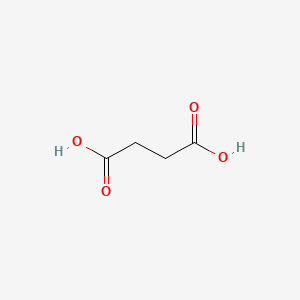
Succinic Acid
Succinic acid is an alpha,-dicarboxylic acid resulting from the formal oxidation of each of the terminal methyl groups of butane to the corresponding carboxy group. It is an intermediate metabolite in the citric acid cycle. It has a role as a micronutrient, an anti-ulcer drug, a nutraceutical, a radiation protective agent and a fundamental metabolite. It is an alpha,omega-dicarboxylic acid and a C4-dicarboxylic acid. It is a conjugate acid of a succinate(1-). — ChEBI
- IUPAC name
- butanedioic acid
- Molecular formula
- C4H6O4
- Molecular weight
- 118.09 g/mol
- Exact mass
- 118.02660867 Da
- XLogP3
- -0.6
- Topological polar surface area
- 74.6 Ų
- Hydrogen-bond donors
- 2
- Hydrogen-bond acceptors
- 4
- Covalent units
- 1
- Defined stereocentres
- 0
Also known as
16 more reported names
External database identifiers
Evidence from additional scientific databases
NIH PubChem PUG-View
Attributed physical-property, hazard, environmental and use annotations.
- Boiling Point: 455 °F at 760 mmHg (Decomposes) (NTP, 1992) Source: CAMEO Chemicals
- Boiling Point: 235 dec °C Source: DrugBank
- Boiling Point: 235 °C Source: Hazardous Substances Data Bank (HSDB)
- Boiling Point: 235 °C @760 [mm Hg] Source: PAC Chemical Database, U.S. Department of Energy
- Color/Form: WHITE MINUTE MONOCLINIC PRISMS Source: Hazardous Substances Data Bank (HSDB)
- Color/Form: Triclinic or monoclinic prisms Source: Hazardous Substances Data Bank (HSDB)
- Density: 1.572 at 68 °F (NTP, 1992) - Denser than water; will sink Source: CAMEO Chemicals
- Density: 1.572 @ 25 °C/4 °C Source: Hazardous Substances Data Bank (HSDB)
- Density: BULK DENSITY: 55 LB/CU FT; NONHYGROSCOPIC Source: Hazardous Substances Data Bank (HSDB)
- Density: 1.154 @ 15°C Source: PAC Chemical Database, U.S. Department of Energy
- pKa: 4.21 (at 25 °C) Source: DrugBank
- Dissociation Constants: pK1 = 4.207, pK2 = 5.635 at 25 °C Source: Hazardous Substances Data Bank (HSDB)
- Flash Point: 160 °C (open cup) Source: Hazardous Substances Data Bank (HSDB)
- LogP: -0.59 Source: DrugBank
- LogP: log Kow = -0.59 Source: Hazardous Substances Data Bank (HSDB)
- LogP: -0.59 Source: Human Metabolome Database (HMDB)
- Melting Point: 363 to 365 °F (NTP, 1992) Source: CAMEO Chemicals
- Melting Point: 188 °C Source: DrugBank
- Melting Point: 185,0-190,0 °C Source: EU Food Improvement Agents
- Melting Point: 188 °C Source: Hazardous Substances Data Bank (HSDB)
- Melting Point: 185 - 188 °C Source: Human Metabolome Database (HMDB)
- Melting Point: 185 °C Source: PAC Chemical Database, U.S. Department of Energy
- Odor: Odorless Source: Hazardous Substances Data Bank (HSDB)
- Physical Description: Succinic acid appears as white crystals or shiny white odorless crystalline powder. pH of 0.1 molar solution: 2.7. Very acid taste. (NTP, 1992) Source: CAMEO Chemicals
- Physical Description: Liquid; Other Solid; Liquid; CBI; Dry Powder Source: EPA Chemical Data Reporting (CDR)
- Physical Description: Colourless or white, odourless crystals Source: EU Food Improvement Agents
- Physical Description: Colorless odorless solid; [Hawley] White odorless solid; [HSDB] White fine crystals and fragments; [MSDSonline] Source: Haz-Map, Information on Hazardous Chemicals and Occupational Diseases
- Physical Description: Solid Source: Human Metabolome Database (HMDB)
- Refractive Index: Index of refraction = 1.450 Source: Hazardous Substances Data Bank (HSDB)
- Solubility: 5 to 10 mg/mL at 72 °F (NTP, 1992) Source: CAMEO Chemicals
- Solubility: 83200 mg/L (at 25 °C) Source: DrugBank
- Solubility: Soluble in ethanol, ethyl ether, acetone, methanol; slightly soluble in deuterated dimethyl formamide; insoluble in toluene, benzene. Source: Hazardous Substances Data Bank (HSDB)
- Solubility: 1 g sol in: 13 ml cold water; 1 ml boiling water; 18.5 ml alcohol; 6.3 ml methanol; 36 ml acetone; 20 ml glycerol; 113 ml ether Source: Hazardous Substances Data Bank (HSDB)
- Solubility: Practically insol in carbon disulfide, carbon tetrachloride, petroleum ether Source: Hazardous Substances Data Bank (HSDB)
- Solubility: IN 100 ML SOLVENT @ 25 °C: 9.0 G IN ETHANOL, 0.66 G IN ETHER, 0.02 G IN CHLOROFORM Source: Hazardous Substances Data Bank (HSDB)
- Solubility: In water, 8.32X10+4 mg/L @ 25 °C Source: Hazardous Substances Data Bank (HSDB)
- Solubility: 83.2 mg/mL Source: Human Metabolome Database (HMDB)
- Vapor Pressure: 0.00000019 [mmHg] Source: Haz-Map, Information on Hazardous Chemicals and Occupational Diseases
- Vapor Pressure: 1.91X10⁻⁷ mm Hg @ 25 °C /extrapolated/ Source: Hazardous Substances Data Bank (HSDB)
- pH: pH = 2.7 (0.1 molar aq soln) Source: Hazardous Substances Data Bank (HSDB)
- Carcinogen Classification: Not listed by IARC. Has been implicated in oncogenesis (A15088). Source: Toxin and Toxin Target Database (T3DB)
- Exposure Routes: Eye contact, Inhalation, Ingestion. Source: Toxin and Toxin Target Database (T3DB)
- First Aid: EYES: First check the victim for contact lenses and remove if present. Flush victim's eyes with water or normal saline solution for 20 to 30 minutes while simultaneously calling a hospital or poison control center. Do not put any ointments, oils, or medication in the victim's eyes without specific instructions from a physician. IMMEDIATELY transport the victim after flushing eyes to a hospital even if no symptoms (such as redness or irritation) develop.; SKIN: IMMEDIATELY flood affected skin with water while removing and isolating all contaminated clothing. Gently wash all affected skin areas thoroughly with soap and water. If symptoms such as redness or irritation develop, IMMEDIATELY call a physician and be prepared to transport the victim to a hospital for treatment.; INHALATION: IMMEDIATELY leave the contaminated area; take deep breaths of fresh air. If symptoms (such as wheezing, coughing, shortness of breath, or burning in the mouth, throat, or chest) develop, call a physician and be prepared to transport the victim to a hospital. Provide proper respiratory protection to rescuers entering an unknown atmosphere. Whenever possible, Self-Contained Breathing Apparatus (SCBA) shou Source: CAMEO Chemicals
- Note: This chemical does not meet GHS hazard criteria for 3.4% (78 of 2311) of reports. Source: European Chemicals Agency (ECHA)
- Signal: Danger Source: European Chemicals Agency (ECHA)
- GHS Hazard Statements: H318 (82.6%): Causes serious eye damage [Danger Serious eye damage/eye irritation]; H319 (12.8%): Causes serious eye irritation [Warning Serious eye damage/eye irritation] Source: European Chemicals Agency (ECHA)
- Precautionary Statement Codes: P264+P265, P280, P305+P351+P338, P305+P354+P338, P317, and P337+P317 (click each P-code to see the statement) Source: European Chemicals Agency (ECHA)
- ECHA C&L Notifications Summary: Aggregated GHS information provided per 2311 reports by companies from 28 notifications to the ECHA C&L Inventory. Each notification may be associated with multiple companies.; Reported as not meeting GHS hazard criteria per 78 of 2311 reports by companies.; There are 27 notifications provided by 2233 of 2311 reports by companies with hazard statement code(s).; Information may vary between notifications depending on impurities, additives, and other factors. The percentage value in parenthesis indicates the notified classification ratio from companies that provide hazard codes. Only hazard codes with percentage values above 10% are shown. For more detailed information, please visit ECHA C&L website. Source: European Chemicals Agency (ECHA)
- Health Effects: At acute doses or exposures succinic acid is a skin irritant. Chronically high doses of succinate can lead to succinylation or succination of a variety of enzymes. Partial succinate dehydrogenase deficiency (15% to 50% of normal reference enzyme activity) in skeletal muscle leads to elevated succinate levels and causes mitochondrial myopathy with various symptoms, for example, brain involvement, cardiomyopathy, and/or exercise intolerance. Source: Toxin and Toxin Target Database (T3DB)
- Cosmetic Ingredient Review Finding(s): Safe in the present practices of use and concentration. Ingredient, concentration, and use information are available in documents discoverable at https://cir-reports.cir-safety.org Source: Cosmetic Ingredient Review (CIR)
- Toxicity Summary: Succinate can inhibit the activities of α-KG–dependent oxygenases (KDMs) and the TET family of 5-methlycytosine (5mC) hydroxylases. Succinate also mediates allosteric inhibition of hypoxia inducible factor (HIF) prolyl hydroxylases (PHDs). Inhibition of HIF PHDs leads to activation of HIF-mediated pseudohypoxic response, whereas inhibition of KDMs and TET family of 5mC hydroxylases causes epigenetic alterations that ultimately cause cancer. Succination of KEAP1 in FH deficiency results in the constitutive activation of the antioxidant defense pathway mediated by NRF2, conferring a reductive milieu that promotes cell proliferation. Succination of the Krebs cycle enzyme Aco2 impairs aconitase activity in Fh1-deficient MEFs. Succination also causes irreversible inactivation of glyceraldehyde-3-phosphate dehydrogenase (GAPDH). Source: Toxin and Toxin Target Database (T3DB)
- Environmental Bioconcentration: An estimated BCF of 3 was calculated for succinic acid (SRC), using a log Kow of -0.59(1) and a regression-derived equation(2). According to a classification scheme(3), this BCF value suggests that bioconcentraion in aquatic organisms is low(SRC). Source: Hazardous Substances Data Bank (HSDB)
- Environmental Fate: TERRESTRIAL FATE: Based on a classification scheme(1), an estimated Koc value of 11(SRC), determined from a log Kow of -0.59(2) and a regression-derived equation(3), indicates that succinic acid is expected to have very high mobility in soil(SRC). Volatilization of succinic acid from moist soil surfaces is not expected to be an important fate process(SRC) given an estimated Henry's Law constant of 3.6X10⁻¹³ atm-cu m/mole(SRC), derived from its vapor pressure, 1.91X10⁻⁷ mm Hg(4), and water solubility, 8.32X10+4 mg/L(5). Succinic acid is not expected to volatilize from dry soil surfaces(SRC) based upon its vapor pressure of 1.91X10⁻⁷ mm Hg at 25 °C(4). The anion form, which is the dominant form in the environment (pKa 4.16 and 5.6), will also not volatilize(SRC). Succinic acid has been observed to biodegrade in soil at rates ranging from 52 to 89% in 7 days to 71 to 95% in 84 days at an initial concn of 1000 ppm(6), suggesting biodegration may be an important environmental fate process in soil. Source: Hazardous Substances Data Bank (HSDB)
- Environmental Fate: AQUATIC FATE: Based on a classification scheme(1), an estimated Koc value of 11(SRC), determined from a log Kow of -0.59(2) and a regression-derived equation(3), indicates that succinic acid is not expected to adsorb to suspended solids and sediment(SRC). Volatilization from water surfaces is not expected(3) based upon an estimated Henry's Law constant of 3.6X10⁻¹³ atm-cu m/mole(SRC), derived from its vapor pressure, 1.91X10⁻⁷ mm Hg(4), and water solubility, 8.32X1+4 mg/L(5). One of the pKa values of succinic acid is 4.21(6), indicating that this compound will exist in the dissociated form in the environment and anions generally do not adsorb more strongly to suspended solids and sediment than their neutral counterparts(7), and will not volatilize. According to a classification scheme(8), an estimated BCF of 3(SRC), from its log Kow(2) and a regression-derived equation(9), suggests the potential for bioconcentration in aquatic organisms is low(SRC). Succinic acid, present at 100 mg/L, reached 78% of its theoretical BOD in 14 days using an activated sludge inoculum at 30 mg/L and the Japanese MITI test(10), suggesting biodegradation may be an important environmental fate process in Source: Hazardous Substances Data Bank (HSDB)
- Environmental Fate: ATMOSPHERIC FATE: According to a model of gas/particle partitioning of semivolatile organic compounds in the atmosphere(1), succinic acid, which has a vapor pressure of 1.91X10⁻⁷ mm Hg at 25 °C(2), is expected to exist in both the vapor and particulate phases in the ambient atmosphere. Vapor-phase succinic acid is degraded in the atmosphere by reaction with photochemically-produced hydroxyl radicals(SRC); the half-life for this reaction in air is estimated to be 6 days(SRC), calculated from its rate constant of 2.8X10⁻¹² cu cm/molecule-sec at 25 °C that was derived using a structure estimation method(3). Particulate-phase succinic acid may be removed from the air by wet and dry deposition(SRC). Source: Hazardous Substances Data Bank (HSDB)
- Industry Uses: Lubricating agent; Flavoring and nutrient; pH regulating agent; Processing aids not otherwise specified; Tanning agents not otherwise specified; Monomers; Absorbent; Plasticizer; Intermediate Source: EPA Chemical Data Reporting (CDR)
- Cosmetic Ingredient Review Link: CIR ingredient: Succinic Acid Source: Cosmetic Ingredient Review (CIR)
- Sources/Uses: Found in fossils, fungi, and lichens; [Merck Index] Present in nearly all plant and animal tissues; Used to make lacquers, dyes, esters for perfumes, alkyd resins, pharmaceuticals, plasticizers, lubricants, and pesticides; Also used in photography, as a sequestrant in foods, a buffering and neutralizing agent, for radiation dosimetry, and to promote plant growth and increased yields in food crops; [HSDB] Source: Haz-Map, Information on Hazardous Chemicals and Occupational Diseases
- Industrial Processes with risk of exposure: Farming (Pesticides) [Category: Industry]; Photographic Processing [Category: Other] Source: Haz-Map, Information on Hazardous Chemicals and Occupational Diseases
- Uses: Organic synthesis, manufacture of lacquers, dyes esters for perfumes, photography, in foods as sequestrant, buffer, neutralizing agent Source: Hazardous Substances Data Bank (HSDB)
- Uses: Flavoring agent /Disodium succinate/ Source: Hazardous Substances Data Bank (HSDB)
- Uses: Uses of succinic acid range from scientific applications such as radiation dosimetry and standard buffer solutions to applications in agriculture, food, medicine, plastics, cosmetics, textiles, plating, and waste-gas scrubbing Source: Hazardous Substances Data Bank (HSDB)
- Uses: Succinic acid is used as starting material in the manufacture of alkyd resins, dyes, pharmaceuticals, and pesticides. Reaction with glycols gives polyesters; esters formed by reaction with monoalcohols are important plasticizers and lubricants. Source: Hazardous Substances Data Bank (HSDB)
- Uses: In the growing of food, it is a biogenic stimulant leading to faster plant growth and increased yields. Source: Hazardous Substances Data Bank (HSDB)
- Uses: Succinic acid is a precursor to some specialized polyesters. It is also a component of some alkyd resins. Succinic acid is used in the food and beverage industry, primarily as an acidity regulator. It is also sold as a food additive and dietary supplement, and is generally recognized as safe by the US FDA. Source: Toxin and Toxin Target Database (T3DB)
Mapped by: Existing checksum-valid CAS to unique PubChem CID match. Retrieved: 2026-08-31. Open source record
Scientific classifications and hazard annotations provide context and do not replace the market-specific regulatory decision shown above.
Additional source coverage and match status
| Source | Result | Checked |
|---|---|---|
| NIH PubChem PUG-View | Exact match | 2026-08-31 |
A recorded no-match is useful evidence that the source was checked; it is not a claim that the substance does not exist elsewhere.
Retrieved from NIH PubChem on 2026-08-31 by checksum-valid CAS matching. Chemical properties do not replace the regulatory decision on this page.