
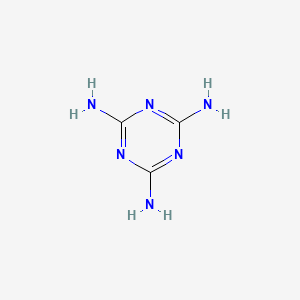
Melamine
Melamine is a trimer of cyanamide, with a 1,3,5-triazine skeleton. It has a role as a xenobiotic metabolite. It is functionally related to a cyanamide. It is a conjugate base of a melamine(1+). — ChEBI
- IUPAC name
- 1,3,5-triazine-2,4,6-triamine
- Molecular formula
- C3H6N6
- Molecular weight
- 126.12 g/mol
- Exact mass
- 126.06539422 Da
- XLogP3
- -1.4
- Topological polar surface area
- 117.0 Ų
- Hydrogen-bond donors
- 3
- Hydrogen-bond acceptors
- 6
- Covalent units
- 1
- Defined stereocentres
- 0
Also known as
16 more reported names
External database identifiers
- ChEBI:CHEBI:27915
- ChEMBL:CHEMBL1231106
- EPA DTXSID:DTXSID6020802
- PubMed:23112709
- PubMed:23101655
- PubMed:23087908
- PubMed:23040986
- PubMed:23037802
- PubMed:23031478
- PubMed:23022775
- PubMed:22986140
- PubMed:22980858
- PubMed:22963836
- PubMed:22953938
- PubMed:22945764
Evidence from additional scientific databases
NIH PubChem PUG-View
Attributed physical-property, hazard, environmental and use annotations.
- Autoignition Temperature: greater than 500 °F (NTP, 1992) Source: CAMEO Chemicals
- Autoignition Temperature: >500 °C Source: ILO-WHO International Chemical Safety Cards (ICSCs)
- Boiling Point: Sublimes (NTP, 1992) Source: CAMEO Chemicals
- Boiling Point: Sublimes Source: Hazardous Substances Data Bank (HSDB)
- Color/Form: Monoclinic prisms Source: Hazardous Substances Data Bank (HSDB)
- Color/Form: Monoclinic colorless prisms or crystals Source: Hazardous Substances Data Bank (HSDB)
- Color/Form: White, monoclinic crystals Source: Hazardous Substances Data Bank (HSDB)
- Density: 1.573 at 61 °F (NTP, 1992) - Denser than water; will sink Source: CAMEO Chemicals
- Density: 1.573 at 14 °C Source: Hazardous Substances Data Bank (HSDB)
- Density: 1574 kg/m³ Source: ILO-WHO International Chemical Safety Cards (ICSCs)
- Density: 1.573 @ 16°C Source: PAC Chemical Database, U.S. Department of Energy
- Dissociation Constants: pKa = 5.0 Source: Hazardous Substances Data Bank (HSDB)
- LogP: log Kow = -1.37 Source: Hazardous Substances Data Bank (HSDB)
- LogP: -1.37 Source: Human Metabolome Database (HMDB)
- LogP: -1.14 Source: ILO-WHO International Chemical Safety Cards (ICSCs)
- Melting Point: 653 °F (decomposes) (NTP, 1992) Source: CAMEO Chemicals
- Melting Point: 354 °C Source: Hazardous Substances Data Bank (HSDB)
- Melting Point: 345 °C Source: Human Metabolome Database (HMDB)
- Melting Point: No melting point; decomposes at >345 °C Source: ILO-WHO International Chemical Safety Cards (ICSCs)
- Physical Description: Melamine appears as colorless to white monoclinic crystals or prisms or white powder. Sublimes when gently heated. (NTP, 1992) Source: CAMEO Chemicals
- Physical Description: Dry Powder; Liquid; Wet Solid; Liquid; Large Crystals; CBI; Dry Powder; Wet Solid Source: EPA Chemical Data Reporting (CDR)
- Physical Description: Colorless to white solid; [ICSC] White powder; [MSDSonline] Source: Haz-Map, Information on Hazardous Chemicals and Occupational Diseases
- Physical Description: Solid Source: Human Metabolome Database (HMDB)
- Physical Description: COLOURLESS-TO-WHITE CRYSTALS. Source: ILO-WHO International Chemical Safety Cards (ICSCs)
- Refractive Index: Index of refraction: 1.872 at 20 degC/D Source: Hazardous Substances Data Bank (HSDB)
- Solubility: less than 1 mg/mL at 72 °F (NTP, 1992) Source: CAMEO Chemicals
- Solubility: Very slightly sol in hot alc; insol in ether Source: Hazardous Substances Data Bank (HSDB)
- Solubility: Sparingly sol in glycol, glycerol, pyridine; very slightly sol in ethanol; insol in benzene, carbon tetrachloride Source: Hazardous Substances Data Bank (HSDB)
- Solubility: In water, 3.23X10+3 mg/L at 20 °C Source: Hazardous Substances Data Bank (HSDB)
- Solubility: 3.24 mg/mL at 20 °C Source: Human Metabolome Database (HMDB)
- Solubility: Solubility in water: poor Source: ILO-WHO International Chemical Safety Cards (ICSCs)
- Vapor Pressure: 50 mmHg at 599 °F (NTP, 1992) Source: CAMEO Chemicals
- Vapor Pressure: VP: 50 mm Hg at 315 °C Source: Hazardous Substances Data Bank (HSDB)
- Vapor Pressure: 3.59X10⁻¹⁰ mm Hg at 20 °C (extrapolated) Source: Hazardous Substances Data Bank (HSDB)
- Vapor Pressure: Vapor pressure, Pa at 20 °C: 6.7 Source: ILO-WHO International Chemical Safety Cards (ICSCs)
- IARC Carcinogenic Agent: Melamine Source: International Agency for Research on Cancer (IARC)
- IARC Carcinogenic Classes: Group 2B: Possibly carcinogenic to humans Source: International Agency for Research on Cancer (IARC)
- IARC Monographs: Volume Sup 7: Overall Evaluations of Carcinogenicity: An Updating of IARC Monographs Volumes 1 to 42, 1987; 440 pages; ISBN 92-832-1411-0 (out of print); Volume 73: (1999) Some Chemicals that Cause Tumours of the Kidney or Urinary Bladder in Rodents and Some Other Substances; Volume 119: (2019) Some Chemicals That Cause Tumours of the Urinary Tract in Rodents Source: International Agency for Research on Cancer (IARC)
- Publication Year: 2019 Source: International Agency for Research on Cancer (IARC)
- Evaluation Year: 2017 Source: International Agency for Research on Cancer (IARC)
- Substance: Melamine Source: NTP Technical Reports
- NTP Technical Report: TR-245: Carcinogenesis Bioassay of Melamine (CASRN 108-78-1) in F344/N Rats and B6C3F1 Mice (Feed Study) (1983 ) Source: NTP Technical Reports
- Peer Review Date: 06/16/82 Source: NTP Technical Reports
- Conclusion for Male Rat: Clear Evidence Source: NTP Technical Reports
- Conclusion for Female Rat: No Evidence Source: NTP Technical Reports
- Conclusion for Male Mice: No Evidence Source: NTP Technical Reports
- Conclusion for Female Mice: No Evidence Source: NTP Technical Reports
- Exposure Routes: Oral (L1775) ; inhalation (L1775) ; dermal (L1775) Source: Toxin and Toxin Target Database (T3DB)
- First Aid: EYES: First check the victim for contact lenses and remove if present. Flush victim's eyes with water or normal saline solution for 20 to 30 minutes while simultaneously calling a hospital or poison control center. Do not put any ointments, oils, or medication in the victim's eyes without specific instructions from a physician. IMMEDIATELY transport the victim after flushing eyes to a hospital even if no symptoms (such as redness or irritation) develop.; SKIN: IMMEDIATELY flood affected skin with water while removing and isolating all contaminated clothing. Gently wash all affected skin areas thoroughly with soap and water. If symptoms such as redness or irritation develop, IMMEDIATELY call a physician and be prepared to transport the victim to a hospital for treatment.; INHALATION: IMMEDIATELY leave the contaminated area; take deep breaths of fresh air. IMMEDIATELY call a physician and be prepared to transport the victim to a hospital even if no symptoms (such as wheezing, coughing, shortness of breath, or burning in the mouth, throat, or chest) develop. Provide proper respiratory protection to rescuers entering an unknown atmosphere. Whenever possible, Self-Contained Breathing Ap Source: CAMEO Chemicals
- Signal: Warning Source: Regulation (EC) No 1272/2008 of the European Parliament and of the Council
- GHS Hazard Statements: H351: Suspected of causing cancer [Warning Carcinogenicity]; H373: May causes damage to organs through prolonged or repeated exposure [Warning Specific target organ toxicity, repeated exposure] Source: Regulation (EC) No 1272/2008 of the European Parliament and of the Council
- Precautionary Statement Codes: P203, P260, P280, P318, P319, P405, and P501 (click each P-code to see the statement) Source: Regulation (EC) No 1272/2008 of the European Parliament and of the Council
- Note: This chemical does not meet GHS hazard criteria for 67.5% (624 of 924) of all reports. Source: European Chemicals Agency (ECHA)
- Signal: Warning Source: European Chemicals Agency (ECHA)
- GHS Hazard Statements: H351 (18.2%): Suspected of causing cancer [Warning Carcinogenicity]; H361 (18.7%): Suspected of damaging fertility or the unborn child [Warning Reproductive toxicity]; H361f (17.1%): Suspected of damaging fertility [Warning Reproductive toxicity]; H373 (18.5%): May causes damage to organs through prolonged or repeated exposure [Warning Specific target organ toxicity, repeated exposure] Source: European Chemicals Agency (ECHA)
- Precautionary Statement Codes: P203, P260, P280, P318, P319, P405, and P501 (click each P-code to see the statement) Source: European Chemicals Agency (ECHA)
- ECHA C&L Notifications Summary: Aggregated GHS information provided per 924 reports by companies from 31 notifications to the ECHA C&L Inventory. Each notification may be associated with multiple companies.; Reported as not meeting GHS hazard criteria per 624 of 924 reports by companies.; There are 28 notifications provided by 300 of 924 reports by companies with hazard statement code(s).; Information may vary between notifications depending on impurities, additives, and other factors. The percentage value in parenthesis indicates the notified classification ratio from companies that provide hazard codes. Only hazard codes with percentage values above 10% are shown. For more detailed information, please visit ECHA C&L website. Source: European Chemicals Agency (ECHA)
- Signal: Warning Source: NITE-CMC
- GHS Hazard Statements: H227: Combustible liquid [Warning Flammable liquids]; H315: Causes skin irritation [Warning Skin corrosion/irritation]; H317: May cause an allergic skin reaction [Warning Sensitization, Skin]; H336: May cause drowsiness or dizziness [Warning Specific target organ toxicity, single exposure; Narcotic effects] Source: NITE-CMC
- Precautionary Statement Codes: P210, P261, P264, P271, P272, P280, P302+P352, P304+P340, P319, P321, P332+P317, P333+P317, P362+P364, P370+P378, P403, P403+P233, P405, and P501 (click each P-code to see the statement) Source: NITE-CMC
- Health Effects: Studies ranging from skin irritation to carcinogenicity are available. Melamine is not genotoxic but it causes carcinomas of the urinary bladder at high doses. Melamine is not irritating to skin and eye, not sensitising and not teratogenic. (L1777) Source: Toxin and Toxin Target Database (T3DB)
- Toxicity Summary: IDENTIFICATION: Melamine is a monoclinic prismatic substance that is slightly soluble in water and ethanol. It is insoluble in diethyl ether. Melamine forms synthetic resins with formaldehyde. It is used in the manufacture of melamine resins, laminates, surface coating resins, plastic molding compounds, textile resins, bonding resins, gypsum melamine resin mixtures, orthopedic casts, rubber additives and paper products. HUMAN EXPOSURE: Occupational exposure to melamine may occur during its production and use in manufacture of synthetic resins with formaldehyde. ANIMAL STUDIES: Melamine was tested for its carcinogenicity by oral diet in mice and rats and for initiating activity by skin application in mice. No neoplasm related to treatment was observed after oral administration in mice. Male rats fed diets containing melamine developed transitional cell tumors in the urinary bladder, with one exception; all tumor bearing animals had bladder stones probably containing melamine. The incidence of urinary bladder hyperplasia associated with toxicity in male mice treated with melamine in the diet was observed. Groups of 20 male Fisher 344 rats, six weeks old were fed diets containing mela Source: Hazardous Substances Data Bank (HSDB)
- Toxicity Summary: Melamine causes carcinomas of the urinary bladder at high doses (in male rats). Formation of bladder stones occurred and these calculi are necessary for the induction of tumours. Carcinomas are induced by continuous irritation of the bladder epithelium by the calculi, so that melamine acts only indirectly as a non-genotoxic carcinogen. (L1777) Source: Toxin and Toxin Target Database (T3DB)
- Environmental Bioconcentration: An estimated BCF of 3 was calculated in fish for melamine(SRC), using a log Kow of -1.37(1) and a regression-derived equation(2). According to a classification scheme(3), this BCF suggests the potential for bioconcentration in aquatic organisms is low(SRC). Source: Hazardous Substances Data Bank (HSDB)
- Environmental Fate: TERRESTRIAL FATE: Based on a classification scheme(1), an estimated Koc value of 5(SRC), determined from a log Kow of -1.37(2) and a regression-derived equation(3), indicates that melamine is expected to have very high mobility in soil(SRC). Volatilization of melamine from moist soil surfaces is not expected to be an important fate process(SRC) given an estimated Henry's Law constant of 1.8X10⁻¹⁴ atm-cu m/mole(SRC), derived from its vapor pressure, 3.59X10⁻¹⁰ mm Hg(4), and water solubility, 3.23 mg/L(5). Melamine is not expected to volatilize from dry soil surfaces(SRC) based upon its vapor pressure(4). No biodegradation using a standard 5-day BOD test(6) suggests that biodegradation may not be an important environmental fate process in soil(SRC). Source: Hazardous Substances Data Bank (HSDB)
- Environmental Fate: AQUATIC FATE: Based on a classification scheme(1), an estimated Koc value of 5(SRC), determined from a log Kow of -1.37(2) and a regression-derived equation(3), indicates that melamine is not expected to adsorb to suspended solids and sediment(SRC). Volatilization from water surfaces is not expected(3) based upon an estimated Henry's Law constant of 1.84X10⁻¹⁴ atm-cu m/mole(SRC), derived from its vapor pressure, 3.59X10⁻¹⁰ mm Hg(4), and water solubility, 3.23X10+3 mg/L(5). According to a classification scheme(6), an estimated BCF of 3(SRC), from its log Kow(2) and a regression-derived equation(7), suggests the potential for bioconcentration in aquatic organisms is(SRC). No biodegradation using a standard 5-day BOD test was observed(8), suggesting that biodegradation may not be an important environmental fate process in water(SRC). Source: Hazardous Substances Data Bank (HSDB)
- Environmental Fate: ATMOSPHERIC FATE: According to a model of gas/particle partitioning of semivolatile organic compounds in the atmosphere(1), melamine, which has a vapor pressure of 3.59X10⁻¹⁰ mm Hg at 20 °C(2), is expected to exist solely in the particulate phase in the ambient atmosphere. Particulate-phase melamine may be removed from the air by wet or dry deposition(SRC). Source: Hazardous Substances Data Bank (HSDB)
- Consumer Uses: Filler; Not Known or Reasonably Ascertainable; Sealant (barrier); Flame retardant; Surface modifier; Hardener; Pigment; Adhesion/cohesion promoter; Other; Binder Source: EPA Chemical Data Reporting (CDR)
- Industry Uses: Flame retardant; Sealant (barrier); Stabilizing agent; Filler; Not Known or Reasonably Ascertainable; Hardener; Pigment; Adhesion/cohesion promoter; Intermediate; Other; Processing aids not otherwise specified; Surfactant (surface active agent) Source: EPA Chemical Data Reporting (CDR)
- Sources/Uses: Used as a co-monomer with formaldehyde to make high pressure laminate resins, molding compounds and surface coating resins, textile and paper treating resins, adhesive resins for gluing lumber, plywood, and flooring; Also used as a flame retardant additive for polypropylene and polyethylene, a leather tanning agent, a rust remover, a metal surface cleaner, an etching agent in the semiconductor industry, and a reagent in numerous fluorination processes; [HSDB] Source: Haz-Map, Information on Hazardous Chemicals and Occupational Diseases
- Industrial Processes with risk of exposure: Metal Degreasing [Category: Clean]; Semiconductor Manufacturing [Category: Industry]; Pulp and Paper Processing [Category: Industry]; Textiles (Fiber & Fabric Manufacturing) [Category: Industry]; Painting (Pigments, Binders, and Biocides) [Category: Paint]; Working with Glues and Adhesives [Category: Other]; Plastic Composites Manufacturing [Category: Industry]; Leather Tanning and Processing [Category: Industry] Source: Haz-Map, Information on Hazardous Chemicals and Occupational Diseases
- Uses: Melamine, melamine cyanurate, other melamine salts and guanidine compounds are currently the most used group of nitrogen-containing flame retardants. Melamine is used as a flame retardant additive for polypropylene and polyethylene. Melamine cyanurate is employed commercially as a flame retardant for polyamides and terephthalates (PET/PBT) and is being developed for use in epoxy and polyurethane resins. Melamine phosphate is also used as a flame retardant for terephthalates (PET/PBT) and is currently being developed for use in epoxy and polyurethane flame retardant formulations. Also in the development stages for use as flame-retardant additives are melamine salts and melamine formaldehyde for their application in thermoset resins. Source: Hazardous Substances Data Bank (HSDB)
- Uses: Melamine resins, organic syntheses, leather tanning. Source: Hazardous Substances Data Bank (HSDB)
- Uses: TO MAKE HIGH PRESSURE LAMINATE RESINS, MOLDING COMPOUNDS & SURFACE COATING RESINS, TEXTILE & PAPER TREATING RESINS, ADHESIVE RESINS FOR GLUING LUMBER, PLYWOOD, & FLOORING Source: Hazardous Substances Data Bank (HSDB)
- Uses: COMONOMER WITH FORMALDEHYDE FOR AMINO RESIN PRODN Source: Hazardous Substances Data Bank (HSDB)
- Uses: For more Uses (Complete) data for MELAMINE (6 total), please visit the HSDB record page. Source: Hazardous Substances Data Bank (HSDB)
- Uses: Plastics -> Typical concentration range in plastic materials -> 25% Source: NORMAN Suspect List Exchange
- Uses: Melamine has many industrial uses, including the production of laminates, glues, adhesives, moulding compounds, coatings and flame retardants. It is also used in some fertilizers and in the production of melamine resins, typically by reaction with formaldehyde. Melamine is a metabolite of the pesticide cyromazine in plants, goats, hens and rats. (L1775) (L1778) Source: Toxin and Toxin Target Database (T3DB)
Mapped by: Existing checksum-valid CAS to unique PubChem CID match. Retrieved: 2026-08-31. Open source record
Scientific classifications and hazard annotations provide context and do not replace the market-specific regulatory decision shown above.
Additional source coverage and match status
| Source | Result | Checked |
|---|---|---|
| NIH PubChem PUG-View | Exact match | 2026-08-31 |
A recorded no-match is useful evidence that the source was checked; it is not a claim that the substance does not exist elsewhere.
Retrieved from NIH PubChem on 2026-09-02 by checksum-valid CAS matching. Chemical properties do not replace the regulatory decision on this page.