
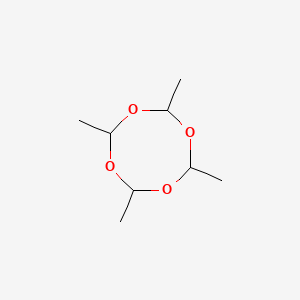
Metaldehyde
Metaldehyde is a white-colored crystalline solid. It is insoluble in water. It is highly flammable and when ignited will give off irritating fumes. It may be toxic by ingestion and is very irritating to skin and eyes. It is used to make other chemicals. — CAMEO Chemicals
- IUPAC name
- 2,4,6,8-tetramethyl-1,3,5,7-tetraoxocane
- Molecular formula
- C8H16O4
- Molecular weight
- 176.21 g/mol
- Exact mass
- 176.10485899 Da
- XLogP3
- 1.1
- Topological polar surface area
- 36.9 Ų
- Hydrogen-bond donors
- 0
- Hydrogen-bond acceptors
- 4
- Covalent units
- 1
- Defined stereocentres
- 0
Also known as
16 more reported names
External database identifiers
- ChEBI:CHEBI:81931
- ChEMBL:CHEMBL2251334
- EPA DTXSID:DTXSID1034715
- PubMed:22901408
- PubMed:22859414
- PubMed:22474571
- PubMed:22471218
- PubMed:22322291
- PubMed:22272399
- PubMed:22215313
- PubMed:22164375
- PubMed:22069667
- PubMed:21965242
- PubMed:21852306
- PubMed:21843803
Evidence from additional scientific databases
NIH PubChem PUG-View
Attributed physical-property, hazard, environmental and use annotations.
- Boiling Point: 115 °C (sublimes) Source: Hazardous Substances Data Bank (HSDB)
- Color/Form: Crystalline powder Source: Hazardous Substances Data Bank (HSDB)
- Color/Form: Crystals Source: Hazardous Substances Data Bank (HSDB)
- Density: 1.27 at 20 °C Source: Hazardous Substances Data Bank (HSDB)
- Flash Point: 97 °F (36 °C) (closed cup) Source: Hazardous Substances Data Bank (HSDB)
- LogP: log Kow = 0.12 Source: Hazardous Substances Data Bank (HSDB)
- Melting Point: 246.2 °C (closed capillary) Source: Hazardous Substances Data Bank (HSDB)
- Odor: Menthol odor Source: Hazardous Substances Data Bank (HSDB)
- Physical Description: Metaldehyde is a white-colored crystalline solid. It is insoluble in water. It is highly flammable and when ignited will give off irritating fumes. It may be toxic by ingestion and is very irritating to skin and eyes. It is used to make other chemicals. Source: CAMEO Chemicals
- Physical Description: Solid; [IUCLID] Formulated as granules, pellets, mini-pellets, meal, paste, and liquid; [Reference #1] Colorless or white solid; [Reference #2] White odorless powder; [Alfa Aesar MSDS] Source: Haz-Map, Information on Hazardous Chemicals and Occupational Diseases
- Solubility: In water, 200 mg/L at 17 °C /Polymer/ Source: Hazardous Substances Data Bank (HSDB)
- Solubility: Moderately soluble in water, fairly soluble in toluene, readily soluble in methanol, very soluble in benzene and chloroform, insoluble in acetic acid, and slightly soluble in ethanol. Source: Hazardous Substances Data Bank (HSDB)
- Solubility: Insoluble in water, acetone, acetic acid, and carbon disulfide. Source: Hazardous Substances Data Bank (HSDB)
- Solubility: In toluene 530 mg/L at 20 °C, in methanol 1730 mg/L at 20 °C Source: Hazardous Substances Data Bank (HSDB)
- Solubility: In water, 222 mg/L at 20 °C Source: Hazardous Substances Data Bank (HSDB)
- Vapor Pressure: Vapor pressure is negligible at room temperature. Source: Hazardous Substances Data Bank (HSDB)
- Vapor Pressure: 6.6X10+3 mPa (5.0X10⁻² mm Hg) at 25 °C Source: Hazardous Substances Data Bank (HSDB)
- Carcinogen Classification: No indication of carcinogenicity to humans (not listed by IARC). Source: Toxin and Toxin Target Database (T3DB)
- Exposure Routes: Oral (L1782) ; inhalation (L1782) ; dermal (L1782) Source: Toxin and Toxin Target Database (T3DB)
- First Aid: Excerpt from ERG Guide 133 [Flammable Solids]:; Refer to the "General First Aid" section. Specific First Aid: Removal of solidified molten material from skin requires medical assistance. (ERG, 2024) Source: CAMEO Chemicals
- ERG2024, Guide 133 (Metaldehyde): General First Aid:; · Call 911 or emergency medical service.; · Ensure that medical personnel are aware of the material(s) involved, take precautions to protect themselves and avoid contamination.; · Move victim to fresh air if it can be done safely.; · Administer oxygen if breathing is difficult.; · If victim is not breathing:; -- DO NOT perform mouth-to-mouth resuscitation; the victim may have ingested or inhaled the substance.; -- If equipped and pulse detected, wash face and mouth, then give artificial respiration using a proper respiratory medical device (bag-valve mask, pocket mask equipped with a one-way valve or other device).; -- If no pulse detected or no respiratory medical device available, provide continuous compressions. Conduct a pulse check every two minutes or monitor for any signs of spontaneous respirations.; · Remove and isolate contaminated clothing and shoes.; · For minor skin contact, avoid spreading material on unaffected skin.; · In case of contact with substance, remove immediately by flushing skin or eyes with running water for at least 20 minutes.; · For severe burns, immediate medical attention is required.; · Effects of exposure (inhalation, ingestion, Source: Emergency Response Guidebook (ERG)
- Signal: Danger Source: Regulation (EC) No 1272/2008 of the European Parliament and of the Council
- GHS Hazard Statements: H228: Flammable solid [Danger Flammable solids]; H301: Toxic if swallowed [Danger Acute toxicity, oral]; H361f: Suspected of damaging fertility [Warning Reproductive toxicity]; H412: Harmful to aquatic life with long lasting effects [Hazardous to the aquatic environment, long-term hazard] Source: Regulation (EC) No 1272/2008 of the European Parliament and of the Council
- Precautionary Statement Codes: P203, P210, P240, P241, P264, P270, P273, P280, P301+P316, P318, P321, P330, P370+P378, P405, and P501 (click each P-code to see the statement) Source: Regulation (EC) No 1272/2008 of the European Parliament and of the Council
- Signal: Danger Source: European Chemicals Agency (ECHA)
- GHS Hazard Statements: H228 (100%): Flammable solid [Danger Flammable solids]; H301 (77.2%): Toxic if swallowed [Danger Acute toxicity, oral]; H312 (17.2%): Harmful in contact with skin [Warning Acute toxicity, dermal]; H361 (11.9%): Suspected of damaging fertility or the unborn child [Warning Reproductive toxicity]; H361f (44%): Suspected of damaging fertility [Warning Reproductive toxicity]; H412 (68.2%): Harmful to aquatic life with long lasting effects [Hazardous to the aquatic environment, long-term hazard] Source: European Chemicals Agency (ECHA)
- Precautionary Statement Codes: P203, P210, P240, P241, P264, P270, P273, P280, P301+P316, P302+P352, P317, P318, P321, P330, P362+P364, P370+P378, P405, and P501 (click each P-code to see the statement) Source: European Chemicals Agency (ECHA)
- ECHA C&L Notifications Summary: Aggregated GHS information provided per 302 reports by companies from 13 notifications to the ECHA C&L Inventory. Each notification may be associated with multiple companies.; Information may vary between notifications depending on impurities, additives, and other factors. The percentage value in parenthesis indicates the notified classification ratio from companies that provide hazard codes. Only hazard codes with percentage values above 10% are shown. For more detailed information, please visit ECHA C&L website. Source: European Chemicals Agency (ECHA)
- GHS Hazard Statements: Not Classified Source: NITE-CMC
- Signal: Danger Source: NITE-CMC
- GHS Hazard Statements: H228: Flammable solid [Danger Flammable solids]; H301: Toxic if swallowed [Danger Acute toxicity, oral]; H320: Causes eye irritation [Warning Serious eye damage/eye irritation]; H370: Causes damage to organs [Danger Specific target organ toxicity, single exposure]; H373: May causes damage to organs through prolonged or repeated exposure [Warning Specific target organ toxicity, repeated exposure] Source: NITE-CMC
- Precautionary Statement Codes: P210, P240, P241, P260, P264, P264+P265, P270, P280, P301+P316, P305+P351+P338, P308+P316, P319, P321, P330, P337+P317, P370+P378, P405, and P501 (click each P-code to see the statement) Source: NITE-CMC
- Signal: Danger Source: Hazardous Chemical Information System (HCIS), Safe Work Australia
- Health Effects: Metaldehyde intoxicatin leads to central nervous system depression, and liver and kidney injury. Death from respiratory failure can occur within a few hours of exposure. (L1787) Source: Toxin and Toxin Target Database (T3DB)
- NFPA Health Rating: 3 - Materials that, under emergency conditions, can cause serious or permanent injury. Source: Hazardous Substances Data Bank (HSDB)
- NFPA Fire Rating: 3 - Liquids and solids that can be ignited under almost all ambient temperature conditions. Materials produce hazardous atmospheres with air under almost all ambient temperatures or, though unaffected by ambient temperatures, are readily ignited under almost all conditions. Source: Hazardous Substances Data Bank (HSDB)
- NFPA Instability Rating: 1 - Materials that in themselves are normally stable but that can become unstable at elevated temperatures and pressures. Source: Hazardous Substances Data Bank (HSDB)
- Toxicity Summary: The toxicologically active substance in metaldehyde intoxication is mainly the degradation product acetaldehyde; other toxic products are probably also formed. Acetaldehyde acts as a releasing factor for 5-hydroxytryptamine (5-HT) and noradrenaline (NA). It also competitively inhibits biogenic amine oxidation which, in turn, decreases 5-hydroxyindoleacetic acid (5-HIAA), a metabolite of 5-HT by competitively inhibiting 5-HT-oxidation. Acetaldehyde also increases monoamine oxidase activity and decreases central serotonin levels. (L1782) Source: Toxin and Toxin Target Database (T3DB)
- Environmental Bioconcentration: An estimated BCF of 3.2 was calculated for metaldehyde(SRC), using a log Kow of 0.12(1) and a regression-derived equation(2). According to a classification scheme(3), this BCF suggests the potential for bioconcentration in aquatic organisms is low(SRC). Source: Hazardous Substances Data Bank (HSDB)
- Environmental Fate: TERRESTRIAL FATE: Based on a classification scheme(1), a measured Koc value of 240(2) indicates that metaldehyde is expected to have moderate mobility in soil(SRC). Volatilization of metaldehyde from moist soil surfaces is expected to be an important fate process(SRC) given an estimated Henry's Law constant of 5.2X10⁻⁵ atm-cu m/mole(SRC), derived from its vapor pressure, 5.0X10⁻² mm Hg(2), and water solubility, 2.22X10+2 mg/L(2). Metaldehyde is not expected to volatilize from dry soil surfaces(SRC) based upon its vapor pressure(2). The results of a laboratory volatility study suggest that volatilization losses from soil surfaces will be minor(3). In a field study, 6% metaldehyde pellets were broadcast at the rate of 4 kg product/ha in a rice paddy ecosystem(4). Paddy soil samples collected 3 to 14 days after application had metaldehyde residue concentrations ranging from 0.053 to 0.127 mg/kg, reaching a peak at 0.127 mg/kg 14 days after application(4). Metaldehyde residue was below the minimum detection limit of 0.016 mg/kg 22 days after application(4). A reported half-life of approximately 2 months for metaldehyde in soil(3) suggests that biodegradation is not an important environ Source: Hazardous Substances Data Bank (HSDB)
- Environmental Fate: AQUATIC FATE: Based on a classification scheme(1), a measured Koc value of 240(2) indicates that metaldehyde is not expected to adsorb to suspended solids and sediment(SRC). Volatilization from water surfaces is expected(3) based upon an estimated Henry's Law constant of 5.2X10⁻⁵ atm-cu m/mole(SRC), derived from its vapor pressure, 5.0X10⁻² mm Hg(2), and water solubility, 2.22X10+2 mg/L(2). Using this Henry's Law constant and an estimation method(3), volatilization half-lives for a model river and model lake are 26 hours and 12 days, respectively(SRC). In a field study, 6% metaldehyde pellets were broadcast at the rate of 4 kg product/ha in a rice paddy ecosystem(4). Paddy water samples collected 1 to 3 days after application had metaldehyde residue concentrations of 1.58 to 1.47 mg/L(4). Residues could be detected only up to 9 days after application, with its degradation pattern following pseudo first-order kinetics showing a half-life of 0.27 days(4). According to a classification scheme(5), an estimated BCF of 3.2(SRC), from its log Kow(2) and a regression-derived equation(6), suggests the potential for bioconcentration in aquatic organisms is low. Utilizing the Japanese MITI te Source: Hazardous Substances Data Bank (HSDB)
- Environmental Fate: ATMOSPHERIC FATE: According to a model of gas/particle partitioning of semivolatile organic compounds in the atmosphere(1), metaldehyde, which has a vapor pressure of 5.0X10⁻² mm Hg at 25 °C(2), is expected to exist solely as a vapor in the ambient atmosphere. Vapor-phase metaldehyde is degraded in the atmosphere by reaction with photochemically-produced hydroxyl radicals(SRC); the half-life for this reaction in air is estimated to be 13 hours(SRC), calculated from its rate constant of 2.9X10⁻¹¹ cu cm/molecule-sec at 25 °C(SRC) that was derived using a structure estimation method(3). Metaldehyde does not contain chromophores that absorb at wavelengths >290 nm(4) and therefore is not expected to be susceptible to direct photolysis by sunlight(SRC). Source: Hazardous Substances Data Bank (HSDB)
- Sources/Uses: Used for control of snails in seed crops, turf, ornamentals, berries, citrus, vegetables, and other crops; [Reference #1] Used for synthesis in the chemical industry, as odor agent, and as pesticide; [IUCLID] Used as molluscicide, solid fuel for small heaters (alcohol replacement), and fire starter; [Reference #2] Source: Haz-Map, Information on Hazardous Chemicals and Occupational Diseases
- Industrial Processes with risk of exposure: Farming (Pesticides) [Category: Industry] Source: Haz-Map, Information on Hazardous Chemicals and Occupational Diseases
- Uses: For metaldehyde (USEPA/OPP Pesticide Code: 053001) ACTIVE products with label matches. /SRP: Registered for use in the U.S. but approved pesticide uses may change periodically and so federal, state and local authorities must be consulted for currently approved uses./ Source: Hazardous Substances Data Bank (HSDB)
- Uses: Metaldehyde is a molluscicide used to control snails and slugs on a wide variety of sites, including turf, ornamentals, berries, citrus, and vegetables. Source: Hazardous Substances Data Bank (HSDB)
- Uses: In compressed form as a fuel instead of alcohol; molluscicide. /Polymer/ Source: Hazardous Substances Data Bank (HSDB)
- Uses: Metaldehyde is used as a pesticide against slugs, snails, and other gastropods, it is also used in tablets as a solid fuel for small heaters, and as fire-starter. (L1782) Source: Toxin and Toxin Target Database (T3DB)
Mapped by: Existing checksum-valid CAS to unique PubChem CID match. Retrieved: 2026-08-31. Open source record
Scientific classifications and hazard annotations provide context and do not replace the market-specific regulatory decision shown above.
Additional source coverage and match status
| Source | Result | Checked |
|---|---|---|
| NIH PubChem PUG-View | Exact match | 2026-08-31 |
A recorded no-match is useful evidence that the source was checked; it is not a claim that the substance does not exist elsewhere.
Retrieved from NIH PubChem on 2026-09-02 by checksum-valid CAS matching. Chemical properties do not replace the regulatory decision on this page.