
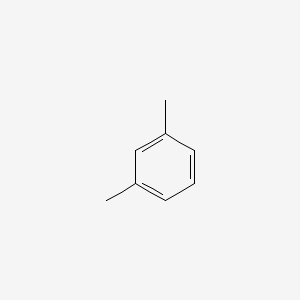
CAS 108-38-3PubChem CID 7929
M-Xylene
M-xylene is a xylene carrying methyl groups at positions 1 and 3. — ChEBI
- IUPAC name
- 1,3-xylene
- Molecular formula
- C8H10
- Molecular weight
- 106.16 g/mol
- Exact mass
- 106.078250319 Da
- XLogP3
- 3.2
- Topological polar surface area
- 0.0 Ų
- Hydrogen-bond donors
- 0
- Hydrogen-bond acceptors
- 0
- Covalent units
- 1
- Defined stereocentres
- 0
Also known as
1,3-Dimethylbenzenemeta-Xylenem-Dimethylbenzenem-Xylolm-MethyltolueneBenzene, 1,3-dimethyl-3-Xylene1,3-Dimethylbenzol
16 more reported names
O9XS864HTENSC-61769CHEBI:28488RefChem:83203-576-3m-Xylenes2,4-XyleneNSC 61769M-XYLENE-ALPHA,ALPHA'-13C2Xylene, m-Benzene, m-dimethyl-CAS-108-38-3CCRIS 907HSDB 135EINECS 203-576-3UNII-O9XS864HTE
External database identifiers
- ChEBI:CHEBI:28488
- ChEMBL:CHEMBL286727
- EPA DTXSID:DTXSID6026298
- PubMed:40619073
- PubMed:33269480
- PubMed:25051312
- PubMed:23112641
- PubMed:23084275
- PubMed:23071444
- PubMed:22939158
- PubMed:22924985
- PubMed:22845424
- PubMed:22807736
- PubMed:22783623
- PubMed:22719759
Evidence from additional scientific databases
NIH PubChem PUG-View
Exact identifier match7929
Attributed physical-property, hazard, environmental and use annotations.
- Autoignition Temperature: 982 °F (USCG, 1999) Source: CAMEO Chemicals
- Autoignition Temperature: 982 °F (527 °C) Source: Hazardous Substances Data Bank (HSDB)
- Autoignition Temperature: 540 °C Source: ILO-WHO International Chemical Safety Cards (ICSCs)
- Boiling Point: 282.4 °F at 760 mmHg (NTP, 1992) Source: CAMEO Chemicals
- Boiling Point: 139.1 °C Source: Hazardous Substances Data Bank (HSDB)
- Boiling Point: p-Xylene and m-xylene cannot be separated by distillation because their boiling points are too close. Source: Hazardous Substances Data Bank (HSDB)
- Boiling Point: 139 °C Source: ILO-WHO International Chemical Safety Cards (ICSCs)
- Boiling Point: 139.07 °C @760 [mm Hg] Source: PAC Chemical Database, U.S. Department of Energy
- Boiling Point: 282 °F Source: The National Institute for Occupational Safety and Health (NIOSH)
- Color/Form: Clear, colorless liquid Source: Hazardous Substances Data Bank (HSDB)
- Color/Form: Color: Saybolt units +30 (research, pure and technical grades) Source: Hazardous Substances Data Bank (HSDB)
- Density: 0.864 at 68 °F (USCG, 1999) - Less dense than water; will float Source: CAMEO Chemicals
- Density: 0.8698 g/cu cm at 25 °C Source: Hazardous Substances Data Bank (HSDB)
- Density: Critical density: 2.66 mmol/cu m; Critical volume: 376.0 cu m/mol Source: Hazardous Substances Data Bank (HSDB)
- Density: Relative density (water = 1): 0.86 (20 °C) Source: ILO-WHO International Chemical Safety Cards (ICSCs)
- Density: 0.8598 @25 °C Source: PAC Chemical Database, U.S. Department of Energy
- Density: 0.86 Source: The National Institute for Occupational Safety and Health (NIOSH)
- Flash Point: 85 °F (NTP, 1992) Source: CAMEO Chemicals
- Flash Point: 25.0 °C (77.0 °F) - closed cup Source: Hazardous Substances Data Bank (HSDB)
- Flash Point: 77 °F (25 °C) (closed cup) Source: Hazardous Substances Data Bank (HSDB)
- Flash Point: 25 °C c.c. Source: ILO-WHO International Chemical Safety Cards (ICSCs)
- Flash Point: 82 °F Source: The National Institute for Occupational Safety and Health (NIOSH)
- LogP: log Kow = 3.20 Source: Hazardous Substances Data Bank (HSDB)
- LogP: 3.20 Source: ILO-WHO International Chemical Safety Cards (ICSCs)
- Melting Point: -54.2 °F (NTP, 1992) Source: CAMEO Chemicals
- Melting Point: -47.85 °C Source: Hazardous Substances Data Bank (HSDB)
- Melting Point: -48 °C Source: ILO-WHO International Chemical Safety Cards (ICSCs)
- Melting Point: -47.8 °C Source: PAC Chemical Database, U.S. Department of Energy
- Melting Point: -54 °F Source: The National Institute for Occupational Safety and Health (NIOSH)
- Odor: Sweet odor Source: Hazardous Substances Data Bank (HSDB)
- Odor: Aromatic odor Source: Hazardous Substances Data Bank (HSDB)
- Physical Description: M-xylene appears as a colorless watery liquid with a sweet odor. Less dense than water. Insoluble in water. Irritating vapor. (USCG, 1999) Source: CAMEO Chemicals
- Physical Description: Liquid Source: EPA Chemical Data Reporting (CDR)
- Physical Description: Colorless liquid; [Merck Index] Sweet odor; [CHRIS] Source: Haz-Map, Information on Hazardous Chemicals and Occupational Diseases
- Physical Description: COLOURLESS LIQUID WITH CHARACTERISTIC ODOUR. Source: ILO-WHO International Chemical Safety Cards (ICSCs)
- Physical Description: Colorless liquid with an aromatic odor. Source: The National Institute for Occupational Safety and Health (NIOSH)
- Refractive Index: Index of refraction: 1.4973 at 20 °C/D Source: Hazardous Substances Data Bank (HSDB)
- Solubility: Insoluble (NTP, 1992) Source: CAMEO Chemicals
- Solubility: In water, 1.61X10+2 mg/L at 25 °C. Source: Hazardous Substances Data Bank (HSDB)
- Solubility: In water, 160 mg/L at 25 °C (average of 13 literature values ranging from 134-206 mg/L at 25 °C) Source: Hazardous Substances Data Bank (HSDB)
- Solubility: Miscible with acetone, alcohol, ether, benzene; soluble in chloroform Source: Hazardous Substances Data Bank (HSDB)
- Solubility: Solubility in water, g/l at 25 °C: 0.174 (very slightly soluble) Source: ILO-WHO International Chemical Safety Cards (ICSCs)
- Solubility: Slight Source: The National Institute for Occupational Safety and Health (NIOSH)
- Vapor Pressure: 10 mmHg at 82.9 °F (NTP, 1992) Source: CAMEO Chemicals
- Vapor Pressure: 8.29 [mmHg] Source: Haz-Map, Information on Hazardous Chemicals and Occupational Diseases
- Vapor Pressure: 8.29 mm Hg at 25 °C Source: Hazardous Substances Data Bank (HSDB)
- Vapor Pressure: Vapor pressure, kPa at 20 °C: 0.8 Source: ILO-WHO International Chemical Safety Cards (ICSCs)
- Vapor Pressure: 7.5 [mm Hg] @23.4 °C Source: PAC Chemical Database, U.S. Department of Energy
- Vapor Pressure: 9 mmHg Source: The National Institute for Occupational Safety and Health (NIOSH)
- Viscosity: 0.581 mPa.s at 25 °C Source: Hazardous Substances Data Bank (HSDB)
- Viscosity: 0.58 mPa*s at 25 °C Source: ILO-WHO International Chemical Safety Cards (ICSCs)
- Carcinogen Classification: 3, not classifiable as to its carcinogenicity to humans. (L135) Source: Toxin and Toxin Target Database (T3DB)
- Exposure Routes: The substance can be absorbed into the body by inhalation, through the skin and by ingestion. Source: ILO-WHO International Chemical Safety Cards (ICSCs)
- Exposure Routes: inhalation, skin absorption, ingestion, skin and/or eye contact Source: The National Institute for Occupational Safety and Health (NIOSH)
- Exposure Routes: Oral (L165) ; inhalation (L165) ; dermal (L165) Source: Toxin and Toxin Target Database (T3DB)
- First Aid: EYES: First check the victim for contact lenses and remove if present. Flush victim's eyes with water or normal saline solution for 20 to 30 minutes while simultaneously calling a hospital or poison control center. Do not put any ointments, oils, or medication in the victim's eyes without specific instructions from a physician. IMMEDIATELY transport the victim after flushing eyes to a hospital even if no symptoms (such as redness or irritation) develop.; SKIN: IMMEDIATELY flood affected skin with water while removing and isolating all contaminated clothing. Gently wash all affected skin areas thoroughly with soap and water. If symptoms such as redness or irritation develop, IMMEDIATELY call a physician and be prepared to transport the victim to a hospital for treatment.; INHALATION: IMMEDIATELY leave the contaminated area; take deep breaths of fresh air. If symptoms (such as wheezing, coughing, shortness of breath, or burning in the mouth, throat, or chest) develop, call a physician and be prepared to transport the victim to a hospital. Provide proper respiratory protection to rescuers entering an unknown atmosphere. Whenever possible, Self-Contained Breathing Apparatus (SCBA) shou Source: CAMEO Chemicals
- First Aid: (General first aid procedures); Eye: Irrigate immediately - If this chemical contacts the eyes, immediately wash (irrigate) the eyes with large amounts of water, occasionally lifting the lower and upper lids. Get medical attention immediately.; Skin: Soap wash promptly - If this chemical contacts the skin, promptly wash the contaminated skin with soap and water. If this chemical penetrates the clothing, promptly remove the clothing and wash the skin with soap and water. Get medical attention promptly.; Breathing: Respiratory support; Swallow: Medical attention immediately - If this chemical has been swallowed, get medical attention immediately. Source: The National Institute for Occupational Safety and Health (NIOSH)
- Signal: Warning Source: Regulation (EC) No 1272/2008 of the European Parliament and of the Council
- GHS Hazard Statements: H226: Flammable liquid and vapor [Warning Flammable liquids]; H312: Harmful in contact with skin [Warning Acute toxicity, dermal]; H315: Causes skin irritation [Warning Skin corrosion/irritation]; H332: Harmful if inhaled [Warning Acute toxicity, inhalation] Source: Regulation (EC) No 1272/2008 of the European Parliament and of the Council
- Precautionary Statement Codes: P210, P233, P240, P241, P242, P243, P261, P264, P271, P280, P302+P352, P303+P361+P353, P304+P340, P317, P321, P332+P317, P362+P364, P370+P378, P403+P235, and P501 (click each P-code to see the statement) Source: Regulation (EC) No 1272/2008 of the European Parliament and of the Council
- Note: This chemical does not meet GHS hazard criteria for 0.8% (11 of 1386) of reports. Source: European Chemicals Agency (ECHA)
- Signal: Danger Source: European Chemicals Agency (ECHA)
- GHS Hazard Statements: H226 (99.2%): Flammable liquid and vapor [Warning Flammable liquids]; H304 (41.8%): May be fatal if swallowed and enters airways [Danger Aspiration hazard]; H312+H332 (37.2%): Harmful in contact with skin or if inhaled [Warning Acute toxicity, dermal; acute toxicity, inhalation]; H312 (98.7%): Harmful in contact with skin [Warning Acute toxicity, dermal]; H315 (99.2%): Causes skin irritation [Warning Skin corrosion/irritation]; H318 (31.8%): Causes serious eye damage [Danger Serious eye damage/eye irritation]; H319 (10.5%): Causes serious eye irritation [Warning Serious eye damage/eye irritation]; H332 (98.7%): Harmful if inhaled [Warning Acute toxicity, inhalation]; H335 (10.4%): May cause respiratory irritation [Warning Specific target organ toxicity, single exposure; Respiratory tract irritation] Source: European Chemicals Agency (ECHA)
- Precautionary Statement Codes: P210, P233, P240, P241, P242, P243, P261, P264, P264+P265, P271, P280, P301+P316, P302+P352, P303+P361+P353, P304+P340, P305+P351+P338, P305+P354+P338, P317, P319, P321, P331, P332+P317, P337+P317, P362+P364, P370+P378, P403+P233, P403+P235, P405, and P501 (click each P-code to see the statement) Source: European Chemicals Agency (ECHA)
- ECHA C&L Notifications Summary: Aggregated GHS information provided per 1386 reports by companies from 24 notifications to the ECHA C&L Inventory. Each notification may be associated with multiple companies.; Reported as not meeting GHS hazard criteria per 11 of 1386 reports by companies.; There are 23 notifications provided by 1375 of 1386 reports by companies with hazard statement code(s).; Information may vary between notifications depending on impurities, additives, and other factors. The percentage value in parenthesis indicates the notified classification ratio from companies that provide hazard codes. Only hazard codes with percentage values above 10% are shown. For more detailed information, please visit ECHA C&L website. Source: European Chemicals Agency (ECHA)
- Signal: Danger Source: NITE-CMC
- GHS Hazard Statements: H226: Flammable liquid and vapor [Warning Flammable liquids]; H304: May be fatal if swallowed and enters airways [Danger Aspiration hazard]; H315: Causes skin irritation [Warning Skin corrosion/irritation]; H319: Causes serious eye irritation [Warning Serious eye damage/eye irritation]; H332: Harmful if inhaled [Warning Acute toxicity, inhalation]; H336: May cause drowsiness or dizziness [Warning Specific target organ toxicity, single exposure; Narcotic effects]; H370: Causes damage to organs [Danger Specific target organ toxicity, single exposure]; H372: Causes damage to organs through prolonged or repeated exposure [Danger Specific target organ toxicity, repeated exposure]; H401: Toxic to aquatic life [Hazardous to the aquatic environment, acute hazard]; H412: Harmful to aquatic life with long lasting effects [Hazardous to the aquatic environment, long-term hazard] Source: NITE-CMC
- Precautionary Statement Codes: P210, P233, P240, P241, P242, P243, P260, P261, P264, P264+P265, P270, P271, P273, P280, P301+P316, P302+P352, P303+P361+P353, P304+P340, P305+P351+P338, P308+P316, P317, P319, P321, P331, P332+P317, P337+P317, P362+P364, P370+P378, P403+P233, P403+P235, P405, and P501 (click each P-code to see the statement) Source: NITE-CMC
- GHS Hazard Statements: H226: Flammable liquid and vapor [Warning Flammable liquids]; H304: May be fatal if swallowed and enters airways [Danger Aspiration hazard]; H315: Causes skin irritation [Warning Skin corrosion/irritation]; H319: Causes serious eye irritation [Warning Serious eye damage/eye irritation]; H336: May cause drowsiness or dizziness [Warning Specific target organ toxicity, single exposure; Narcotic effects]; H361: Suspected of damaging fertility or the unborn child [Warning Reproductive toxicity]; H372: Causes damage to organs through prolonged or repeated exposure [Danger Specific target organ toxicity, repeated exposure] Source: NITE-CMC
- Health Effects: Acute exposure to cholinesterase inhibitors can cause a cholinergic crisis characterized by severe nausea/vomiting, salivation, sweating, bradycardia, hypotension, collapse, and convulsions. Increasing muscle weakness is a possibility and may result in death if respiratory muscles are involved. Accumulation of ACh at motor nerves causes overstimulation of nicotinic expression at the neuromuscular junction. When this occurs symptoms such as muscle weakness, fatigue, muscle cramps, fasciculation, and paralysis can be seen. When there is an accumulation of ACh at autonomic ganglia this causes overstimulation of nicotinic expression in the sympathetic system. Symptoms associated with this are hypertension, and hypoglycemia. Overstimulation of nicotinic acetylcholine receptors in the central nervous system, due to accumulation of ACh, results in anxiety, headache, convulsions, ataxia, depression of respiration and circulation, tremor, general weakness, and potentially coma. When there is expression of muscarinic overstimulation due to excess acetylcholine at muscarinic acetylcholine receptors symptoms of visual disturbances, tightness in chest, wheezing due to bronchoconstriction, incre Source: Toxin and Toxin Target Database (T3DB)
- NFPA Health Rating: 2 - Materials that, under emergency conditions, can cause temporary incapacitation or residual injury. Source: Hazardous Substances Data Bank (HSDB)
- NFPA Fire Rating: 3 - Liquids and solids that can be ignited under almost all ambient temperature conditions. Materials produce hazardous atmospheres with air under almost all ambient temperatures or, though unaffected by ambient temperatures, are readily ignited under almost all conditions. Source: Hazardous Substances Data Bank (HSDB)
- NFPA Instability Rating: 0 - Materials that in themselves are normally stable, even under fire conditions. Source: Hazardous Substances Data Bank (HSDB)
- Target Organs: Eyes, skin, respiratory system, central nervous system, gastrointestinal tract, blood, liver, kidneys Source: The National Institute for Occupational Safety and Health (NIOSH)
- Toxicity Summary: IDENTIFICATION AND USE: 3-Xylene (m-xylene) is a clear colorless liquid. It is used as a solvent; intermediate for dyes and organic synthesis, especially isophthallic acid; in insecticides; in aviation fuel. m-Xylene is also used in the manufacturing of polyester and alkyl resins. HUMAN EXPOSURE AND TOXICITY: The effects of exposure to m-xylene on the central nervous system were investigated in humans. Male volunteers were exposed to m-xylene vapor, at stable concentration of 8.2 umol/L or fluctuating concentration with peaks (16.4 umol/L) for 4 hr a day. Body balance of subjects was clearly impaired in the anteroposterior direction, especially when subjects closed their eyes during the peaks at rest. Body balance improved when subjects exercised, even in the presence of the high m-xylene concn in the blood. Complex motor reactions were impaired after the peaks combined with exercise. In other experiment volunteers exposed to m-xylene were subjected to tests of numerical ability, reaction time, short-term memory and critical flicker fusion. There was evidence of reduction in the performance on 3 of the 4 tests in the second set of experiments. Slight, but statistically significant, Source: Hazardous Substances Data Bank (HSDB)
- Toxicity Summary: m-Xylene is a cholinesterase or acetylcholinesterase (AChE) inhibitor. A cholinesterase inhibitor (or 'anticholinesterase') suppresses the action of acetylcholinesterase. Because of its essential function, chemicals that interfere with the action of acetylcholinesterase are potent neurotoxins, causing excessive salivation and eye-watering in low doses, followed by muscle spasms and ultimately death. Nerve gases and many substances used in insecticides have been shown to act by binding a serine in the active site of acetylcholine esterase, inhibiting the enzyme completely. Acetylcholine esterase breaks down the neurotransmitter acetylcholine, which is released at nerve and muscle junctions, in order to allow the muscle or organ to relax. The result of acetylcholine esterase inhibition is that acetylcholine builds up and continues to act so that any nerve impulses are continually transmitted and muscle contractions do not stop. Among the most common acetylcholinesterase inhibitors are phosphorus-based compounds, which are designed to bind to the active site of the enzyme. The structural requirements are a phosphorus atom bearing two lipophilic groups, a leaving group (such as a halid Source: Toxin and Toxin Target Database (T3DB)
- Environmental Bioconcentration: A BCF value of 14.8 was measured in goldfish exposed to 3-xylene at 1 mg/L(1). According to a classification scheme(2), this BCF value suggests the potential for bioconcentration in aquatic organisms is low(SRC). BCF values of 23.4 for eels(3) and 6 for clams(4) have been measured. A mean concentration of 21.7 mg/kg was measured in the muscles of eels (Aguilla japonica) exposed to sea water containing 14.1 mg/kg 3-xylene and 13.1 mg/kg 2-xylene(5). Rainbow trout (Oncorhynchus mykiss) exposed to xylene (emulsified in aquatic weed control) for 56 days in a flow-through system had a maximum BCF of 25.9(6). Source: Hazardous Substances Data Bank (HSDB)
- Environmental Fate: TERRESTRIAL FATE: Based on a classification scheme(1), Koc values ranging from 166-275(2-4), indicate that 3-xylene is expected to have moderate mobility in soil(SRC). Volatilization of 3-xylene from moist soil surfaces is expected to be an important fate process(SRC) given a Henry's Law constant of 7.18X10⁻³ atm-cu m/mole(5). 3-Xylene is expected to volatilize from dry soil surfaces(SRC) based upon a vapor pressure of 8.29 mm Hg at 25 °C(6). 3-Xylene is expected to biodegrade in soil under both aerobic and anaerobic conditions(7). Biodegradation is an important process in subsurface soils and groundwater where volatilization is hindered(7). 3-Xylene has been observed to biodegade in standard biodegradability tests using various inocula(8). For example, using OECD Guideline 301F (Ready Biodegradability: Manometric Respirometry Test) with a mixture of sewage, soil and natural water inoculum, 3-xylene reached 98% of its O2 consumption in 28 days which classified 3-xylene as readily biodegradable(8). 3-Xylene, present in soil samples contaminated with jet fuel, was completely degraded aerobically within 5 days(9), suggesting that biodegradation may be an important environmental fate p Source: Hazardous Substances Data Bank (HSDB)
- Environmental Fate: AQUATIC FATE: Based on a classification scheme(1), Koc values ranging from 166-275(2-4), indicate that 3-xylene is not expected to adsorb to suspended solids and sediment(SRC). Volatilization from water surfaces is expected(5) based upon a Henry's Law constant of 7.18X10⁻³ atm-cu m/mole(6). Using this Henry's Law constant and an estimation method(5), volatilization half-lives for a model river and model lake are 3.1 hours and 4.1 days, respectively(SRC). According to a classification scheme(7), a BCF of 14.8 measured in goldfish(8) suggest the potential for bioconcentration in aquatic organisms is low(SRC). Biodegradation is an important process in groundwater where volatilization is hindered(9). 3-Xylene has been observed to biodegade in standard biodegradability tests using various inocula(10). For example, using OECD Guideline 301F (Ready Biodegradability: Manometric Respirometry Test) with a mixture of sewage, soil and natural water inoculum, 3-xylene reached 98% of its O2 consumption in 28 days which classified 3-xylene as readily biodegradable(10). However, under anaerobic conditions, a long lag period may be required before xylene degradation commences(11). Hydrolysis is not Source: Hazardous Substances Data Bank (HSDB)
- Environmental Fate: ATMOSPHERIC FATE: According to a model of gas/particle partitioning of semivolatile organic compounds in the atmosphere(1), 3-xylene, which has a vapor pressure of 8.29 mm Hg at 25 °C(2), is expected to exist solely as a vapor in the ambient atmosphere. Vapor-phase 3-xylene is degraded in the atmosphere by reaction with photochemically-produced hydroxyl radicals(SRC); the half-life for this reaction in air is estimated to be 17 hours(SRC), calculated from its rate constant of 2.31X10⁻¹¹ cu cm/molecule-sec at 25 °C(3). Vapor-phase 3-xylene is degraded slowly in the atmosphere by reaction with night-time nitrate radicals(SRC); the half-life for this reaction in air is estimated to be 138 days(SRC), calculated from its rate constant of 2.32X10⁻¹⁶ cu cm/molecule-sec at 25 °C(4). 3-Xylene has been detected in rainwater and snow(5,6) and, therefore, it may be removed from the air by wet deposition(SRC). 3-Xylene does not absorb at wavelengths >290 nm(7) and, therefore, is not expected to be susceptible to direct photolysis by sunlight(SRC). Source: Hazardous Substances Data Bank (HSDB)
- Consumer Uses: Solvent; Not Known or Reasonably Ascertainable; Intermediate Source: EPA Chemical Data Reporting (CDR)
- Industry Uses: Fuel agents; Solvent; Intermediate Source: EPA Chemical Data Reporting (CDR)
- Sources/Uses: Permitted for use as an inert ingredient in non-food pesticide products; [EPA] Found in coal tar; Commercial xylene is a mixture of the o-, m-, and p- isomers with the m-isomer predominating; Used as a solvent, to make dyes, and to sterilize catgut; [Merck Index] Used as a solvent and to make polyester and alkyd resins, insecticides, aviation fuel, and dyes; [HSDB] Source: Haz-Map, Information on Hazardous Chemicals and Occupational Diseases
- Industrial Processes with risk of exposure: Painting (Solvents) [Category: Paint] Source: Haz-Map, Information on Hazardous Chemicals and Occupational Diseases
- Uses: Solvent; intermediate for dyes and organic synthesis, especially isophthallic acid; insecticides; aviation fuel. Source: Hazardous Substances Data Bank (HSDB)
- Uses: Most of the MX /3-xylene/ that is contained in recovered mixed xylenes is isomerized to PX /4-xylene/ and OX /2-xylene/. MX is also used to produce isophthalic acid and isophthalonitrile. Source: Hazardous Substances Data Bank (HSDB)
- Uses: m-Xylene is used in the manufacturing of polyester and alkyl resins. Source: Hazardous Substances Data Bank (HSDB)
- Uses: Used as a chemical intermediate for the synthesis of 5-t-butyl-m-xylene; 3,5-di-(trifluoromethyl)aniline; isophthalic acid; isophthalodinitrile; 3-(trifluoromethyl)-benzoyl fluoride; 3,5-xylenol; 2,4-xylidine; 2,6-xylidine. Source: Hazardous Substances Data Bank (HSDB)
- Uses: Xylene is used as a solvent and in the printing, rubber, and leather industries. It is also used as a cleaning agent, a thinner for paint, and in paints and varnishes. It is found in small amounts in airplane fuel and gasoline. Exposure to xylene may occur from breathing it in contaminated air, drinking or eating xylene-contaminated water or food, and through dermal and eye contact with xylene containing products. (L165, L165) Source: Toxin and Toxin Target Database (T3DB)
Mapped by: Existing checksum-valid CAS to unique PubChem CID match. Retrieved: 2026-08-31. Open source record
Scientific classifications and hazard annotations provide context and do not replace the market-specific regulatory decision shown above.
Additional source coverage and match status
| Source | Result | Checked |
|---|---|---|
| NIH PubChem PUG-View | Exact match | 2026-08-31 |
A recorded no-match is useful evidence that the source was checked; it is not a claim that the substance does not exist elsewhere.
Retrieved from NIH PubChem on 2026-09-02 by checksum-valid CAS matching. Chemical properties do not replace the regulatory decision on this page.