
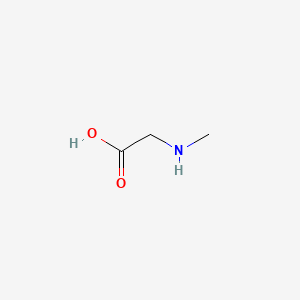
Sarcosine
Sarcosine is a N-alkylglycine that is the N-methyl derivative of glycine. It is an intermediate in the metabolic pathway of glycine. It has a role as a glycine transporter 1 inhibitor, a glycine receptor agonist, a mouse metabolite, an Escherichia coli metabolite and a human metabolite. It is a N-methyl-amino acid, a member of N-methylglycines and a N-alkylglycine. It is a conjugate base of a sarcosinium. It is a conjugate acid of a sarcosinate. It is a tautomer of a sarcosine zwitterion. — ChEBI
- IUPAC name
- 2-(methylamino)acetic acid
- Molecular formula
- C3H7NO2
- Molecular weight
- 89.09 g/mol
- Exact mass
- 89.047678466 Da
- XLogP3
- -2.8
- Topological polar surface area
- 49.3 Ų
- Hydrogen-bond donors
- 2
- Hydrogen-bond acceptors
- 3
- Covalent units
- 1
- Defined stereocentres
- 0
Also known as
16 more reported names
External database identifiers
- ChEBI:CHEBI:15611
- ChEMBL:CHEMBL304383
- EPA DTXSID:DTXSID1047025
- PubMed:23077758
- PubMed:23051772
- PubMed:23027421
- PubMed:22992127
- PubMed:22990486
- PubMed:22932812
- PubMed:22836829
- PubMed:22831945
- PubMed:22825317
- PubMed:22821849
- PubMed:22790564
- PubMed:22777780
Evidence from additional scientific databases
EMBL-EBI ChEBI
sarcosine
A N-alkylglycine that is the N-methyl derivative of glycine. It is an intermediate in the metabolic pathway of glycine.
- Formula
- C3H7NO2
- Average mass
- 89.094 g/mol
- Monoisotopic mass
- 89.04768 Da
- Formal charge
- 0
- N-methylglycines — is a (CHEBI:21766)
- N-alkylglycine — is a (CHEBI:66933)
- N-methyl-amino acid — is a (CHEBI:21760)
- Escherichia coli metabolite — has role (CHEBI:76971)
- antipsychotic agent — has role (CHEBI:35476)
- antidepressant — has role (CHEBI:35469)
- human metabolite — has role (CHEBI:77746)
- glycine transporter 1 inhibitor — has role (CHEBI:64588)
- glycine receptor agonist — has role (CHEBI:64589)
- mouse metabolite — has role (CHEBI:75771)
- Escherichia coli metabolite — has role (CHEBI:76971)
- antipsychotic agent — has role (CHEBI:35476)
- antidepressant — has role (CHEBI:35469)
- human metabolite — has role (CHEBI:77746)
- glycine transporter 1 inhibitor — has role (CHEBI:64588)
- glycine receptor agonist — has role (CHEBI:64589)
- mouse metabolite — has role (CHEBI:75771)
- N-methylglycines — is a (CHEBI:21766)
- N-alkylglycine — is a (CHEBI:66933)
- N-methyl-amino acid — is a (CHEBI:21760)
- sarcosinate — is conjugate acid of (CHEBI:46915)
- sarcosinium — is conjugate base of (CHEBI:46842)
- sarcosine zwitterion — is tautomer of (CHEBI:57433)
- 11272730 Source: PubMed
- 11850512 Source: PubMed
- 15023571 Source: PubMed
- 15331688 Source: PubMed
- 16154544 Source: PubMed
- 17095900 Source: PubMed
- 17190852 Source: PubMed
- 17901997 Source: PubMed
- 19433577 Source: PubMed
- 19577367 Source: PubMed
- 19619564 Source: PubMed
- 19944746 Source: PubMed
- 21955456 Source: PubMed
- 2549245 Source: PubMed
- 28876062 Source: PubMed
- 3965711 Source: PubMed
Additional curated names
Cross-references from this source
- CAS: 107-97-1 — KEGG COMPOUND
- CAS: 107-97-1 — ChemIDplus
- CAS: 107-97-1 — NIST Chemistry WebBook
- REGISTRY_NUMBER: 1699442 — Reaxys
- REGISTRY_NUMBER: 2018 — Gmelin
- MANUAL_X_REF: C00213 — KEGG COMPOUND
- MANUAL_X_REF: c0135 — UM-BBD
- MANUAL_X_REF: HMDB0000271 — HMDB
- MANUAL_X_REF: SAR — PDBeChem
- MANUAL_X_REF: Sarcosine — Wikipedia
- MANUAL_X_REF: SARCOSINE — MetaCyc
Mapped by: Exact CAS cross-reference in the ChEBI compound record. Source updated: 2016-01-27. Retrieved: 2026-08-31. Open source record
NIH PubChem PUG-View
Attributed physical-property, hazard, environmental and use annotations.
- LogP: -2.78 Source: Human Metabolome Database (HMDB)
- Melting Point: 406 °F (Decomposes) (NTP, 1992) Source: CAMEO Chemicals
- Melting Point: 208 °C Source: Human Metabolome Database (HMDB)
- Physical Description: Deliquescent crystals or powder. Has a sweetish taste. (NTP, 1992) Source: CAMEO Chemicals
- Physical Description: Deliquescent solid; [Merck Index] Cream-colored hygroscopic solid; [NTP] White odorless crystalline powder; Hygroscopic; [Alfa Aesar MSDS] Source: Haz-Map, Information on Hazardous Chemicals and Occupational Diseases
- Physical Description: Solid Source: Human Metabolome Database (HMDB)
- Solubility: greater than or equal to 100 mg/mL at 61 °F (NTP, 1992) Source: CAMEO Chemicals
- Solubility: 300.0 mg/mL Source: Human Metabolome Database (HMDB)
- Solubility: 5.6 [ug/mL] (The mean of the results at pH 7.4) Source: Sanford-Burnham Center for Chemical Genomics
- Vapor Pressure: 0.00000017 [mmHg] Source: Haz-Map, Information on Hazardous Chemicals and Occupational Diseases
- Carcinogen Classification: No indication of carcinogenicity (not listed by IARC). (L135) Source: Toxin and Toxin Target Database (T3DB)
- Carcinogen Classification: Not listed by IARC. Has been implicated in oncogenesis (A15089). Source: Toxin and Toxin Target Database (T3DB)
- Exposure Routes: Oral (A2881) ; inhalation (A2881) ; dermal (A2881) Source: Toxin and Toxin Target Database (T3DB)
- Exposure Routes: Endogenous, Eye contact, Ingestion. Source: Toxin and Toxin Target Database (T3DB)
- First Aid: EYES: First check the victim for contact lenses and remove if present. Flush victim's eyes with water or normal saline solution for 20 to 30 minutes while simultaneously calling a hospital or poison control center. Do not put any ointments, oils, or medication in the victim's eyes without specific instructions from a physician. IMMEDIATELY transport the victim after flushing eyes to a hospital even if no symptoms (such as redness or irritation) develop.; SKIN: IMMEDIATELY flood affected skin with water while removing and isolating all contaminated clothing. Gently wash all affected skin areas thoroughly with soap and water. If symptoms such as redness or irritation develop, IMMEDIATELY call a physician and be prepared to transport the victim to a hospital for treatment.; INHALATION: IMMEDIATELY leave the contaminated area; take deep breaths of fresh air. If symptoms (such as wheezing, coughing, shortness of breath, or burning in the mouth, throat, or chest) develop, call a physician and be prepared to transport the victim to a hospital. Provide proper respiratory protection to rescuers entering an unknown atmosphere. Whenever possible, Self-Contained Breathing Apparatus (SCBA) shou Source: CAMEO Chemicals
- Note: This chemical does not meet GHS hazard criteria for 98.7% (149 of 151) of all reports. Source: European Chemicals Agency (ECHA)
- GHS Hazard Statements: Not Classified; Reported as not meeting GHS hazard criteria by 149 of 151 companies (only 1.3% companies provided GHS information). For more detailed information, please visit ECHA C&L website. Source: European Chemicals Agency (ECHA)
- ECHA C&L Notifications Summary: Aggregated GHS information provided per 151 reports by companies from 3 notifications to the ECHA C&L Inventory.; Reported as not meeting GHS hazard criteria per 149 of 151 reports by companies.; There is 1 notification provided by 2 of 151 reports by companies with hazard statement code(s).; Information may vary between notifications depending on impurities, additives, and other factors. The percentage value in parenthesis indicates the notified classification ratio from companies that provide hazard codes. Only hazard codes with percentage values above 10% are shown. For more detailed information, please visit ECHA C&L website. Source: European Chemicals Agency (ECHA)
- Health Effects: Acyl sarcosines may cause irritation to the skin and eyes. They may also react to produce N-nitrososarcosine, which is believed to be carcinogenic. (A2881) Source: Toxin and Toxin Target Database (T3DB)
- Health Effects: Acute Exposure: Can lead to eye and skin irritation. Chronic Exposure: High levels of sarcosine in prostate tissues are associated with aggressive prostate tumors. In this regard, sarcosine appears to function as an oncometabolite. High levels of sarcosine are also seen in patients with sarcosinemia. Sarcosinemia is a rare inborn error of metabolism that is characterized by an increased level of sarcosine (N-methylglycine) in the plasma and urine. The enzymatic block results from a deficiency of sarcosine dehydrogenase (SarDH), a liver mitochondrial matrix enzyme that converts sarcosine into glycine. The disease is mostly characterized by mental delay, cardiomyopathy, deafness and visual disturbance. Source: Toxin and Toxin Target Database (T3DB)
- Cosmetic Ingredient Review Conclusion: The CIR Expert Panel concluded that the following ingredients are safe as used in cosmetics when formulated to be non-irritating. The Expert Panel cautions that these ingredients should not be used in cosmetic products in which N-nitroso compounds can be found...Cocoyl Sarcosine... Source: Cosmetic Ingredient Review (CIR)
- Cosmetic Ingredient Review Finding(s): Safe for use in cosmetics, with qualifications Source: Cosmetic Ingredient Review (CIR)
- Toxicity Summary: While acyl sarcosines themselves are not toxic, they are nitrosating agents. Nitrosating agents may decompose and/or react to cause nitrosamine contamination. Nitrosamines are produced from secondary amines and amides in the presence of nitrite ions and are believed to be carcinogenic. The particular nitrosamine produced by acyl sarcosines is N-nitrososarcosine. Once in the body, nitrosamines are activated by cytochrome P-450 enzymes. They are then believed to induce their carcinogenic effects by forming DNA adducts at the N- and O-atoms. (L1889, L1890, A2878, A2879, A2880, A2881) Source: Toxin and Toxin Target Database (T3DB)
- Toxicity Summary: Sarcosine is an oncometabolite. Sarcosine appears to upregulate the expression of the potent oncoprotein called human epidermal growth factor receptor 2 (HER2/neu) in androgen-dependent prostate cancer cells upon exposure to exogenous sarcosine. Thus, sarcosine may induce prostate cancer progression by increased HER2/neu expression. Source: Toxin and Toxin Target Database (T3DB)
- Cosmetic Ingredient Review Link: CIR ingredient: Cocoyl Sarcosine Source: Cosmetic Ingredient Review (CIR)
- Sources/Uses: Used as an intermediate in synthesis of toothpaste antienzyme agents; [Merck Index] An amino acid intermediate in the metabolism of choline. [ChemIDplus] Used to make antienzyme agents for cosmetics and pharmaceuticals; [NTP] Source: Haz-Map, Information on Hazardous Chemicals and Occupational Diseases
- Uses: Acyl sarcosines are used as hair-conditioning agents and surfactant-cleansing agents in cosmetics, as well as to improve wetting and penetration of topical pharmaceutical products. Acyl sarcosines and their sodium salts are also used in the metal finishing and processing industries for their crystal modifying, anti-rust, and anti-corrosion properties. (A2881) Source: Toxin and Toxin Target Database (T3DB)
- Uses: Sarcosine can be used as a cognitive enhancer and to treat schizophrenia. Source: Toxin and Toxin Target Database (T3DB)
Mapped by: Existing checksum-valid CAS to unique PubChem CID match. Retrieved: 2026-08-31. Open source record
Scientific classifications and hazard annotations provide context and do not replace the market-specific regulatory decision shown above.
Additional source coverage and match status
| Source | Result | Checked |
|---|---|---|
| EMBL-EBI ChEBI | Exact match | 2026-08-31 |
| NIH PubChem PUG-View | Exact match | 2026-08-31 |
A recorded no-match is useful evidence that the source was checked; it is not a claim that the substance does not exist elsewhere.
Retrieved from NIH PubChem on 2026-08-31 by checksum-valid CAS matching. Chemical properties do not replace the regulatory decision on this page.