
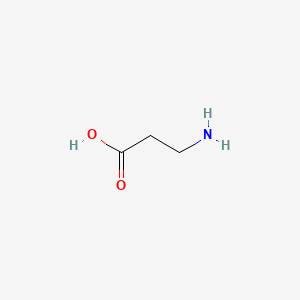
Beta-Alanine
Beta-alanine is a naturally-occurring beta-amino acid comprising propionic acid with the amino group in the 3-position. It has a role as a neurotransmitter, an inhibitor, an agonist, a human metabolite and a fundamental metabolite. It is a conjugate acid of a beta-alaninate. It is a tautomer of a beta-alanine zwitterion. — ChEBI
- IUPAC name
- 3-aminopropanoic acid
- Molecular formula
- C3H7NO2
- Molecular weight
- 89.09 g/mol
- Exact mass
- 89.047678466 Da
- XLogP3
- -3.0
- Topological polar surface area
- 63.3 Ų
- Hydrogen-bond donors
- 2
- Hydrogen-bond acceptors
- 3
- Covalent units
- 1
- Defined stereocentres
- 0
Also known as
16 more reported names
External database identifiers
- ChEBI:CHEBI:16958
- ChEMBL:CHEMBL297569
- EPA DTXSID:DTXSID0030823
- PubMed:29968805
- PubMed:24867890
- PubMed:23686350
- PubMed:23446738
- PubMed:23396314
- PubMed:23091359
- PubMed:23075550
- PubMed:22973590
- PubMed:22953626
- PubMed:22948694
- PubMed:22915429
- PubMed:22910132
Evidence from additional scientific databases
EMBL-EBI ChEBI
β-alanine
A naturally-occurring β-amino acid comprising propionic acid with the amino group in the 3-position.
- Formula
- C3H7NO2
- Average mass
- 89.094 g/mol
- Monoisotopic mass
- 89.04768 Da
- Formal charge
- 0
- β-amino acid — is a (CHEBI:33706)
- fundamental metabolite — has role (CHEBI:78675)
- human metabolite — has role (CHEBI:77746)
- inhibitor — has role (CHEBI:35222)
- agonist — has role (CHEBI:48705)
- neurotransmitter — has role (CHEBI:25512)
- fundamental metabolite — has role (CHEBI:78675)
- human metabolite — has role (CHEBI:77746)
- inhibitor — has role (CHEBI:35222)
- agonist — has role (CHEBI:48705)
- neurotransmitter — has role (CHEBI:25512)
- β-amino acid — is a (CHEBI:33706)
- β-alaninate — is conjugate acid of (CHEBI:63070)
- β-alanine zwitterion — is tautomer of (CHEBI:57966)
- 11139233 Source: PubMed
- 11850512 Source: PubMed
- 12107759 Source: PubMed
- 12887142 Source: PubMed
- 14363188 Source: PubMed
- 16934791 Source: PubMed
- 18528519 Source: PubMed
- 18613640 Source: PubMed
- 19239140 Source: PubMed
- 19955842 Source: PubMed
- 20199122 Source: PubMed
- 20386120 Source: PubMed
- 20479615 Source: PubMed
- 20994958 Source: PubMed
- 22735334 Source: PubMed
Additional curated names
Cross-references from this source
- CAS: 107-95-9 — NIST Chemistry WebBook
- CAS: 107-95-9 — KEGG COMPOUND
- CAS: 107-95-9 — ChemIDplus
- REGISTRY_NUMBER: 49614 — Gmelin
- REGISTRY_NUMBER: 906793 — Reaxys
- MANUAL_X_REF: BAL — PDBeChem
- MANUAL_X_REF: B-ALANINE — MetaCyc
- MANUAL_X_REF: Beta-Alanine — Wikipedia
- MANUAL_X_REF: C00001333 — KNApSAcK
- MANUAL_X_REF: C00099 — KEGG COMPOUND
- MANUAL_X_REF: D07561 — KEGG DRUG
- MANUAL_X_REF: DB03107 — DrugBank
- MANUAL_X_REF: HMDB0000056 — HMDB
Mapped by: Exact CAS cross-reference in the ChEBI compound record. Source updated: 2026-05-13. Retrieved: 2026-08-31. Open source record
NIH PubChem PUG-View
Attributed physical-property, hazard, environmental and use annotations.
- LogP: -3.05 Source: DrugBank
- LogP: -3.05 Source: Human Metabolome Database (HMDB)
- Melting Point: 200 dec °C Source: DrugBank
- Melting Point: 200 °C Source: Human Metabolome Database (HMDB)
- Physical Description: Solid; [Merck Index] White crystalline solid; [Alfa Aesar MSDS] Source: Haz-Map, Information on Hazardous Chemicals and Occupational Diseases
- Physical Description: Solid Source: Human Metabolome Database (HMDB)
- Physical Description: Colourless needles; Source: Joint FAO/WHO Expert Committee on Food Additives (JECFA)
- Solubility: 545000 mg/L (at 25 °C) Source: DrugBank
- Solubility: 545.0 mg/mL Source: Human Metabolome Database (HMDB)
- Solubility: Soluble in water; Insoluble in ether and acetone Source: Joint FAO/WHO Expert Committee on Food Additives (JECFA)
- Solubility: Slightly soluble (in ethanol) Source: Joint FAO/WHO Expert Committee on Food Additives (JECFA)
- Vapor Pressure: 0.00000005 [mmHg] Source: Haz-Map, Information on Hazardous Chemicals and Occupational Diseases
- Carcinogen Classification: No indication of carcinogenicity to humans (not listed by IARC). Source: Toxin and Toxin Target Database (T3DB)
- Note: This chemical does not meet GHS hazard criteria for 98.5% (322 of 327) of all reports. Source: European Chemicals Agency (ECHA)
- GHS Hazard Statements: Not Classified; Reported as not meeting GHS hazard criteria by 322 of 327 companies (only 1.5% companies provided GHS information). For more detailed information, please visit ECHA C&L website. Source: European Chemicals Agency (ECHA)
- ECHA C&L Notifications Summary: Aggregated GHS information provided per 327 reports by companies from 5 notifications to the ECHA C&L Inventory.; Reported as not meeting GHS hazard criteria per 322 of 327 reports by companies.; There are 4 notifications provided by 5 of 327 reports by companies with hazard statement code(s).; Information may vary between notifications depending on impurities, additives, and other factors. The percentage value in parenthesis indicates the notified classification ratio from companies that provide hazard codes. Only hazard codes with percentage values above 10% are shown. For more detailed information, please visit ECHA C&L website. Source: European Chemicals Agency (ECHA)
- Health Effects: Chronically high levels of beta-alanine are associated with at least 2 inborn errors of metabolism including: GABA-Transaminase Deficiency and Methylmalonate Semialdehyde Dehydrogenase Deficiency. Source: Toxin and Toxin Target Database (T3DB)
- Sources/Uses: Used to make pantothenic acid and derivatives and as a buffer in electroplating; [Merck Index] Used as flavoring agent or adjuvant and nutritional supplement; [FDA] An amino acid not found in protein; Used in organic synthesis and biochemical research; [Alfa Aesar MSDS] Source: Haz-Map, Information on Hazardous Chemicals and Occupational Diseases
- Industrial Processes with risk of exposure: Electroplating [Category: Plate] Source: Haz-Map, Information on Hazardous Chemicals and Occupational Diseases
- Uses: Use (kg; approx.) in Germany (2009): >1000; Consumption (g per capita; approx.) in Germany (2009): 0.0122; Calculated removal (%): 92.1 Source: NORMAN Suspect List Exchange
- Uses: This is an endogenously produced metabolite found in the human body. It is used in metabolic reactions, catabolic reactions or waste generation. Source: Toxin and Toxin Target Database (T3DB)
Mapped by: Existing checksum-valid CAS to unique PubChem CID match. Retrieved: 2026-08-31. Open source record
Scientific classifications and hazard annotations provide context and do not replace the market-specific regulatory decision shown above.
Additional source coverage and match status
| Source | Result | Checked |
|---|---|---|
| EMBL-EBI ChEBI | Exact match | 2026-08-31 |
| NIH PubChem PUG-View | Exact match | 2026-08-31 |
A recorded no-match is useful evidence that the source was checked; it is not a claim that the substance does not exist elsewhere.
Retrieved from NIH PubChem on 2026-08-31 by checksum-valid CAS matching. Chemical properties do not replace the regulatory decision on this page.