
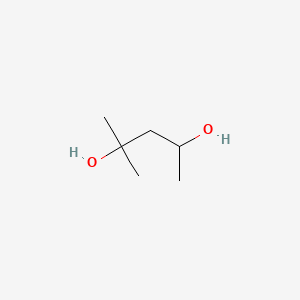
Hexylene Glycol
2-methylpentane-2,4-diol is a glycol in which the two hydroxy groups are at positions 2 and 4 of 2-methylpentane (isopentane). — ChEBI
- IUPAC name
- 2-methylpentane-2,4-diol
- Molecular formula
- C6H14O2
- Molecular weight
- 118.17 g/mol
- Exact mass
- 118.099379685 Da
- XLogP3
- 0.3
- Topological polar surface area
- 40.5 Ų
- Hydrogen-bond donors
- 2
- Hydrogen-bond acceptors
- 2
- Covalent units
- 1
- Defined stereocentres
- 0
Also known as
16 more reported names
External database identifiers
- ChEBI:CHEBI:62995
- ChEMBL:CHEMBL2104293
- EPA DTXSID:DTXSID5021885
- PubMed:22868754
- PubMed:22615807
- PubMed:22505415
- PubMed:22457833
- PubMed:22347812
- PubMed:22314358
- PubMed:22309255
- PubMed:22260067
- PubMed:22244759
- PubMed:22096507
- PubMed:22059929
- PubMed:21946559
Evidence from additional scientific databases
EMBL-EBI ChEBI
2-methylpentane-2,4-diol
A glycol in which the two hydroxy groups are at positions 2 and 4 of 2-methylpentane (isopentane).
- Formula
- C6H14O2
- Average mass
- 118.176 g/mol
- Monoisotopic mass
- 118.09938 Da
- Formal charge
- 0
- glycol — is a (CHEBI:13643)
- glycol — is a (CHEBI:13643)
Additional curated names
Cross-references from this source
- CAS: 107-41-5 — NIST Chemistry WebBook
- CAS: 107-41-5 — ChemIDplus
- REGISTRY_NUMBER: 1098298 — Reaxys
- MANUAL_X_REF: 1315 — PPDB
- MANUAL_X_REF: 2-Methyl-2,4-pentanediol — Wikipedia
- MANUAL_X_REF: WO2010048675 — Patent
Mapped by: Exact CAS cross-reference in the ChEBI compound record. Source updated: 2014-04-17. Retrieved: 2026-08-31. Open source record
NIH PubChem PUG-View
Attributed physical-property, hazard, environmental and use annotations.
- Autoignition Temperature: 583 °F (USCG, 1999) Source: CAMEO Chemicals
- Autoignition Temperature: Autoignition temp = 579 K Source: Hazardous Substances Data Bank (HSDB)
- Autoignition Temperature: 306 °C Source: ILO-WHO International Chemical Safety Cards (ICSCs)
- Boiling Point: 387 °F at 760 mmHg (USCG, 1999) Source: CAMEO Chemicals
- Boiling Point: 198 °C at 760 mm Hg Source: Hazardous Substances Data Bank (HSDB)
- Boiling Point: 198 °C Source: ILO-WHO International Chemical Safety Cards (ICSCs)
- Boiling Point: 388 °F Source: Occupational Safety and Health Administration (OSHA)
- Boiling Point: 197.1 °C @760 [mm Hg] Source: PAC Chemical Database, U.S. Department of Energy
- Boiling Point: 388 °F Source: The National Institute for Occupational Safety and Health (NIOSH)
- Color/Form: Liquid Source: Hazardous Substances Data Bank (HSDB)
- Color/Form: Colorless liquid Source: Hazardous Substances Data Bank (HSDB)
- Density: 0.923 at 68 °F (USCG, 1999) - Less dense than water; will float Source: CAMEO Chemicals
- Density: 0.923 g/cu cm at 15 °C Source: Hazardous Substances Data Bank (HSDB)
- Density: Bulk density 7.69 lb/gal Source: Hazardous Substances Data Bank (HSDB)
- Density: Density = 0.92109 at 20 °C; 0.9181 at 25 °C Source: Hazardous Substances Data Bank (HSDB)
- Density: Relative density (water = 1): 0.92 Source: ILO-WHO International Chemical Safety Cards (ICSCs)
- Density: 0.923 Source: Occupational Safety and Health Administration (OSHA)
- Density: 0.9234 @ 15°C Source: PAC Chemical Database, U.S. Department of Energy
- Density: 0.92 Source: The National Institute for Occupational Safety and Health (NIOSH)
- Flash Point: 200 °F (USCG, 1999) Source: CAMEO Chemicals
- Flash Point: 93 °C, closed cup Source: Haz-Map, Information on Hazardous Chemicals and Occupational Diseases
- Flash Point: 93 degree C (closed cup) Source: Hazardous Substances Data Bank (HSDB)
- Flash Point: 205 °F (96 °C) (Open cup) Source: Hazardous Substances Data Bank (HSDB)
- Flash Point: 96 °C o.c. Source: ILO-WHO International Chemical Safety Cards (ICSCs)
- Flash Point: 209 °F Source: Occupational Safety and Health Administration (OSHA)
- Flash Point: 209 °F Source: The National Institute for Occupational Safety and Health (NIOSH)
- LogP: 0.58 Source: ILO-WHO International Chemical Safety Cards (ICSCs)
- Melting Point: -58 °F (USCG, 1999) Source: CAMEO Chemicals
- Melting Point: Freezing point = -50 °C (glass or vitreous condition) Source: Hazardous Substances Data Bank (HSDB)
- Melting Point: Heat of fusion at melting point = 1.48X10+7 J/kmol Source: Hazardous Substances Data Bank (HSDB)
- Melting Point: -50 °C Source: ILO-WHO International Chemical Safety Cards (ICSCs)
- Melting Point: -58 °F (sets to glass) Source: Occupational Safety and Health Administration (OSHA)
- Melting Point: -50 °C Source: PAC Chemical Database, U.S. Department of Energy
- Melting Point: -58 °F (Sets to glass) Source: The National Institute for Occupational Safety and Health (NIOSH)
- Odor: Mild sweetish Source: Hazardous Substances Data Bank (HSDB)
- Odor: ATMOSPHERES ESSENTIALLY SATURATED AT ROOM TEMP ARE DETECTABLE BY ODOR... Source: Hazardous Substances Data Bank (HSDB)
- Odor: Mild, sweetish odor Source: Hazardous Substances Data Bank (HSDB)
- Physical Description: Hexylene glycol is an oily colorless liquid with a mild sweet odor. Floats and mixes slowly with water. (USCG, 1999) Source: CAMEO Chemicals
- Physical Description: CBI; Liquid; Liquid; Other Solid Source: EPA Chemical Data Reporting (CDR)
- Physical Description: Colorless liquid with a mild, sweetish odor; [NIOSH] Source: Haz-Map, Information on Hazardous Chemicals and Occupational Diseases
- Physical Description: COLOURLESS LIQUID WITH CHARACTERISTIC ODOUR. Source: ILO-WHO International Chemical Safety Cards (ICSCs)
- Physical Description: Colorless liquid with a mild, sweetish odor. Source: Occupational Safety and Health Administration (OSHA)
- Physical Description: Colorless liquid with a mild, sweetish odor. Source: The National Institute for Occupational Safety and Health (NIOSH)
- Refractive Index: Index of refraction: 1.4276 at 20 °C/D Source: Hazardous Substances Data Bank (HSDB)
- Solubility: Miscible (NIOSH, 2024) Source: CAMEO Chemicals
- Solubility: Miscible with water Source: Hazardous Substances Data Bank (HSDB)
- Solubility: Soluble in alcohol, ether, lower aliphatic hydrocarbons Source: Hazardous Substances Data Bank (HSDB)
- Solubility: Soluble in ethanol, ethyl ether; slightly soluble in carbon tetrachloride Source: Hazardous Substances Data Bank (HSDB)
- Solubility: Miscible with fatty acids Source: Hazardous Substances Data Bank (HSDB)
- Solubility: Solubility in water: miscible Source: ILO-WHO International Chemical Safety Cards (ICSCs)
- Solubility: Miscible Source: The National Institute for Occupational Safety and Health (NIOSH)
- Vapor Pressure: 0.05 mmHg (NIOSH, 2024) Source: CAMEO Chemicals
- Vapor Pressure: 0.07 [mmHg] Source: Haz-Map, Information on Hazardous Chemicals and Occupational Diseases
- Vapor Pressure: Vapor pressure = 0.013 mm Hg at 25 °C Source: Hazardous Substances Data Bank (HSDB)
- Vapor Pressure: 7.0X10⁻² mm Hg at 25 °C Source: Hazardous Substances Data Bank (HSDB)
- Vapor Pressure: Vapor pressure, Pa at 20 °C: 6.7 Source: ILO-WHO International Chemical Safety Cards (ICSCs)
- Vapor Pressure: 0.05 mmHg Source: Occupational Safety and Health Administration (OSHA)
- Vapor Pressure: 0.05 [mm Hg] @20 °C Source: PAC Chemical Database, U.S. Department of Energy
- Vapor Pressure: 0.05 mmHg Source: The National Institute for Occupational Safety and Health (NIOSH)
- Viscosity: 34 cP at 20 °C Source: Hazardous Substances Data Bank (HSDB)
- Exposure Routes: The substance can be absorbed into the body by inhalation of its aerosol. Source: ILO-WHO International Chemical Safety Cards (ICSCs)
- Exposure Routes: inhalation, ingestion, skin and/or eye contact Source: The National Institute for Occupational Safety and Health (NIOSH)
- First Aid: Excerpt from NIOSH Pocket Guide for Hexylene glycol:; Eye: IRRIGATE IMMEDIATELY - If this chemical contacts the eyes, immediately wash (irrigate) the eyes with large amounts of water, occasionally lifting the lower and upper lids. Get medical attention immediately.; Skin: WATER WASH IMMEDIATELY - If this chemical contacts the skin, immediately wash the contaminated skin with water. If this chemical penetrates the clothing, immediately remove the clothing and wash the skin with water. If symptoms occur after washing, get medical attention immediately.; Breathing: RESPIRATORY SUPPORT - If a person breathes large amounts of this chemical, move the exposed person to fresh air at once. If breathing has stopped, perform artificial respiration. Keep the affected person warm and at rest. Get medical attention as soon as possible.; Swallow: MEDICAL ATTENTION IMMEDIATELY - If this chemical has been swallowed, get medical attention immediately. (NIOSH, 2024) Source: CAMEO Chemicals
- First Aid: (General first aid procedures); Eye: Irrigate immediately - If this chemical contacts the eyes, immediately wash (irrigate) the eyes with large amounts of water, occasionally lifting the lower and upper lids. Get medical attention immediately.; Skin: Water wash immediately - If this chemical contacts the skin, immediately wash the contaminated skin with water. If this chemical penetrates the clothing, immediately remove the clothing and wash the skin with water. If symptoms occur after washing, get medical attention immediately.; Breathing: Respiratory support; Swallow: Medical attention immediately - If this chemical has been swallowed, get medical attention immediately. Source: The National Institute for Occupational Safety and Health (NIOSH)
- Signal: Warning Source: Regulation (EC) No 1272/2008 of the European Parliament and of the Council
- GHS Hazard Statements: H315: Causes skin irritation [Warning Skin corrosion/irritation]; H319: Causes serious eye irritation [Warning Serious eye damage/eye irritation] Source: Regulation (EC) No 1272/2008 of the European Parliament and of the Council
- Precautionary Statement Codes: P264, P264+P265, P280, P302+P352, P305+P351+P338, P321, P332+P317, P337+P317, and P362+P364 (click each P-code to see the statement) Source: Regulation (EC) No 1272/2008 of the European Parliament and of the Council
- Note: This chemical does not meet GHS hazard criteria for < 0.1% (1 of 5235) of reports. Source: European Chemicals Agency (ECHA)
- Signal: Warning Source: European Chemicals Agency (ECHA)
- GHS Hazard Statements: H315 (97.4%): Causes skin irritation [Warning Skin corrosion/irritation]; H319 (99.8%): Causes serious eye irritation [Warning Serious eye damage/eye irritation] Source: European Chemicals Agency (ECHA)
- Precautionary Statement Codes: P264, P264+P265, P280, P302+P352, P305+P351+P338, P321, P332+P317, P337+P317, and P362+P364 (click each P-code to see the statement) Source: European Chemicals Agency (ECHA)
- ECHA C&L Notifications Summary: Aggregated GHS information provided per 5235 reports by companies from 16 notifications to the ECHA C&L Inventory. Each notification may be associated with multiple companies.; Reported as not meeting GHS hazard criteria per 1 of 5235 reports by companies.; There are 15 notifications provided by 5234 of 5235 reports by companies with hazard statement code(s).; Information may vary between notifications depending on impurities, additives, and other factors. The percentage value in parenthesis indicates the notified classification ratio from companies that provide hazard codes. Only hazard codes with percentage values above 10% are shown. For more detailed information, please visit ECHA C&L website. Source: European Chemicals Agency (ECHA)
- Signal: Warning Source: NITE-CMC
- GHS Hazard Statements: H227: Combustible liquid [Warning Flammable liquids] Source: NITE-CMC
- Precautionary Statement Codes: P210, P280, P370+P378, P403, and P501 (click each P-code to see the statement) Source: NITE-CMC
- GHS Hazard Statements: H319: Causes serious eye irritation [Warning Serious eye damage/eye irritation]; H335: May cause respiratory irritation [Warning Specific target organ toxicity, single exposure; Respiratory tract irritation]; H336: May cause drowsiness or dizziness [Warning Specific target organ toxicity, single exposure; Narcotic effects] Source: NITE-CMC
- NFPA Health Rating: 2 - Materials that, under emergency conditions, can cause temporary incapacitation or residual injury. Source: Hazardous Substances Data Bank (HSDB)
- NFPA Fire Rating: 1 - Materials that must be preheated before ignition can occur. Materials require considerable preheating, under all ambient temperature conditions, before ignition and combustion can occur. Source: Hazardous Substances Data Bank (HSDB)
- NFPA Instability Rating: 0 - Materials that in themselves are normally stable, even under fire conditions. Source: Hazardous Substances Data Bank (HSDB)
- Target Organs: Eyes, skin, respiratory system, central nervous system Source: The National Institute for Occupational Safety and Health (NIOSH)
- Cosmetic Ingredient Review Finding(s): Safe in the present practices of use and concentration. Ingredient, concentration, and use information are available in documents discoverable at https://cir-reports.cir-safety.org Source: Cosmetic Ingredient Review (CIR)
- Toxicity Summary: IDENTIFICATION AND USE: Hexylene glycol is a colorless liquid used as a chemical intermediate, a selective solvent in petroleum refining, a component of hydraulic fluids, a solvent for inks, a cement additive, and in cosmetics. HUMAN EXPOSURE AND TOXICITY: Five human subjects given oral doses of 37 g of hexylene glycol daily for 24 days (estimated daily dosage 14-28 mg/kg body weight) reported no subjective symptoms that could be attributed to the intake of hexylene glycol; no alterations in urine parameters were detected. In another study, most subjects exposed for 15 min to 50 ppm of hexylene glycol in the air were able to detect the odor and a few noted eye irritation. At a concentration of 100 ppm, the odor was plain and some noted nasal irritation and respiratory discomfort. At 1000 ppm (4840 mg/cu m), there was irritation of the eyes, nose, and throat, and respiratory discomfort. Additionally, a case of severe contact urticaria with systemic involvement resembling an anaphylactic reaction, following the application of a topical corticosteroid formulated with hexylene glycol as an excipient has been reported. Swelling and redness were seen in 23 out of 823 eczema patients who Source: Hazardous Substances Data Bank (HSDB)
- Environmental Bioconcentration: An estimated BCF of 3 was calculated in fish for 2-methyl-2,4-pentanediol(SRC), using an estimated log Kow of 0.58(1) and a regression-derived equation(1). According to a classification scheme(2), this BCF suggests the potential for bioconcentration in aquatic organisms is low(SRC). Source: Hazardous Substances Data Bank (HSDB)
- Environmental Fate: TERRESTRIAL FATE: Based on a classification scheme(1), an estimated Koc value of 1(SRC), determined from a structure estimation method(2), indicates that 2-methyl-2,4-pentanediol is expected to have very high mobility in soil(SRC). Volatilization of 2-methyl-2,4-pentanediol from moist soil surfaces is not expected to be an important fate process(SRC) given an estimated Henry's Law constant of 4.1X10⁻⁷ atm-cu m/mole(SRC) using a fragment constant estimation method(3). 2-Methyl-2,4-pentanediol is not expected to volatilize from dry soil surfaces(SRC) based upon a vapor pressure of 7.0X10⁻² mm Hg at 25 °C(4). Utilizing the Japanese MITI test, 55.7% of the Theoretical BOD was reached in 2 weeks(5) indicating that biodegradation is an important environmental fate process in soil(SRC). Source: Hazardous Substances Data Bank (HSDB)
- Environmental Fate: AQUATIC FATE: Based on a classification scheme(1), an estimated Koc value of 1(SRC), determined from a structure estimation method(2), indicates that 2-methyl-2,4-pentanediol is not expected to adsorb to suspended solids and sediment(SRC). Volatilization from water surfaces is not expected(3) based upon an estimated Henry's Law constant of 4.1X10⁻⁷ atm-cu m/mole(SRC), developed using a fragment constant estimation method(4). According to a classification scheme(6), an estimated BCF of 3(SRC), from an estimated log Kow of 0.58(2) and a regression-derived equation(2), suggests the potential for bioconcentration in aquatic organisms is low(SRC). Utilizing the Japanese MITI test, 55.7% of the Theoretical BOD was reached in 2 weeks(6) indicating that biodegradation is an important environmental fate process in water(SRC). Source: Hazardous Substances Data Bank (HSDB)
- Environmental Fate: ATMOSPHERIC FATE: According to a model of gas/particle partitioning of semivolatile organic compounds in the atmosphere(1), 2-methyl-2,4-pentanediol, which has a vapor pressure of 7.0X10⁻² mm Hg at 25 °C(2), is expected to exist solely as a vapor in the ambient atmosphere. Vapor-phase 2-methyl-2,4-pentanediol is degraded in the atmosphere by reaction with photochemically-produced hydroxyl radicals(SRC); the half-life for this reaction in air is estimated to be 14 hrs(SRC), calculated from its rate constant of 2.77X10⁻¹¹ cu cm/molecule-sec at 25 °C(3). 2-Methyl-2,4-pentanediol does not contain chromophores that absorb at wavelengths >290 nm(4) and, therefore, is not expected to be susceptible to direct photolysis by sunlight(SRC). Source: Hazardous Substances Data Bank (HSDB)
- Consumer Uses: Solvent; Not Known or Reasonably Ascertainable; Flame retardant; Cleaning agent; Fragrance; Etching agent Source: EPA Chemical Data Reporting (CDR)
- Industry Uses: Etching agent; Chelating agent; Intermediate; Filler; Not Known or Reasonably Ascertainable; Hydraulic fluids; Cleaning agent; Plating agent; Processing aids not otherwise specified; Tanning agents not otherwise specified; Lubricating agent; Solvent; Anti-freeze agent Source: EPA Chemical Data Reporting (CDR)
- Cosmetic Ingredient Review Link: CIR ingredient: Hexylene Glycol Source: Cosmetic Ingredient Review (CIR)
- Sources/Uses: Used as a solvent plasticizer in paints and lacquers; Also used in the chemical, petroleum refining, and cosmetic industries and as an additive to hydraulic fluids, inks, cement, leather, paper, and textiles; [ACGIH] Source: Haz-Map, Information on Hazardous Chemicals and Occupational Diseases
- Industrial Processes with risk of exposure: Petroleum Production and Refining [Category: Industry]; Pulp and Paper Processing [Category: Industry]; Textiles (Fiber & Fabric Manufacturing) [Category: Industry]; Painting (Pigments, Binders, and Biocides) [Category: Paint]; Leather Tanning and Processing [Category: Industry]; Cement Producing [Category: Industry] Source: Haz-Map, Information on Hazardous Chemicals and Occupational Diseases
- Uses: For 2-methyl-2,4-pentanediol (USEPA/OPP Pesticide Code: 068601) there are 0 labels match. /SRP: Not registered for current use in the U.S., but approved pesticide uses may change periodically and so federal, state and local authorities must be consulted for currently approved uses./ Source: Hazardous Substances Data Bank (HSDB)
- Uses: The active ingredient is no longer contained in any registered pesticide products ... "cancelled." Source: Hazardous Substances Data Bank (HSDB)
- Uses: ... Hydraulic brake fluids (as coupling agent to castor oil). Source: Hazardous Substances Data Bank (HSDB)
- Uses: Used as solvent and viscosity decreasing agent in cosmetics and personal care products Source: Hazardous Substances Data Bank (HSDB)
- Uses: For more Uses (Complete) data for 2-METHYL-2,4-PENTANEDIOL (7 total), please visit the HSDB record page. Source: Hazardous Substances Data Bank (HSDB)
Mapped by: Existing checksum-valid CAS to unique PubChem CID match. Retrieved: 2026-08-31. Open source record
Scientific classifications and hazard annotations provide context and do not replace the market-specific regulatory decision shown above.
Additional source coverage and match status
| Source | Result | Checked |
|---|---|---|
| EMBL-EBI ChEBI | Exact match | 2026-08-31 |
| NIH PubChem PUG-View | Exact match | 2026-08-31 |
A recorded no-match is useful evidence that the source was checked; it is not a claim that the substance does not exist elsewhere.
Retrieved from NIH PubChem on 2026-08-31 by checksum-valid CAS matching. Chemical properties do not replace the regulatory decision on this page.