
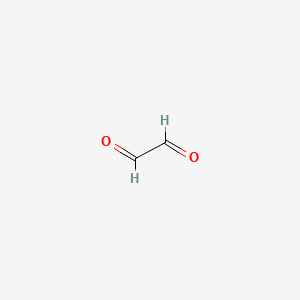
Glyoxal
Glyoxal is the dialdehyde that is the smallest possible and which consists of ethane having oxo groups on both carbons. It has a role as a pesticide, a plant growth regulator, an agrochemical and an allergen. — ChEBI
- IUPAC name
- oxaldehyde
- Molecular formula
- C2H2O2
- Molecular weight
- 58.04 g/mol
- Exact mass
- 58.005479302 Da
- XLogP3
- -0.4
- Topological polar surface area
- 34.1 Ų
- Hydrogen-bond donors
- 0
- Hydrogen-bond acceptors
- 2
- Covalent units
- 1
- Defined stereocentres
- 0
Also known as
16 more reported names
External database identifiers
- ChEBI:CHEBI:34779
- ChEMBL:CHEMBL1606435
- EPA DTXSID:DTXSID5025364
- PubMed:40562332
- PubMed:40527391
- PubMed:33715048
- PubMed:33253783
- PubMed:29496360
- PubMed:28760545
- PubMed:27965148
- PubMed:26795242
- PubMed:25724174
- PubMed:23999411
- PubMed:23445166
- PubMed:23125892
Evidence from additional scientific databases
EMBL-EBI ChEBI
glyoxal
The dialdehyde that is the smallest possible and which consists of ethane having oxo groups on both carbons.
- Formula
- C2H2O2
- Average mass
- 58.036 g/mol
- Monoisotopic mass
- 58.00548 Da
- Formal charge
- 0
- dialdehyde — is a (CHEBI:38124)
- allergen — has role (CHEBI:50904)
- plant growth regulator — has role (CHEBI:26155)
- pesticide — has role (CHEBI:25944)
- agrochemical — has role (CHEBI:33286)
- allergen — has role (CHEBI:50904)
- plant growth regulator — has role (CHEBI:26155)
- pesticide — has role (CHEBI:25944)
- agrochemical — has role (CHEBI:33286)
- dialdehyde — is a (CHEBI:38124)
Additional curated names
Cross-references from this source
- CAS: 107-22-2 — ChemIDplus
- CAS: 107-22-2 — KEGG COMPOUND
- CAS: 107-22-2 — NIST Chemistry WebBook
- REGISTRY_NUMBER: 1732463 — Reaxys
- MANUAL_X_REF: 272 — PPDB
- MANUAL_X_REF: C14448 — KEGG COMPOUND
- MANUAL_X_REF: CPD-8887 — MetaCyc
- MANUAL_X_REF: FDB007802 — FooDB
- MANUAL_X_REF: Glyoxal — Wikipedia
- MANUAL_X_REF: GXT — PDBeChem
Mapped by: Exact CAS cross-reference in the ChEBI compound record. Source updated: 2020-10-12. Retrieved: 2026-08-31. Open source record
NIH PubChem PUG-View
Attributed physical-property, hazard, environmental and use annotations.
- Autoignition Temperature: 545 °F (NTP, 1992) Source: CAMEO Chemicals
- Autoignition Temperature: 285 °C Source: ILO-WHO International Chemical Safety Cards (ICSCs)
- Boiling Point: 124 °F at 776 mmHg (NTP, 1992) Source: CAMEO Chemicals
- Boiling Point: 51 °C at 776 mm Hg Source: Hazardous Substances Data Bank (HSDB)
- Boiling Point: 104 °C Source: ILO-WHO International Chemical Safety Cards (ICSCs)
- Boiling Point: 124 °F Source: Occupational Safety and Health Administration (OSHA)
- Color/Form: Yellow prisms or irregular pieces turning white on cooling; opaque at 10 °C; vapors are green Source: Hazardous Substances Data Bank (HSDB)
- Color/Form: Yellow crystals or light yellow liquid Source: Hazardous Substances Data Bank (HSDB)
- Density: 1.29 at 68 °F (liquid,40% solution) (USCG, 1999) - Denser than water; will sink Source: CAMEO Chemicals
- Density: 1.14 g/cu cm at 20 °C Source: Hazardous Substances Data Bank (HSDB)
- Density: Relative density (water = 1): 1.27 Source: ILO-WHO International Chemical Safety Cards (ICSCs)
- Density: 1.29 Source: Occupational Safety and Health Administration (OSHA)
- Density: 1.29 @ 20°C Source: PAC Chemical Database, U.S. Department of Energy
- Flash Point: 428 °F (NTP, 1992) Source: CAMEO Chemicals
- Flash Point: 428 °F Source: Haz-Map, Information on Hazardous Chemicals and Occupational Diseases
- Flash Point: >100 °C Source: ILO-WHO International Chemical Safety Cards (ICSCs)
- Flash Point: 428 °F Source: Occupational Safety and Health Administration (OSHA)
- LogP: -0.85 Source: ILO-WHO International Chemical Safety Cards (ICSCs)
- Melting Point: 59 °F (NTP, 1992) Source: CAMEO Chemicals
- Melting Point: 15 °C for pure glyoxal and approximately -10 °C for the 40% solution Source: Haz-Map, Information on Hazardous Chemicals and Occupational Diseases
- Melting Point: 15 °C Source: Hazardous Substances Data Bank (HSDB)
- Melting Point: -14 °C Source: ILO-WHO International Chemical Safety Cards (ICSCs)
- Melting Point: 59 °F Source: Occupational Safety and Health Administration (OSHA)
- Melting Point: 15 °C Source: PAC Chemical Database, U.S. Department of Energy
- Odor: Mild odor Source: Hazardous Substances Data Bank (HSDB)
- Physical Description: Glyoxal appears as yellow crystals melting at15 °C. Hence often encountered as a light yellow liquid with a weak sour odor. Vapor has a green color and burns with a violet flame. Source: CAMEO Chemicals
- Physical Description: CBI; Dry Powder; Liquid Source: EPA Chemical Data Reporting (CDR)
- Physical Description: Commercially available as a 40% aqueous solution, clear to slightly yellow with a faint, sour odor; [AIHA] Yellow solid that turns white on cooling; Vapors are green; mp = 15 deg C; [Merck Index] Liquid; Yellow solid below 15 deg C; [Reference #1] Source: Haz-Map, Information on Hazardous Chemicals and Occupational Diseases
- Physical Description: Liquid Source: Human Metabolome Database (HMDB)
- Physical Description: COLOURLESS-TO-PALE-YELLOW LIQUID. Source: ILO-WHO International Chemical Safety Cards (ICSCs)
- Physical Description: Yellow prisms which turn white on cooling; soluble in anhydrous solvents. Often encountered as a light yellow liquid with a weak sour odor. Vapor has a green color and burns with a violet flame. Source: Occupational Safety and Health Administration (OSHA)
- Refractive Index: Index of refraction = 1.3826 at 20 °C Source: Hazardous Substances Data Bank (HSDB)
- Solubility: greater than or equal to 100 mg/mL at 72 °F (NTP, 1992) Source: CAMEO Chemicals
- Solubility: Sol in anhydrous solvents Source: Hazardous Substances Data Bank (HSDB)
- Solubility: In water, miscible at 20 °C Source: Hazardous Substances Data Bank (HSDB)
- Vapor Pressure: 18 mmHg at 68 °F (NTP, 1992) Source: CAMEO Chemicals
- Vapor Pressure: 255 mm Hg at 25 °C /extrapolated/ Source: Hazardous Substances Data Bank (HSDB)
- Vapor Pressure: Vapor pressure, kPa at 20 °C: 2.4 Source: ILO-WHO International Chemical Safety Cards (ICSCs)
- Vapor Pressure: 18 mmHg Source: Occupational Safety and Health Administration (OSHA)
- Vapor Pressure: 255 [mm Hg] @25 °C Source: PAC Chemical Database, U.S. Department of Energy
- pH: pH of 40% aqueous solution = 2.1 to 2.7 Source: Hazardous Substances Data Bank (HSDB)
- Exposure Routes: The substance can be absorbed into the body by inhalation of its aerosol or vapour and by ingestion. Source: ILO-WHO International Chemical Safety Cards (ICSCs)
- First Aid: EYES: First check the victim for contact lenses and remove if present. Flush victim's eyes with water or normal saline solution for 20 to 30 minutes while simultaneously calling a hospital or poison control center. Do not put any ointments, oils, or medication in the victim's eyes without specific instructions from a physician. IMMEDIATELY transport the victim after flushing eyes to a hospital even if no symptoms (such as redness or irritation) develop.; SKIN: IMMEDIATELY flood affected skin with water while removing and isolating all contaminated clothing. Gently wash all affected skin areas thoroughly with soap and water. If symptoms such as redness or irritation develop, IMMEDIATELY call a physician and be prepared to transport the victim to a hospital for treatment.; INHALATION: IMMEDIATELY leave the contaminated area; take deep breaths of fresh air. If symptoms (such as wheezing, coughing, shortness of breath, or burning in the mouth, throat, or chest) develop, call a physician and be prepared to transport the victim to a hospital. Provide proper respiratory protection to rescuers entering an unknown atmosphere. Whenever possible, Self-Contained Breathing Apparatus (SCBA) shou Source: CAMEO Chemicals
- Signal: Warning Source: Regulation (EC) No 1272/2008 of the European Parliament and of the Council
- GHS Hazard Statements: H315: Causes skin irritation [Warning Skin corrosion/irritation]; H317: May cause an allergic skin reaction [Warning Sensitization, Skin]; H319: Causes serious eye irritation [Warning Serious eye damage/eye irritation]; H332: Harmful if inhaled [Warning Acute toxicity, inhalation]; H341: Suspected of causing genetic defects [Warning Germ cell mutagenicity] Source: Regulation (EC) No 1272/2008 of the European Parliament and of the Council
- Precautionary Statement Codes: P203, P261, P264, P264+P265, P271, P272, P280, P302+P352, P304+P340, P305+P351+P338, P317, P318, P321, P332+P317, P333+P317, P337+P317, P362+P364, P405, and P501 (click each P-code to see the statement) Source: Regulation (EC) No 1272/2008 of the European Parliament and of the Council
- Note: This chemical does not meet GHS hazard criteria for < 0.1% (1 of 1432) of reports. Source: European Chemicals Agency (ECHA)
- Signal: Danger Source: European Chemicals Agency (ECHA)
- GHS Hazard Statements: H302+H332 (30.8%): Harmful if swallowed or if inhaled [Warning Acute toxicity, oral; acute toxicity, inhalation]; H302 (30.8%): Harmful if swallowed [Warning Acute toxicity, oral]; H315 (> 99.9%): Causes skin irritation [Warning Skin corrosion/irritation]; H317 (> 99.9%): May cause an allergic skin reaction [Warning Sensitization, Skin]; H319 (99.2%): Causes serious eye irritation [Warning Serious eye damage/eye irritation]; H332 (96.5%): Harmful if inhaled [Warning Acute toxicity, inhalation]; H334 (30.8%): May cause allergy or asthma symptoms or breathing difficulties if inhaled [Danger Sensitization, respiratory]; H335 (22%): May cause respiratory irritation [Warning Specific target organ toxicity, single exposure; Respiratory tract irritation]; H341 (> 99.9%): Suspected of causing genetic defects [Warning Germ cell mutagenicity] Source: European Chemicals Agency (ECHA)
- Precautionary Statement Codes: P203, P233, P260, P261, P264, P264+P265, P270, P271, P272, P280, P284, P301+P317, P302+P352, P304+P340, P305+P351+P338, P317, P318, P319, P321, P330, P332+P317, P333+P317, P337+P317, P342+P316, P362+P364, P403, P403+P233, P405, and P501 (click each P-code to see the statement) Source: European Chemicals Agency (ECHA)
- ECHA C&L Notifications Summary: Aggregated GHS information provided per 1432 reports by companies from 32 notifications to the ECHA C&L Inventory. Each notification may be associated with multiple companies.; Reported as not meeting GHS hazard criteria per 1 of 1432 reports by companies.; There are 31 notifications provided by 1431 of 1432 reports by companies with hazard statement code(s).; Information may vary between notifications depending on impurities, additives, and other factors. The percentage value in parenthesis indicates the notified classification ratio from companies that provide hazard codes. Only hazard codes with percentage values above 10% are shown. For more detailed information, please visit ECHA C&L website. Source: European Chemicals Agency (ECHA)
- Signal: Danger Source: NITE-CMC
- GHS Hazard Statements: H302: Harmful if swallowed [Warning Acute toxicity, oral]; H315: Causes skin irritation [Warning Skin corrosion/irritation]; H317: May cause an allergic skin reaction [Warning Sensitization, Skin]; H319: Causes serious eye irritation [Warning Serious eye damage/eye irritation]; H331: Toxic if inhaled [Danger Acute toxicity, inhalation]; H335: May cause respiratory irritation [Warning Specific target organ toxicity, single exposure; Respiratory tract irritation]; H372: Causes damage to organs through prolonged or repeated exposure [Danger Specific target organ toxicity, repeated exposure]; H402: Harmful to aquatic life [Hazardous to the aquatic environment, acute hazard] Source: NITE-CMC
- Precautionary Statement Codes: P260, P261, P264, P264+P265, P270, P271, P272, P273, P280, P301+P317, P302+P352, P304+P340, P305+P351+P338, P316, P319, P321, P330, P332+P317, P333+P317, P337+P317, P362+P364, P403+P233, P405, and P501 (click each P-code to see the statement) Source: NITE-CMC
- GHS Hazard Statements: H301: Toxic if swallowed [Danger Acute toxicity, oral]; H315: Causes skin irritation [Warning Skin corrosion/irritation]; H317: May cause an allergic skin reaction [Warning Sensitization, Skin]; H319: Causes serious eye irritation [Warning Serious eye damage/eye irritation]; H332: Harmful if inhaled [Warning Acute toxicity, inhalation]; H371: May cause damage to organs [Warning Specific target organ toxicity, single exposure]; H372: Causes damage to organs through prolonged or repeated exposure [Danger Specific target organ toxicity, repeated exposure]; H402: Harmful to aquatic life [Hazardous to the aquatic environment, acute hazard] Source: NITE-CMC
- Cosmetic Ingredient Review Conclusion: Based on the available data, the CIR Panel concludes that Glyoxal is safe for use in products intended to be applied to the nail at concentrations ≤ 1.25%. The available data are insufficient to support the safety for other uses. Source: Cosmetic Ingredient Review (CIR)
- Cosmetic Ingredient Review Finding(s): Safe for use in cosmetics, with qualifications Source: Cosmetic Ingredient Review (CIR)
- Toxicity Summary: IDENTIFICATION: Glyoxal is generally available as an aqueous solution, typically containing 30-50% glyoxal in which hydrated oligomers are present. This chemical is used as a chemical intermediate in the production of pharmaceuticals and dyestuffs, as a cross-linking agent in the production of polymers, as a biocide, and as a disinfecting agent. Due to microbial activity as well as non-enzymatic autoxidation of oil or browning reactions of saccharides, glyoxal is frequently detected in fermented food and beverages. It is found in beer, wine and tea. HUMAN EXPOSURE: The main routes of occupational exposure to glyoxal during use as a disinfectant are via inhalation and dermal absorption. The general population is exposed mainly through ingestion of glyoxal containing food, but could be exposed through polluted air in urban areas and traces of glyoxal found in drinking water. Glyoxal is endogenously produced during normal cellular metabolism by a multitude of enzyme independent pathways. Glyoxal is found in human blood and individuals with diabetes or renal failure have higher concentrations. Glyoxal is irritating to mucous membranes and acts as a skin sensitizing agent. ANIMAL/PLANT Source: Hazardous Substances Data Bank (HSDB)
- Environmental Bioconcentration: An estimated BCF of 3 was calculated for glyoxal(SRC), using an estimated log Kow of -1.66(1) and a regression-derived equation(2). According to a classification scheme(3), this BCF suggests the potential for bioconcentration in aquatic organisms is low(SRC). Source: Hazardous Substances Data Bank (HSDB)
- Environmental Fate: TERRESTRIAL FATE: Based on a classification scheme(1), an estimated Koc value of 1(SRC), determined from a structure estimation method(2), indicates that glyoxal is expected to have very high mobility in soil(SRC). Volatilization from moist soil surfaces is not expected to be an important environmental fate process given a Henry's law constant of 3.33X10⁻⁹ atm-cu m/mol(3). The potential for volatilization of glyoxal from dry soil surfaces may exist(SRC) based upon an extrapolated vapor pressure of 255 mm Hg at 25 °C(4). Screening studies using sewage seed have indicated that glyoxal is readily biodegradable(5,6). Source: Hazardous Substances Data Bank (HSDB)
- Environmental Fate: AQUATIC FATE: Based on a classification scheme(1), an estimated Koc value of 1(SRC), determined from a structure estimation method(2), indicates that glyoxal is not expected to adsorb to suspended solids and sediment(SRC). Volatilization from water surfaces is not expected to be an important environmental fate process(3), based on a Henry's law constant of 3.33X10⁻⁹ atm cu m/mol(4). According to a classification scheme(5), an estimated BCF of 3(SRC), from an estimated log Kow of -1.66(6) and a regression-derived equation(7), suggests the potential for bioconcentration in aquatic organisms is low(SRC). Glyoxal undergoes direct photolysis with an estimated atmospheric lifetime of 5 hours(8), suggesting that photolysis in sunlit surface waters may be an important environmental fate process(SRC). Glyoxal is not expected to undergo hydrolysis in the environment due to the lack of hydrolyzable functional groups. Screening studies using sewage seed have indicated that glyoxal is readily biodegradable(9,10). Source: Hazardous Substances Data Bank (HSDB)
- Environmental Fate: ATMOSPHERIC FATE: According to a model of gas/particle partitioning of semivolatile organic compounds in the atmosphere(1), glyoxal, which has an extrapolated vapor pressure of 255 mm Hg at 25 °C(2), is expected to exist solely in the vapor phase in the ambient atmosphere. Vapor-phase glyoxal is degraded in the atmosphere by reaction with photochemically-produced hydroxyl radicals(SRC); the half-life for this reaction in air is estimated to be 34 hours(SRC), calculated from its rate constant of 1.14X10⁻¹¹ cu cm/molecule-sec at 25 °C(3). Glyoxal also undergoes direct photolysis in the environment, with an estimated atmospheric lifetime of 5 hours(4). Glyoxal also reacts with ozone(4); however, the rate is significantly slower than the rate of direct photolysis and reaction with hydroxyl radicals and not considered an important atmospheric degradation mechanism(4). Source: Hazardous Substances Data Bank (HSDB)
- Consumer Uses: Surface modifier; Not Known or Reasonably Ascertainable; Processing aids not otherwise specified; Other Source: EPA Chemical Data Reporting (CDR)
- Industry Uses: Other; Monomers; Viscosity modifiers; Not Known or Reasonably Ascertainable; Softener and conditioner; Surface modifier; Intermediate Source: EPA Chemical Data Reporting (CDR)
- Cosmetic Ingredient Review Link: CIR ingredient: Glyoxal Source: Cosmetic Ingredient Review (CIR)
- Sources/Uses: Used in paper and textile production, leather tanning, textile dyeing, embalming, curing and cross-linking polymers; Also used as biocide and disinfectant and to make proteins and other materials insoluble; [HSDB] Used in organic synthesis and glues; [Merck Index] Used predominantly as a chemical intermediate; Also used as reducing agent in the photographic industry and to make silvered mirrors; [Reference #1] Source: Haz-Map, Information on Hazardous Chemicals and Occupational Diseases
- Industrial Processes with risk of exposure: Pulp and Paper Processing [Category: Industry]; Textiles (Fiber & Fabric Manufacturing) [Category: Industry]; Working with Glues and Adhesives [Category: Other]; Using Disinfectants or Biocides [Category: Clean]; Plastic Composites Manufacturing [Category: Industry]; Leather Tanning and Processing [Category: Industry]; Photographic Processing [Category: Other]; Textiles (Printing, Dyeing, or Finishing) [Category: Industry] Source: Haz-Map, Information on Hazardous Chemicals and Occupational Diseases
- Uses: Permanent-press fabrics; dimensional stabilization of rayon and other fibers; insolubilizing agent for compounds containing polyhydroxyl groups (polyvinyl alcohol, starch and cellulosic materials); insolubilizing of proteins (casein, gelatin and animal glue); embalming fluids; leather tanning; paper coatings with hydroxyethylcellulose; reducing agent in dyeing textiles. Source: Hazardous Substances Data Bank (HSDB)
- Uses: In paper industry for sizing, washable wall paper, treating glue surface of envelopes; in textile industry for preventing shrinking and creasing; as substitute for formaldehyde in embalming fluids. Source: Hazardous Substances Data Bank (HSDB)
- Uses: Glyoxal is used as a chemical intermediate in the production of pharmaceuticals and dyestuffs. It is also used in the industrial production of alpha-hydroxyalkylureas (the addition of glyoxal to urea) and is industrially employed as a cross-linking agent in the production of a range of different polymers, such as textiles (e.g., permanent press fabrics), paper, and proteins. It is used as a biocide and as a disinfecting agent and is present in many products, such as cleansers used for the disinfection of surfaces. Source: Hazardous Substances Data Bank (HSDB)
- Uses: Use (kg; approx.) in Germany (2009): >25000; Consumption (g per capita; approx.) in Germany (2009): 0.305; Excretion rate: 1; Calculated removal (%): 92.1 Source: NORMAN Suspect List Exchange
Mapped by: Existing checksum-valid CAS to unique PubChem CID match. Retrieved: 2026-08-31. Open source record
Scientific classifications and hazard annotations provide context and do not replace the market-specific regulatory decision shown above.
Additional source coverage and match status
| Source | Result | Checked |
|---|---|---|
| EMBL-EBI ChEBI | Exact match | 2026-08-31 |
| NIH PubChem PUG-View | Exact match | 2026-08-31 |
A recorded no-match is useful evidence that the source was checked; it is not a claim that the substance does not exist elsewhere.
Retrieved from NIH PubChem on 2026-08-31 by checksum-valid CAS matching. Chemical properties do not replace the regulatory decision on this page.