
CAS 1067-33-0PubChem CID 16682740
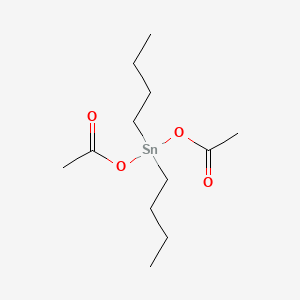
Dibutyltin diacetate
Dibutyltin diacetate is a clear yellow liquid. (NTP, 1992) — CAMEO Chemicals
- IUPAC name
- [acetyloxy(dibutyl)stannyl] acetate
- Molecular formula
- C12H24O4Sn
- Molecular weight
- 351.03 g/mol
- Exact mass
- 352.069662 Da
- Topological polar surface area
- 52.6 Ų
- Hydrogen-bond donors
- 0
- Hydrogen-bond acceptors
- 4
- Covalent units
- 1
- Defined stereocentres
- 0
Also known as
DiacetoxybutyltinDiacetoxydibutyltinDiacetoxydibutylstannaneStannane, bis(acetyloxy)dibutyl-Di-n-butyltin diacetateBis(acetyloxy)dibutylstannaneT 1 (Catalyst)Stannane, diacetoxydibutyl-
16 more reported names
Dibutylstannium diacetateFomrez sul-3DiacetoxydibutlyltinDibutyl tin diacetateDibutyltin di(acetate)Dibutyltin acetateTin, dibutyl-, diacetateBA 2726NCI-C02028DibutyldiacetoxystannaneBC9AZH1UZGNSC 8786Acetic acid, 1,1'-(dibutylstannylene) esterNSC-8786Dibutly Tin DiacetateRefChem:586576
External database identifiers
- EPA DTXSID:DTXSID3020419
Evidence from additional scientific databases
NIH PubChem PUG-View
Exact identifier match16682740
Attributed physical-property, hazard, environmental and use annotations.
- Boiling Point: 266 °F at 2 mmHg (NTP, 1992) Source: CAMEO Chemicals
- Boiling Point: 130 °C @ 2 mm Hg Source: Hazardous Substances Data Bank (HSDB)
- Boiling Point: 130 °C @760 [mm Hg] Source: PAC Chemical Database, U.S. Department of Energy
- Color/Form: COLORLESS LIQUID Source: Hazardous Substances Data Bank (HSDB)
- Color/Form: Clear, yellow liquid Source: Hazardous Substances Data Bank (HSDB)
- Density: 1.31 at 77 °F (NTP, 1992) - Denser than water; will sink Source: CAMEO Chemicals
- Density: 1.31 at 25 °C Source: Hazardous Substances Data Bank (HSDB)
- Density: 1.31 @25 °C Source: PAC Chemical Database, U.S. Department of Energy
- Flash Point: 290 °F (NTP, 1992) Source: CAMEO Chemicals
- Flash Point: 143 °C (290 °F) (OPEN CUP) Source: Hazardous Substances Data Bank (HSDB)
- LogP: log Kow=1.27 Source: Hazardous Substances Data Bank (HSDB)
- Melting Point: less than 53.6 °F (NTP, 1992) Source: CAMEO Chemicals
- Melting Point: 10 °C Source: Hazardous Substances Data Bank (HSDB)
- Odor: Slight acetic acid Source: Hazardous Substances Data Bank (HSDB)
- Physical Description: Dibutyltin diacetate is a clear yellow liquid. (NTP, 1992) Source: CAMEO Chemicals
- Physical Description: CBI; Liquid Source: EPA Chemical Data Reporting (CDR)
- Physical Description: Clear yellow liquid; [Hawley] Colorless or yellow liquid; mp = 10 deg C; [HSDB] Colorless liquid; [MSDSonline] Source: Haz-Map, Information on Hazardous Chemicals and Occupational Diseases
- Refractive Index: INDEX OF REFRACTION: 1.482 @ 20 °C Source: Hazardous Substances Data Bank (HSDB)
- Solubility: less than 1 mg/mL at 59 °F; forms white precipitate (NTP, 1992) Source: CAMEO Chemicals
- Solubility: Sol in water and most org solvents Source: Hazardous Substances Data Bank (HSDB)
- Vapor Pressure: 1.3 [mmHg] Source: Haz-Map, Information on Hazardous Chemicals and Occupational Diseases
- Vapor Pressure: 1.3 mm Hg at 20 °C Source: Hazardous Substances Data Bank (HSDB)
- Vapor Pressure: 1.3 [mm Hg] @20 °C Source: PAC Chemical Database, U.S. Department of Energy
- Viscosity: 18 cP at 25 °C Source: Hazardous Substances Data Bank (HSDB)
- Substance: Dibutyltin diacetate Source: NTP Technical Reports
- NTP Technical Report: TR-183: Bioassay of Dibutyltin Diacetate for Possible Carcinogenicity (CASRN 1067-33-0) (1979 ) Source: NTP Technical Reports
- Peer Review Date: 10/25/78 Source: NTP Technical Reports
- Conclusion for Male Rat: No Evidence Source: NTP Technical Reports
- Conclusion for Female Rat: Inadequate Experiment Source: NTP Technical Reports
- Conclusion for Male Mice: No Evidence Source: NTP Technical Reports
- Conclusion for Female Mice: No Evidence Source: NTP Technical Reports
- Summary: Under the conditions of this bioassay, there was no conclusive evidence for the carcinogenicity of dibutyltin diacetate in male Fischer 344 rats or B6C3F1 mice of either sex. The loss of tissues taken from high dose female rats in this bioassay precluded an evaluation of the carcinogenicity of dibutyltin diacetate to female Fischer 344 rats. Source: NTP Technical Reports
- Carcinogen Classification: No indication of carcinogenicity to humans (not listed by IARC). Source: Toxin and Toxin Target Database (T3DB)
- Exposure Routes: Oral (L308) ; inhalation (L308) ; dermal (L308) Source: Toxin and Toxin Target Database (T3DB)
- First Aid: EYES: First check the victim for contact lenses and remove if present. Flush victim's eyes with water or normal saline solution for 20 to 30 minutes while simultaneously calling a hospital or poison control center. Do not put any ointments, oils, or medication in the victim's eyes without specific instructions from a physician. IMMEDIATELY transport the victim after flushing eyes to a hospital even if no symptoms (such as redness or irritation) develop.; SKIN: IMMEDIATELY flood affected skin with water while removing and isolating all contaminated clothing. Gently wash all affected skin areas thoroughly with soap and water. IMMEDIATELY call a hospital or poison control center even if no symptoms (such as redness or irritation) develop. IMMEDIATELY transport the victim to a hospital for treatment after washing the affected areas.; INHALATION: IMMEDIATELY leave the contaminated area; take deep breaths of fresh air. IMMEDIATELY call a physician and be prepared to transport the victim to a hospital even if no symptoms (such as wheezing, coughing, shortness of breath, or burning in the mouth, throat, or chest) develop. Provide proper respiratory protection to rescuers entering an unknow Source: CAMEO Chemicals
- Signal: Danger Source: Regulation (EC) No 1272/2008 of the European Parliament and of the Council
- GHS Hazard Statements: H341: Suspected of causing genetic defects [Warning Germ cell mutagenicity]; H360FD: May damage fertility; May damage the unborn child [Danger Reproductive toxicity]; H372: Causes damage to organs through prolonged or repeated exposure [Danger Specific target organ toxicity, repeated exposure] Source: Regulation (EC) No 1272/2008 of the European Parliament and of the Council
- Precautionary Statement Codes: P203, P260, P264, P270, P280, P318, P319, P405, and P501 (click each P-code to see the statement) Source: Regulation (EC) No 1272/2008 of the European Parliament and of the Council
- Note: This chemical does not meet GHS hazard criteria for 1.5% (10 of 665) of reports. Source: European Chemicals Agency (ECHA)
- Signal: Danger Source: European Chemicals Agency (ECHA)
- GHS Hazard Statements: H314 (94.7%): Causes severe skin burns and eye damage [Danger Skin corrosion/irritation]; H317 (82%): May cause an allergic skin reaction [Warning Sensitization, Skin]; H318 (76.5%): Causes serious eye damage [Danger Serious eye damage/eye irritation]; H341 (82.4%): Suspected of causing genetic defects [Warning Germ cell mutagenicity]; H360 (64.4%): May damage fertility or the unborn child [Danger Reproductive toxicity]; H360FD (18.2%): May damage fertility; May damage the unborn child [Danger Reproductive toxicity]; H370 (82%): Causes damage to organs [Danger Specific target organ toxicity, single exposure]; H372 (92.3%): Causes damage to organs through prolonged or repeated exposure [Danger Specific target organ toxicity, repeated exposure]; H400 (58.6%): Very toxic to aquatic life [Warning Hazardous to the aquatic environment, acute hazard]; H410 (89%): Very toxic to aquatic life with long lasting effects [Warning Hazardous to the aquatic environment, long-term hazard] Source: European Chemicals Agency (ECHA)
- Precautionary Statement Codes: P203, P260, P261, P264, P264+P265, P270, P272, P273, P280, P301+P330+P331, P302+P352, P302+P361+P354, P304+P340, P305+P354+P338, P308+P316, P316, P317, P318, P319, P321, P333+P317, P362+P364, P363, P391, P405, and P501 (click each P-code to see the statement) Source: European Chemicals Agency (ECHA)
- ECHA C&L Notifications Summary: Aggregated GHS information provided per 665 reports by companies from 44 notifications to the ECHA C&L Inventory. Each notification may be associated with multiple companies.; Reported as not meeting GHS hazard criteria per 10 of 665 reports by companies.; There are 43 notifications provided by 655 of 665 reports by companies with hazard statement code(s).; Information may vary between notifications depending on impurities, additives, and other factors. The percentage value in parenthesis indicates the notified classification ratio from companies that provide hazard codes. Only hazard codes with percentage values above 10% are shown. For more detailed information, please visit ECHA C&L website. Source: European Chemicals Agency (ECHA)
- Signal: Danger Source: NITE-CMC
- GHS Hazard Statements: H300: Fatal if swallowed [Danger Acute toxicity, oral]; H360: May damage fertility or the unborn child [Danger Reproductive toxicity]; H373: May causes damage to organs through prolonged or repeated exposure [Warning Specific target organ toxicity, repeated exposure]; H400: Very toxic to aquatic life [Warning Hazardous to the aquatic environment, acute hazard]; H410: Very toxic to aquatic life with long lasting effects [Warning Hazardous to the aquatic environment, long-term hazard] Source: NITE-CMC
- Precautionary Statement Codes: P203, P260, P264, P270, P273, P280, P301+P316, P318, P319, P321, P330, P391, P405, and P501 (click each P-code to see the statement) Source: NITE-CMC
- Signal: Danger Source: Hazardous Chemical Information System (HCIS), Safe Work Australia
- Health Effects: Breathing or swallowing, or skin contact with organotins, can interfere with the way the brain and nervous system work, causing death in severe cases. Organic tin compounds may also damage the immune and reproductive system. (L307, L308) Source: Toxin and Toxin Target Database (T3DB)
- Toxicity Summary: Organotin compounds produce neurotoxic and immunotoxic effects. Organotins may directly activate glial cells contributing to neuronal cell degeneration by local release of pro-inflammatory cytokines, tumor necrosis factor-_, and/or interleukins. They may also induce apoptosis by direct action on neuronal cells. Organotin compounds stimulate the neuronal release of and/or decrease of neuronal cell uptake of neurotransmitters in brain tissue, including aspartate, GABA, glutamate, norepinephrine, and serotonin. This may be either a contributing factor to or result of the neuronal cell loss. The immunotoxic effects of organotins are characterized by thymic atrophy caused by the suppression of proliferation of immature thymocytes and apoptosis of mature thymocytes. Organotin compounds are believed to exert these effects by suppressing DNA and protein synthesis, inducing the expression of genes involved in apoptosis (such as nur77), and disrupting the regulation of intracellular calcium levels, giving rise to the uncontrolled production of reactive oxygen species, release of cytochrome c to the cytosol, and the proteolytic and nucleolytic cascade of apoptosis. The suppression of prolifer Source: Toxin and Toxin Target Database (T3DB)
- Consumer Uses: Stabilizing agent Source: EPA Chemical Data Reporting (CDR)
- Industry Uses: Catalyst; Processing aids not otherwise specified Source: EPA Chemical Data Reporting (CDR)
- Sources/Uses: Used as stabilizer for polyvinyl chloride, a catalyst for manufacturing silicone and urethane foams, and a curing agent for silicone elastomers; [HSDB] Source: Haz-Map, Information on Hazardous Chemicals and Occupational Diseases
- Industrial Processes with risk of exposure: Plastic Composites Manufacturing [Category: Industry] Source: Haz-Map, Information on Hazardous Chemicals and Occupational Diseases
- Uses: Stabilizer for chlorinated org cmpd; catalyst for condensation reactions. Source: Hazardous Substances Data Bank (HSDB)
- Uses: CATALYST FOR MFR OF SILICONE AND URETHANE FOAMS, FOR ESTERIFICATION REACTIONS Source: Hazardous Substances Data Bank (HSDB)
- Uses: The largest single industrial application for organotin compounds is in the stabilization of polyvinyl chloride. /Diorganotin compounds/ Source: Hazardous Substances Data Bank (HSDB)
- Uses: Dialkyltin compounds are the best general-purpose stabilizers for polyvinyl chloride, esp if colorlessness & transparency are required. ... Diorganotin compounds have been used increasingly as catalysts for high resiliency foam in automotive seating. /Diorganotin compounds/ Source: Hazardous Substances Data Bank (HSDB)
- Uses: For more Uses (Complete) data for DIBUTYLTIN DIACETATE (7 total), please visit the HSDB record page. Source: Hazardous Substances Data Bank (HSDB)
Mapped by: Existing checksum-valid CAS to unique PubChem CID match. Retrieved: 2026-08-31. Open source record
Scientific classifications and hazard annotations provide context and do not replace the market-specific regulatory decision shown above.
Additional source coverage and match status
| Source | Result | Checked |
|---|---|---|
| EMBL-EBI ChEBI | No exact record | 2026-08-31 |
| NIH PubChem PUG-View | Exact match | 2026-08-31 |
A recorded no-match is useful evidence that the source was checked; it is not a claim that the substance does not exist elsewhere.
Retrieved from NIH PubChem on 2026-09-02 by checksum-valid CAS matching. Chemical properties do not replace the regulatory decision on this page.