
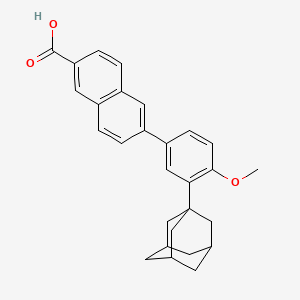
Adapalene
Adapalene is a naphthoic acid that is CD437 in which the phenolic hydroxy group has been converted to its methyl ether. It has a role as a non-steroidal anti-inflammatory drug, a dermatologic drug and an EC 2.7.11.22 (cyclin-dependent kinase) inhibitor. It is a monocarboxylic acid, a naphthoic acid and a member of adamantanes. It is functionally related to a CD437. — ChEBI
- IUPAC name
- 6-[3-(1-adamantyl)-4-methoxyphenyl]naphthalene-2-carboxylic acid
- Molecular formula
- C28H28O3
- Molecular weight
- 412.5 g/mol
- Exact mass
- 412.20384475 Da
- XLogP3
- 7.7
- Topological polar surface area
- 46.5 Ų
- Hydrogen-bond donors
- 1
- Hydrogen-bond acceptors
- 3
- Covalent units
- 1
- Defined stereocentres
- 0
Also known as
16 more reported names
External database identifiers
- ChEBI:CHEBI:31174
- ChEMBL:CHEMBL1265
- ChEMBL:CHEMBL4303650
- EPA DTXSID:DTXSID5046481
- PubMed:24177211
- PubMed:22988653
- PubMed:22908733
- PubMed:22859236
- PubMed:22847319
- PubMed:22808305
- PubMed:22779096
- PubMed:22772617
- PubMed:22728381
- PubMed:22677304
- PubMed:22648218
- PubMed:22615511
Evidence from additional scientific databases
EMBL-EBI ChEBI
adapalene
A naphthoic acid that is CD437 in which the phenolic hydroxy group has been converted to its methyl ether.
- Formula
- C28H28O3
- Average mass
- 412.529 g/mol
- Monoisotopic mass
- 412.20384 Da
- Formal charge
- 0
- naphthoic acid — is a (CHEBI:25483)
- monocarboxylic acid — is a (CHEBI:25384)
- adamantanes — is a (CHEBI:51339)
- dermatologic drug — has role (CHEBI:50177)
- non-steroidal anti-inflammatory drug — has role (CHEBI:35475)
- EC 2.7.11.22 (cyclin-dependent kinase) inhibitor — has role (CHEBI:82665)
- CD437 — has functional parent (CHEBI:88334)
- dermatologic drug — has role (CHEBI:50177)
- non-steroidal anti-inflammatory drug — has role (CHEBI:35475)
- EC 2.7.11.22 (cyclin-dependent kinase) inhibitor — has role (CHEBI:82665)
- naphthoic acid — is a (CHEBI:25483)
- monocarboxylic acid — is a (CHEBI:25384)
- adamantanes — is a (CHEBI:51339)
- 11594670 Source: PubMed
- 12833014 Source: PubMed
- 16472241 Source: PubMed
- 18759424 Source: PubMed
- 22194678 Source: PubMed
- 23956101 Source: PubMed
- 25016424 Source: PubMed
- 25790278 Source: PubMed
- 26398439 Source: PubMed
- 26483036 Source: PubMed
- 29706423 Source: PubMed
- 30852084 Source: PubMed
- 34812616 Source: PubMed
- 35820623 Source: PubMed
- 37468498 Source: PubMed
- 8544175 Source: PubMed
Additional curated names
Cross-references from this source
Mapped by: Exact CAS cross-reference in the ChEBI compound record. Source updated: 2017-02-22. Retrieved: 2026-08-31. Open source record
NIH PubChem PUG-View
Attributed physical-property, hazard, environmental and use annotations.
- Boiling Point: 606.3 Source: DrugBank
- LogP: 6.917 Source: DrugBank
- LogP: 8.6 Source: Human Metabolome Database (HMDB)
- Melting Point: 300 Source: DrugBank
- Physical Description: Solid Source: Human Metabolome Database (HMDB)
- Solubility: 4.01e-06 g/L Source: Human Metabolome Database (HMDB)
- Carcinogen Classification: No indication of carcinogenicity to humans (not listed by IARC). Source: Toxin and Toxin Target Database (T3DB)
- Exposure Routes: Absorption of adapalene through human skin is low. Only trace amounts (<0.25 ng/mL) of parent substance have been found in the plasma of acne patients following chronic topical application of adapalene in controlled clinical trials Source: Toxin and Toxin Target Database (T3DB)
- Note: This chemical does not meet GHS hazard criteria for 9.1% (1 of 11) of reports. Source: European Chemicals Agency (ECHA)
- Signal: Warning Source: European Chemicals Agency (ECHA)
- GHS Hazard Statements: H302 (18.2%): Harmful if swallowed [Warning Acute toxicity, oral]; H315 (72.7%): Causes skin irritation [Warning Skin corrosion/irritation]; H317 (54.5%): May cause an allergic skin reaction [Warning Sensitization, Skin]; H319 (72.7%): Causes serious eye irritation [Warning Serious eye damage/eye irritation]; H335 (18.2%): May cause respiratory irritation [Warning Specific target organ toxicity, single exposure; Respiratory tract irritation]; H361 (81.8%): Suspected of damaging fertility or the unborn child [Warning Reproductive toxicity] Source: European Chemicals Agency (ECHA)
- Precautionary Statement Codes: P203, P261, P264, P264+P265, P270, P271, P272, P280, P301+P317, P302+P352, P304+P340, P305+P351+P338, P318, P319, P321, P330, P332+P317, P333+P317, P337+P317, P362+P364, P403+P233, P405, and P501 (click each P-code to see the statement) Source: European Chemicals Agency (ECHA)
- ECHA C&L Notifications Summary: Aggregated GHS information provided per 11 reports by companies from 7 notifications to the ECHA C&L Inventory. Each notification may be associated with multiple companies.; Reported as not meeting GHS hazard criteria per 1 of 11 reports by companies.; There are 6 notifications provided by 10 of 11 reports by companies with hazard statement code(s).; Information may vary between notifications depending on impurities, additives, and other factors. The percentage value in parenthesis indicates the notified classification ratio from companies that provide hazard codes. Only hazard codes with percentage values above 10% are shown. For more detailed information, please visit ECHA C&L website. Source: European Chemicals Agency (ECHA)
- Health Effects: Chronic ingestion of the drug may lead to the same side effects as those associated with excessive oral intake of Vitamin A. Source: Toxin and Toxin Target Database (T3DB)
- Toxicity Summary: If the adapalene is applied excessively, marked redness, scaling, or skin discomfort may occur. In addition, according to product labeling, chronic ingestion of the drug may lead to the same adverse drug reactions associated with excessive oral intake of vitamin A. Source: StatPearls
- Toxicity Summary: Mechanistically, adapalene binds to specific retinoic acid nuclear receptors (gamma and beta) and retinoid X receptors but does not bind to the cytosolic receptor protein. Although the exact mode of action of adapalene is unknown, it is suggested that topical adapalene may normalize the differentiation of follicular epithelial cells resulting in decreased microcomedone formation. Source: Toxin and Toxin Target Database (T3DB)
- Uses: Use (kg) in USA (2002): 78; Consumption (g per capita) in the USA (2002): 0.000278; Calculated removal (%): 97.7 Source: NORMAN Suspect List Exchange
- Uses: For the topical treatment of comedo, papular and pustular acne (acne vulgaris) of the face, chest or back. Source: Toxin and Toxin Target Database (T3DB)
Mapped by: Existing checksum-valid CAS to unique PubChem CID match. Retrieved: 2026-08-31. Open source record
Scientific classifications and hazard annotations provide context and do not replace the market-specific regulatory decision shown above.
Additional source coverage and match status
| Source | Result | Checked |
|---|---|---|
| EMBL-EBI ChEBI | Exact match | 2026-08-31 |
| NIH PubChem PUG-View | Exact match | 2026-08-31 |
A recorded no-match is useful evidence that the source was checked; it is not a claim that the substance does not exist elsewhere.
Retrieved from NIH PubChem on 2026-08-31 by checksum-valid CAS matching. Chemical properties do not replace the regulatory decision on this page.