
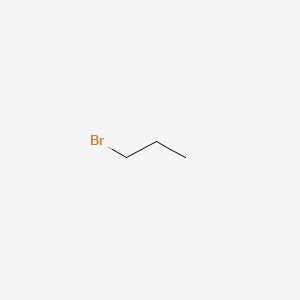
1-Bromopropane
1-bromopropane is a bromoalkane that is propane carrying a bromo substituent at position 1. It has a role as a solvent and a neurotoxin. It is a bromohydrocarbon and a bromoalkane. — ChEBI
- IUPAC name
- 1-bromopropane
- Molecular formula
- C3H7Br
- Molecular weight
- 122.99 g/mol
- Exact mass
- 121.97311 Da
- XLogP3
- 2.1
- Topological polar surface area
- 0.0 Ų
- Hydrogen-bond donors
- 0
- Hydrogen-bond acceptors
- 0
- Covalent units
- 1
- Defined stereocentres
- 0
Also known as
16 more reported names
External database identifiers
- ChEBI:CHEBI:47105
- ChEMBL:CHEMBL1230095
- EPA DTXSID:DTXSID6021874
- PubMed:32715571
- PubMed:30247689
- PubMed:27634370
- PubMed:27452781
- PubMed:27421776
- PubMed:23395825
- PubMed:23384675
- PubMed:23266320
- PubMed:23062436
- PubMed:22893012
- PubMed:22865591
- PubMed:22824114
Evidence from additional scientific databases
EMBL-EBI ChEBI
1-bromopropane
A bromoalkane that is propane carrying a bromo substituent at position 1.
- Formula
- C3H7Br
- Average mass
- 122.993 g/mol
- Monoisotopic mass
- 121.97311 Da
- Formal charge
- 0
- bromoalkane — is a (CHEBI:22929)
- bromohydrocarbon — is a (CHEBI:22926)
- neurotoxin — has role (CHEBI:50910)
- solvent — has role (CHEBI:46787)
- neurotoxin — has role (CHEBI:50910)
- solvent — has role (CHEBI:46787)
- bromoalkane — is a (CHEBI:22929)
- bromohydrocarbon — is a (CHEBI:22926)
Additional curated names
Cross-references from this source
- CAS: 106-94-5 — ChemIDplus
- MANUAL_X_REF: 3BR — PDBeChem
- MANUAL_X_REF: N-Propyl_bromide — Wikipedia
- REGISTRY_NUMBER: 505936 — Reaxys
Mapped by: Exact CAS cross-reference in the ChEBI compound record. Source updated: 2021-05-20. Retrieved: 2026-08-31. Open source record
NIH PubChem PUG-View
Attributed physical-property, hazard, environmental and use annotations.
- Autoignition Temperature: 914 °F (USCG, 1999) Source: CAMEO Chemicals
- Autoignition Temperature: 914 °F (490 °C) Source: Hazardous Substances Data Bank (HSDB)
- Autoignition Temperature: 490 °C Source: ILO-WHO International Chemical Safety Cards (ICSCs)
- Boiling Point: 160 °F at 760 mmHg (USCG, 1999) Source: CAMEO Chemicals
- Boiling Point: 71 °C at 760 mm Source: Hazardous Substances Data Bank (HSDB)
- Boiling Point: 71.0 °C Source: ILO-WHO International Chemical Safety Cards (ICSCs)
- Boiling Point: 159.6 °F Source: Occupational Safety and Health Administration (OSHA)
- Boiling Point: 71 °C @760 [mm Hg] Source: PAC Chemical Database, U.S. Department of Energy
- Color/Form: Colorless liquid Source: Hazardous Substances Data Bank (HSDB)
- Density: 1.3537 at 68 °F (USCG, 1999) - Denser than water; will sink Source: CAMEO Chemicals
- Density: 1.353 at 20 °C/20 °C Source: Hazardous Substances Data Bank (HSDB)
- Density: Relative density (water = 1): 1.35 Source: ILO-WHO International Chemical Safety Cards (ICSCs)
- Density: 1.3537 Source: Occupational Safety and Health Administration (OSHA)
- Density: 1.35 @ 20°C Source: PAC Chemical Database, U.S. Department of Energy
- Flash Point: 78 °F (USCG, 1999) Source: CAMEO Chemicals
- Flash Point: 22 °C (72 °F) - closed cup Source: Hazardous Substances Data Bank (HSDB)
- Flash Point: 22 °C c.c. Source: ILO-WHO International Chemical Safety Cards (ICSCs)
- Flash Point: 71.6 °F (closed cup) Source: Occupational Safety and Health Administration (OSHA)
- LogP: log Kow = 2.10 Source: Hazardous Substances Data Bank (HSDB)
- LogP: 2.1 Source: ILO-WHO International Chemical Safety Cards (ICSCs)
- Melting Point: -166 °F (USCG, 1999) Source: CAMEO Chemicals
- Melting Point: -110 °C Source: Hazardous Substances Data Bank (HSDB)
- Melting Point: Liquid molar volume = 0.09143 cu m/kmol; IG heat of formation = -8.7864X10+7 J/kmol; Heat fusion at melting point = 6.5270X10+6 J/kmol Source: Hazardous Substances Data Bank (HSDB)
- Melting Point: -110 °C Source: ILO-WHO International Chemical Safety Cards (ICSCs)
- Melting Point: -166 °F Source: Occupational Safety and Health Administration (OSHA)
- Melting Point: -110 °C Source: PAC Chemical Database, U.S. Department of Energy
- Odor: Sweet odor Source: Hazardous Substances Data Bank (HSDB)
- Physical Description: 1-bromopropane appears as a colorless liquid. Slightly denser than water and slightly soluble in water. Flash point below 75 °F. When heated to high temperatures may emit toxic fumes. Special Hazards of Combustion Products: Toxic fumes of Hydrogen Bromide (USCG, 1999) Source: CAMEO Chemicals
- Physical Description: Liquid Source: EPA Chemical Data Reporting (CDR)
- Physical Description: Colorless liquid; [ACGIH] Source: Haz-Map, Information on Hazardous Chemicals and Occupational Diseases
- Physical Description: COLOURLESS LIQUID. Source: ILO-WHO International Chemical Safety Cards (ICSCs)
- Physical Description: A flammable or combustible colorless liquid. Source: Occupational Safety and Health Administration (OSHA)
- Refractive Index: Index of refraction: 1.4343 at 20 °C/D Source: Hazardous Substances Data Bank (HSDB)
- Solubility: In water, 2,450 mg/L at 20 °C Source: Hazardous Substances Data Bank (HSDB)
- Solubility: Slightly soluble in water Source: Hazardous Substances Data Bank (HSDB)
- Solubility: Soluble in acetone, ethanol, ether, benzene chloroform, carbon tetrachloride Source: Hazardous Substances Data Bank (HSDB)
- Solubility: Solubility in water, g/l at 20 °C: 2.5 (slightly soluble) Source: ILO-WHO International Chemical Safety Cards (ICSCs)
- Vapor Pressure: 274.01 mmHg (USCG, 1999) Source: CAMEO Chemicals
- Vapor Pressure: 111.0 [mmHg] Source: Haz-Map, Information on Hazardous Chemicals and Occupational Diseases
- Vapor Pressure: 110.8 mm Hg at 20 °C Source: Hazardous Substances Data Bank (HSDB)
- Vapor Pressure: Vapor pressure, kPa at 18 °C: 13.3 Source: ILO-WHO International Chemical Safety Cards (ICSCs)
- Vapor Pressure: 274.01 mmHg Source: Occupational Safety and Health Administration (OSHA)
- Vapor Pressure: 110.8 [mm Hg] @18 °C Source: PAC Chemical Database, U.S. Department of Energy
- Viscosity: 0.489 mPa.s at 25 °C Source: Hazardous Substances Data Bank (HSDB)
- IARC Carcinogenic Agent: 1-Bromopropane Source: International Agency for Research on Cancer (IARC)
- IARC Carcinogenic Classes: Group 2B: Possibly carcinogenic to humans Source: International Agency for Research on Cancer (IARC)
- IARC Monographs: Volume 115: (2018) Some Industrial Chemicals Source: International Agency for Research on Cancer (IARC)
- Publication Year: 2018 Source: International Agency for Research on Cancer (IARC)
- Evaluation Year: 2016 Source: International Agency for Research on Cancer (IARC)
- Substance: 1-Bromopropane Source: NTP Technical Reports
- NTP Technical Report: TR-564: Toxicology and Carcinogenesis Studies of 1-Bromopropane (CASRN 106-94-5) in F344/N Rats and B6C3F1 (Inhalation Studies) (2011 ) Source: NTP Technical Reports
- Peer Review Date: 11/19/09 Source: NTP Technical Reports
- Conclusion for Male Rat: Some Evidence Source: NTP Technical Reports
- Conclusion for Female Rat: Clear Evidence Source: NTP Technical Reports
- Conclusion for Male Mice: No Evidence Source: NTP Technical Reports
- Conclusion for Female Mice: Clear Evidence Source: NTP Technical Reports
- Exposure Routes: The substance can be absorbed into the body by inhalation of its vapour, through the skin and by ingestion. Source: ILO-WHO International Chemical Safety Cards (ICSCs)
- Exposure Routes: Oral (L626) ; inhalation (L626) ; dermal (L626) Source: Toxin and Toxin Target Database (T3DB)
- First Aid: Call a physician.; EYES: Flush with running water for at least 15 minutes.; SKIN: Remove contaminated clothing and shoes, flush affected areas with water for at least 15 minutes.; INHALATION: Move to fresh air. If breathing has stopped, give artificial respiration. If breathing is difficult, give oxygen.; INGESTION: Do nothing except keep victim warm. (USCG, 1999) Source: CAMEO Chemicals
- Signal: Danger Source: Regulation (EC) No 1272/2008 of the European Parliament and of the Council
- GHS Hazard Statements: H225: Highly Flammable liquid and vapor [Danger Flammable liquids]; H315: Causes skin irritation [Warning Skin corrosion/irritation]; H319: Causes serious eye irritation [Warning Serious eye damage/eye irritation]; H335: May cause respiratory irritation [Warning Specific target organ toxicity, single exposure; Respiratory tract irritation]; H336: May cause drowsiness or dizziness [Warning Specific target organ toxicity, single exposure; Narcotic effects]; H360FD: May damage fertility; May damage the unborn child [Danger Reproductive toxicity]; H373 **: May causes damage to organs through prolonged or repeated exposure [Warning Specific target organ toxicity, repeated exposure] Source: Regulation (EC) No 1272/2008 of the European Parliament and of the Council
- Precautionary Statement Codes: P203, P210, P233, P240, P241, P242, P243, P260, P261, P264, P264+P265, P271, P280, P302+P352, P303+P361+P353, P304+P340, P305+P351+P338, P318, P319, P321, P332+P317, P337+P317, P362+P364, P370+P378, P403+P233, P403+P235, P405, and P501 (click each P-code to see the statement) Source: Regulation (EC) No 1272/2008 of the European Parliament and of the Council
- Signal: Danger Source: European Chemicals Agency (ECHA)
- GHS Hazard Statements: H225 (100%): Highly Flammable liquid and vapor [Danger Flammable liquids]; H315 (100%): Causes skin irritation [Warning Skin corrosion/irritation]; H319 (100%): Causes serious eye irritation [Warning Serious eye damage/eye irritation]; H335 (85.4%): May cause respiratory irritation [Warning Specific target organ toxicity, single exposure; Respiratory tract irritation]; H336 (99.4%): May cause drowsiness or dizziness [Warning Specific target organ toxicity, single exposure; Narcotic effects]; H360 (95.8%): May damage fertility or the unborn child [Danger Reproductive toxicity]; H373 (99.9%): May causes damage to organs through prolonged or repeated exposure [Warning Specific target organ toxicity, repeated exposure] Source: European Chemicals Agency (ECHA)
- Precautionary Statement Codes: P203, P210, P233, P240, P241, P242, P243, P260, P261, P264, P264+P265, P271, P280, P302+P352, P303+P361+P353, P304+P340, P305+P351+P338, P318, P319, P321, P332+P317, P337+P317, P362+P364, P370+P378, P403+P233, P403+P235, P405, and P501 (click each P-code to see the statement) Source: European Chemicals Agency (ECHA)
- ECHA C&L Notifications Summary: Aggregated GHS information provided per 720 reports by companies from 22 notifications to the ECHA C&L Inventory. Each notification may be associated with multiple companies.; Information may vary between notifications depending on impurities, additives, and other factors. The percentage value in parenthesis indicates the notified classification ratio from companies that provide hazard codes. Only hazard codes with percentage values above 10% are shown. For more detailed information, please visit ECHA C&L website. Source: European Chemicals Agency (ECHA)
- Signal: Danger Source: NITE-CMC
- GHS Hazard Statements: H225: Highly Flammable liquid and vapor [Danger Flammable liquids]; H319: Causes serious eye irritation [Warning Serious eye damage/eye irritation]; H332: Harmful if inhaled [Warning Acute toxicity, inhalation]; H335: May cause respiratory irritation [Warning Specific target organ toxicity, single exposure; Respiratory tract irritation]; H336: May cause drowsiness or dizziness [Warning Specific target organ toxicity, single exposure; Narcotic effects]; H351: Suspected of causing cancer [Warning Carcinogenicity]; H360: May damage fertility or the unborn child [Danger Reproductive toxicity]; H372: Causes damage to organs through prolonged or repeated exposure [Danger Specific target organ toxicity, repeated exposure]; H373: May causes damage to organs through prolonged or repeated exposure [Warning Specific target organ toxicity, repeated exposure]; H402: Harmful to aquatic life [Hazardous to the aquatic environment, acute hazard]; H412: Harmful to aquatic life with long lasting effects [Hazardous to the aquatic environment, long-term hazard] Source: NITE-CMC
- Precautionary Statement Codes: P203, P210, P233, P240, P241, P242, P243, P260, P261, P264, P264+P265, P270, P271, P273, P280, P303+P361+P353, P304+P340, P305+P351+P338, P317, P318, P319, P337+P317, P370+P378, P403+P233, P403+P235, P405, and P501 (click each P-code to see the statement) Source: NITE-CMC
- GHS Hazard Statements: H225: Highly Flammable liquid and vapor [Danger Flammable liquids]; H319: Causes serious eye irritation [Warning Serious eye damage/eye irritation]; H332: Harmful if inhaled [Warning Acute toxicity, inhalation]; H335: May cause respiratory irritation [Warning Specific target organ toxicity, single exposure; Respiratory tract irritation]; H336: May cause drowsiness or dizziness [Warning Specific target organ toxicity, single exposure; Narcotic effects]; H361: Suspected of damaging fertility or the unborn child [Warning Reproductive toxicity]; H372: Causes damage to organs through prolonged or repeated exposure [Danger Specific target organ toxicity, repeated exposure] Source: NITE-CMC
- Precautionary Statement Codes: P203, P210, P233, P240, P241, P242, P243, P260, P261, P264, P264+P265, P270, P271, P280, P303+P361+P353, P304+P340, P305+P351+P338, P317, P318, P319, P337+P317, P370+P378, P403+P233, P403+P235, P405, and P501 (click each P-code to see the statement) Source: NITE-CMC
- Health Effects: Skin irritation if contacts skin, redness and itching of skin and eyes. Acute exposure may lead to coughing, shortness of breath, headache, nausea, vomiting. Chronic exposure can lead to damage of the blood, liver and CNS. Neurotoxicity can arise due to chronic exposure through inhalation or skin. Human cases of 1-bromopropane (1-BP) toxicity exhibit ataxic gait and cognitive dysfunction, whereas rat studies showed pyknotic shrinkage in cerebellar Purkinje cells and electrophysiological changes in the hippocampus. Inhalation exposure to 1-bromopropane causes skin tumors in male rats, large intestine tumors in female and male rats, and lung tumors in female mice. 1-bromopropane, either directly or via reactive metabolites, can cause molecular alterations that typically are associated with carcinogenesis, including genotoxicity, oxidative stress, and glutathione depletion. Hepatotoxicity and reproductive toxicity have been noted in rodent studies. Source: Toxin and Toxin Target Database (T3DB)
- NFPA Health Rating: 2 - Materials that, under emergency conditions, can cause temporary incapacitation or residual injury. Source: Hazardous Substances Data Bank (HSDB)
- NFPA Fire Rating: 2 - Materials that must be moderately heated or exposed to relatively high ambient temperatures before ignition can occur. Materials would not under normal conditions form hazardous atmospheres with air, but under high ambient temperatures or under moderate heating could release vapor in sufficient quantities to produce hazardous atmospheres with air. Source: Hazardous Substances Data Bank (HSDB)
- NFPA Instability Rating: 0 - Materials that in themselves are normally stable, even under fire conditions. Source: Hazardous Substances Data Bank (HSDB)
- Target Organs: Cancer, Neurological (Nervous System) Source: Agency for Toxic Substances and Disease Registry (ATSDR)
- Toxicity Summary: IDENTIFICATION AND USE: 1-Bromopropane (1-BP) is a colorless liquid. 1-BP is used primarily as a solvent cleaner in vapor and immersion degreasing operations to clean optics, electronics, and metals and as a solvent vehicle in industries using aerosol-applied adhesives, such as foam cushion manufacturing. HUMAN STUDIES: Occupational exposure to 1-BP has been linked to neurological illnesses. Exposure to 1-BP could adversely affect peripheral nerves or/and the central nervous system. A 43-year-old male industrial worker developed muscle weakness, pain, numbness, and gait disturbance. Neurological examination indicated sensory ataxic neuropathy associated with mild impairment of upper motor neurons. He had used 1-BP as a cleaning agent for metal parts at his workplace without appropriate protection. Another case study reported that a 19-year-old male experienced weakness of the lower extremities and the right hand, numbness, and difficulty swallowing and urinating after 2 months of occupational exposure to a degreasing solvent based on 1-BP. 1-BP is cytotoxic but not corrosive, based on results from a cultured reconstructed human epidermal model (EpiDerm Skin Corrosivity Test). 1-BP Source: Hazardous Substances Data Bank (HSDB)
- Toxicity Summary: Organobromide compounds, especially alkylbromides are strong alkylating agents. Consequently they can randomly modify the surfaces of proteins and lipids, leading to the disruption of enzyme, transporter or membrane functions. Alkylation of DNA by alkylbromides may also lead to mutations. 1-bromopropane reacts quickly with hepatic glutathione (GSH) leading to its rapid depletion and subsequent liver damage. Long-term exposure to 1-bromopropane decreases neurogenesis in the dentate gyrus which may contribute to the neurotoxicity. Downregulation of brain derived neurotrophic factor and glucocoritoid receptor mRNA expression and low hippocampal norepinephrine levels might contribute, at least in part, to the reduced neurogenesis. Source: Toxin and Toxin Target Database (T3DB)
- Environmental Bioconcentration: An estimated BCF of 11 was calculated in fish for 1-bromopropane(SRC), using a measured log Kow of 2.10(1) and a regression-derived equation(2). According to a classification scheme(3), this BCF suggests the potential for bioconcentration in aquatic organisms is low(SRC). 1-Bromopropane was classified as having low bioconcentration based on fish accumulation studies (specific data not reported)(4). Source: Hazardous Substances Data Bank (HSDB)
- Environmental Fate: TERRESTRIAL FATE: Based on a classification scheme(1), an estimated Koc value of 37(SRC), determined from a structure estimation method(2), indicates that 1-bromopropane is expected to have very high mobility in soil(SRC). Volatilization of 1-bromopropane from moist soil surfaces is expected to be an important fate process(SRC) given an estimated Henry's Law constant of 7.3X10⁻³ atm-cu m/mole(SRC) derived from a vapor pressure of 111 mm Hg(3) and water solubility of 2450 mg/L(4). 1-Bromopropane is expected to volatilize from dry soil surfaces based upon its vapor pressure(SRC). A 70% of theoretical BOD using activated sludge in the Japanese MITI test(5) suggests that biodegradation may be an important environmental fate process in soil(SRC). A number of pure culture studies(6-9) have shown that microorganisms are capable of degrading 1-bromopropane. Source: Hazardous Substances Data Bank (HSDB)
- Environmental Fate: AQUATIC FATE: Based on a classification scheme(1), an estimated Koc value of 37(SRC), determined from a structure estimation method(2), indicates that 1-bromopropane is not expected to adsorb to suspended solids and sediment(SRC). Volatilization from water surfaces is expected(3) based upon an estimated Henry's Law constant of 7.3X10⁻³ atm-cu m/mole(SRC), derived from a vapor pressure of 111 mm Hg(4) and water solubility of 2450 mg/L(5). Using this Henry's Law constant and an estimation method(3), volatilization half-lives for a model river and model lake are 3.4 hours and 4.4 days, respectively(SRC). According to a classification scheme(6), an estimated BCF of 11(SRC), from its log Kow of 2.10(7) and a regression-derived equation(2), suggests the potential for bioconcentration in aquatic organisms is low(SRC). The hydrolysis half-life of 1-bromopropane is approximately 26 days at pH 7 and 25 °C(8). A 70% of theoretical BOD using activated sludge in the Japanese MITI test(9) suggests that biodegradation may be an important environmental fate process in water(SRC). A number of pure culture studies(10-13) have shown that microorganisms are capable of degrading 1-bromopropane. Source: Hazardous Substances Data Bank (HSDB)
- Environmental Fate: ATMOSPHERIC FATE: According to a model of gas/particle partitioning of semivolatile organic compounds in the atmosphere(1), 1-bromopropane, which has a vapor pressure of 111 mm Hg at 25 °C(2), is expected to exist solely as a vapor in the ambient atmosphere. Vapor-phase 1-bromopropane is degraded in the atmosphere by reaction with photochemically-produced hydroxyl radicals(SRC); the half-life for this reaction in air is estimated to be 15 days(SRC), calculated from its rate constant of 1.06X10⁻¹² cu cm/molecule-sec at 25 °C(3). 1-Bromopropane does not contain chromophores that absorb at wavelengths >290 nm(4) and, therefore, is not expected to be susceptible to direct photolysis by sunlight(SRC). Source: Hazardous Substances Data Bank (HSDB)
- Industry Uses: Cleaning agent; Intermediate Source: EPA Chemical Data Reporting (CDR)
- Sources/Uses: Used as a solvent substitute to clean metals and electronics, in adhesive and coating applications, and in aerosol propellant applications. Has also been used to replace perchloroethylene in dry cleaning; [ACGIH] Source: Haz-Map, Information on Hazardous Chemicals and Occupational Diseases
- Industrial Processes with risk of exposure: Metal Degreasing [Category: Clean]; Painting (Solvents) [Category: Paint]; Working with Glues and Adhesives [Category: Other]; Dry Cleaning [Category: Clean] Source: Haz-Map, Information on Hazardous Chemicals and Occupational Diseases
- Uses: Solvent for fats, waxes and resins; intermediate in synthesis of pharmaceuticals, insecticides and other compounds; in spray adhesives; degreaser; cleaner for metal and precision electronic components. Source: Hazardous Substances Data Bank (HSDB)
- Uses: Production of penconazole, valproic acid /From table/ Source: Hazardous Substances Data Bank (HSDB)
- Uses: In the early to mid 1990s, 1-bromopropane was used primarily as an intermediate in the production of pesticides, quaternary ammonium compounds, flavors and fragrances, pharmaceuticals, and other chemicals in well-controlled, closed processes. In the mid to late 1990s, it was introduced as a less toxic replacement for methylene chloride in emissive applications such as vapor and immersion degreasing operations and critical cleaning of electronics and metals. 1-Bromopropane was also introduced as a nonflammable, nontoxic, fast-drying, and inexpensive solvent for adhesive resins, and has been marketed as a replacement for ozone depleting refrigerants. Source: Hazardous Substances Data Bank (HSDB)
- Uses: 1-Bromopropane is used primarily as a solvent cleaner in vapor and immersion degreasing operations to clean optics, electronics, and metals and as a solvent vehicle in industries using aerosol-applied adhesives, such as foam cushion manufacturing. ...1-Bromopropane also has potential for use as a spot remover in the textile industry... In the past, 1-bromopropane was used primarily as a solvent for fats, waxes, and resins and as an intermediate in the synthesis of pharmaceuticals, insecticides, quaternary ammonium compounds, flavors, and fragrances in generally well-controlled, closed processes. Source: Hazardous Substances Data Bank (HSDB)
- Uses: Cleaning solvent, drycleaning solvent, aerosol glue solvent. 1-bromopropane may be found in products used in vapor and immersion degreasing operations for cleaning metal, plastics, electronic and optical components; in adhesive spray applications; and in dry cleaning operations. 1-bromopropane may also be a component of some aerosol spray products. Exposures to 1-bromopropane in occupational settings occur via two primary routes: (1) inhalation of 1-bromopropane vapors and mists; and (2) skin contact with 1-bromopropane. Source: Toxin and Toxin Target Database (T3DB)
Mapped by: Existing checksum-valid CAS to unique PubChem CID match. Retrieved: 2026-08-31. Open source record
Scientific classifications and hazard annotations provide context and do not replace the market-specific regulatory decision shown above.
Additional source coverage and match status
| Source | Result | Checked |
|---|---|---|
| EMBL-EBI ChEBI | Exact match | 2026-08-31 |
| NIH PubChem PUG-View | Exact match | 2026-08-31 |
A recorded no-match is useful evidence that the source was checked; it is not a claim that the substance does not exist elsewhere.
Retrieved from NIH PubChem on 2026-09-02 by checksum-valid CAS matching. Chemical properties do not replace the regulatory decision on this page.