
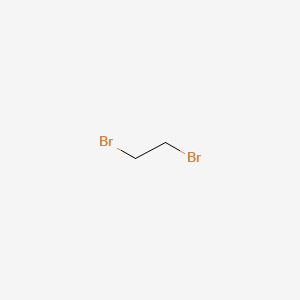
1,2-Dibromoethane
1,2-dibromoethane is a bromoalkane that is ethane carrying bromo substituents at positions 1 and 2. It is produced by marine algae. It has a role as a mutagen, a fumigant, a carcinogenic agent, a mouse metabolite, a marine metabolite and an algal metabolite. It is a bromohydrocarbon and a bromoalkane. — ChEBI
- IUPAC name
- 1,2-dibromoethane
- Molecular formula
- C2H4Br2
- Molecular weight
- 187.86 g/mol
- Exact mass
- 187.86593 Da
- XLogP3
- 2.0
- Topological polar surface area
- 0.0 Ų
- Hydrogen-bond donors
- 0
- Hydrogen-bond acceptors
- 0
- Covalent units
- 1
- Defined stereocentres
- 0
Also known as
16 more reported names
External database identifiers
- ChEBI:CHEBI:28534
- ChEMBL:CHEMBL452370
- EPA DTXSID:DTXSID3020415
- PubMed:30203046
- PubMed:30114225
- PubMed:27029555
- PubMed:24906048
- PubMed:22940321
- PubMed:22676410
- PubMed:22655244
- PubMed:22606128
- PubMed:22589164
- PubMed:22463689
- PubMed:22457804
- PubMed:22434383
Evidence from additional scientific databases
EMBL-EBI ChEBI
1,2-dibromoethane
A bromoalkane that is ethane carrying bromo substituents at positions 1 and 2. It is produced by marine algae.
- Formula
- C2H4Br2
- Average mass
- 187.862 g/mol
- Monoisotopic mass
- 185.86797 Da
- Formal charge
- 0
- bromohydrocarbon — is a (CHEBI:22926)
- bromoalkane — is a (CHEBI:22929)
- algal metabolite — has role (CHEBI:84735)
- mutagen — has role (CHEBI:25435)
- fumigant — has role (CHEBI:39276)
- carcinogenic agent — has role (CHEBI:50903)
- marine metabolite — has role (CHEBI:76507)
- mouse metabolite — has role (CHEBI:75771)
- algal metabolite — has role (CHEBI:84735)
- mutagen — has role (CHEBI:25435)
- fumigant — has role (CHEBI:39276)
- carcinogenic agent — has role (CHEBI:50903)
- marine metabolite — has role (CHEBI:76507)
- mouse metabolite — has role (CHEBI:75771)
- bromohydrocarbon — is a (CHEBI:22926)
- bromoalkane — is a (CHEBI:22929)
Additional curated names
Cross-references from this source
- CAS: 106-93-4 — KEGG COMPOUND
- CAS: 106-93-4 — NIST Chemistry WebBook
- CAS: 106-93-4 — ChemIDplus
- MANUAL_X_REF: 1,2-Dibromoethane — Wikipedia
- MANUAL_X_REF: 12-DIBROMOETHANE — MetaCyc
- MANUAL_X_REF: 1484 — PPDB
- MANUAL_X_REF: C11088 — KEGG COMPOUND
- MANUAL_X_REF: HMDB0060334 — HMDB
- REGISTRY_NUMBER: 1913 — Gmelin
- REGISTRY_NUMBER: 605266 — Reaxys
Mapped by: Exact CAS cross-reference in the ChEBI compound record. Source updated: 2017-10-17. Retrieved: 2026-08-31. Open source record
NIH PubChem PUG-View
Attributed physical-property, hazard, environmental and use annotations.
- Autoignition Temperature: Not flammable (USCG, 1999) Source: CAMEO Chemicals
- Boiling Point: 268 to 270 °F at 760 mmHg (NTP, 1992) Source: CAMEO Chemicals
- Boiling Point: 131.3 °C Source: Hazardous Substances Data Bank (HSDB)
- Boiling Point: 131 °C Source: ILO-WHO International Chemical Safety Cards (ICSCs)
- Boiling Point: 268 °F Source: Occupational Safety and Health Administration (OSHA)
- Boiling Point: 131.6 °C @760 [mm Hg] Source: PAC Chemical Database, U.S. Department of Energy
- Boiling Point: 268 °F Source: The National Institute for Occupational Safety and Health (NIOSH)
- Color/Form: Heavy liquid Source: Hazardous Substances Data Bank (HSDB)
- Color/Form: Colorless liquid or solid (below 50 degrees F) Source: Hazardous Substances Data Bank (HSDB)
- Density: 2.18 at 68 °F (USCG, 1999) - Denser than water; will sink Source: CAMEO Chemicals
- Density: 2.16832 g/cu cm at 25 °C Source: Hazardous Substances Data Bank (HSDB)
- Density: Relative density (water = 1): 2.2 Source: ILO-WHO International Chemical Safety Cards (ICSCs)
- Density: 2.17 Source: Occupational Safety and Health Administration (OSHA)
- Density: 2.1683 @25 °C Source: PAC Chemical Database, U.S. Department of Energy
- Density: 2.17 Source: The National Institute for Occupational Safety and Health (NIOSH)
- LogP: log Kow = 1.96 Source: Hazardous Substances Data Bank (HSDB)
- LogP: 1.96 Source: ILO-WHO International Chemical Safety Cards (ICSCs)
- Melting Point: 49.9 °F (NTP, 1992) Source: CAMEO Chemicals
- Melting Point: 9.8 °C Source: Hazardous Substances Data Bank (HSDB)
- Melting Point: 10 °C Source: ILO-WHO International Chemical Safety Cards (ICSCs)
- Melting Point: 50 °F Source: Occupational Safety and Health Administration (OSHA)
- Melting Point: 9.84 °C Source: PAC Chemical Database, U.S. Department of Energy
- Melting Point: 50 °F Source: The National Institute for Occupational Safety and Health (NIOSH)
- Odor: Chloroform odor Source: Hazardous Substances Data Bank (HSDB)
- Odor: Sweetish odor Source: Hazardous Substances Data Bank (HSDB)
- Physical Description: Ethylene dibromide appears as a clear colorless liquid with a sweetish odor. Density 18.1 lb /gal. Slightly soluble in water. Soluble in most organic solvents and thinners. Noncombustible. Very toxic by inhalation, skin absorption or ingestion. Used as a solvent, scavenger for lead in gasoline, grain fumigant and in the manufacture of other chemicals. Source: CAMEO Chemicals
- Physical Description: Liquid Source: EPA Chemical Data Reporting (CDR)
- Physical Description: Colorless liquid or solid (below 50 degrees F) with a sweet odor. [fumigant] [NIOSH] Source: Haz-Map, Information on Hazardous Chemicals and Occupational Diseases
- Physical Description: COLOURLESS LIQUID WITH CHARACTERISTIC ODOUR. TURNS BROWN ON EXPOSURE TO LIGHT. Source: ILO-WHO International Chemical Safety Cards (ICSCs)
- Physical Description: Colorless liquid or solid (below 50 °F) with a sweet odor. Source: Occupational Safety and Health Administration (OSHA)
- Physical Description: Colorless liquid or solid (below 50 °F) with a sweet odor. [fumigant] Source: The National Institute for Occupational Safety and Health (NIOSH)
- Refractive Index: Index of refraction: 1.5356 at 20 °C/D Source: Hazardous Substances Data Bank (HSDB)
- Solubility: less than 1 mg/mL at 70 °F (NTP, 1992) Source: CAMEO Chemicals
- Solubility: In water, 4,310 mg/L at 30 °C Source: Hazardous Substances Data Bank (HSDB)
- Solubility: In water, 3.91X10+3 mg/L at 25 °C Source: Hazardous Substances Data Bank (HSDB)
- Solubility: Soluble in about 250 parts water Source: Hazardous Substances Data Bank (HSDB)
- Solubility: Soluble in diethyl ether, ethanol and most organic solvents. Miscible with non-alkaline organic liquids Source: Hazardous Substances Data Bank (HSDB)
- Solubility: For more Solubility (Complete) data for Ethylene dibromide (7 total), please visit the HSDB record page. Source: Hazardous Substances Data Bank (HSDB)
- Solubility: Solubility in water, g/100ml at 20 °C: 0.34 (poor) Source: ILO-WHO International Chemical Safety Cards (ICSCs)
- Solubility: 0.4% Source: The National Institute for Occupational Safety and Health (NIOSH)
- Vapor Pressure: 11 mmHg at 68 °F ; 17.4 mmHg at 86 °F (NTP, 1992) Source: CAMEO Chemicals
- Vapor Pressure: 11.2 [mmHg] Source: Haz-Map, Information on Hazardous Chemicals and Occupational Diseases
- Vapor Pressure: 11.2 mm Hg at 25 °C Source: Hazardous Substances Data Bank (HSDB)
- Vapor Pressure: Vapor pressure, kPa at 20 °C: 1.5 Source: ILO-WHO International Chemical Safety Cards (ICSCs)
- Vapor Pressure: 12 mmHg Source: Occupational Safety and Health Administration (OSHA)
- Vapor Pressure: 7.5 [mm Hg] @18 °C Source: PAC Chemical Database, U.S. Department of Energy
- Vapor Pressure: 11 mmHg (@ 77 °F) Source: The National Institute for Occupational Safety and Health (NIOSH)
- Viscosity: 1.727 cP at 20 °C Source: Hazardous Substances Data Bank (HSDB)
- IARC Carcinogenic Agent: Ethylene dibromide Source: International Agency for Research on Cancer (IARC)
- IARC Carcinogenic Classes: Group 2A: Probably carcinogenic to humans Source: International Agency for Research on Cancer (IARC)
- IARC Monographs: Volume 15: (1977) Some Fumigants, the Herbicides 2,4-D and 2,4,5-T, Chlorinated Dibenzodioxins and Miscellaneous Industrial Chemicals; Volume Sup 7: Overall Evaluations of Carcinogenicity: An Updating of IARC Monographs Volumes 1 to 42, 1987; 440 pages; ISBN 92-832-1411-0 (out of print); Volume 71: (1999) Re-evaluation of Some Organic Chemicals, Hydrazine and Hydrogen Peroxide (Part 1, Part 2, Part 3) Source: International Agency for Research on Cancer (IARC)
- Publication Year: 1999 Source: International Agency for Research on Cancer (IARC)
- Evaluation Year: 1998 Source: International Agency for Research on Cancer (IARC)
- Additional information: NB Overall evaluation upgraded to Group 2A with supporting evidence from other relevant data Source: International Agency for Research on Cancer (IARC)
- Substance: 1,2-Dibromoethane Source: NTP Technical Reports
- NTP Technical Report: TR-210: Carcinogenesis Bioassay of 1,2-Dibromoethane (CASRN 106-93-4) in F344 Rats and B6C3F1 Mice (Inhalation Study) (1982 ) Source: NTP Technical Reports
- Peer Review Date: 06/27/80 Source: NTP Technical Reports
- Conclusion for Male Rat: Clear Evidence Source: NTP Technical Reports
- Conclusion for Female Rat: Clear Evidence Source: NTP Technical Reports
- Conclusion for Male Mice: Clear Evidence Source: NTP Technical Reports
- Exposure Routes: The substance can be absorbed into the body by inhalation of its vapour, through the skin and by ingestion. Source: ILO-WHO International Chemical Safety Cards (ICSCs)
- Exposure Routes: inhalation, skin absorption, ingestion, skin and/or eye contact Source: The National Institute for Occupational Safety and Health (NIOSH)
- Exposure Routes: Oral (L120) ; inhalation (L120) ; dermal (L120) Source: Toxin and Toxin Target Database (T3DB)
- First Aid: EYES: First check the victim for contact lenses and remove if present. Flush victim's eyes with water or normal saline solution for 20 to 30 minutes while simultaneously calling a hospital or poison control center. Do not put any ointments, oils, or medication in the victim's eyes without specific instructions from a physician. IMMEDIATELY transport the victim after flushing eyes to a hospital even if no symptoms (such as redness or irritation) develop.; SKIN: IMMEDIATELY flood affected skin with water while removing and isolating all contaminated clothing. Gently wash all affected skin areas thoroughly with soap and water. IMMEDIATELY call a hospital or poison control center even if no symptoms (such as redness or irritation) develop. IMMEDIATELY transport the victim to a hospital for treatment after washing the affected areas.; INHALATION: IMMEDIATELY leave the contaminated area; take deep breaths of fresh air. IMMEDIATELY call a physician and be prepared to transport the victim to a hospital even if no symptoms (such as wheezing, coughing, shortness of breath, or burning in the mouth, throat, or chest) develop. Provide proper respiratory protection to rescuers entering an unknow Source: CAMEO Chemicals
- ERG2024, Guide 154 (Ethylene dibromide): General First Aid:; · Call 911 or emergency medical service.; · Ensure that medical personnel are aware of the material(s) involved, take precautions to protect themselves and avoid contamination.; · Move victim to fresh air if it can be done safely.; · Administer oxygen if breathing is difficult.; · If victim is not breathing:; -- DO NOT perform mouth-to-mouth resuscitation; the victim may have ingested or inhaled the substance.; -- If equipped and pulse detected, wash face and mouth, then give artificial respiration using a proper respiratory medical device (bag-valve mask, pocket mask equipped with a one-way valve or other device).; -- If no pulse detected or no respiratory medical device available, provide continuous compressions. Conduct a pulse check every two minutes or monitor for any signs of spontaneous respirations.; · Remove and isolate contaminated clothing and shoes.; · For minor skin contact, avoid spreading material on unaffected skin.; · In case of contact with substance, remove immediately by flushing skin or eyes with running water for at least 20 minutes.; · For severe burns, immediate medical attention is required.; · Effects of exposure (inhalation, ingestion, Source: Emergency Response Guidebook (ERG)
- First Aid: (General first aid procedures); Eye: Irrigate immediately - If this chemical contacts the eyes, immediately wash (irrigate) the eyes with large amounts of water, occasionally lifting the lower and upper lids. Get medical attention immediately.; Skin: Soap wash immediately - If this chemical contacts the skin, immediately wash the contaminated skin with soap and water. If this chemical penetrates the clothing, immediately remove the clothing, wash the skin with soap and water, and get medical attention promptly.; Breathing: Respiratory support; Swallow: Medical attention immediately - If this chemical has been swallowed, get medical attention immediately. Source: The National Institute for Occupational Safety and Health (NIOSH)
- Signal: Danger Source: Regulation (EC) No 1272/2008 of the European Parliament and of the Council
- GHS Hazard Statements: H301: Toxic if swallowed [Danger Acute toxicity, oral]; H311: Toxic in contact with skin [Danger Acute toxicity, dermal]; H315: Causes skin irritation [Warning Skin corrosion/irritation]; H319: Causes serious eye irritation [Warning Serious eye damage/eye irritation]; H331: Toxic if inhaled [Danger Acute toxicity, inhalation]; H335: May cause respiratory irritation [Warning Specific target organ toxicity, single exposure; Respiratory tract irritation]; H350: May cause cancer [Danger Carcinogenicity]; H411: Toxic to aquatic life with long lasting effects [Hazardous to the aquatic environment, long-term hazard] Source: Regulation (EC) No 1272/2008 of the European Parliament and of the Council
- Precautionary Statement Codes: P203, P261, P262, P264, P264+P265, P270, P271, P273, P280, P301+P316, P302+P352, P304+P340, P305+P351+P338, P316, P318, P319, P321, P330, P332+P317, P337+P317, P361+P364, P362+P364, P391, P403+P233, P405, and P501 (click each P-code to see the statement) Source: Regulation (EC) No 1272/2008 of the European Parliament and of the Council
- Signal: Danger Source: European Chemicals Agency (ECHA)
- GHS Hazard Statements: H301+H311+H331 (26.7%): Toxic if swallowed, in contact with skin or if inhaled [Danger Acute toxicity, oral; acute toxicity, dermal; acute toxicity, inhalation]; H301 (100%): Toxic if swallowed [Danger Acute toxicity, oral]; H311 (100%): Toxic in contact with skin [Danger Acute toxicity, dermal]; H315 (100%): Causes skin irritation [Warning Skin corrosion/irritation]; H319 (100%): Causes serious eye irritation [Warning Serious eye damage/eye irritation]; H331 (94.2%): Toxic if inhaled [Danger Acute toxicity, inhalation]; H335 (100%): May cause respiratory irritation [Warning Specific target organ toxicity, single exposure; Respiratory tract irritation]; H350 (99.2%): May cause cancer [Danger Carcinogenicity]; H411 (100%): Toxic to aquatic life with long lasting effects [Hazardous to the aquatic environment, long-term hazard] Source: European Chemicals Agency (ECHA)
- Precautionary Statement Codes: P203, P261, P262, P264, P264+P265, P270, P271, P273, P280, P301+P316, P302+P352, P304+P340, P305+P351+P338, P316, P318, P319, P321, P330, P332+P317, P337+P317, P361+P364, P362+P364, P391, P403+P233, P405, and P501 (click each P-code to see the statement) Source: European Chemicals Agency (ECHA)
- ECHA C&L Notifications Summary: Aggregated GHS information provided per 120 reports by companies from 14 notifications to the ECHA C&L Inventory. Each notification may be associated with multiple companies.; Information may vary between notifications depending on impurities, additives, and other factors. The percentage value in parenthesis indicates the notified classification ratio from companies that provide hazard codes. Only hazard codes with percentage values above 10% are shown. For more detailed information, please visit ECHA C&L website. Source: European Chemicals Agency (ECHA)
- Signal: Danger Source: NITE-CMC
- GHS Hazard Statements: H301: Toxic if swallowed [Danger Acute toxicity, oral]; H311: Toxic in contact with skin [Danger Acute toxicity, dermal]; H315: Causes skin irritation [Warning Skin corrosion/irritation]; H319: Causes serious eye irritation [Warning Serious eye damage/eye irritation]; H330: Fatal if inhaled [Danger Acute toxicity, inhalation]; H341: Suspected of causing genetic defects [Warning Germ cell mutagenicity]; H350: May cause cancer [Danger Carcinogenicity]; H360: May damage fertility or the unborn child [Danger Reproductive toxicity]; H370: Causes damage to organs [Danger Specific target organ toxicity, single exposure]; H372: Causes damage to organs through prolonged or repeated exposure [Danger Specific target organ toxicity, repeated exposure] Source: NITE-CMC
- Precautionary Statement Codes: P203, P260, P262, P264, P264+P265, P270, P271, P280, P284, P301+P316, P302+P352, P304+P340, P305+P351+P338, P308+P316, P316, P318, P319, P320, P321, P330, P332+P317, P337+P317, P361+P364, P362+P364, P403+P233, P405, and P501 (click each P-code to see the statement) Source: NITE-CMC
- GHS Hazard Statements: H401: Toxic to aquatic life [Hazardous to the aquatic environment, acute hazard]; H411: Toxic to aquatic life with long lasting effects [Hazardous to the aquatic environment, long-term hazard] Source: NITE-CMC
- Precautionary Statement Codes: P273, P391, and P501 (click each P-code to see the statement) Source: NITE-CMC
- Health Effects: Long term exposure can result in liver, kidney, and reproductive system damage. 1,2-Dibromoethane is also known to have adverse effects on the brain. (L120) Source: Toxin and Toxin Target Database (T3DB)
- Target Organs: Body Weight, Cancer, Gastrointestinal (Stomach and Intestines, part of the digestive system), Hepatic (Liver), Renal (Urinary System or Kidneys), Reproductive (Producing Children) Source: Agency for Toxic Substances and Disease Registry (ATSDR)
- Target Organs: Endocrine; Hepatic; Reproductive; Respiratory Source: EPA Integrated Risk Information System (IRIS)
- Target Organs: Eyes, skin, respiratory system, liver, kidneys, reproductive system Source: The National Institute for Occupational Safety and Health (NIOSH)
- Toxicity Summary: IDENTIFICATION AND USE: Ethylene dibromide (1,2-Dibromoethane) is a colorless liquid. Historically, the primary use of 1,2-dibromoethane has been as a lead scavenger in antiknock mixtures added to gasolines. Another major past use of 1,2-dibromoethane was as a pesticide and an ingredient of soil and grain fumigants and for post-harvest application. 1,2-Dibromoethane has been used as a chemical intermediate in the manufacture of resins, gums, waxes, dyes, and pharmaceuticals and as a high-density, nonflammable solvent. HUMAN STUDIES: 1,2-Dibromoethane has produced oral ulcerations, followed by liver and renal toxicity. Cases of fatal poisoning have been reported. It was a DNA damaging agent when tested in human lymphocytes, but positive results were noted only after metabolic activation. ANIMAL STUDIES: Dogs exposed for 1 to 1.5 hr to vapor of 1,2-dibromoethane developed clouding of corneas several hours after removal from the exposure chamber. Rats tolerated exposure to 25 ppm 1,2-dibromoethane in air over 7 hr/day for 151 days, but 63 similar exposures to levels of 50 ppm were lethal to 20-50% of animals. Deaths from acute exposure were usually due to lung congestion and hemorrhag Source: Hazardous Substances Data Bank (HSDB)
- Toxicity Summary: The metabolite 2-bromoacetaldehyde produces liver damage by binding to cellular proteins. S-(2-bromoethyl)glutathione, another metabolite, exerts genotoxic and carcinogenic effects by binding to DNA. Antispermatogenic effects of 1,2-dibromoethanes metabolites may be caused by their covalent binding to thiol groups of nucleoproteins in nuclei of spermatozoa. Such adduct formation interferes with DNA, causing improper packing of the chromatin. (L120) Source: Toxin and Toxin Target Database (T3DB)
- Environmental Bioconcentration: A BCF range of <3.5 to 14.9 was measured in fish for ethylene dibromide(SRC) using carp (Cyprinus carpio) which were exposed over a 6-week period(1). A measured fish BCF of <1 has also been reported(2). According to a classification scheme(3), this BCF range suggests the potential for bioconcentration in aquatic organisms is low(SRC). Source: Hazardous Substances Data Bank (HSDB)
- Environmental Fate: TERRESTRIAL FATE: Based on a classification scheme(1), Koc values ranging from 14-160(2,3) indicate that ethylene dibromide is expected to have high to very high mobility in soil(SRC). Volatilization of ethylene dibromide from moist soil surfaces is expected to be an important fate process(SRC) given a Henry's Law constant of 6.50X10⁻⁴ atm-cu m/mole(2). Ethylene dibromide is expected to volatilize from dry soil surfaces(SRC) based upon a vapor pressure of 11.2 mm Hg at 25 °C(4). Biodegradation can be a primary degradation process in soil(2,5). A review of biodegradation data pertaining to ethylene dibromide concluded that ethylene dibromide can be biotransformed fairly readily in the environment(5); lifetimes can be as short as several days in surface soils and as long as many months in aquifer materials(5). Persistence can vary greatly from soil to soil. In one laboratory screening study using 100 soils, half-lives ranging from 1.5 to 18 weeks were determined(6). In one field, ethylene dibromide was detected in soil 19 years after its last known application(7); the long persistence was the result of entrapment in intraparticle micropores of the soil(7). The field dissipation half- Source: Hazardous Substances Data Bank (HSDB)
- Environmental Fate: AQUATIC FATE: Based on a classification scheme(1), Koc values ranging from 14-160(2), indicate that ethylene dibromide is not expected to adsorb to suspended solids and sediment(SRC). Volatilization from water surfaces is expected(3) based upon a Henry's Law constant of 6.50X10⁻⁴ atm-cu m/mole(2). Using this Henry's Law constant and an estimation method(3), volatilization half-lives for a model river and model lake are 5.9 hrs and 6.0 days, respectively(SRC). According to a classification scheme(4), BCFs ranging from <1 to 14.9 (5,6), suggest the potential for bioconcentration in aquatic organisms is low(SRC). Degradation screening studies have demonstrated that ethylene dibromide is predominately biodegraded in aquatic conditions via comparison of sterile versus non-sterile conditions(7,8). Degradation rates can vary greatly. Three day die-away tests using Japanese river and seawater observed moderate degradation (21-35% degradation)(9). Microbial degradation in microcosms using shallow aquifer material and groundwater found ethylene dibromide degraded aerobically in all samples with half-lives ranging from 35-350 days(10). Biodegradation in a methanogenic aquifer at 17 °C (and 19 Source: Hazardous Substances Data Bank (HSDB)
- Environmental Fate: ATMOSPHERIC FATE: According to a model of gas/particle partitioning of semivolatile organic compounds in the atmosphere(1), ethylene dibromide, which has a vapor pressure of 11.2 mm Hg at 25 °C(2) is expected to exist solely as a vapor in the ambient atmosphere. Vapor-phase ethylene dibromide is degraded in the atmosphere by reaction with photochemically-produced hydroxyl radicals(SRC); the half-life for this reaction in air is estimated to be 64 days(SRC), calculated from its rate constant of 2.50X10⁻¹³ cu cm/molecule-sec at 25 °C(3). The transformation products from the reaction of ethylene dibromide with hydroxyl radical in the atmosphere includes formaldehyde, bromoethanol, hydrogen bromide, and formyl bromide(4). Ethylene dibromide does not absorb at wavelengths >290 nm(5) and, therefore, is not expected to be susceptible to direct photolysis by sunlight(SRC). It did not directly photolyze when exposed to UV light between 300 and 400 nm(6). Source: Hazardous Substances Data Bank (HSDB)
- Consumer Uses: Fuel agents Source: EPA Chemical Data Reporting (CDR)
- Industry Uses: Fuel agents Source: EPA Chemical Data Reporting (CDR)
- Uses: Ethylene dibromide was used in the past as an additive to leaded gasoline; however, since leaded gasoline is now banned, it is no longer used for this purpose. Ethylene dibromide is currently used in the treatment of felled logs for bark beetles and termites, and control of wax moths in beehives. Source: EPA Hazardous Air Pollutants
- Sources/Uses: Used as a fumigant, a solvent, a scavenger for lead in leaded gasoline, and an intermediate in organic synthesis; no longer used in the United States as a soil or grain fumigant; [ACGIH] Source: Haz-Map, Information on Hazardous Chemicals and Occupational Diseases
- Restricted Notes: Use as fumigant suspended by EPA due to toxicity and ground water contamination. [Sullivan, p. 1053] Source: Haz-Map, Information on Hazardous Chemicals and Occupational Diseases
- Uses: For ethylene dibromide (USEPA/OPP Pesticide Code: 042002) there are 0 labels match. /SRP: Not registered for current use in the U.S., but approved pesticide uses may change periodically and so federal, state and local authorities must be consulted for currently approved uses./ Source: Hazardous Substances Data Bank (HSDB)
- Uses: The active ingredient is no longer contained in any registered products ... "cancelled." Source: Hazardous Substances Data Bank (HSDB)
- Uses: Soil and grain fumigant; as lead scavenger in anti-knock gasolines. Source: Hazardous Substances Data Bank (HSDB)
- Uses: EDB is a versatile reagent in organic synthesis. Major uses in this category are as an intermediate for pharmaceuticals (tetramisole, theodrenaline), herbicides (diquat dibromide), and dyes (Vat Blue 16), where it provides an ''ethylene bridge'' in the molecular structure. EDB is used as a nonflammable solvent for resins, gums, and waxes. Additionally, EDB can be used as a raw material in the synthesis of chemicals such as vinyl bromide (a precursor of flame-retardants) and styrenic block copolymers. Source: Hazardous Substances Data Bank (HSDB)
- Uses: For more Uses (Complete) data for Ethylene dibromide (8 total), please visit the HSDB record page. Source: Hazardous Substances Data Bank (HSDB)
- Uses: 1,2-Dibromoethane was once widely used as an additive in leaded gasoline and a pesticide, however, today it's use is restricted to only certain pesticides (treatment of logs for termites and beetles, control of moths in beehives) and dye preparations. (L120) Source: Toxin and Toxin Target Database (T3DB)
Mapped by: Existing checksum-valid CAS to unique PubChem CID match. Retrieved: 2026-08-31. Open source record
Scientific classifications and hazard annotations provide context and do not replace the market-specific regulatory decision shown above.
Additional source coverage and match status
| Source | Result | Checked |
|---|---|---|
| EMBL-EBI ChEBI | Exact match | 2026-08-31 |
| NIH PubChem PUG-View | Exact match | 2026-08-31 |
A recorded no-match is useful evidence that the source was checked; it is not a claim that the substance does not exist elsewhere.
Retrieved from NIH PubChem on 2026-09-02 by checksum-valid CAS matching. Chemical properties do not replace the regulatory decision on this page.