
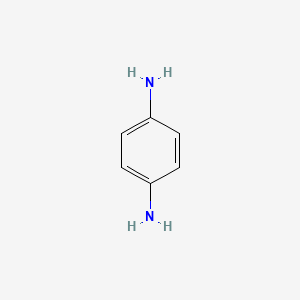
P-Phenylenediamine
1,4-phenylenediamine is a phenylenediamine in which the amino functions are at positions 1 and 4 of the benzene nucleus. It has a role as a reagent, a dye, an allergen and a hapten. — ChEBI
- IUPAC name
- benzene-1,4-diamine
- Molecular formula
- C6H8N2
- Molecular weight
- 108.14 g/mol
- Exact mass
- 108.068748264 Da
- XLogP3
- -0.3
- Topological polar surface area
- 52.0 Ų
- Hydrogen-bond donors
- 2
- Hydrogen-bond acceptors
- 2
- Covalent units
- 1
- Defined stereocentres
- 0
Also known as
16 more reported names
External database identifiers
- ChEBI:CHEBI:51403
- ChEMBL:CHEMBL403741
- EPA DTXSID:DTXSID9021138
- PubMed:40527391
- PubMed:35363429
- PubMed:34826398
- PubMed:32006680
- PubMed:31967339
- PubMed:31734321
- PubMed:31276767
- PubMed:31226360
- PubMed:30439388
- PubMed:27965148
- PubMed:27585668
- PubMed:26795242
Evidence from additional scientific databases
EMBL-EBI ChEBI
1,4-phenylenediamine
A phenylenediamine in which the amino functions are at positions 1 and 4 of the benzene nucleus.
- Formula
- C6H8N2
- Average mass
- 108.144 g/mol
- Monoisotopic mass
- 108.06875 Da
- Formal charge
- 0
- phenylenediamine — is a (CHEBI:51402)
- dye — has role (CHEBI:37958)
- reagent — has role (CHEBI:33893)
- allergen — has role (CHEBI:50904)
- hapten — has role (CHEBI:59174)
- dye — has role (CHEBI:37958)
- reagent — has role (CHEBI:33893)
- allergen — has role (CHEBI:50904)
- hapten — has role (CHEBI:59174)
- phenylenediamine — is a (CHEBI:51402)
- 10694312 Source: PubMed
- 10771133 Source: PubMed
- 11495521 Source: PubMed
- 1395635 Source: PubMed
- 15462465 Source: PubMed
- 17256041 Source: PubMed
- 17827020 Source: PubMed
- 18837732 Source: PubMed
- 18844695 Source: PubMed
- 19099270 Source: PubMed
- 19469519 Source: PubMed
- 19958436 Source: PubMed
- 20565505 Source: PubMed
- 21616561 Source: PubMed
- 23257336 Source: PubMed
- 23510340 Source: PubMed
- 24385090 Source: PubMed
- 8254706 Source: PubMed
- 8735869 Source: PubMed
- 9540973 Source: PubMed
Additional curated names
Cross-references from this source
- CAS: 106-50-3 — NIST Chemistry WebBook
- CAS: 106-50-3 — ChemIDplus
- CAS: 106-50-3 — KEGG COMPOUND
- MANUAL_X_REF: 13835179 — ChemSpider
- MANUAL_X_REF: C19499 — KEGG COMPOUND
- MANUAL_X_REF: DB14141 — DrugBank
- MANUAL_X_REF: HMDB0256055 — HMDB
- MANUAL_X_REF: P-Phenylenediamine — Wikipedia
- REGISTRY_NUMBER: 749029 — Reaxys
Mapped by: Exact CAS cross-reference in the ChEBI compound record. Source updated: 2024-03-05. Retrieved: 2026-08-31. Open source record
NIH PubChem PUG-View
Attributed physical-property, hazard, environmental and use annotations.
- Autoignition Temperature: 400 °C Source: ILO-WHO International Chemical Safety Cards (ICSCs)
- Boiling Point: 513 °F at 760 mmHg (NTP, 1992) Source: CAMEO Chemicals
- Boiling Point: 267 °C Source: Hazardous Substances Data Bank (HSDB)
- Boiling Point: 267 °C Source: ILO-WHO International Chemical Safety Cards (ICSCs)
- Boiling Point: 513 °F Source: Occupational Safety and Health Administration (OSHA)
- Boiling Point: 267 °C @760 [mm Hg] Source: PAC Chemical Database, U.S. Department of Energy
- Boiling Point: 513 °F Source: The National Institute for Occupational Safety and Health (NIOSH)
- Color/Form: WHITE TO SLIGHTLY RED CRYSTALS Source: Hazardous Substances Data Bank (HSDB)
- Color/Form: WHITE PLATES FROM BENZENE, ETHER Source: Hazardous Substances Data Bank (HSDB)
- Density: Greater than 1 (water= 1) Source: Hazardous Substances Data Bank (HSDB)
- Density: Relative density (water = 1): 1.1 Source: ILO-WHO International Chemical Safety Cards (ICSCs)
- Density: >1 no temp Source: PAC Chemical Database, U.S. Department of Energy
- Dissociation Constants: The pKa value of the conjugate acid is 6.2 Source: Hazardous Substances Data Bank (HSDB)
- Flash Point: 311 °F (NTP, 1992) Source: CAMEO Chemicals
- Flash Point: 311 °F Source: Haz-Map, Information on Hazardous Chemicals and Occupational Diseases
- Flash Point: 156 °C c.c. Source: ILO-WHO International Chemical Safety Cards (ICSCs)
- Flash Point: 312 °F Source: Occupational Safety and Health Administration (OSHA)
- Flash Point: 312 °F Source: The National Institute for Occupational Safety and Health (NIOSH)
- LogP: log Kow= -0.25 Source: Hazardous Substances Data Bank (HSDB)
- Melting Point: 284 °F (NTP, 1992) Source: CAMEO Chemicals
- Melting Point: 145-147 °C Source: Hazardous Substances Data Bank (HSDB)
- Melting Point: 139-147 °C Source: ILO-WHO International Chemical Safety Cards (ICSCs)
- Melting Point: 295 °F Source: Occupational Safety and Health Administration (OSHA)
- Melting Point: 141.1 °C Source: PAC Chemical Database, U.S. Department of Energy
- Melting Point: 295 °F Source: The National Institute for Occupational Safety and Health (NIOSH)
- Physical Description: P-phenylenediamine appears as a white to purple crystalline solid (melting point 234 F) that turns purple to black in air. Flash point 309 F. Toxic by skin absorption, inhalation or ingestion. Used for production of aramid fiber, antioxidants, as a laboratory reagent, in photographic developing, and as a dye for hair and furs. Source: CAMEO Chemicals
- Physical Description: Large Crystals; Liquid Source: EPA Chemical Data Reporting (CDR)
- Physical Description: White to slightly red, crystalline solid; [NIOSH] Source: Haz-Map, Information on Hazardous Chemicals and Occupational Diseases
- Physical Description: WHITE-TO-SLIGHTLY-RED CRYSTALS. TURNS DARK ON EXPOSURE TO AIR. Source: ILO-WHO International Chemical Safety Cards (ICSCs)
- Physical Description: White to slightly red, crystalline solid. Source: Occupational Safety and Health Administration (OSHA)
- Physical Description: White to slightly red, crystalline solid. Source: The National Institute for Occupational Safety and Health (NIOSH)
- Solubility: 4 % at 75 °F (NIOSH, 2024) Source: CAMEO Chemicals
- Solubility: SOL IN 100 PARTS COLD WATER; SOL IN ALCOHOL, CHLOROFORM, ETHER Source: Hazardous Substances Data Bank (HSDB)
- Solubility: SOL IN HOT BENZENE Source: Hazardous Substances Data Bank (HSDB)
- Solubility: Water solubility= 38,000 ppm Source: Hazardous Substances Data Bank (HSDB)
- Solubility: Solubility in water, g/100ml at 25 °C: 4 Source: ILO-WHO International Chemical Safety Cards (ICSCs)
- Solubility: (75 °F): 4% Source: The National Institute for Occupational Safety and Health (NIOSH)
- Vapor Pressure: less than 1 mmHg (NIOSH, 2024) Source: CAMEO Chemicals
- Vapor Pressure: 0.005 [mmHg] Source: Haz-Map, Information on Hazardous Chemicals and Occupational Diseases
- Vapor Pressure: <1 mm Hg at 21 °C (technical product) Source: Hazardous Substances Data Bank (HSDB)
- Vapor Pressure: Vapor pressure, Pa at 100 °C: 144 Source: ILO-WHO International Chemical Safety Cards (ICSCs)
- Vapor Pressure: <1 mmHg Source: Occupational Safety and Health Administration (OSHA)
- Vapor Pressure: <1 mmHg Source: The National Institute for Occupational Safety and Health (NIOSH)
- IARC Carcinogenic Agent: para-Phenylenediamine Source: International Agency for Research on Cancer (IARC)
- IARC Carcinogenic Classes: Group 3: Not classifiable as to its carcinogenicity to humans Source: International Agency for Research on Cancer (IARC)
- IARC Monographs: Volume 16: (1978) Some Aromatic Amines and Related Nitro Compounds – Hair Dyes, Colouring Agents and Miscellaneous Industrial Chemicals; Volume Sup 7: Overall Evaluations of Carcinogenicity: An Updating of IARC Monographs Volumes 1 to 42, 1987; 440 pages; ISBN 92-832-1411-0 (out of print) Source: International Agency for Research on Cancer (IARC)
- Publication Year: 1987 Source: International Agency for Research on Cancer (IARC)
- Evaluation Year: 1987 Source: International Agency for Research on Cancer (IARC)
- Exposure Routes: The substance can be absorbed into the body by inhalation, through the skin and by ingestion. Source: ILO-WHO International Chemical Safety Cards (ICSCs)
- Exposure Routes: inhalation, skin absorption, ingestion, skin and/or eye contact Source: The National Institute for Occupational Safety and Health (NIOSH)
- First Aid: EYES: First check the victim for contact lenses and remove if present. Flush victim's eyes with water or normal saline solution for 20 to 30 minutes while simultaneously calling a hospital or poison control center. Do not put any ointments, oils, or medication in the victim's eyes without specific instructions from a physician. IMMEDIATELY transport the victim after flushing eyes to a hospital even if no symptoms (such as redness or irritation) develop.; SKIN: IMMEDIATELY flood affected skin with water while removing and isolating all contaminated clothing. Gently wash all affected skin areas thoroughly with soap and water. If symptoms such as redness or irritation develop, IMMEDIATELY call a physician and be prepared to transport the victim to a hospital for treatment.; INHALATION: IMMEDIATELY leave the contaminated area; take deep breaths of fresh air. If symptoms (such as wheezing, coughing, shortness of breath, or burning in the mouth, throat, or chest) develop, call a physician and be prepared to transport the victim to a hospital. Provide proper respiratory protection to rescuers entering an unknown atmosphere. Whenever possible, Self-Contained Breathing Apparatus (SCBA) shou Source: CAMEO Chemicals
- First Aid: (General first aid procedures); Eye: Irrigate immediately - If this chemical contacts the eyes, immediately wash (irrigate) the eyes with large amounts of water, occasionally lifting the lower and upper lids. Get medical attention immediately.; Skin: Soap wash promptly - If this chemical contacts the skin, promptly wash the contaminated skin with soap and water. If this chemical penetrates the clothing, promptly remove the clothing and wash the skin with soap and water. Get medical attention promptly.; Breathing: Respiratory support; Swallow: Medical attention immediately - If this chemical has been swallowed, get medical attention immediately. Source: The National Institute for Occupational Safety and Health (NIOSH)
- Signal: Danger Source: Regulation (EC) No 1272/2008 of the European Parliament and of the Council
- GHS Hazard Statements: H301: Toxic if swallowed [Danger Acute toxicity, oral]; H311: Toxic in contact with skin [Danger Acute toxicity, dermal]; H317: May cause an allergic skin reaction [Warning Sensitization, Skin]; H319: Causes serious eye irritation [Warning Serious eye damage/eye irritation]; H331: Toxic if inhaled [Danger Acute toxicity, inhalation]; H400: Very toxic to aquatic life [Warning Hazardous to the aquatic environment, acute hazard]; H410: Very toxic to aquatic life with long lasting effects [Warning Hazardous to the aquatic environment, long-term hazard] Source: Regulation (EC) No 1272/2008 of the European Parliament and of the Council
- Precautionary Statement Codes: P261, P262, P264, P264+P265, P270, P271, P272, P273, P280, P301+P316, P302+P352, P304+P340, P305+P351+P338, P316, P321, P330, P333+P317, P337+P317, P361+P364, P362+P364, P391, P403+P233, P405, and P501 (click each P-code to see the statement) Source: Regulation (EC) No 1272/2008 of the European Parliament and of the Council
- Signal: Danger Source: European Chemicals Agency (ECHA)
- GHS Hazard Statements: H301+H311+H331 (43.2%): Toxic if swallowed, in contact with skin or if inhaled [Danger Acute toxicity, oral; acute toxicity, dermal; acute toxicity, inhalation]; H301 (99.7%): Toxic if swallowed [Danger Acute toxicity, oral]; H311 (99.7%): Toxic in contact with skin [Danger Acute toxicity, dermal]; H317 (99.8%): May cause an allergic skin reaction [Warning Sensitization, Skin]; H319 (99.7%): Causes serious eye irritation [Warning Serious eye damage/eye irritation]; H331 (99.7%): Toxic if inhaled [Danger Acute toxicity, inhalation]; H370 (38.9%): Causes damage to organs [Danger Specific target organ toxicity, single exposure]; H400 (98.3%): Very toxic to aquatic life [Warning Hazardous to the aquatic environment, acute hazard]; H410 (99.7%): Very toxic to aquatic life with long lasting effects [Warning Hazardous to the aquatic environment, long-term hazard] Source: European Chemicals Agency (ECHA)
- Precautionary Statement Codes: P260, P261, P262, P264, P264+P265, P270, P271, P272, P273, P280, P301+P316, P302+P352, P304+P340, P305+P351+P338, P308+P316, P316, P321, P330, P333+P317, P337+P317, P361+P364, P362+P364, P391, P403+P233, P405, and P501 (click each P-code to see the statement) Source: European Chemicals Agency (ECHA)
- ECHA C&L Notifications Summary: Aggregated GHS information provided per 597 reports by companies from 32 notifications to the ECHA C&L Inventory. Each notification may be associated with multiple companies.; Information may vary between notifications depending on impurities, additives, and other factors. The percentage value in parenthesis indicates the notified classification ratio from companies that provide hazard codes. Only hazard codes with percentage values above 10% are shown. For more detailed information, please visit ECHA C&L website. Source: European Chemicals Agency (ECHA)
- Signal: Danger Source: NITE-CMC
- GHS Hazard Statements: H301: Toxic if swallowed [Danger Acute toxicity, oral]; H317: May cause an allergic skin reaction [Warning Sensitization, Skin]; H320: Causes eye irritation [Warning Serious eye damage/eye irritation]; H331: Toxic if inhaled [Danger Acute toxicity, inhalation]; H334: May cause allergy or asthma symptoms or breathing difficulties if inhaled [Danger Sensitization, respiratory]; H370: Causes damage to organs [Danger Specific target organ toxicity, single exposure]; H372: Causes damage to organs through prolonged or repeated exposure [Danger Specific target organ toxicity, repeated exposure]; H400: Very toxic to aquatic life [Warning Hazardous to the aquatic environment, acute hazard]; H410: Very toxic to aquatic life with long lasting effects [Warning Hazardous to the aquatic environment, long-term hazard] Source: NITE-CMC
- Precautionary Statement Codes: P233, P260, P261, P264, P264+P265, P270, P271, P272, P273, P280, P284, P301+P316, P302+P352, P304+P340, P305+P351+P338, P308+P316, P316, P319, P321, P330, P333+P317, P337+P317, P342+P316, P362+P364, P391, P403, P403+P233, P405, and P501 (click each P-code to see the statement) Source: NITE-CMC
- GHS Hazard Statements: H301: Toxic if swallowed [Danger Acute toxicity, oral]; H315: Causes skin irritation [Warning Skin corrosion/irritation]; H317: May cause an allergic skin reaction [Warning Sensitization, Skin]; H320: Causes eye irritation [Warning Serious eye damage/eye irritation]; H331: Toxic if inhaled [Danger Acute toxicity, inhalation]; H334: May cause allergy or asthma symptoms or breathing difficulties if inhaled [Danger Sensitization, respiratory]; H370: Causes damage to organs [Danger Specific target organ toxicity, single exposure]; H372: Causes damage to organs through prolonged or repeated exposure [Danger Specific target organ toxicity, repeated exposure]; H373: May causes damage to organs through prolonged or repeated exposure [Warning Specific target organ toxicity, repeated exposure]; H400: Very toxic to aquatic life [Warning Hazardous to the aquatic environment, acute hazard]; H410: Very toxic to aquatic life with long lasting effects [Warning Hazardous to the aquatic environment, long-term hazard] Source: NITE-CMC
- Precautionary Statement Codes: P233, P260, P261, P264, P264+P265, P270, P271, P272, P273, P280, P284, P301+P316, P302+P352, P304+P340, P305+P351+P338, P308+P316, P316, P319, P321, P330, P332+P317, P333+P317, P337+P317, P342+P316, P362+P364, P391, P403, P403+P233, P405, and P501 (click each P-code to see the statement) Source: NITE-CMC
- Target Organs: respiratory system, skin Source: The National Institute for Occupational Safety and Health (NIOSH)
- Cosmetic Ingredient Review Finding(s): Safe in the present practices of use and concentration. Ingredient, concentration, and use information are available in documents discoverable at https://cir-reports.cir-safety.org Source: Cosmetic Ingredient Review (CIR)
- Environmental Bioconcentration: An estimated BCF value of 0.3 was calculated for 1,4-benzenediamine(SRC), using a measured log Kow of -0.3(1,SRC) and a recommended regression-derived equation(2). According to a classification scheme(3), this BCF value suggests that bioconcentration in aquatic organisms is low(SRC). An experimental BCF value of 450 was measured for algae exposed to 1,4-diaminobenzene dihydrochloride for 24 hours(4). An experimental BCF value of 6 was measured for fish (golden ide) exposed to 1,4-diaminobenzene dihydrochloride for 3 days(4). Source: Hazardous Substances Data Bank (HSDB)
- Environmental Fate: TERRESTRIAL FATE: Based on a recommended classification scheme(1), an estimated Koc value of 16(SRC), determined from a measured log Kow of -0.30(2), and a recommended regression-derived equation(3), indicates that 1,4-benzenediamine is expected to have high mobility in soil(SRC); however it may form covalent bonds to humic material which would limit movement through soil(4). Volatilization of 1,4-benzenediamine is not expected from moist soil surfaces(SRC) given an estimated Henry's Law constant of 6.7X10⁻¹⁰ atm-cu m/mole(SRC), using a fragment constant estimation method(5). Volatilization of 1,4-benzenediamine from dry soil surfaces is not expected(SRC) based on an extrapolated vapor pressure of 0.005 mm Hg(SRC) at 25 °C(6). Biodegradation is expected to occur slowly in soils based on standard biodegradability tests conducted with activated sludge(7-11). Source: Hazardous Substances Data Bank (HSDB)
- Environmental Fate: AQUATIC FATE: Based on a recommended classification scheme(1), an estimated Koc value of 16(SRC), determined from a measured log Kow of -0.30(2), and a recommended regression-derived equation(3), indicates that 1,4-benzenediamine is not expected to adsorb to suspended solids and sediment in water(SRC). 1,4-benzenediamine is not expected to volatilize from water surfaces(3,SRC) based on an estimated Henry's Law constant of 6.7X10⁻¹⁰ atm-cu m/mole(SRC), developed using a fragment constant estimation method(4). Degradation of 1,4-benzenediamine by photochemically produced peroxy radicals will be an important environmental fate process in surface waters(5,SRC). The half-life of this reaction is estimated as 1 day for a solution concentration of 1X10⁻⁹ M of peroxy radicals and an estimated rate constant of 1X10+4 L/mol-s(5). According to a classification scheme(6), an estimated BCF value of 0.3(3,SRC), from a measured log Kow of -0.3(2,SRC), suggests that bioconcentration in aquatic organisms is low(SRC). Biodegradation in aquatic environments is not expected to be an important environmental fate process(SRC). A 0% theoretical oxygen demand was observed for 1,4-benzenediamine in a Warbu Source: Hazardous Substances Data Bank (HSDB)
- Environmental Fate: ATMOSPHERIC FATE: According to a model of gas/particle partitioning of semivolatile organic compounds in the atmosphere(1), 1,4-benzenediamine, which has an extrapolated vapor pressure of 0.005 mm Hg at 25 °C(2,SRC), is expected to exist primarily as a vapor in the ambient atmosphere. Vapor-phase 1,4-benzenediamine is degraded in the atmosphere by reaction with photochemically-produced hydroxyl radicals(SRC); the half-life for this reaction in air is estimated to be about 2 hours(3,SRC). Source: Hazardous Substances Data Bank (HSDB)
- Consumer Uses: Not Known or Reasonably Ascertainable Source: EPA Chemical Data Reporting (CDR)
- Industry Uses: Not Known or Reasonably Ascertainable; Intermediate Source: EPA Chemical Data Reporting (CDR)
- Cosmetic Ingredient Review Link: CIR ingredient: p-Phenylenediamine Source: Cosmetic Ingredient Review (CIR)
- Uses: p-Phenylenediamine is primarily used as a dye intermediate and as a dye (e.g., hair dyes and dyes used for dyeing furs), as well as a photographic developing agent and a chemical intermediate. p-Phenylenediamine is also used as a vulcanization accelerator and as an antioxidant in rubber compounds. Source: EPA Hazardous Air Pollutants
- Sources/Uses: Used to dye hair and fur; also used to develop photographs and to synthesize other organic compounds; [ACGIH] Occupational asthma reported in fur dyers; [Malo] Allergic contact dermatitis in hairdressers, mechanics, printers, and textile workers; [Marks] Used to dye leather; [PMID 21938525] Source: Haz-Map, Information on Hazardous Chemicals and Occupational Diseases
- Industrial Processes with risk of exposure: Leather Tanning and Processing [Category: Industry]; Photographic Processing [Category: Other]; Fur Dressing and Dyeing [Category: Industry]; Textiles (Printing, Dyeing, or Finishing) [Category: Industry]; Dressing Hair [Category: Other] Source: Haz-Map, Information on Hazardous Chemicals and Occupational Diseases
- Uses: Dyeing furs; also in photochemical measurements, accelerating vulcanization; manuf azo dyes. Source: Hazardous Substances Data Bank (HSDB)
- Uses: CHEM INT FOR DYES (EG, DIRECT BLACK 19, 78 & 80); OXIDN BASE 10 & DEVELOPER 13 FOR DYES; CHEM INT FOR ARAMID FIBERS (USED IN TIRE CORD); CHEM INT FOR N,N'-DISUBSTITUTED-P-PHENYLENEDIAMINES; COMPONENT OF GASOLINE ANTIOXIDANTS. Source: Hazardous Substances Data Bank (HSDB)
- Uses: Used as an intermediate for the manufacture of diisocyanates for polyurethane Source: Hazardous Substances Data Bank (HSDB)
- Uses: Substance listed with specific concentration in tattoo ink and/or permanent make up according to EU Commission Regulation 2020/2081. The concentration limit (by weight) is 0.0005%. Source: NORMAN Suspect List Exchange
Mapped by: Existing checksum-valid CAS to unique PubChem CID match. Retrieved: 2026-08-31. Open source record
Scientific classifications and hazard annotations provide context and do not replace the market-specific regulatory decision shown above.
Additional source coverage and match status
| Source | Result | Checked |
|---|---|---|
| EMBL-EBI ChEBI | Exact match | 2026-08-31 |
| NIH PubChem PUG-View | Exact match | 2026-08-31 |
A recorded no-match is useful evidence that the source was checked; it is not a claim that the substance does not exist elsewhere.
Retrieved from NIH PubChem on 2026-08-31 by checksum-valid CAS matching. Chemical properties do not replace the regulatory decision on this page.