
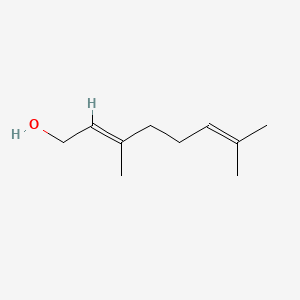
Geraniol
Geraniol is a monoterpenoid consisting of two prenyl units linked head-to-tail and functionalised with a hydroxy group at its tail end. It has a role as a volatile oil component, a fragrance, an allergen and a plant metabolite. It is a primary alcohol, a 3,7-dimethylocta-2,6-dien-1-ol and a monoterpenoid. — ChEBI
- IUPAC name
- (2E)-3,7-dimethylocta-2,6-dien-1-ol
- Molecular formula
- C10H18O
- Molecular weight
- 154.25 g/mol
- Exact mass
- 154.135765193 Da
- XLogP3
- 2.9
- Topological polar surface area
- 20.2 Ų
- Hydrogen-bond donors
- 1
- Hydrogen-bond acceptors
- 1
- Covalent units
- 1
- Defined stereocentres
- 0
Also known as
16 more reported names
External database identifiers
- ChEBI:CHEBI:17447
- ChEBI:CHEBI:24221
- ChEMBL:CHEMBL25719
- EPA DTXSID:DTXSID8026727
- PubMed:33859287
- PubMed:29422862
- PubMed:26983575
- PubMed:23943375
- PubMed:23449869
- PubMed:22945026
- PubMed:21336686
- PubMed:17924309
- PubMed:16000717
- PubMed:14757700
- PubMed:11961066
- PubMed:11731906
Evidence from additional scientific databases
EMBL-EBI ChEBI
geraniol
A monoterpenoid consisting of two prenyl units linked head-to-tail and functionalised with a hydroxy group at its tail end.
- Formula
- C10H18O
- Average mass
- 154.253 g/mol
- Monoisotopic mass
- 154.13577 Da
- Formal charge
- 0
- primary alcohol — is a (CHEBI:15734)
- 3,7-dimethylocta-2,6-dien-1-ol — is a (CHEBI:24221)
- monoterpenoid — is a (CHEBI:25409)
- allergen — has role (CHEBI:50904)
- fragrance — has role (CHEBI:48318)
- volatile oil component — has role (CHEBI:27311)
- plant metabolite — has role (CHEBI:76924)
- allergen — has role (CHEBI:50904)
- fragrance — has role (CHEBI:48318)
- volatile oil component — has role (CHEBI:27311)
- plant metabolite — has role (CHEBI:76924)
- primary alcohol — is a (CHEBI:15734)
- 3,7-dimethylocta-2,6-dien-1-ol — is a (CHEBI:24221)
- monoterpenoid — is a (CHEBI:25409)
Additional curated names
Cross-references from this source
- CAS: 106-24-1 — KEGG COMPOUND
- CAS: 106-24-1 — NIST Chemistry WebBook
- CAS: 106-24-1 — ChemIDplus
- REGISTRY_NUMBER: 1722456 — Beilstein
- REGISTRY_NUMBER: 185248 — Gmelin
- MANUAL_X_REF: 2374 — VSDB
- MANUAL_X_REF: 2374 — BPDB
- MANUAL_X_REF: C00000845 — KNApSAcK
- MANUAL_X_REF: C01500 — KEGG COMPOUND
- MANUAL_X_REF: Geraniol — Wikipedia
- MANUAL_X_REF: LMPR0102010016 — LIPID MAPS
Mapped by: Exact CAS cross-reference in the ChEBI compound record. Source updated: 2020-10-28. Retrieved: 2026-08-31. Open source record
NIH PubChem PUG-View
Attributed physical-property, hazard, environmental and use annotations.
- Boiling Point: 446 °F at 760 mmHg (NTP, 1992) Source: CAMEO Chemicals
- Boiling Point: 230 °C Source: Hazardous Substances Data Bank (HSDB)
- Boiling Point: 229.00 to 230.00 °C. @ 760.00 mm Hg Source: Human Metabolome Database (HMDB)
- Boiling Point: 230 °C Source: Joint FAO/WHO Expert Committee on Food Additives (JECFA)
- Color/Form: Colorless to pale-yellow, liquid oil Source: Hazardous Substances Data Bank (HSDB)
- Color/Form: Oily liquid Source: Hazardous Substances Data Bank (HSDB)
- Density: 0.8894 at 68 °F (NTP, 1992) - Less dense than water; will float Source: CAMEO Chemicals
- Density: 0.8894 g/cu cm at 20 °C Source: Hazardous Substances Data Bank (HSDB)
- Density: Density: 0.870-0.890 at 15 °C Source: Hazardous Substances Data Bank (HSDB)
- Density: 0.870-0.885 Source: Joint FAO/WHO Expert Committee on Food Additives (JECFA)
- Flash Point: 108 °C (226 °F) - closed cup Source: Hazardous Substances Data Bank (HSDB)
- Flash Point: >212 °F (>100 °C) (closed cup) Source: Hazardous Substances Data Bank (HSDB)
- LogP: log Kow = 3.56 Source: Hazardous Substances Data Bank (HSDB)
- LogP: 3.56 Source: Human Metabolome Database (HMDB)
- Melting Point: less than 5 °F (NTP, 1992) Source: CAMEO Chemicals
- Melting Point: -15 °C Source: Hazardous Substances Data Bank (HSDB)
- Melting Point: < -15 °C Source: Human Metabolome Database (HMDB)
- Odor: Sweet rose odor Source: Hazardous Substances Data Bank (HSDB)
- Odor: Pleasant geranium-like odor Source: Hazardous Substances Data Bank (HSDB)
- Odor: Pleasant, floral odor Source: Hazardous Substances Data Bank (HSDB)
- Physical Description: Geraniol is a colorless to pale yellow oily liquid with a sweet rose odor. (NTP, 1992) Source: CAMEO Chemicals
- Physical Description: CBI; Dry Powder; Liquid; Liquid Source: EPA Chemical Data Reporting (CDR)
- Physical Description: Colorless to yellow liquid with geranium odor; [Hawley] Colorless liquid; [MSDSonline] Source: Haz-Map, Information on Hazardous Chemicals and Occupational Diseases
- Physical Description: Liquid Source: Human Metabolome Database (HMDB)
- Physical Description: Colourless liquid; rose-like aroma Source: Joint FAO/WHO Expert Committee on Food Additives (JECFA)
- Refractive Index: Index of refraction: 1.4710-1.4780 at 20 °C Source: Hazardous Substances Data Bank (HSDB)
- Refractive Index: 1.469-1.478 Source: Joint FAO/WHO Expert Committee on Food Additives (JECFA)
- Solubility: In water, 100 mg/L at 25 °C Source: Hazardous Substances Data Bank (HSDB)
- Solubility: Slightly soluble in water Source: Hazardous Substances Data Bank (HSDB)
- Solubility: Miscible with ether, acetone Source: Hazardous Substances Data Bank (HSDB)
- Solubility: 1:3 in 70% alcohol Source: Hazardous Substances Data Bank (HSDB)
- Solubility: For more Solubility (Complete) data for GERANIOL (7 total), please visit the HSDB record page. Source: Hazardous Substances Data Bank (HSDB)
- Solubility: 0.1 mg/mL at 25 °C Source: Human Metabolome Database (HMDB)
- Solubility: Insoluble in glycerol; slightly soluble in water; soluble in most fixed oils, propylene glycol Source: Joint FAO/WHO Expert Committee on Food Additives (JECFA)
- Solubility: soluble (in ethanol) Source: Joint FAO/WHO Expert Committee on Food Additives (JECFA)
- Vapor Pressure: 0.03 [mmHg] Source: Haz-Map, Information on Hazardous Chemicals and Occupational Diseases
- Carcinogen Classification: No indication of carcinogenicity to humans (not listed by IARC). Source: Toxin and Toxin Target Database (T3DB)
- First Aid: EYES: First check the victim for contact lenses and remove if present. Flush victim's eyes with water or normal saline solution for 20 to 30 minutes while simultaneously calling a hospital or poison control center. Do not put any ointments, oils, or medication in the victim's eyes without specific instructions from a physician. IMMEDIATELY transport the victim after flushing eyes to a hospital even if no symptoms (such as redness or irritation) develop.; SKIN: IMMEDIATELY flood affected skin with water while removing and isolating all contaminated clothing. Gently wash all affected skin areas thoroughly with soap and water. If symptoms such as redness or irritation develop, IMMEDIATELY call a physician and be prepared to transport the victim to a hospital for treatment.; INHALATION: IMMEDIATELY leave the contaminated area; take deep breaths of fresh air. If symptoms (such as wheezing, coughing, shortness of breath, or burning in the mouth, throat, or chest) develop, call a physician and be prepared to transport the victim to a hospital. Provide proper respiratory protection to rescuers entering an unknown atmosphere. Whenever possible, Self-Contained Breathing Apparatus (SCBA) shou Source: CAMEO Chemicals
- Signal: Warning Source: Regulation (EC) No 1272/2008 of the European Parliament and of the Council
- GHS Hazard Statements: H317: May cause an allergic skin reaction [Warning Sensitization, Skin] Source: Regulation (EC) No 1272/2008 of the European Parliament and of the Council
- Precautionary Statement Codes: P261, P272, P280, P302+P352, P321, P333+P317, P362+P364, and P501 (click each P-code to see the statement) Source: Regulation (EC) No 1272/2008 of the European Parliament and of the Council
- Note: This chemical does not meet GHS hazard criteria for 0.3% (7 of 2637) of reports. Source: European Chemicals Agency (ECHA)
- Signal: Danger Source: European Chemicals Agency (ECHA)
- GHS Hazard Statements: H315 (98.9%): Causes skin irritation [Warning Skin corrosion/irritation]; H317 (99.4%): May cause an allergic skin reaction [Warning Sensitization, Skin]; H318 (92.4%): Causes serious eye damage [Danger Serious eye damage/eye irritation] Source: European Chemicals Agency (ECHA)
- Precautionary Statement Codes: P261, P264, P264+P265, P272, P280, P302+P352, P305+P354+P338, P317, P321, P332+P317, P333+P317, P362+P364, and P501 (click each P-code to see the statement) Source: European Chemicals Agency (ECHA)
- ECHA C&L Notifications Summary: Aggregated GHS information provided per 2637 reports by companies from 32 notifications to the ECHA C&L Inventory. Each notification may be associated with multiple companies.; Reported as not meeting GHS hazard criteria per 7 of 2637 reports by companies.; There are 31 notifications provided by 2630 of 2637 reports by companies with hazard statement code(s).; Information may vary between notifications depending on impurities, additives, and other factors. The percentage value in parenthesis indicates the notified classification ratio from companies that provide hazard codes. Only hazard codes with percentage values above 10% are shown. For more detailed information, please visit ECHA C&L website. Source: European Chemicals Agency (ECHA)
- Signal: Warning Source: NITE-CMC
- GHS Hazard Statements: H227: Combustible liquid [Warning Flammable liquids]; H315: Causes skin irritation [Warning Skin corrosion/irritation]; H317: May cause an allergic skin reaction [Warning Sensitization, Skin]; H336: May cause drowsiness or dizziness [Warning Specific target organ toxicity, single exposure; Narcotic effects]; H401: Toxic to aquatic life [Hazardous to the aquatic environment, acute hazard] Source: NITE-CMC
- Precautionary Statement Codes: P210, P261, P264, P271, P272, P273, P280, P302+P352, P304+P340, P319, P321, P332+P317, P333+P317, P362+P364, P370+P378, P403, P403+P233, P405, and P501 (click each P-code to see the statement) Source: NITE-CMC
- Signal: Danger Source: Hazardous Chemical Information System (HCIS), Safe Work Australia
- NFPA Health Rating: 2 - Materials that, under emergency conditions, can cause temporary incapacitation or residual injury. Source: Hazardous Substances Data Bank (HSDB)
- NFPA Fire Rating: 1 - Materials that must be preheated before ignition can occur. Materials require considerable preheating, under all ambient temperature conditions, before ignition and combustion can occur. Source: Hazardous Substances Data Bank (HSDB)
- NFPA Instability Rating: 0 - Materials that in themselves are normally stable, even under fire conditions. Source: Hazardous Substances Data Bank (HSDB)
- Toxicity Summary: IDENTIFICATION AND USE: Geraniol is colorless to pale-yellow, liquid oil. It has a sweet rose like odor. Geraniol is one of the most frequently used terpenoid fragrance materials. It can be used in all flowery-rose like compositions and does not discolor soaps. In flavor compositions, geraniol is used in small quantities to accentuate citrus notes. It is also used in alcoholic and nonalcoholic beverages, baked goods, chewing gum, frozen dairy, gelatin (pudding), gravies, hard candy, meat products, soft candy. It is an important intermediate in the manufacture of geranyl esters, citronellol, and citral. HUMAN EXPOSURE AND TOXICITY: A report of a 32 year old female patient working in a company for baking ingredients, who had been handling grated lemon peel and lemon oil for several years, developed allergic contact dermatitis of the fingers of both her hands. The material responsible for the dermatitis was identified as geraniol in both lemon peel and lemon oil and it proved to be the only source of the allergic reaction. In a human patch test, geraniol at a 32% concentration was severely irritating and geranyl acetate mildly irritating. Occupational exposure to geraniol may occur th Source: Hazardous Substances Data Bank (HSDB)
- Toxicity Summary: The existing information was reviewed by the independent Expert Panel for Fragrance Safety and supports the use of geraniol as described in this safety assessment. Data show that it is not genotoxic and provide a calculated Margin of Exposure (MOE) greater than 100 for the repeated dose toxicity and reproductive toxicity endpoints. Data for geraniol support a No Expected Sensitization Induction Level (NESIL) of 11000 μg/cm2 for the skin sensitization endpoint. Geraniol is not expected to be phototoxic/photoallergenic based on the ultraviolet/visible (UV/Vis) spectra. The local respiratory toxicity endpoint was evaluated using the Threshold of Toxicological Concern (TTC) for a Cramer Class I material, and the exposure is below the TTC (1.4 mg/day). Source: Pertti (Bert) Hakkinen's Toxicology and Other Annotations
- Environmental Bioconcentration: An estimated BCF of 100 was calculated in fish for geraniol(SRC), using a log Kow of 3.56(1) and a regression-derived equation(2). According to a classification scheme(3), this BCF suggests the potential for bioconcentration in aquatic organisms is moderate(SRC). Source: Hazardous Substances Data Bank (HSDB)
- Environmental Fate: TERRESTRIAL FATE: Based on a classification scheme(1), an estimated Koc value of 90(SRC), determined from a structure estimation method(2), indicates that geraniol is expected to have high mobility in soil(SRC). Volatilization of geraniol from moist soil surfaces is expected to be an important fate process(SRC) given an estimated Henry's Law constant of 1.15X10⁻⁵ atm-cu m/mole(2) based upon its vapor pressure, 3.0X10⁻² mm Hg(3), and water solubility, 100 mg/L(4). Geraniol is not expected to volatilize from dry soil surfaces(SRC) based upon its estimated vapor pressure(3). A 53% of theoretical BOD using activated sludge in the Japanese MITI test(4), and 98% degradation in the Manometric Respirometry test(5) suggests that biodegradation is an important environmental fate process in soil(SRC). Source: Hazardous Substances Data Bank (HSDB)
- Environmental Fate: AQUATIC FATE: Based on a classification scheme(1), an estimated Koc value of 90(SRC), determined from a structure estimation method(2), indicates that geraniol is not expected to adsorb to suspended solids and sediment(SRC). Volatilization from water surfaces is expected(3) based upon an estimated Henry's Law constant of 1.15X10⁻⁵ atm-cu m/mole(2) derived from its vapor pressure, 3.0X10⁻² mm Hg(4), and water solubility, 100 mg/L(5). Using this Henry's Law constant and an estimation method(2), volatilization half-lives for a model river and model lake are 3 days and 34 days, respectively(SRC). According to a classification scheme(6), an estimated BCF of 100(SRC), derived from its log Kow of 3.56(7) and a regression-derived equation(2), suggests the potential for bioconcentration in aquatic organisms is moderate(SRC). A 53% of theoretical BOD using activated sludge in the Japanese MITI test(5), and 98% degradation in the Manometric Respirometry test(8) suggests that biodegradation is an important environmental fate process in water(SRC). Source: Hazardous Substances Data Bank (HSDB)
- Environmental Fate: ATMOSPHERIC FATE: According to a model of gas/particle partitioning of semivolatile organic compounds in the atmosphere(1), geraniol, which has a vapor pressure of 3.0X10⁻² mm Hg at 25 °C(2), is expected to exist solely as a vapor in the ambient atmosphere. Vapor-phase geraniol is degraded in the atmosphere by reaction with photochemically-produced hydroxyl radicals(SRC); the half-life for this reaction in air is estimated to be 2 hours(SRC), calculated from its rate constant of 1.8x10⁻¹⁰ cu cm/molecule-sec at 25 °C(SRC) that was derived using a structure estimation method(3). Geraniol absorbs UV at wavelengths of 190-195 nm(4) and, therefore, is not expected to be susceptible to direct photolysis by sunlight(SRC). Source: Hazardous Substances Data Bank (HSDB)
- Consumer Uses: Odor agents; Fragrance Source: EPA Chemical Data Reporting (CDR)
- Industry Uses: Intermediate; Odor agents; Cleaning agent; Fragrance; Other; Flavoring and nutrient; Intermediates Source: EPA Chemical Data Reporting (CDR)
- Sources/Uses: Used in soaps, cosmetics, perfumes, insect attractants, foods, and beverages; [HSDB] Occurs naturally in oil of rose, oil of palmarosa, citronella, lemon grass, and other essential oils; [Merck Index] One of the most common terpenoid chemicals used in soap as a fragrance; [Marks, p. 173] Active ingredient in biopesticide used to control mites on agricultural crops, ornamentals, and landscapes; [ExPub: EPA BRADs] Source: Haz-Map, Information on Hazardous Chemicals and Occupational Diseases
- Industrial Processes with risk of exposure: Farming (Pesticides) [Category: Industry] Source: Haz-Map, Information on Hazardous Chemicals and Occupational Diseases
- Uses: For geraniol (USEPA/OPP Pesticide Code: 597501) ACTIVE products with label matches. /SRP: Registered for use in the USA but approved pesticide uses may change periodically and so federal, state and local authorities must be consulted for currently approved uses./ Source: Hazardous Substances Data Bank (HSDB)
- Uses: Insecticide Source: Hazardous Substances Data Bank (HSDB)
- Uses: Reported uses (ppm):; Table: Reported uses (ppm): (Flavor and Extract Manufacturers' Association, 1994) [Table#1350] Source: Hazardous Substances Data Bank (HSDB)
- Uses: Geraniol is one of the most frequently used terpenoid fragrance materials. It can be used in all flowery-roselike compositions and does not discolor soaps. In flavor compositions, geraniol is used in small quantities to accentuate citrus notes. It is an important intermediate in the manufacture of geranyl esters, citronellol, and citral. Source: Hazardous Substances Data Bank (HSDB)
- Uses: For more Uses (Complete) data for GERANIOL (8 total), please visit the HSDB record page. Source: Hazardous Substances Data Bank (HSDB)
Mapped by: Existing checksum-valid CAS to unique PubChem CID match. Retrieved: 2026-08-31. Open source record
Scientific classifications and hazard annotations provide context and do not replace the market-specific regulatory decision shown above.
Additional source coverage and match status
| Source | Result | Checked |
|---|---|---|
| EMBL-EBI ChEBI | Exact match | 2026-08-31 |
| NIH PubChem PUG-View | Exact match | 2026-08-31 |
A recorded no-match is useful evidence that the source was checked; it is not a claim that the substance does not exist elsewhere.
Retrieved from NIH PubChem on 2026-09-02 by checksum-valid CAS matching. Chemical properties do not replace the regulatory decision on this page.