
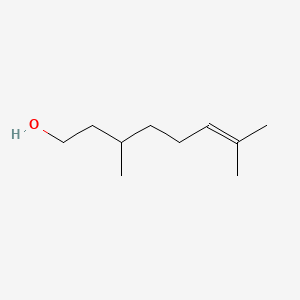
Citronellol
(±)-β-citronellol has been reported in Ambrosiozyma monospora, Artemisia princeps, and other organisms with data available. — LOTUS - the natural products occurrence database
- IUPAC name
- 3,7-dimethyloct-6-en-1-ol
- Molecular formula
- C10H20O
- Molecular weight
- 156.26 g/mol
- Exact mass
- 156.151415257 Da
- XLogP3
- 3.2
- Topological polar surface area
- 20.2 Ų
- Hydrogen-bond donors
- 1
- Hydrogen-bond acceptors
- 1
- Covalent units
- 1
- Defined stereocentres
- 0
Also known as
16 more reported names
External database identifiers
- ChEBI:CHEBI:50462
- ChEMBL:CHEMBL395827
- EPA DTXSID:DTXSID3026726
- PubMed:32513280
- PubMed:31926054
- PubMed:29445768
- PubMed:27607409
- PubMed:26944432
- PubMed:26795242
- PubMed:26456648
- PubMed:26141506
- PubMed:25414073
- PubMed:23449869
- PubMed:22945026
- PubMed:21819085
Evidence from additional scientific databases
EMBL-EBI ChEBI
citronellol
A monoterpenoid that is oct-6-ene substituted by a hydroxy group at position 1 and methyl groups at positions 3 and 7.
- Formula
- C10H20O
- Average mass
- 156.269 g/mol
- Monoisotopic mass
- 156.15142 Da
- Formal charge
- 0
- monoterpenoid — is a (CHEBI:25409)
- plant metabolite — has role (CHEBI:76924)
- plant metabolite — has role (CHEBI:76924)
- monoterpenoid — is a (CHEBI:25409)
- 20964319 Source: PubMed
Additional curated names
Cross-references from this source
- CAS: 106-22-9 — ChemIDplus
- CAS: 106-22-9 — NIST Chemistry WebBook
- REGISTRY_NUMBER: 1362474 — Reaxys
- MANUAL_X_REF: Citronellol — Wikipedia
Mapped by: Exact CAS cross-reference in the ChEBI compound record. Source updated: 2015-08-17. Retrieved: 2026-08-31. Open source record
NIH PubChem PUG-View
Attributed physical-property, hazard, environmental and use annotations.
- Boiling Point: 224 °C Source: Hazardous Substances Data Bank (HSDB)
- Boiling Point: BP: 108-109 °C at 10 mm Hg; specific gravity: 1.4576 at 18/4 °C /(-)-Form/ Source: Hazardous Substances Data Bank (HSDB)
- Boiling Point: 225 °C Source: Joint FAO/WHO Expert Committee on Food Additives (JECFA)
- Color/Form: Colorless oily liquid Source: Hazardous Substances Data Bank (HSDB)
- Density: 0.8550 g/cu cm at 20 °C Source: Hazardous Substances Data Bank (HSDB)
- Density: 0.850-0.860 Source: Joint FAO/WHO Expert Committee on Food Additives (JECFA)
- LogP: log Kow = 3.91 Source: Hazardous Substances Data Bank (HSDB)
- Melting Point: <-20 °C Source: Hazardous Substances Data Bank (HSDB)
- Odor: Fresh rosy odor Source: Hazardous Substances Data Bank (HSDB)
- Odor: Rose odor Source: Hazardous Substances Data Bank (HSDB)
- Physical Description: CBI; Liquid; Dry Powder; Liquid Source: EPA Chemical Data Reporting (CDR)
- Physical Description: Colorless to pale yellow liquid with a sweet floral odor; [EPA BRADs] Colorless liquid with a rose-like odor; [Acros Organics MSDS] Source: Haz-Map, Information on Hazardous Chemicals and Occupational Diseases
- Physical Description: colourless oily liquid; rose-like aroma Source: Joint FAO/WHO Expert Committee on Food Additives (JECFA)
- Refractive Index: Index of refraction: 1.4559 at 20 °C Source: Hazardous Substances Data Bank (HSDB)
- Refractive Index: 1.454-1.462 Source: Joint FAO/WHO Expert Committee on Food Additives (JECFA)
- Solubility: In water, 200 mg/L at 25 °C Source: Hazardous Substances Data Bank (HSDB)
- Solubility: In water, 307 mg/L at 25 °C; 300 mg/L at 20 °C Source: Hazardous Substances Data Bank (HSDB)
- Solubility: Soluble in fixed oils, propylene glycol; insoluble in glycerin Source: Hazardous Substances Data Bank (HSDB)
- Solubility: Miscible in ethanol and ether /(+)-citronellol/; very soluble in ethanol and ether /(-)-citronellol/ Source: Hazardous Substances Data Bank (HSDB)
- Solubility: Insoluble in glycerol; slightly soluble in water; soluble in most fixed oils, propylene glycol Source: Joint FAO/WHO Expert Committee on Food Additives (JECFA)
- Solubility: soluble (in ethanol) Source: Joint FAO/WHO Expert Committee on Food Additives (JECFA)
- Vapor Pressure: 0.04 [mmHg] Source: Haz-Map, Information on Hazardous Chemicals and Occupational Diseases
- Vapor Pressure: 0.02 mm Hg at 25 °C Source: Hazardous Substances Data Bank (HSDB)
- Viscosity: 11.1 mPa s (dynamic) at 20 °C; 5.33 mPa s (dynamic) at 40 °C Source: Hazardous Substances Data Bank (HSDB)
- Signal: Warning Source: European Chemicals Agency (ECHA)
- GHS Hazard Statements: H315 (95.7%): Causes skin irritation [Warning Skin corrosion/irritation]; H317 (99.6%): May cause an allergic skin reaction [Warning Sensitization, Skin]; H319 (65.1%): Causes serious eye irritation [Warning Serious eye damage/eye irritation]; H411 (15.8%): Toxic to aquatic life with long lasting effects [Hazardous to the aquatic environment, long-term hazard] Source: European Chemicals Agency (ECHA)
- Precautionary Statement Codes: P261, P264, P264+P265, P272, P273, P280, P302+P352, P305+P351+P338, P321, P332+P317, P333+P317, P337+P317, P362+P364, P391, and P501 (click each P-code to see the statement) Source: European Chemicals Agency (ECHA)
- ECHA C&L Notifications Summary: Aggregated GHS information provided per 1657 reports by companies from 29 notifications to the ECHA C&L Inventory. Each notification may be associated with multiple companies.; Information may vary between notifications depending on impurities, additives, and other factors. The percentage value in parenthesis indicates the notified classification ratio from companies that provide hazard codes. Only hazard codes with percentage values above 10% are shown. For more detailed information, please visit ECHA C&L website. Source: European Chemicals Agency (ECHA)
- GHS Hazard Statements: H315 (100%): Causes skin irritation [Warning Skin corrosion/irritation]; H317 (100%): May cause an allergic skin reaction [Warning Sensitization, Skin]; H319 (17.5%): Causes serious eye irritation [Warning Serious eye damage/eye irritation] Source: European Chemicals Agency (ECHA)
- Precautionary Statement Codes: P261, P264, P264+P265, P272, P280, P302+P352, P305+P351+P338, P321, P332+P317, P333+P317, P337+P317, P362+P364, and P501 (click each P-code to see the statement) Source: European Chemicals Agency (ECHA)
- ECHA C&L Notifications Summary: Aggregated GHS information provided per 103 reports by companies from 4 notifications to the ECHA C&L Inventory. Each notification may be associated with multiple companies.; Information may vary between notifications depending on impurities, additives, and other factors. The percentage value in parenthesis indicates the notified classification ratio from companies that provide hazard codes. Only hazard codes with percentage values above 10% are shown. For more detailed information, please visit ECHA C&L website. Source: European Chemicals Agency (ECHA)
- Signal: Warning Source: Hazardous Substances Data Bank (HSDB)
- GHS Hazard Statements: H315: Causes skin irritation [Warning Skin corrosion/irritation]; H317: May cause an allergic skin reaction [Warning Sensitization, Skin]; H319: Causes serious eye irritation [Warning Serious eye damage/eye irritation]; H401: Toxic to aquatic life [Hazardous to the aquatic environment, acute hazard] Source: Hazardous Substances Data Bank (HSDB)
- Precautionary Statement Codes: P261, P264, P264+P265, P272, P273, P280, P302+P352, P305+P351+P338, P321, P332+P317, P333+P317, P337+P317, P362+P364, and P501 (click each P-code to see the statement) Source: Hazardous Substances Data Bank (HSDB)
- Toxicity Summary: IDENTIFICATION AND USE: Citronellol has been found in nature, and it has been reported in about 70 essential oils. It is registered for pesticide use in the USA but approved pesticide uses may change periodically and so federal, state and local authorities must be consulted for currently approved uses. It is also used in perfumery. HUMAN EXPOSURE AND TOXICITY: Adult male volunteers with no known allergic reactions were patch-tested on their back for 48 hr with 32% citronellol. After 48 hr, patches were removed and the skin was cleaned of any residual test material. Moderate irritation was observed. A patch test using a 1% concentration of citronellol in acetone gave a positive reaction in subjects allergic to citronella oil. ANIMAL STUDIES: Citronellol applied full strength to intact or abraded rabbit skin for 24 hr under occlusion was moderately irritating. Severe irritation was observed in rabbits and guinea pigs exposed to 100% compound (unoccluded) for 24, 48 or 72 hr. Citronellol was not mutagenic when tested in Salmonella typhimurium strains TA98 and TA100 in the presence and absence of metabolic activation. ECOTOXICITY STUDIES: Golden Orfe (Leuciscus idus) were exposed to th Source: Hazardous Substances Data Bank (HSDB)
- Environmental Bioconcentration: An estimated BCF of 177 was calculated in fish for citronellol(SRC), using a log Kow of 3.91(1) and a regression-derived equation(2). According to a classification scheme(3), this BCF suggests the potential for bioconcentration in aquatic organisms is high(SRC), provided the compound is not metabolized by the organism(SRC). Source: Hazardous Substances Data Bank (HSDB)
- Environmental Fate: TERRESTRIAL FATE: Based on a classification scheme(1), an estimated Koc value of 94(SRC), determined from a structure estimation method(2), indicates that citronellol is expected to have high mobility in soil(SRC). Volatilization of citronellol from moist soil surfaces is expected to be an important fate process(SRC) given an estimated Henry's Law constant of 2.1X10⁻⁵ atm-cu m/mole(SRC), derived from its vapor pressure, 0.02 mm Hg(3), and water solubility, 200 mg/L(4). Even though the vapor pressure is low environmentally at standard temperature and pressure, there is a detectable odor; therefore, citronellol may volatilize from dry soil(SRC). An 80-90% of Theoretical BOD using activated sludge in the OECD 301F test(5) suggests that biodegradation is an important environmental fate process in soil(SRC). Citronellol was also classified as readily biodegradable by the results of the OECD 301C test (modified MITI) with 65% degradation in 4 weeks(6) and by a DOC Method F test (100% biodegradation in 15 days)(6). Citronellol absorbs at wavelengths >290 nm(7) and, therefore, may be susceptible to direct photolysis on soil surfaces exposed to sunlight(SRC). Source: Hazardous Substances Data Bank (HSDB)
- Environmental Fate: AQUATIC FATE: Based on a classification scheme(1), an estimated Koc value of 94(SRC), determined from a structure estimation method(2), indicates that citronellol is not expected to adsorb to suspended solids and sediment(SRC). Volatilization from water surfaces is expected(3) based upon an estimated Henry's Law constant of 2.1X10⁻⁵ atm-cu m/mole(SRC), derived from its vapor pressure, 0.02 mm Hg(4), and water solubility, 200 mg/L(5). Using this Henry's Law constant and an estimation method(3), volatilization half-lives for a model river and model lake are 2.4 and 21 days, respectively(SRC). According to a classification scheme(6), an estimated BCF of 177(SRC), from its log Kow of 3.91(7) and a regression-derived equation(2), suggests the potential for bioconcentration in aquatic organisms is high(SRC). An 80-90% of Theoretical BOD using activated sludge in the OECD 301F test(8) suggests that biodegradation is an important environmental fate process in water(SRC). Citronellol was also classified as readily biodegradable by the results of the OECD 301C test (modified MITI) with 65% degradation in 4 weeks(9) and by a DOC Method F test (100% biodegradation in 15 days)(9). Citronellol i Source: Hazardous Substances Data Bank (HSDB)
- Environmental Fate: ATMOSPHERIC FATE: According to a model of gas/particle partitioning of semivolatile organic compounds in the atmosphere(1), citronellol, which has a vapor pressure of 0.02 mm Hg at 25 °C(2), is expected to exist solely as a vapor in the ambient atmosphere. Vapor-phase citronellol is degraded in the atmosphere by reaction with photochemically-produced hydroxyl radicals(SRC); the half-life for this reaction in air is estimated to be 2.3 hours(SRC), calculated from its rate constant of 1.70X10⁻¹⁰ cu cm/molecule-sec at 24 deg(3). Citronellol is also degraded in the atmosphere by reaction with ozone and nitrate radicals. The half-life for the reaction with ozone is estimated to be 1.1 hours(SRC), calculated from its rate constant of 2.4X10⁻¹⁶ cu cm/molecule-sec at 24 °C(3). The half-life for the reaction with nitrate radicals is estimated to be 4 minutes(SRC), calculated from its rate constant of 1.21X10⁻¹¹ cu cm/molecule-sec at 24 °C(4). The nitrate radical (NO3) is the dominant atmospheric oxidant during the night-time in most atmospheric environments(5), therefore, night-time degradation appears to be a major fate process for citronellol(SRC). Citronellol absorbs at wavelengths >290 Source: Hazardous Substances Data Bank (HSDB)
- Consumer Uses: Fragrance; Odor agents Source: EPA Chemical Data Reporting (CDR)
- Industry Uses: Other; Intermediate; Odor agents; Fragrance Source: EPA Chemical Data Reporting (CDR)
- Sources/Uses: l-Form: in rose and geranium oils; d-Form: in Ceylon and Java citronella oils; Used in perfumery; [Merck Index] Permitted for use as an inert ingredient in non-food pesticide products; [EPA] Present in over 30 essential oils, fruits, edible plants, wine, beer, and black tea; Active ingredient in pesticide used to control mites on agricultural crops, ornamentals, and landscapes; Also extensively used as fragrance (detergents, soaps, lotions, perfumes, etc.), as a flavoring agent, and component of citronella oil (used in candles, sprays, oils, and insect repellents); [EPA BRADs] Source: Haz-Map, Information on Hazardous Chemicals and Occupational Diseases
- Industrial Processes with risk of exposure: Farming (Pesticides) [Category: Industry] Source: Haz-Map, Information on Hazardous Chemicals and Occupational Diseases
- Uses: For citronellol (USEPA/OPP Pesticide Code: 167004) ACTIVE products with label matches. /SRP: Registered for use in the USA but approved pesticide uses may change periodically and so federal, state and local authorities must be consulted for currently approved uses./ Source: Hazardous Substances Data Bank (HSDB)
- Uses: Reported uses (ppm):; Table: Reported uses (ppm): (Flavor and Extract Manufacturers' Association, 1994) [Table#6302] Source: Hazardous Substances Data Bank (HSDB)
- Uses: In perfumery Source: Hazardous Substances Data Bank (HSDB)
- Uses: Citronellol is one of the components responsible for the insect repellent properties of citronella oil ... Citronellol finds extensive use in floral fragrances and in flavors for citrus and other fruit notes. Its stability makes it particularly useful in fragrances for soaps, detergents, and other household products. Citronellol is also important as an intermediate in the synthesis of a number of other aroma chemicals ... Citronellol is the key feedstock for the synthesis of rose oxide. Source: Hazardous Substances Data Bank (HSDB)
- Uses: Citronellol is one of the most widely used fragrance materials, particularly for rose notes and for floral compositions in general. As flavor material, citronellol is added for bouquetting purposes to citrus compositions. It is the starting material for numerous citronellyl esters and for hydroxydihydrocitronellol, an intermediate in the production of hydroxydihydrocitronellal. Source: Hazardous Substances Data Bank (HSDB)
Mapped by: Existing checksum-valid CAS to unique PubChem CID match. Retrieved: 2026-08-31. Open source record
Scientific classifications and hazard annotations provide context and do not replace the market-specific regulatory decision shown above.
Additional source coverage and match status
| Source | Result | Checked |
|---|---|---|
| EMBL-EBI ChEBI | Exact match | 2026-08-31 |
| NIH PubChem PUG-View | Exact match | 2026-08-31 |
A recorded no-match is useful evidence that the source was checked; it is not a claim that the substance does not exist elsewhere.
Retrieved from NIH PubChem on 2026-09-02 by checksum-valid CAS matching. Chemical properties do not replace the regulatory decision on this page.