
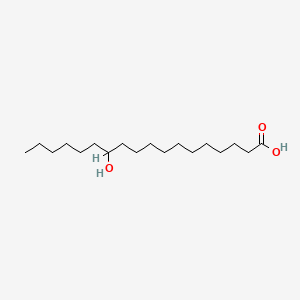
12-Hydroxystearic acid
12-hydroxyoctadecanoic acid is a hydroxy fatty acid that is stearic acid bearing a hydroxy substituent at position 12. It has a role as a plant metabolite and a bacterial xenobiotic metabolite. It is a hydroxyoctadecanoic acid and a secondary alcohol. It is a conjugate acid of a 12-hydroxyoctadecanoate. — ChEBI
- IUPAC name
- 12-hydroxyoctadecanoic acid
- Molecular formula
- C18H36O3
- Molecular weight
- 300.5 g/mol
- Exact mass
- 300.26644501 Da
- XLogP3
- 6.5
- Topological polar surface area
- 57.5 Ų
- Hydrogen-bond donors
- 2
- Hydrogen-bond acceptors
- 3
- Covalent units
- 1
- Defined stereocentres
- 0
Also known as
16 more reported names
External database identifiers
- ChEBI:CHEBI:85208
- ChEMBL:CHEMBL292352
- EPA DTXSID:DTXSID8026725
- PubMed:22819394
- PubMed:22709592
- PubMed:22692074
- PubMed:22680251
- PubMed:22515071
- PubMed:22300620
- PubMed:22162653
- PubMed:22077441
- PubMed:21714494
- PubMed:21075187
- PubMed:21053983
- PubMed:20945136
Evidence from additional scientific databases
EMBL-EBI ChEBI
12-hydroxyoctadecanoic acid
A hydroxy fatty acid that is stearic acid bearing a hydroxy substituent at position 12.
- Formula
- C18H36O3
- Average mass
- 300.483 g/mol
- Monoisotopic mass
- 300.26645 Da
- Formal charge
- 0
- hydroxyoctadecanoic acid — is a (CHEBI:24747)
- secondary alcohol — is a (CHEBI:35681)
- plant metabolite — has role (CHEBI:76924)
- bacterial xenobiotic metabolite — has role (CHEBI:76976)
- plant metabolite — has role (CHEBI:76924)
- bacterial xenobiotic metabolite — has role (CHEBI:76976)
- hydroxyoctadecanoic acid — is a (CHEBI:24747)
- secondary alcohol — is a (CHEBI:35681)
- 12-hydroxyoctadecanoate — is conjugate acid of (CHEBI:84201)
Additional curated names
Cross-references from this source
- CAS: 106-14-9 — ChemIDplus
- CAS: 106-14-9 — NIST Chemistry WebBook
- REGISTRY_NUMBER: 1726730 — Reaxys
- MANUAL_X_REF: HMDB0061706 — HMDB
- MANUAL_X_REF: LMFA02000130 — LIPID MAPS
Mapped by: Exact CAS cross-reference in the ChEBI compound record. Source updated: 2024-03-28. Retrieved: 2026-08-31. Open source record
NIH PubChem PUG-View
Attributed physical-property, hazard, environmental and use annotations.
- Color/Form: Crystals from alcohol Source: Hazardous Substances Data Bank (HSDB)
- Melting Point: 82 °C Source: Hazardous Substances Data Bank (HSDB)
- Physical Description: Dry Powder; Other Solid; Large Crystals; Liquid Source: EPA Chemical Data Reporting (CDR)
- Physical Description: Solid; [HSDB] White powder; [MSDSonline] Source: Haz-Map, Information on Hazardous Chemicals and Occupational Diseases
- Solubility: Soluble in alcohol, ether, chloroform; insoluble in water Source: Hazardous Substances Data Bank (HSDB)
- Note: This chemical does not meet GHS hazard criteria for 60.2% (305 of 507) of all reports. Source: European Chemicals Agency (ECHA)
- Signal: Warning Source: European Chemicals Agency (ECHA)
- GHS Hazard Statements: H315 (17.4%): Causes skin irritation [Warning Skin corrosion/irritation]; H319 (17.4%): Causes serious eye irritation [Warning Serious eye damage/eye irritation]; H335 (17.2%): May cause respiratory irritation [Warning Specific target organ toxicity, single exposure; Respiratory tract irritation]; H400 (22.5%): Very toxic to aquatic life [Warning Hazardous to the aquatic environment, acute hazard] Source: European Chemicals Agency (ECHA)
- Precautionary Statement Codes: P261, P264, P264+P265, P271, P273, P280, P302+P352, P304+P340, P305+P351+P338, P319, P321, P332+P317, P337+P317, P362+P364, P391, P403+P233, P405, and P501 (click each P-code to see the statement) Source: European Chemicals Agency (ECHA)
- ECHA C&L Notifications Summary: Aggregated GHS information provided per 507 reports by companies from 9 notifications to the ECHA C&L Inventory. Each notification may be associated with multiple companies.; Reported as not meeting GHS hazard criteria per 305 of 507 reports by companies.; There are 7 notifications provided by 202 of 507 reports by companies with hazard statement code(s).; Information may vary between notifications depending on impurities, additives, and other factors. The percentage value in parenthesis indicates the notified classification ratio from companies that provide hazard codes. Only hazard codes with percentage values above 10% are shown. For more detailed information, please visit ECHA C&L website. Source: European Chemicals Agency (ECHA)
- Cosmetic Ingredient Review Conclusion: The CIR Expert Panel concluded that the following ingredients are safe in the present practices of use andconcentration described in the safety assessment when formulated to be non-irritating and non-sensitizing, which may be basedon a QRA...Hydroxystearic Acid... Source: Cosmetic Ingredient Review (CIR)
- Cosmetic Ingredient Review Finding(s): Safe for use in cosmetics, with qualifications Source: Cosmetic Ingredient Review (CIR)
- Environmental Bioconcentration: An estimated BCF of 56 was calculated in fish for 12-hydroxyoctadecanoic acid(SRC), using an estimated log Kow of 6.41(1) and a regression-derived equation(2). According to a classification scheme(3), this BCF suggests the potential for bioconcentration in aquatic organisms is moderate(SRC), provided the compound is not metabolized by the organism(SRC). Source: Hazardous Substances Data Bank (HSDB)
- Environmental Fate: TERRESTRIAL FATE: Based on a classification scheme(1), an estimated Koc value of 900(SRC), determined from a structure estimation method(2), indicates that 12-hydroxyoctadecanoic acid is expected to have low mobility in soil(SRC). The pKa of 12-hydroxyoctadecanoic acid is 4.75(3), indicating that this compound will almost entirely exist in anion form in the environment and anions generally do not adsorb more strongly to soils containing organic carbon and clay than their neutral counterparts(4). Volatilization from moist soil is not expected because the acid exists as an anion and anions do not volatilize(SRC). 12-Hydroxyoctadecanoic acid is not expected to volatilize from dry soil surfaces(SRC) based upon an estimated vapor pressure of 1.94X10⁻⁸ mm Hg at 25 °C(SRC), determined from a fragment constant method(5). 12-Hydroxyoctadecanoic acid degraded 93% of theoretical BOD using activated sludge in the Japanese MITI test(6), suggesting that biodegradation is an important environmental fate process in soil(SRC). Source: Hazardous Substances Data Bank (HSDB)
- Environmental Fate: AQUATIC FATE: Based on a classification scheme(1), an estimated Koc value of 900(SRC), determined from a structure estimation method(2), indicates that 12-hydroxyoctadecanoic acid is expected to adsorb to suspended solids and sediment(SRC). An estimated pKa of 4.75(3) indicates 12-hydroxyoctadecanoic acid will exist almost entirely in the anion form at pH values of 5 to 9 and therefore volatilization from water surfaces is not expected to be an important fate process(SRC). According to a classification scheme(4), an estimated BCF of 56(SRC), from an estimated log Kow of 6.41(5) and a regression-derived equation(2), suggests the potential for bioconcentration in aquatic organisms is moderate, provided the compound is not metabolized by the organism(SRC). 12-Hydroxyoctadecanoic acid degraded 93% of theoretical BOD using activated sludge in the Japanese MITI test(6), suggesting that biodegradation is an important environmental fate process in water(SRC). Source: Hazardous Substances Data Bank (HSDB)
- Environmental Fate: ATMOSPHERIC FATE: According to a model of gas/particle partitioning of semivolatile organic compounds in the atmosphere(1), 12-hydroxyoctadecanoic acid, which has an estimated vapor pressure of 1.94X10⁻⁸ mm Hg at 25 °C(SRC), determined from a fragment constant method(2), is expected to exist solely in the particulate phase in the ambient atmosphere. Particulate-phase 12-hydroxyoctadecanoic acid may be removed from the air by wet or dry deposition(SRC). 12-Hydroxyoctadecanoic acid does not contain chromophores that absorb at wavelengths >290 nm(3), and therefore is not expected to be susceptible to direct photolysis by sunlight(SRC). Source: Hazardous Substances Data Bank (HSDB)
- Consumer Uses: Lubricating agent; Heat stabilizer; Not Known or Reasonably Ascertainable; Viscosity modifiers Source: EPA Chemical Data Reporting (CDR)
- Industry Uses: Surfactant (surface active agent); Other; Lubricating agent; Intermediate; Emulsifier; Thickening agent; Not Known or Reasonably Ascertainable Source: EPA Chemical Data Reporting (CDR)
- Cosmetic Ingredient Review Link: CIR ingredient: Hydroxystearic Acid Source: Cosmetic Ingredient Review (CIR)
- Sources/Uses: Used in lithium greases; as a chemical intermediate; as a defoamer in foods; as an ingredient in cosmetics; [HSDB] Source: Haz-Map, Information on Hazardous Chemicals and Occupational Diseases
- Uses: Hydroxystearic acid is used as a surfactant-cleansing agent in cosmetic products. Source: Hazardous Substances Data Bank (HSDB)
- Uses: 12-Hydroxystearic acid has been used as a textile lubricant and as a saponifiable base for greases. 12-Hydroxystearic acid-polyethylene glycol block polymers have been approved by FDA for use as surfactants, for dispersions of polyacrylamide retention and draining aids, employed prior to the sheet forming operation in the manufacture of paper and paperboard that come in contact with aqueous and fatty foods. Source: Hazardous Substances Data Bank (HSDB)
- Uses: Lithium greases; chemical intermediates Source: Hazardous Substances Data Bank (HSDB)
- Uses: Used for skin and hair-cleaning purposes and as emulsifiers in cosmetics. Source: Hazardous Substances Data Bank (HSDB)
- Uses: For more Uses (Complete) data for 12-Hydroxyoctadecanoic acid (9 total), please visit the HSDB record page. Source: Hazardous Substances Data Bank (HSDB)
Mapped by: Existing checksum-valid CAS to unique PubChem CID match. Retrieved: 2026-08-31. Open source record
Scientific classifications and hazard annotations provide context and do not replace the market-specific regulatory decision shown above.
Additional source coverage and match status
| Source | Result | Checked |
|---|---|---|
| EMBL-EBI ChEBI | Exact match | 2026-08-31 |
| NIH PubChem PUG-View | Exact match | 2026-08-31 |
A recorded no-match is useful evidence that the source was checked; it is not a claim that the substance does not exist elsewhere.
Retrieved from NIH PubChem on 2026-08-31 by checksum-valid CAS matching. Chemical properties do not replace the regulatory decision on this page.