
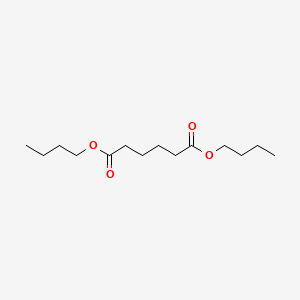
- IUPAC name
- dibutyl hexanedioate
- Molecular formula
- C14H26O4
- Molecular weight
- 258.35 g/mol
- Exact mass
- 258.18310931 Da
- XLogP3
- 3.1
- Topological polar surface area
- 52.6 Ų
- Hydrogen-bond donors
- 0
- Hydrogen-bond acceptors
- 4
- Covalent units
- 1
- Defined stereocentres
- 0
Also known as
16 more reported names
External database identifiers
- ChEBI:CHEBI:34686
- ChEMBL:CHEMBL3188143
- EPA DTXSID:DTXSID2021866
- PubMed:21604779
- PubMed:20374814
- PubMed:20352652
- PubMed:19646033
- PubMed:17406864
- PubMed:17174535
- PubMed:16835133
- PubMed:16497524
- PubMed:15468220
- PubMed:15360276
- PubMed:14565775
- PubMed:11766136
Evidence from additional scientific databases
EMBL-EBI ChEBI
Dibutyl adipate
- Formula
- C14H26O4
- Average mass
- 258.358 g/mol
- Monoisotopic mass
- 258.18311 Da
- Formal charge
- 0
- fatty acid ester — is a (CHEBI:35748)
- fatty acid ester — is a (CHEBI:35748)
Additional curated names
Cross-references from this source
- CAS: 105-99-7 — KEGG COMPOUND
- MANUAL_X_REF: C14253 — KEGG COMPOUND
Mapped by: Exact CAS cross-reference in the ChEBI compound record. Source updated: 2023-02-26. Retrieved: 2026-08-31. Open source record
NIH PubChem PUG-View
Attributed physical-property, hazard, environmental and use annotations.
- Boiling Point: 183 °C Source: ILO-WHO International Chemical Safety Cards (ICSCs)
- Density: Relative density (water = 1): 0.96 Source: ILO-WHO International Chemical Safety Cards (ICSCs)
- Flash Point: 113 °C c.c. Source: ILO-WHO International Chemical Safety Cards (ICSCs)
- LogP: 4.17 Source: ILO-WHO International Chemical Safety Cards (ICSCs)
- Melting Point: -38 °C Source: ILO-WHO International Chemical Safety Cards (ICSCs)
- Physical Description: COLOURLESS LIQUID. Source: ILO-WHO International Chemical Safety Cards (ICSCs)
- Solubility: Solubility in water, g/100ml at 25 °C: 0.0035 (very poor) Source: ILO-WHO International Chemical Safety Cards (ICSCs)
- Vapor Pressure: Vapor pressure, Pa at 25 °C: 0.021 Source: ILO-WHO International Chemical Safety Cards (ICSCs)
- Note: This chemical does not meet GHS hazard criteria for 84.9% (146 of 172) of all reports. Source: European Chemicals Agency (ECHA)
- GHS Hazard Statements: H411 (14.5%): Toxic to aquatic life with long lasting effects [Hazardous to the aquatic environment, long-term hazard] Source: European Chemicals Agency (ECHA)
- Precautionary Statement Codes: P273, P391, and P501 (click each P-code to see the statement) Source: European Chemicals Agency (ECHA)
- ECHA C&L Notifications Summary: Aggregated GHS information provided per 172 reports by companies from 5 notifications to the ECHA C&L Inventory.; Reported as not meeting GHS hazard criteria per 146 of 172 reports by companies.; There are 3 notifications provided by 26 of 172 reports by companies with hazard statement code(s).; Information may vary between notifications depending on impurities, additives, and other factors. The percentage value in parenthesis indicates the notified classification ratio from companies that provide hazard codes. Only hazard codes with percentage values above 10% are shown. For more detailed information, please visit ECHA C&L website. Source: European Chemicals Agency (ECHA)
- Signal: Warning Source: NITE-CMC
- GHS Hazard Statements: H361: Suspected of damaging fertility or the unborn child [Warning Reproductive toxicity]; H401: Toxic to aquatic life [Hazardous to the aquatic environment, acute hazard]; H411: Toxic to aquatic life with long lasting effects [Hazardous to the aquatic environment, long-term hazard] Source: NITE-CMC
- Precautionary Statement Codes: P203, P273, P280, P318, P391, P405, and P501 (click each P-code to see the statement) Source: NITE-CMC
- Cosmetic Ingredient Review Finding(s): Safe in the present practices of use and concentration. Ingredient, concentration, and use information are available in documents discoverable at https://cir-reports.cir-safety.org Source: Cosmetic Ingredient Review (CIR)
- Cosmetic Ingredient Review Link: CIR ingredient: Dibutyl Adipate Source: Cosmetic Ingredient Review (CIR)
- Uses: Plastics -> Typical concentration range in plastic materials -> 10.0 - 35.0% Source: NORMAN Suspect List Exchange
Mapped by: Existing checksum-valid CAS to unique PubChem CID match. Retrieved: 2026-08-31. Open source record
Scientific classifications and hazard annotations provide context and do not replace the market-specific regulatory decision shown above.
Additional source coverage and match status
| Source | Result | Checked |
|---|---|---|
| EMBL-EBI ChEBI | Exact match | 2026-08-31 |
| NIH PubChem PUG-View | Exact match | 2026-08-31 |
A recorded no-match is useful evidence that the source was checked; it is not a claim that the substance does not exist elsewhere.
Retrieved from NIH PubChem on 2026-08-31 by checksum-valid CAS matching. Chemical properties do not replace the regulatory decision on this page.