
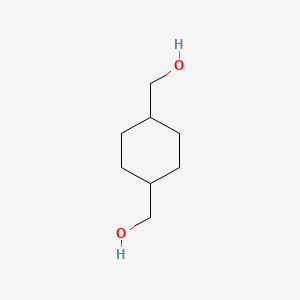
CAS 105-08-8PubChem CID 7735
1,4-Cyclohexanedimethanol
- IUPAC name
- [4-(hydroxymethyl)cyclohexyl]methanol
- Molecular formula
- C8H16O2
- Molecular weight
- 144.21 g/mol
- Exact mass
- 144.115029749 Da
- XLogP3
- 0.6
- Topological polar surface area
- 40.5 Ų
- Hydrogen-bond donors
- 2
- Hydrogen-bond acceptors
- 2
- Covalent units
- 1
- Defined stereocentres
- 0
Also known as
1,4-Bis(hydroxymethyl)cyclohexaneCHDM1,4-ChidmCyclohexane-1,4-dimethanolRikabinol DM1,4-DimethylolcyclohexaneCyclohex-1,4-ylenedimethanol1,4-Cyclohexamethylenebis methylol
16 more reported names
8C3FKR6R1BNSC-44508(4-(hydroxymethyl)cyclohexyl)methanolRefChem:6712EASTMAN VERITYL AB-1000 DIOL203-268-9692-674-3trans-1,4-Cyclohexanedimethanol3236-48-43236-47-3cis-1,4-Cyclohexanedimethanol1,4-Cyclohexanedimethanol, cis-1,4-Cyclohexanedimethanol, trans-trans-cyclohexane-1,4-diyldimethanolcis-cyclohexane-1,4-diyldimethanolHSDB 5364
External database identifiers
- ChEMBL:CHEMBL3185118
- EPA DTXSID:DTXSID00274143
- EPA DTXSID:DTXSID60274144
- EPA DTXSID:DTXSID9026712
- PubMed:22343188
- PubMed:21732135
- PubMed:21110566
- PubMed:20699060
- PubMed:20482988
- PubMed:20112991
- PubMed:18620358
- PubMed:17226951
- PubMed:12789693
- PubMed:12775470
- PubMed:12534301
- PubMed:11413830
Evidence from additional scientific databases
NIH PubChem PUG-View
Exact identifier match7735
Attributed physical-property, hazard, environmental and use annotations.
- Autoignition Temperature: 600 °F (316 °C). Source: Hazardous Substances Data Bank (HSDB)
- Boiling Point: 286 °C (cis-isomer), 283 °C (trans-isomer) Source: Hazardous Substances Data Bank (HSDB)
- Boiling Point: 274 °C @760 [mm Hg] Source: PAC Chemical Database, U.S. Department of Energy
- Color/Form: Liquid Source: Hazardous Substances Data Bank (HSDB)
- Color/Form: White waxy solid Source: Hazardous Substances Data Bank (HSDB)
- Density: 1.0381 at 25 °C/4 °C Source: Hazardous Substances Data Bank (HSDB)
- Density: 1.0381 @25 °C Source: PAC Chemical Database, U.S. Department of Energy
- Flash Point: 166 °C Source: Haz-Map, Information on Hazardous Chemicals and Occupational Diseases
- Flash Point: 330 °F OC Source: Hazardous Substances Data Bank (HSDB)
- LogP: log Kow = 1.14 /Estimated by Experimental Value Adjustment method using cyclohexanediol/ Source: Hazardous Substances Data Bank (HSDB)
- Melting Point: 43 °C (cis-isomer), 67 °C (trans-isomer) Source: Hazardous Substances Data Bank (HSDB)
- Odor: Sweet (1,3/1,4-cyclohexanedimethanol mixture) Source: Hazardous Substances Data Bank (HSDB)
- Odor: Mild hydrocarbon odor Source: Hazardous Substances Data Bank (HSDB)
- Physical Description: Liquid; Other Solid; Liquid Source: EPA Chemical Data Reporting (CDR)
- Physical Description: Liquid; [HSDB] White low melting solid; [MSDSonline] Source: Haz-Map, Information on Hazardous Chemicals and Occupational Diseases
- Refractive Index: Index of refraction: 1.4893 at 20 °C/D Source: Hazardous Substances Data Bank (HSDB)
- Solubility: In water, 920,000 mg/L at 20 °C Source: Hazardous Substances Data Bank (HSDB)
- Solubility: Solluble in ethyl alcohol Source: Hazardous Substances Data Bank (HSDB)
- Vapor Pressure: 3.08X10⁻⁴ mm Hg at 25 °C Source: Hazardous Substances Data Bank (HSDB)
- Viscosity: 877 cP at 50 °C, supercooled Source: Hazardous Substances Data Bank (HSDB)
- Note: This chemical does not meet GHS hazard criteria for 5.8% (27 of 467) of reports. Source: European Chemicals Agency (ECHA)
- Signal: Danger Source: European Chemicals Agency (ECHA)
- GHS Hazard Statements: H318 (63.6%): Causes serious eye damage [Danger Serious eye damage/eye irritation]; H319 (30.6%): Causes serious eye irritation [Warning Serious eye damage/eye irritation] Source: European Chemicals Agency (ECHA)
- Precautionary Statement Codes: P264+P265, P280, P305+P351+P338, P305+P354+P338, P317, and P337+P317 (click each P-code to see the statement) Source: European Chemicals Agency (ECHA)
- ECHA C&L Notifications Summary: Aggregated GHS information provided per 467 reports by companies from 4 notifications to the ECHA C&L Inventory. Each notification may be associated with multiple companies.; Reported as not meeting GHS hazard criteria per 27 of 467 reports by companies.; There are 3 notifications provided by 440 of 467 reports by companies with hazard statement code(s).; Information may vary between notifications depending on impurities, additives, and other factors. The percentage value in parenthesis indicates the notified classification ratio from companies that provide hazard codes. Only hazard codes with percentage values above 10% are shown. For more detailed information, please visit ECHA C&L website. Source: European Chemicals Agency (ECHA)
- GHS Hazard Statements: H318 (10%): Causes serious eye damage [Danger Serious eye damage/eye irritation]; H319 (90%): Causes serious eye irritation [Warning Serious eye damage/eye irritation] Source: European Chemicals Agency (ECHA)
- ECHA C&L Notifications Summary: Aggregated GHS information provided per 10 reports by companies from 2 notifications to the ECHA C&L Inventory. Each notification may be associated with multiple companies.; Information may vary between notifications depending on impurities, additives, and other factors. The percentage value in parenthesis indicates the notified classification ratio from companies that provide hazard codes. Only hazard codes with percentage values above 10% are shown. For more detailed information, please visit ECHA C&L website. Source: European Chemicals Agency (ECHA)
- Signal: Danger Source: Hazardous Chemical Information System (HCIS), Safe Work Australia
- GHS Hazard Statements: H318: Causes serious eye damage [Danger Serious eye damage/eye irritation] Source: Hazardous Chemical Information System (HCIS), Safe Work Australia
- Precautionary Statement Codes: P264+P265, P280, P305+P354+P338, and P317 (click each P-code to see the statement) Source: Hazardous Chemical Information System (HCIS), Safe Work Australia
- NFPA Health Rating: 1 - Materials that, under emergency conditions, can cause significant irritation. Source: Hazardous Substances Data Bank (HSDB)
- NFPA Fire Rating: 1 - Materials that must be preheated before ignition can occur. Materials require considerable preheating, under all ambient temperature conditions, before ignition and combustion can occur. Source: Hazardous Substances Data Bank (HSDB)
- NFPA Instability Rating: 0 - Materials that in themselves are normally stable, even under fire conditions. Source: Hazardous Substances Data Bank (HSDB)
- Environmental Bioconcentration: An estimated BCF of 3 was calculated in fish for 1,4-cyclohexanedimethanol(SRC), using an estimated log Kow of 1.14(1) and a regression-derived equation(1). According to a classification scheme(2), this BCF suggests the potential for bioconcentration in aquatic organisms is low(SRC). Source: Hazardous Substances Data Bank (HSDB)
- Environmental Fate: TERRESTRIAL FATE: Based on a classification scheme(1), an estimated Koc value of 10(SRC), determined from a structure estimation method(2), indicates that 1,4-cyclohexanedimethanol is expected to have very high mobility in soil(SRC). Volatilization of 1,4-cyclohexanedimethanol from moist soil surfaces is not expected to be an important fate process(SRC) given an estimated Henry's Law constant of 6.4X10⁻¹¹ atm-cu m/mole(SRC) derived from its vapor pressure, 3.08X10⁻⁴ mm Hg(3), and water solubility, 1.92X10+5 mg/L(4). Volatilization from dry soil surfaces may not be an important fate process based upon its vapor pressure(SRC). Using the OECD-302B method (Zahn-Wellens/EMPA test for inherent biodegradability), 98% of initial 1,4-cyclohexanedimethanol was degraded over a 19-day incubation period which classified the compound as inherently biodegradable(5). Source: Hazardous Substances Data Bank (HSDB)
- Environmental Fate: AQUATIC FATE: Based on a classification scheme(1), an estimated Koc value of 10(SRC), determined from a structure estimation method(2), indicates that 1,4-cyclohexanedimethanol is not expected to adsorb to suspended solids and sediment(SRC). Volatilization from water surfaces is not expected(3) based upon an estimated Henry's Law constant of 6.4X10⁻¹¹ atm-cu m/mole(SRC), derived from its vapor pressure, 3.08X10⁻⁴ mm Hg(4), and water solubility, 9.2X10+5 mg/L(5). According to a classification scheme(6), an estimated BCF of 3(SRC), from an estimated log Kow of 1.14(2) and a regression-derived equation(2), suggests the potential for bioconcentration in aquatic organisms is low(SRC). 1,4-Cyclohexanedimethanol is not expected to undergo hydrolysis in the environment due to the lack of functional groups that hydrolyze under environmental conditions(3). Using the method OECD-111, <1% of initial 1,4-cyclohexanedimethanol hydrolyzed under acidic, neutral or basic conditions after a 5-day period at 50 °C(7). Using the OECD-302B method (Zahn-Wellens/EMPA test for inherent biodegradability), 98% of initial 1,4-cyclohexanedimethanol was degraded over a 19-day incubation period which classified Source: Hazardous Substances Data Bank (HSDB)
- Environmental Fate: ATMOSPHERIC FATE: According to a model of gas/particle partitioning of semivolatile organic compounds in the atmosphere(1), 1,4-cyclohexanedimethanol, which has a vapor pressure of 3.08X10⁻⁴ mm Hg at 25 °C(2), will exist in both the vapor and particulate phases in the ambient atmosphere. Vapor-phase 1,4-cyclohexanedimethanol is degraded in the atmosphere by reaction with photochemically-produced hydroxyl radicals(SRC); the half-life for this reaction in air is estimated to be 18 hours(SRC), calculated from its rate constant of 2.1X10⁻¹¹ cu cm/molecule-sec at 25 °C(SRC) that was derived using a structure estimation method(3). Particulate-phase 1,4-cyclohexanedimethanol may be removed from the air by wet and dry deposition(SRC). 1,4-Cyclohexanedimethanol does not contain chromophores that absorb at wavelengths >290 nm(4) and, therefore, is not expected to be susceptible to direct photolysis by sunlight(SRC). Source: Hazardous Substances Data Bank (HSDB)
- Consumer Uses: Not Known or Reasonably Ascertainable Source: EPA Chemical Data Reporting (CDR)
- Industry Uses: Not Known or Reasonably Ascertainable; Monomers Source: EPA Chemical Data Reporting (CDR)
- Sources/Uses: Used in polyester films and protective coatings; for the reduction of reaction time in esterification; as a chemical intermediate for linear polyester fibers, polyester resins, unsaturated resins, high performance polyester enamels, polyurethane foams and elastomers, cyclohexane dimethanol glycidyl ether, and for its dimethacrylate ester derivative; [HSDB] Source: Haz-Map, Information on Hazardous Chemicals and Occupational Diseases
- Industrial Processes with risk of exposure: Painting (Solvents) [Category: Paint] Source: Haz-Map, Information on Hazardous Chemicals and Occupational Diseases
- Uses: Polyester films and protective coatings; reduction of reaction time in esterification Source: Hazardous Substances Data Bank (HSDB)
- Uses: Used to make saturated and unsaturated polyester resins and coatings; used in unsaturated polyester resins for gel coats, sheet molding compounds, and injection moldable fiberglass-reinforced plastics; used as a chemical and pharmaceutical intermediate Source: Hazardous Substances Data Bank (HSDB)
- Uses: 1,4-Cyclohexanedimethanol is used for polyester films and protective coatings. The substance is an intermediate reactant, promoting reduction of reaction time in esterification for polymers industry. Source: Hazardous Substances Data Bank (HSDB)
- Uses: Used in saturated polyesters used in powder, water- and solvent-borne coatings to enhance, eg, outdoor durability as well as chemical, hydrolytic, stain, humidity, and corrosion resistance. It is used for example in automotive, trains, buses, aerospace, and general industrial coatings. Source: Hazardous Substances Data Bank (HSDB)
- Uses: For more Uses (Complete) data for 1,4-CYCLOHEXANEDIMETHANOL (8 total), please visit the HSDB record page. Source: Hazardous Substances Data Bank (HSDB)
Mapped by: Existing checksum-valid CAS to unique PubChem CID match. Retrieved: 2026-08-31. Open source record
Scientific classifications and hazard annotations provide context and do not replace the market-specific regulatory decision shown above.
Additional source coverage and match status
| Source | Result | Checked |
|---|---|---|
| EMBL-EBI ChEBI | No exact record | 2026-08-31 |
| NIH PubChem PUG-View | Exact match | 2026-08-31 |
A recorded no-match is useful evidence that the source was checked; it is not a claim that the substance does not exist elsewhere.
Retrieved from NIH PubChem on 2026-09-02 by checksum-valid CAS matching. Chemical properties do not replace the regulatory decision on this page.