
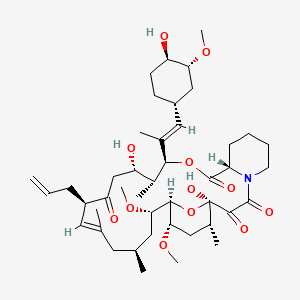
Tacrolimus
Tacrolimus is a calcineurin inhibitor and potent immunosuppressive agent used largely as a means of prophylaxis against cellular rejection after transplantation. Tacrolimus therapy can be associated with mild serum enzyme elevations, and it has been linked to rare instances of clinically apparent cholestatic liver injury. — LiverTox
- IUPAC name
- (1R,9S,12S,13R,14S,17R,18E,21S,23S,24R,25S,27R)-1,14-dihydroxy-12-[(E)-1-[(1R,3R,4R)-4-hydroxy-3-methoxycyclohexyl]prop-1-en-2-yl]-23,25-dimethoxy-13,19,21,27-tetramethyl-17-prop-2-enyl-11,28-dioxa-4-azatricyclo[22.3.1.04,9]octacos-18-ene-2,3,10,16-tetrone
- Molecular formula
- C44H69NO12
- Molecular weight
- 804.0 g/mol
- Exact mass
- 803.48197664 Da
- XLogP3
- 2.7
- Topological polar surface area
- 178.0 Ų
- Hydrogen-bond donors
- 3
- Hydrogen-bond acceptors
- 12
- Covalent units
- 1
- Defined stereocentres
- 14
Also known as
16 more reported names
External database identifiers
- ChEBI:CHEBI:61049
- ChEBI:CHEBI:93221
- ChEMBL:CHEMBL269732
- EPA DTXSID:DTXSID5046354
- PubMed:30545944
- PubMed:17965516
- PubMed:16702731
- PubMed:16021174
- PubMed:15896681
- PubMed:14661025
- PubMed:11145792
- PubMed:9857082
- PubMed:2445721
- PubMed:1715244
Evidence from additional scientific databases
EMBL-EBI ChEBI
tacrolimus (anhydrous)
A macrolide lactam containing a 23-membered lactone ring, originally isolated from the fermentation broth of a Japanese soil sample that contained the bacteria Streptomyces tsukubaensis.
- Formula
- C44H69NO12
- Average mass
- 804.031 g/mol
- Monoisotopic mass
- 803.48198 Da
- Formal charge
- 0
- macrolide lactam — is a (CHEBI:145565)
- bacterial metabolite — has role (CHEBI:76969)
- immunosuppressive agent — has role (CHEBI:35705)
- bacterial metabolite — has role (CHEBI:76969)
- immunosuppressive agent — has role (CHEBI:35705)
- macrolide lactam — is a (CHEBI:145565)
Additional curated names
Cross-references from this source
- CAS: 104987-11-3 — KEGG COMPOUND
- CAS: 104987-11-3 — ChemIDplus
- CAS: 104987-11-3 — KEGG DRUG
- REGISTRY_NUMBER: 3647477 — Reaxys
- REGISTRY_NUMBER: 8821611 — Reaxys
- MANUAL_X_REF: C01375 — KEGG COMPOUND
- MANUAL_X_REF: D08556 — KEGG DRUG
- MANUAL_X_REF: DB00864 — DrugBank
- MANUAL_X_REF: EP184162 — Patent
- MANUAL_X_REF: FK5 — PDBeChem
- MANUAL_X_REF: LMPK04000003 — LIPID MAPS
- MANUAL_X_REF: US5665727 — Patent
Mapped by: Exact CAS cross-reference in the ChEBI compound record. Source updated: 2019-12-03. Retrieved: 2026-08-31. Open source record
NIH PubChem PUG-View
Attributed physical-property, hazard, environmental and use annotations.
- LogP: 3.3 Source: DrugBank
- Melting Point: 126 °C Source: DrugBank
- Solubility: Insoluble Source: DrugBank
- IARC Carcinogenic Agent: Tacrolimus Source: International Agency for Research on Cancer (IARC)
- IARC Carcinogenic Classes: Group 1: Carcinogenic to humans Source: International Agency for Research on Cancer (IARC)
- IARC Monographs: Volume 137: (2026) Hydrochlorothiazide, Voriconazole, and Tacrolimus Source: International Agency for Research on Cancer (IARC)
- Publication Year: 2026 online Source: International Agency for Research on Cancer (IARC)
- Evaluation Year: 2024 Source: International Agency for Research on Cancer (IARC)
- Carcinogen Classification: No indication of carcinogenicity to humans (not listed by IARC). Source: Toxin and Toxin Target Database (T3DB)
- Exposure Routes: Absorption of tacrolimus from the gastrointestinal tract after oral administration is incomplete and variable. The absolute bioavailability in adult kidney transplant patients is 17Њ±10%; in adults liver transplant patients is 22Њ±6%; in healthy subjects is 18Њ±5%. The absolute bioavailability in pediatric liver transplant patients was 31Њ±24%. Tacrolimus maximum blood concentrations (Cmax) and area under the curve (AUC) appeared to increase in a dose-proportional fashion in 18 fasted healthy volunteers receiving a single oral dose of 3, 7, and 10 mg. When given without food, the rate and extent of absorption were the greatest. The time of the meal also affected bioavailability. When given immediately after a meal, mean Cmax was reduced 71%, and mean AUC was reduced 39%, relative to the fasted condition. When administered 1.5 hours following the meal, mean Cmax was reduced 63%, and mean AUC was reduced 39%, relative to the fasted condition. Source: Toxin and Toxin Target Database (T3DB)
- Signal: Danger Source: European Chemicals Agency (ECHA)
- GHS Hazard Statements: H301 (97.6%): Toxic if swallowed [Danger Acute toxicity, oral]; H361 (92.7%): Suspected of damaging fertility or the unborn child [Warning Reproductive toxicity]; H372 (91.5%): Causes damage to organs through prolonged or repeated exposure [Danger Specific target organ toxicity, repeated exposure] Source: European Chemicals Agency (ECHA)
- Precautionary Statement Codes: P203, P260, P264, P270, P280, P301+P316, P318, P319, P321, P330, P405, and P501 (click each P-code to see the statement) Source: European Chemicals Agency (ECHA)
- ECHA C&L Notifications Summary: Aggregated GHS information provided per 82 reports by companies from 13 notifications to the ECHA C&L Inventory. Each notification may be associated with multiple companies.; Information may vary between notifications depending on impurities, additives, and other factors. The percentage value in parenthesis indicates the notified classification ratio from companies that provide hazard codes. Only hazard codes with percentage values above 10% are shown. For more detailed information, please visit ECHA C&L website. Source: European Chemicals Agency (ECHA)
- GHS Hazard Statements: H301 (100%): Toxic if swallowed [Danger Acute toxicity, oral]; H361 (100%): Suspected of damaging fertility or the unborn child [Warning Reproductive toxicity]; H372 (100%): Causes damage to organs through prolonged or repeated exposure [Danger Specific target organ toxicity, repeated exposure] Source: European Chemicals Agency (ECHA)
- ECHA C&L Notifications Summary: The GHS information provided by 1 company from 1 notification to the ECHA C&L Inventory. Source: European Chemicals Agency (ECHA)
- Signal: Danger Source: Hazardous Substances Data Bank (HSDB)
- GHS Hazard Statements: H301: Toxic if swallowed [Danger Acute toxicity, oral] Source: Hazardous Substances Data Bank (HSDB)
- Precautionary Statement Codes: P264, P270, P301+P316, P321, P330, P405, and P501 (click each P-code to see the statement) Source: Hazardous Substances Data Bank (HSDB)
- Toxicity Summary: IDENTIFICATION AND USE: Tacrolimus is white to off-white crystalline powder. It is a calcineurin-inhibitor immunosuppressant available in several preparations. Tacrolimus in both oral capsules and a solution for IV injection is used for prophylaxis of organ rejection in patients receiving liver, kidney or heart transplants. Tacrolimus topical ointment is used as a second-line therapy for the short-term and non-continuous chronic treatment of moderate to severe atopic dermatitis in non-immunocompromised adults and children. HUMAN EXPOSURE AND TOXICITY: While most acute overdosages of tacrolimus at up to 30 times the intended dose have been asymptomatic and all patients recovered with no sequelae, some acute overdosages were followed by adverse reactions including tremors, abnormal renal function, hypertension, and peripheral edema. At therapeutic doses, patients receiving tacrolimus are at increased risk of developing lymphomas and other malignancies, particularly of the skin, as well as an increased risk of developing bacterial, viral, fungal, and protozoal infections, including opportunistic infections. These infections may lead to serious, including fatal, outcomes. While there a Source: Hazardous Substances Data Bank (HSDB)
- Toxicity Summary: Signs and Symptoms of Overdose; Tacrolimus toxicity commonly presents as acute kidney injury. Close monitoring of serum creatinine, glomerular filtration rate, and urine output is necessary for patients on tacrolimus. Toxicity may also present as adverse effects, including tremors, electrolyte disturbances, and headaches. Monitor for neurotoxicity, nephrotoxicity, and hypertension. Investigations may indicate increased serum creatinine. An electrocardiogram should be obtained to rule out QT prolongation.; Management of Overdose; No specific antidote is currently available for tacrolimus toxicity, and the drug is not removed by hemodialysis. Management focuses on supportive care, including symptom monitoring and management. Consultation with the poison control center is recommended for current guidance and treatment recommendations. Source: StatPearls
- Toxicity Summary: The mechanism of action of tacrolimus in atopic dermatitis is not known. While the following have been observed, the clinical significance of these observations in atopic dermatitis is not known. It has been demonstrated that tacrolimus inhibits T-lymphocyte activation by first binding to an intracellular protein, FKBP-12. A complex of tacrolimus-FKBP-12, calcium, calmodulin, and calcineurin is then formed and the phosphatase activity of calcineurin is inhibited. This prevents the dephosphorylation and translocation of nuclear factor of activated T-cells (NF-AT), a nuclear component thought to initiate gene transcription for the formation of lymphokines. Tacrolimus also inhibits the transcription for genes which encode IL-3, IL-4, IL-5, GM-CSF, and TNF-, all of which are involved in the early stages of T-cell activation. Additionally, tacrolimus has been shown to inhibit the release of pre-formed mediators from skin mast cells and basophils, and to downregulate the expression of FceRI on Langerhans cells. Source: Toxin and Toxin Target Database (T3DB)
- Uses: THERAPEUTIC CATEGORY: Immunosupressant; dermatological treatment of atopic eczema Source: Hazardous Substances Data Bank (HSDB)
- Uses: Immunosuppressive Agents Source: Hazardous Substances Data Bank (HSDB)
- Uses: MEDICATION Source: Hazardous Substances Data Bank (HSDB)
- Uses: Use (kg; approx.) in Germany (2009): >25; Use (kg) in USA (2002): 45; Consumption (g per capita; approx.) in Germany (2009): 0.000305; Consumption (g per capita) in the USA (2002): 0.00016; Calculated removal (%): 6 Source: NORMAN Suspect List Exchange
- Uses: For use after allogenic organ transplant to reduce the activity of the patient's immune system and so the risk of organ rejection. It was first approved by the FDA in 1994 for use in liver transplantation, this has been extended to include kidney, heart, small bowel, pancreas, lung, trachea, skin, cornea, and limb transplants. It has also been used in a topical preparation in the treatment of severe atopic dermatitis. Source: Toxin and Toxin Target Database (T3DB)
Mapped by: Existing checksum-valid CAS to unique PubChem CID match. Retrieved: 2026-08-31. Open source record
Scientific classifications and hazard annotations provide context and do not replace the market-specific regulatory decision shown above.
Additional source coverage and match status
| Source | Result | Checked |
|---|---|---|
| EMBL-EBI ChEBI | Exact match | 2026-08-31 |
| NIH PubChem PUG-View | Exact match | 2026-08-31 |
A recorded no-match is useful evidence that the source was checked; it is not a claim that the substance does not exist elsewhere.
Retrieved from NIH PubChem on 2026-08-31 by checksum-valid CAS matching. Chemical properties do not replace the regulatory decision on this page.