
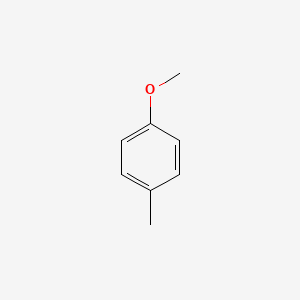
4-Methylanisole
1-Methoxy-4-methylbenzene is a member of methoxybenzenes. — ChEBI
- IUPAC name
- 1-methoxy-4-methylbenzene
- Molecular formula
- C8H10O
- Molecular weight
- 122.16 g/mol
- Exact mass
- 122.073164938 Da
- XLogP3
- 2.7
- Topological polar surface area
- 9.2 Ų
- Hydrogen-bond donors
- 0
- Hydrogen-bond acceptors
- 1
- Covalent units
- 1
- Defined stereocentres
- 0
Also known as
16 more reported names
External database identifiers
- ChEBI:CHEBI:89728
- ChEMBL:CHEMBL154155
- EPA DTXSID:DTXSID9026710
- PubMed:23019441
- PubMed:23002789
- PubMed:22893112
- PubMed:22595774
- PubMed:22589804
- PubMed:22512340
- PubMed:22412485
- PubMed:22381354
- PubMed:22347121
- PubMed:22346982
- PubMed:22189835
- PubMed:22103657
Evidence from additional scientific databases
EMBL-EBI ChEBI
1-Methoxy-4-methylbenzene
- Formula
- C8H10O
- Average mass
- 122.167 g/mol
- Monoisotopic mass
- 122.07316 Da
- Formal charge
- 0
Additional curated names
Cross-references from this source
- CAS: 104-93-8 — KEGG COMPOUND
- MANUAL_X_REF: HMDB0032076 — HMDB
Mapped by: Exact CAS cross-reference in the ChEBI compound record. Retrieved: 2026-08-31. Open source record
NIH PubChem PUG-View
Attributed physical-property, hazard, environmental and use annotations.
- Boiling Point: 175.5 °C AT 760 MM HG Source: Hazardous Substances Data Bank (HSDB)
- Boiling Point: 175.50 °C. @ 760.00 mm Hg Source: Human Metabolome Database (HMDB)
- Boiling Point: 174 °C Source: Joint FAO/WHO Expert Committee on Food Additives (JECFA)
- Color/Form: COLORLESS LIQUID Source: Hazardous Substances Data Bank (HSDB)
- Density: 0.969 AT 25 °C/25 °C Source: Hazardous Substances Data Bank (HSDB)
- Density: 0.996-1.004 Source: Joint FAO/WHO Expert Committee on Food Additives (JECFA)
- Flash Point: 60 °C Source: Haz-Map, Information on Hazardous Chemicals and Occupational Diseases
- LogP: log Kow = 2.66 Source: Hazardous Substances Data Bank (HSDB)
- LogP: 2.66 Source: Human Metabolome Database (HMDB)
- Melting Point: -32 °C Source: Hazardous Substances Data Bank (HSDB)
- Melting Point: -32 °C Source: Human Metabolome Database (HMDB)
- Odor: STRONG FLORAL ODOR Source: Hazardous Substances Data Bank (HSDB)
- Odor: PUNGENT ODOR SUGGESTIVE OF YLANG-YLANG Source: Hazardous Substances Data Bank (HSDB)
- Odor: SHARP, FRUITY SWEET ODOR Source: Hazardous Substances Data Bank (HSDB)
- Physical Description: Liquid Source: EPA Chemical Data Reporting (CDR)
- Physical Description: Colorless liquid with a strong floral odor; [Hawley] Source: Haz-Map, Information on Hazardous Chemicals and Occupational Diseases
- Physical Description: Liquid Source: Human Metabolome Database (HMDB)
- Physical Description: Colourless liquid, Pungent sharp sweet aroma Source: Joint FAO/WHO Expert Committee on Food Additives (JECFA)
- Refractive Index: INDEX OF REFRACTION: 1.5124 AT 19 °C/D; SADTLER REFERENCE NUMBER: 8044, 1366 (IR, PRISM), 10772 (IR, GRATING); 292 (NMR) Source: Hazardous Substances Data Bank (HSDB)
- Refractive Index: 1.510-1.513 Source: Joint FAO/WHO Expert Committee on Food Additives (JECFA)
- Solubility: INSOL IN WATER; SOL IN ETHER, ETHANOL, AND CHLOROFORM. Source: Hazardous Substances Data Bank (HSDB)
- Solubility: 1:3 IN 80% ALCOHOL, 1:7 IN 70% ALCOHOL Source: Hazardous Substances Data Bank (HSDB)
- Solubility: Insoluble in water, soluble in oils Source: Joint FAO/WHO Expert Committee on Food Additives (JECFA)
- Solubility: soluble (in ethanol) Source: Joint FAO/WHO Expert Committee on Food Additives (JECFA)
- Vapor Pressure: 1.14 [mmHg] Source: Haz-Map, Information on Hazardous Chemicals and Occupational Diseases
- Note: This chemical does not meet GHS hazard criteria for < 0.1% (1 of 1843) of reports. Source: European Chemicals Agency (ECHA)
- Signal: Warning Source: European Chemicals Agency (ECHA)
- GHS Hazard Statements: H226 (86%): Flammable liquid and vapor [Warning Flammable liquids]; H302 (99.9%): Harmful if swallowed [Warning Acute toxicity, oral]; H315 (99.7%): Causes skin irritation [Warning Skin corrosion/irritation]; H319 (11.6%): Causes serious eye irritation [Warning Serious eye damage/eye irritation]; H361 (84%): Suspected of damaging fertility or the unborn child [Warning Reproductive toxicity]; H412 (95.2%): Harmful to aquatic life with long lasting effects [Hazardous to the aquatic environment, long-term hazard] Source: European Chemicals Agency (ECHA)
- Precautionary Statement Codes: P203, P210, P233, P240, P241, P242, P243, P264, P264+P265, P270, P273, P280, P301+P317, P302+P352, P303+P361+P353, P305+P351+P338, P318, P321, P330, P332+P317, P337+P317, P362+P364, P370+P378, P403+P235, P405, and P501 (click each P-code to see the statement) Source: European Chemicals Agency (ECHA)
- ECHA C&L Notifications Summary: Aggregated GHS information provided per 1843 reports by companies from 32 notifications to the ECHA C&L Inventory. Each notification may be associated with multiple companies.; Reported as not meeting GHS hazard criteria per 1 of 1843 reports by companies.; There are 31 notifications provided by 1842 of 1843 reports by companies with hazard statement code(s).; Information may vary between notifications depending on impurities, additives, and other factors. The percentage value in parenthesis indicates the notified classification ratio from companies that provide hazard codes. Only hazard codes with percentage values above 10% are shown. For more detailed information, please visit ECHA C&L website. Source: European Chemicals Agency (ECHA)
- Environmental Bioconcentration: An estimated BCF value of 62 was calculated for 1-methoxy-4-methylbenzene(SRC), using an experimental log Kow of 2.66(1) and a recommended regression-derived equation(2). According to a recommended classification scheme(3), this BCF value suggests that 1-methoxy-4-methylbenzene will bioconcentrate moderately in aquatic organisms(SRC). Source: Hazardous Substances Data Bank (HSDB)
- Environmental Fate: TERRESTRIAL FATE: Based on a recommended classification scheme(1), an estimated Koc value of 670(SRC), determined from an experimental log Kow(2) and a recommended regression-derived equation(3), indicates that 1-methoxy-4-methylbenzene will have low mobility in soil(SRC). Volatilization of 1-methoxy-4-methylbenzene may be important from moist soil surfaces(SRC) given an estimated Henry's Law constant of 4.7X10⁻³ atm-cu m/mole(4,SRC), and from dry soil surfaces(SRC) based on an estimated vapor pressure of 1.14 mm Hg(5,SRC). Insufficient data are available to determine the rate or importance of biodegradation of 1-methoxy-4-methylbenzene in soil(SRC). Source: Hazardous Substances Data Bank (HSDB)
- Environmental Fate: AQUATIC FATE: Based on a recommended classification scheme(1), an estimated Koc value of 670(SRC), determined from an experimental log Kow(2) and a recommended regression-derived equation(3), indicates that 1-methoxy-4-methylbenzene may adsorb to suspended solids and sediment(SRC) in water. 1-Methoxy-4-methylbenzene may volatilize from water surfaces based on an estimated Henry's Law constant of 4.7X10⁻³ atm-cu m/mole(SRC), developed using a fragment constant estimation method(4). Estimated half-lives for a model river and model lake are 3.4 hours and 4.4 days, respectively(3,SRC). An estimated BCF value of 62(3,SRC), from an experimental log Kow(2), suggests that 1-methoxy-4-methylbenzene will only bioconcentrate moderately in aquatic organisms(SRC) according to a recommended classification scheme(5). Insufficient data are available to determine the rate or importance of biodegradation of 1-methoxy-4-methylbenzene in water(SRC). Source: Hazardous Substances Data Bank (HSDB)
- Environmental Fate: ATMOSPHERIC FATE: According to a suggested classification scheme(1), an estimated vapor pressure of 1.1 mm Hg at 25 °C(2,SRC) indicates that 1-methoxy-4-methylbenzene will exist in the vapor phase in the ambient atmosphere. Vapor-phase 1-methoxy-4-methylbenzene is degraded in the atmosphere by reaction with photochemically produced hydroxyl radicals(SRC); the half-life for this reaction in air is estimated to be about 14 hours(3,SRC). Source: Hazardous Substances Data Bank (HSDB)
- Consumer Uses: Fragrance Source: EPA Chemical Data Reporting (CDR)
- Industry Uses: Fragrance Source: EPA Chemical Data Reporting (CDR)
- Sources/Uses: Used as a flavor, fragrance, and starting material for the preparation of p-anisaldehyde; [HSDB] Source: Haz-Map, Information on Hazardous Chemicals and Occupational Diseases
- Uses: SYNTHETIC FLAVOR Source: Hazardous Substances Data Bank (HSDB)
- Uses: PERFUME INGREDIENT Source: Hazardous Substances Data Bank (HSDB)
- Uses: FRAGRANCE, EG, FOR PERFUMES, SOAPS & DETERGENTS Source: Hazardous Substances Data Bank (HSDB)
- Uses: FLAVORING AGENT, EG, FOR SYRUPS, BAKED GOODS & CANDIES Source: Hazardous Substances Data Bank (HSDB)
- Uses: Starting material for the preparation of p-anisaldehyde. Source: Hazardous Substances Data Bank (HSDB)
Mapped by: Existing checksum-valid CAS to unique PubChem CID match. Retrieved: 2026-08-31. Open source record
Scientific classifications and hazard annotations provide context and do not replace the market-specific regulatory decision shown above.
Additional source coverage and match status
| Source | Result | Checked |
|---|---|---|
| EMBL-EBI ChEBI | Exact match | 2026-08-31 |
| NIH PubChem PUG-View | Exact match | 2026-08-31 |
A recorded no-match is useful evidence that the source was checked; it is not a claim that the substance does not exist elsewhere.
Retrieved from NIH PubChem on 2026-08-31 by checksum-valid CAS matching. Chemical properties do not replace the regulatory decision on this page.