
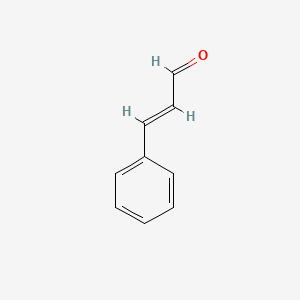
Cinnamaldehyde
(E)-cinnamaldehyde is the E (trans) stereoisomer of cinnamaldehyde, the parent of the class of cinnamaldehydes. It has a role as a sensitiser, a hypoglycemic agent, a flavouring agent, a vasodilator agent, an antifungal agent, an EC 4.3.1.24 (phenylalanine ammonia-lyase) inhibitor and a plant metabolite. It is a 3-phenylprop-2-enal and a member of cinnamaldehydes. — ChEBI
- IUPAC name
- (E)-3-phenylprop-2-enal
- Molecular formula
- C9H8O
- Molecular weight
- 132.16 g/mol
- Exact mass
- 132.057514874 Da
- XLogP3
- 1.9
- Topological polar surface area
- 17.1 Ų
- Hydrogen-bond donors
- 0
- Hydrogen-bond acceptors
- 1
- Covalent units
- 1
- Defined stereocentres
- 0
Also known as
16 more reported names
External database identifiers
- ChEBI:CHEBI:142921
- ChEBI:CHEBI:16731
- ChEMBL:CHEMBL293492
- EPA DTXSID:DTXSID6024834
- PubMed:24010721
- PubMed:23449869
- PubMed:21893402
- PubMed:21708228
- PubMed:21627838
- PubMed:21336686
- PubMed:18035463
- PubMed:16829128
- PubMed:15046718
- PubMed:10879482
Evidence from additional scientific databases
EMBL-EBI ChEBI
3-phenylprop-2-enal
A member of the class of cinnamaldehydes that is prop-2-enal in which a hydrogen at position 3 has been replaced by a phenyl group. The configuration of the double bond is not specified; the name "cinnamaldehyde" is widely used to refer to the E (trans) isomer.
- Formula
- C9H8O
- Average mass
- 132.162 g/mol
- Monoisotopic mass
- 132.05751 Da
- Formal charge
- 0
- cinnamaldehydes — is a (CHEBI:23245)
- cinnamaldehydes — is a (CHEBI:23245)
Additional curated names
Cross-references from this source
- CAS: 104-55-2 — PubChem Compound
Mapped by: Exact CAS cross-reference in the ChEBI compound record. Source updated: 2019-01-16. Retrieved: 2026-08-31. Open source record
NIH PubChem PUG-View
Attributed physical-property, hazard, environmental and use annotations.
- Boiling Point: 253 °C @ 760 MM HG (SLIGHT DECOMP) Source: Hazardous Substances Data Bank (HSDB)
- Boiling Point: 248.00 °C. @ 760.00 mm Hg Source: Human Metabolome Database (HMDB)
- Boiling Point: 248-250 °C Source: Joint FAO/WHO Expert Committee on Food Additives (JECFA)
- Color/Form: Yellowish oily liquid Source: Hazardous Substances Data Bank (HSDB)
- Color/Form: GREENISH-YELLOW LIQUID Source: Hazardous Substances Data Bank (HSDB)
- Density: 1.048-1.052 at 25 °C/25 °C Source: Hazardous Substances Data Bank (HSDB)
- Density: 1.046-1.053 Source: Joint FAO/WHO Expert Committee on Food Additives (JECFA)
- Flash Point: 160 °F Source: Haz-Map, Information on Hazardous Chemicals and Occupational Diseases
- Flash Point: 120 °C closed cup Source: Hazardous Substances Data Bank (HSDB)
- LogP: log Kow = 1.90 Source: Hazardous Substances Data Bank (HSDB)
- LogP: 1.90 Source: Human Metabolome Database (HMDB)
- Melting Point: -7.5 °C Source: Hazardous Substances Data Bank (HSDB)
- Melting Point: -7.5 °C Source: Human Metabolome Database (HMDB)
- Odor: PUNGENT, SPICY NOTE Source: Hazardous Substances Data Bank (HSDB)
- Odor: Strong odor of cinnamon Source: Hazardous Substances Data Bank (HSDB)
- Physical Description: CBI; Other Solid; Liquid Source: EPA Chemical Data Reporting (CDR)
- Physical Description: Yellowish oily liquid; [HSDB] Source: Haz-Map, Information on Hazardous Chemicals and Occupational Diseases
- Physical Description: Clear yellow liquid with a cinnamon odor; [CAMEO] Source: Haz-Map, Information on Hazardous Chemicals and Occupational Diseases
- Physical Description: Liquid Source: Human Metabolome Database (HMDB)
- Physical Description: Yellow liquid, strong cinnamon odour Source: Joint FAO/WHO Expert Committee on Food Additives (JECFA)
- Refractive Index: Index of refraction: 1.618-1.623 at 20 °C/D Source: Hazardous Substances Data Bank (HSDB)
- Refractive Index: 1.619-1.625 Source: Joint FAO/WHO Expert Committee on Food Additives (JECFA)
- Solubility: Dissolves in about 700 parts water, in about 7 volumes of 60% alcohol. Source: Hazardous Substances Data Bank (HSDB)
- Solubility: SOL IN ETHER, CHLOROFORM; INSOL IN PETROLEUM ETHER Source: Hazardous Substances Data Bank (HSDB)
- Solubility: Miscible with alcohol, ether, chloroform, oils Source: Hazardous Substances Data Bank (HSDB)
- Solubility: SOLUBILITY: 1:5 IN 60%, 1:25 IN 50%, 1:2.5 IN 70% ALC Source: Hazardous Substances Data Bank (HSDB)
- Solubility: In water, 1.42X10+3 mg/L at 25 °C Source: Hazardous Substances Data Bank (HSDB)
- Solubility: 1.42 mg/mL at 25 °C Source: Human Metabolome Database (HMDB)
- Solubility: insoluble in water; miscible in oils Source: Joint FAO/WHO Expert Committee on Food Additives (JECFA)
- Solubility: miscible (in ethanol) Source: Joint FAO/WHO Expert Committee on Food Additives (JECFA)
- Vapor Pressure: 2.89X10⁻² mm Hg at 25 °C Source: Hazardous Substances Data Bank (HSDB)
- Substance: trans-Cinnamaldehyde Source: NTP Technical Reports
- NTP Technical Report: TR-514: Toxicology and Carcinogenesis Studies of trans-Cinnamaldehyde (Microencapsulated) (CASRN 14371-10-9) in F344/N Rats and B6C3F1 Mice (Feed Studies) (2004 ) Source: NTP Technical Reports
- Peer Review Date: 09/05/02 Source: NTP Technical Reports
- Conclusion for Male Rat: No Evidence Source: NTP Technical Reports
- Conclusion for Female Rat: No Evidence Source: NTP Technical Reports
- Conclusion for Male Mice: No Evidence Source: NTP Technical Reports
- Conclusion for Female Mice: No Evidence Source: NTP Technical Reports
- Summary: Under the conditions of this 2-year feed study, there was no evidence of carcinogenic activity of transcinnamaldehyde in male or female F344/N rats exposed to 1,000, 2,100, or 4,100 ppm. There was no evidence of carcinogenic activity of trans-cinnamaldehyde in male or female B6C3F1 mice exposed to 1,000, 2,100, or 4,100 ppm.; Exposure to trans-cinnamaldehyde resulted in olfactory epithelial pigmentation in male and female mice. Source: NTP Technical Reports
- Carcinogen Classification: No indication of carcinogenicity to humans (not listed by IARC). Source: Toxin and Toxin Target Database (T3DB)
- Exposure Routes: Inhalation; dermal; ingestion Source: Toxin and Toxin Target Database (T3DB)
- Signal: Warning Source: Regulation (EC) No 1272/2008 of the European Parliament and of the Council
- GHS Hazard Statements: H317: May cause an allergic skin reaction [Warning Sensitization, Skin] Source: Regulation (EC) No 1272/2008 of the European Parliament and of the Council
- Precautionary Statement Codes: P261, P272, P280, P302+P352, P321, P333+P317, P362+P364, and P501 (click each P-code to see the statement) Source: Regulation (EC) No 1272/2008 of the European Parliament and of the Council
- Note: This chemical does not meet GHS hazard criteria for 0.2% (5 of 2854) of reports. Source: European Chemicals Agency (ECHA)
- Signal: Warning Source: European Chemicals Agency (ECHA)
- GHS Hazard Statements: H312 (76%): Harmful in contact with skin [Warning Acute toxicity, dermal]; H315 (98.1%): Causes skin irritation [Warning Skin corrosion/irritation]; H317 (99.7%): May cause an allergic skin reaction [Warning Sensitization, Skin]; H319 (95.6%): Causes serious eye irritation [Warning Serious eye damage/eye irritation] Source: European Chemicals Agency (ECHA)
- Precautionary Statement Codes: P261, P264, P264+P265, P272, P280, P302+P352, P305+P351+P338, P317, P321, P332+P317, P333+P317, P337+P317, P362+P364, and P501 (click each P-code to see the statement) Source: European Chemicals Agency (ECHA)
- ECHA C&L Notifications Summary: Aggregated GHS information provided per 2854 reports by companies from 40 notifications to the ECHA C&L Inventory. Each notification may be associated with multiple companies.; Reported as not meeting GHS hazard criteria per 5 of 2854 reports by companies.; There are 39 notifications provided by 2849 of 2854 reports by companies with hazard statement code(s).; Information may vary between notifications depending on impurities, additives, and other factors. The percentage value in parenthesis indicates the notified classification ratio from companies that provide hazard codes. Only hazard codes with percentage values above 10% are shown. For more detailed information, please visit ECHA C&L website. Source: European Chemicals Agency (ECHA)
- Note: This chemical does not meet GHS hazard criteria for 1.9% (3 of 161) of reports. Source: European Chemicals Agency (ECHA)
- GHS Hazard Statements: H312 (65.2%): Harmful in contact with skin [Warning Acute toxicity, dermal]; H315 (98.1%): Causes skin irritation [Warning Skin corrosion/irritation]; H317 (98.1%): May cause an allergic skin reaction [Warning Sensitization, Skin]; H319 (98.1%): Causes serious eye irritation [Warning Serious eye damage/eye irritation]; H335 (94.4%): May cause respiratory irritation [Warning Specific target organ toxicity, single exposure; Respiratory tract irritation]; H412 (64.6%): Harmful to aquatic life with long lasting effects [Hazardous to the aquatic environment, long-term hazard] Source: European Chemicals Agency (ECHA)
- Precautionary Statement Codes: P261, P264, P264+P265, P271, P272, P273, P280, P302+P352, P304+P340, P305+P351+P338, P317, P319, P321, P332+P317, P333+P317, P337+P317, P362+P364, P403+P233, P405, and P501 (click each P-code to see the statement) Source: European Chemicals Agency (ECHA)
- ECHA C&L Notifications Summary: Aggregated GHS information provided per 161 reports by companies from 12 notifications to the ECHA C&L Inventory. Each notification may be associated with multiple companies.; Reported as not meeting GHS hazard criteria per 3 of 161 reports by companies.; There are 11 notifications provided by 158 of 161 reports by companies with hazard statement code(s).; Information may vary between notifications depending on impurities, additives, and other factors. The percentage value in parenthesis indicates the notified classification ratio from companies that provide hazard codes. Only hazard codes with percentage values above 10% are shown. For more detailed information, please visit ECHA C&L website. Source: European Chemicals Agency (ECHA)
- Health Effects: Allergic reaction. Source: Toxin and Toxin Target Database (T3DB)
- Toxicity Summary: Cinnamaldehyde is an allergen. The physiologic effect of cinnamaldehyde is by means of increased histamine release and cell-mediated immunity. Source: Toxin and Toxin Target Database (T3DB)
- Environmental Bioconcentration: An estimated BCF of 8 was calculated in fish for cinnamaldehyde(SRC), using a log Kow of 1.9(1) and a regression-derived equation(2). According to a classification scheme(3), this BCF suggests the potential for bioconcentration in aquatic organisms is low(SRC). Source: Hazardous Substances Data Bank (HSDB)
- Environmental Fate: TERRESTRIAL FATE: Based on a classification scheme(1), an estimated Koc value of 37(SRC), determined from a log Kow of 1.9(2) and a regression-derived equation(3), indicates that cinnamaldehyde is expected to have very high mobility in soil(SRC). Volatilization of cinnamaldehyde from moist soil surfaces may be an important fate process(SRC) given an estimated Henry's Law constant of 3.5X10⁻⁶ atm-cu m/mole(SRC), derived from its vapor pressure, 2.89X10⁻² mm Hg(4), and water solubility, 1,420 mg/L(5). Cinnamaldehyde is not expected to volatilize from dry soil surfaces(SRC) based upon its vapor pressure(4). Biodegradation data were not available(SRC, 2009). Source: Hazardous Substances Data Bank (HSDB)
- Environmental Fate: AQUATIC FATE: Based on a classification scheme(1), an estimated Koc value of 37(SRC), determined from a log Kow of 1.9(2) and a regression-derived equation(3), indicates that cinnamaldehyde is not expected to adsorb to suspended solids and sediment(SRC). Volatilization from water surfaces is expected(3) based upon an estimated Henry's Law constant of 3.5X10⁻⁶ atm-cu m/mole(SRC), derived from its vapor pressure, 2.89X10⁻² mm Hg(4), and water solubility, 1,420 mg/L(5). Using this Henry's Law constant and an estimation method(3), volatilization half-lives for a model river and model lake are 290 hours and 91 days, respectively(SRC). According to a classification scheme(6), an estimated BCF of 8(SRC), from its log Kow (2) and a regression-derived equation(7), suggests the potential for bioconcentration in aquatic organisms is low(SRC). Biodegradation data were not available(SRC, 2009). Source: Hazardous Substances Data Bank (HSDB)
- Environmental Fate: ATMOSPHERIC FATE: According to a model of gas/particle partitioning of semivolatile organic compounds in the atmosphere(1), cinnamaldehyde, which has a vapor pressure of 2.89X10⁻² mm Hg at 25 °C(2), is expected to exist solely as a vapor in the ambient atmosphere. Vapor-phase cinnamaldehyde is degraded in the atmosphere by reaction with photochemically-produced hydroxyl radicals(SRC); the half-life for this reaction in air is estimated to be 10 hours and 9.5 hours for the cis- and trans-isomers, respectively(SRC), calculated from its rate constant of 3.8X10⁻¹¹ and 4.0X10⁻¹¹ cu cm/molecule-sec at 25 °C for cis- and trans-isomers, respectively(SRC). Cinnamaldehyde does not contain chromophores that absorb at wavelengths >290 nm(4) and therefore is not expected to be susceptible to direct photolysis by sunlight(SRC). Source: Hazardous Substances Data Bank (HSDB)
- Consumer Uses: Flavoring and nutrient; Not Known or Reasonably Ascertainable; Soil amendments (fertilizers); Fragrance; Processing aids, specific to petroleum production Source: EPA Chemical Data Reporting (CDR)
- Industry Uses: Processing aids, specific to petroleum production; Soil amendments (fertilizers); Fixing agent (mordant); Fragrance; Flavoring and nutrient; Solvent Source: EPA Chemical Data Reporting (CDR)
- Cosmetic Ingredient Review Link: CIR ingredient: Cinnamal Source: Cosmetic Ingredient Review (CIR)
- Sources/Uses: Used to flavor beverages, chewing gum, and dental products; [Marks, p. 77] Source: Haz-Map, Information on Hazardous Chemicals and Occupational Diseases
- Sources/Uses: Used in flavors and perfumes; [NTP] Source: Haz-Map, Information on Hazardous Chemicals and Occupational Diseases
- Uses: For cinnamaldehyde (USEPA/OPP Pesticide Code: 040506) ACTIVE products with label matches. /SRP: Registered for use in the U.S. but approved pesticide uses may change periodically and so federal, state and local authorities must be consulted for currently approved uses./ Source: Hazardous Substances Data Bank (HSDB)
- Uses: In electroplating processes, cinnamaldehyde is utilized as a brightener. Other applications include its efficacy as an animal repellent, its use in compositions to attract insects, and demonstration of a positive antifungal activity. Source: Hazardous Substances Data Bank (HSDB)
- Uses: In the flavor and perfume industry Source: Hazardous Substances Data Bank (HSDB)
- Uses: FOOD CHEM TO IMPART CINNAMON FLAVOR TO FOODS, BEVERAGES; PERFUME CHEM; FOOD CHEM; FILTERING AGENT; CINNAMON FLAVORING AGENT IN MEDICINALS, LIQUORS & CORDIALS; RUBBER REINFORCING AGENT Source: Hazardous Substances Data Bank (HSDB)
- Uses: For more Uses (Complete) data for CINNAMALDEHYDE (8 total), please visit the HSDB record page. Source: Hazardous Substances Data Bank (HSDB)
Mapped by: Existing checksum-valid CAS to unique PubChem CID match. Retrieved: 2026-08-31. Open source record
Scientific classifications and hazard annotations provide context and do not replace the market-specific regulatory decision shown above.
Additional source coverage and match status
| Source | Result | Checked |
|---|---|---|
| EMBL-EBI ChEBI | Exact match | 2026-08-31 |
| NIH PubChem PUG-View | Exact match | 2026-08-31 |
A recorded no-match is useful evidence that the source was checked; it is not a claim that the substance does not exist elsewhere.
Retrieved from NIH PubChem on 2026-09-02 by checksum-valid CAS matching. Chemical properties do not replace the regulatory decision on this page.