
Cinnamyl Alcohol
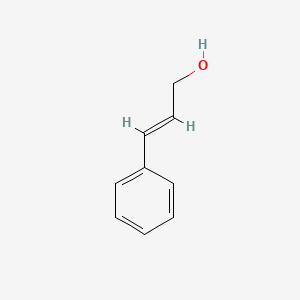
Cinnamyl alcohol is a primary alcohol comprising an allyl core with a hydroxy substituent at the 1-position and a phenyl substituent at the 3-position (geometry of the C=C bond unspecified). It has a role as a plant metabolite. — ChEBI
- IUPAC name
- (E)-3-phenylprop-2-en-1-ol
- Molecular formula
- C9H10O
- Molecular weight
- 134.17 g/mol
- Exact mass
- 134.073164938 Da
- XLogP3
- 1.9
- Topological polar surface area
- 20.2 Ų
- Hydrogen-bond donors
- 1
- Hydrogen-bond acceptors
- 1
- Covalent units
- 1
- Defined stereocentres
- 0
Also known as
16 more reported names
External database identifiers
- ChEBI:CHEBI:17177
- ChEBI:CHEBI:33227
- ChEMBL:CHEMBL324794
- EPA DTXSID:DTXSID301314144
- PubMed:18035463
Evidence from additional scientific databases
NIH PubChem PUG-View
Attributed physical-property, hazard, environmental and use annotations.
- Boiling Point: 250.0 °C @ 760 MM HG Source: Hazardous Substances Data Bank (HSDB)
- Boiling Point: 247.00 to 250.00 °C. @ 760.00 mm Hg Source: Human Metabolome Database (HMDB)
- Boiling Point: 258 °C Source: Joint FAO/WHO Expert Committee on Food Additives (JECFA)
- Color/Form: NEEDLES OR CRYSTAL MASS Source: Hazardous Substances Data Bank (HSDB)
- Color/Form: WHITE TO YELLOWISH SOLID Source: Hazardous Substances Data Bank (HSDB)
- Color/Form: WHITE NEEDLES FROM PETROLEUM ETHER Source: Hazardous Substances Data Bank (HSDB)
- Density: 1.0397 @ 35 °C/35 °C Source: Hazardous Substances Data Bank (HSDB)
- Flash Point: 126 °C Source: Haz-Map, Information on Hazardous Chemicals and Occupational Diseases
- Flash Point: 126 °C Source: Hazardous Substances Data Bank (HSDB)
- LogP: 1.700 Source: Human Metabolome Database (HMDB)
- Melting Point: 33 °C Source: Hazardous Substances Data Bank (HSDB)
- Melting Point: 33 °C Source: Human Metabolome Database (HMDB)
- Odor: ODOR OF HYACINTH Source: Hazardous Substances Data Bank (HSDB)
- Odor: PLEASANT, FLORAL ODOR Source: Hazardous Substances Data Bank (HSDB)
- Physical Description: Liquid Source: EPA Chemical Data Reporting (CDR)
- Physical Description: White solid with a hyacinth-like odor; [Hawley] Pale yellow crystalline solid; mp = 33-35 deg C; [MSDSonline] Source: Haz-Map, Information on Hazardous Chemicals and Occupational Diseases
- Physical Description: Solid Source: Human Metabolome Database (HMDB)
- Physical Description: White to yellowish crystalline solid, warm-balsamic, floral, sweet odour Source: Joint FAO/WHO Expert Committee on Food Additives (JECFA)
- Solubility: FREELY SOL IN ALC, ETHER, OTHER COMMON ORGANIC SOLVENTS; SOL IN WATER, GLYCEROL; CLEARLY SOL IN 3 VOL 50% ALC Source: Hazardous Substances Data Bank (HSDB)
- Solubility: insoluble to slightly soluble in water; soluble in oils Source: Joint FAO/WHO Expert Committee on Food Additives (JECFA)
- Solubility: moderately soluble (in ethanol) Source: Joint FAO/WHO Expert Committee on Food Additives (JECFA)
- Note: This chemical does not meet GHS hazard criteria for < 0.1% (1 of 2033) of reports. Source: European Chemicals Agency (ECHA)
- Signal: Warning Source: European Chemicals Agency (ECHA)
- GHS Hazard Statements: H302 (15.5%): Harmful if swallowed [Warning Acute toxicity, oral]; H317 (99.7%): May cause an allergic skin reaction [Warning Sensitization, Skin] Source: European Chemicals Agency (ECHA)
- Precautionary Statement Codes: P261, P264, P270, P272, P280, P301+P317, P302+P352, P321, P330, P333+P317, P362+P364, and P501 (click each P-code to see the statement) Source: European Chemicals Agency (ECHA)
- ECHA C&L Notifications Summary: Aggregated GHS information provided per 2033 reports by companies from 21 notifications to the ECHA C&L Inventory. Each notification may be associated with multiple companies.; Reported as not meeting GHS hazard criteria per 1 of 2033 reports by companies.; There are 20 notifications provided by 2032 of 2033 reports by companies with hazard statement code(s).; Information may vary between notifications depending on impurities, additives, and other factors. The percentage value in parenthesis indicates the notified classification ratio from companies that provide hazard codes. Only hazard codes with percentage values above 10% are shown. For more detailed information, please visit ECHA C&L website. Source: European Chemicals Agency (ECHA)
- GHS Hazard Statements: H302 (100%): Harmful if swallowed [Warning Acute toxicity, oral]; H315 (12.5%): Causes skin irritation [Warning Skin corrosion/irritation]; H317 (100%): May cause an allergic skin reaction [Warning Sensitization, Skin]; H319 (100%): Causes serious eye irritation [Warning Serious eye damage/eye irritation]; H335 (12.5%): May cause respiratory irritation [Warning Specific target organ toxicity, single exposure; Respiratory tract irritation] Source: European Chemicals Agency (ECHA)
- Precautionary Statement Codes: P261, P264, P264+P265, P270, P271, P272, P280, P301+P317, P302+P352, P304+P340, P305+P351+P338, P319, P321, P330, P332+P317, P333+P317, P337+P317, P362+P364, P403+P233, P405, and P501 (click each P-code to see the statement) Source: European Chemicals Agency (ECHA)
- ECHA C&L Notifications Summary: Aggregated GHS information provided per 8 reports by companies from 2 notifications to the ECHA C&L Inventory. Each notification may be associated with multiple companies.; Information may vary between notifications depending on impurities, additives, and other factors. The percentage value in parenthesis indicates the notified classification ratio from companies that provide hazard codes. Only hazard codes with percentage values above 10% are shown. For more detailed information, please visit ECHA C&L website. Source: European Chemicals Agency (ECHA)
- Signal: Warning Source: Hazardous Chemical Information System (HCIS), Safe Work Australia
- GHS Hazard Statements: H317: May cause an allergic skin reaction [Warning Sensitization, Skin] Source: Hazardous Chemical Information System (HCIS), Safe Work Australia
- Precautionary Statement Codes: P261, P272, P280, P302+P352, P321, P333+P317, P362+P364, and P501 (click each P-code to see the statement) Source: Hazardous Chemical Information System (HCIS), Safe Work Australia
- Industry Uses: Fixing agent (mordant) Source: EPA Chemical Data Reporting (CDR)
- Cosmetic Ingredient Review Link: CIR ingredient: Cinnamyl Alcohol Source: Cosmetic Ingredient Review (CIR)
- Sources/Uses: Used as a fragrance, flavoring agent, deodorant, and chemical intermediate (chemical resistant coatings, photosensitive polymers, and lithographic plates); [HSDB] Source: Haz-Map, Information on Hazardous Chemicals and Occupational Diseases
- Uses: AS DEODORANT IN 12.5% SOLN IN GLYCEROL Source: Hazardous Substances Data Bank (HSDB)
- Uses: FRAGRANCE, EG, FOR COLOGNES, SOAPS, AND LOTIONS; FIXATIVE FOR PERFUME BLENDS; IN MFR OF CHEM RESISTANT COATINGS; FLAVORING AGENT FOR FOOD (EG, CANDY, GUM, BEVERAGES); CHEM INTERMEDIATE FOR CINNAMYL ESTERS USED IN PERFUMERY; IN MFG OF PHOTOSENSITIVE POLYMERS & LITHOGRAPHIC PLATES Source: Hazardous Substances Data Bank (HSDB)
Mapped by: Existing checksum-valid CAS to unique PubChem CID match. Retrieved: 2026-08-31. Open source record
Scientific classifications and hazard annotations provide context and do not replace the market-specific regulatory decision shown above.
Additional source coverage and match status
| Source | Result | Checked |
|---|---|---|
| EMBL-EBI ChEBI | Needs review | 2026-08-31 |
| NIH PubChem PUG-View | Exact match | 2026-08-31 |
A recorded no-match is useful evidence that the source was checked; it is not a claim that the substance does not exist elsewhere.
Retrieved from NIH PubChem on 2026-08-31 by checksum-valid CAS matching. Chemical properties do not replace the regulatory decision on this page.