
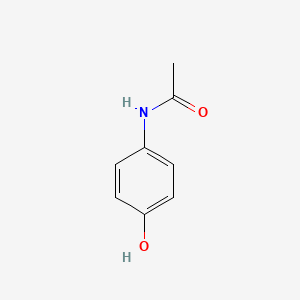
Acetaminophen
Paracetamol is a member of the class of phenols that is 4-aminophenol in which one of the hydrogens attached to the amino group has been replaced by an acetyl group. It has a role as a ferroptosis inducer, a geroprotector, a non-steroidal anti-inflammatory drug, a non-narcotic analgesic, an antipyretic, a xenobiotic, a cyclooxygenase 2 inhibitor, a cyclooxygenase 1 inhibitor, a hepatotoxic agent, a cyclooxygenase 3 inhibitor, an environmental contaminant and a human blood serum metabolite. It is a member of acetamides and a member of phenols. It is functionally related to a 4-aminophenol. — ChEBI
- IUPAC name
- N-(4-hydroxyphenyl)acetamide
- Molecular formula
- C8H9NO2
- Molecular weight
- 151.16 g/mol
- Exact mass
- 151.063328530 Da
- XLogP3
- 0.5
- Topological polar surface area
- 49.3 Ų
- Hydrogen-bond donors
- 2
- Hydrogen-bond acceptors
- 2
- Covalent units
- 1
- Defined stereocentres
- 0
Also known as
16 more reported names
External database identifiers
Evidence from additional scientific databases
EMBL-EBI ChEBI
paracetamol
A member of the class of phenols that is 4-aminophenol in which one of the hydrogens attached to the amino group has been replaced by an acetyl group.
- Formula
- C8H9NO2
- Average mass
- 151.165 g/mol
- Monoisotopic mass
- 151.06333 Da
- Formal charge
- 0
- phenols — is a (CHEBI:33853)
- acetamides — is a (CHEBI:22160)
- cyclooxygenase 2 inhibitor — has role (CHEBI:50629)
- cyclooxygenase 1 inhibitor — has role (CHEBI:50630)
- non-narcotic analgesic — has role (CHEBI:35481)
- antipyretic — has role (CHEBI:35493)
- non-steroidal anti-inflammatory drug — has role (CHEBI:35475)
- anti-HBV agent — has role (CHEBI:64951)
- anti-HIV agent — has role (CHEBI:64946)
- antibacterial agent — has role (CHEBI:33282)
- xenobiotic — has role (CHEBI:35703)
- hepatotoxic agent — has role (CHEBI:50908)
- human blood serum metabolite — has role (CHEBI:85234)
- cyclooxygenase 3 inhibitor — has role (CHEBI:73263)
- environmental contaminant — has role (CHEBI:78298)
- geroprotector — has role (CHEBI:176497)
- ferroptosis inducer — has role (CHEBI:173085)
- analgesic — has role (CHEBI:35480)
- 4-aminophenol — has functional parent (CHEBI:17602)
- cyclooxygenase 2 inhibitor — has role (CHEBI:50629)
- cyclooxygenase 1 inhibitor — has role (CHEBI:50630)
- non-narcotic analgesic — has role (CHEBI:35481)
- antipyretic — has role (CHEBI:35493)
- non-steroidal anti-inflammatory drug — has role (CHEBI:35475)
- anti-HBV agent — has role (CHEBI:64951)
- anti-HIV agent — has role (CHEBI:64946)
- antibacterial agent — has role (CHEBI:33282)
- xenobiotic — has role (CHEBI:35703)
- hepatotoxic agent — has role (CHEBI:50908)
- human blood serum metabolite — has role (CHEBI:85234)
- cyclooxygenase 3 inhibitor — has role (CHEBI:73263)
- environmental contaminant — has role (CHEBI:78298)
- geroprotector — has role (CHEBI:176497)
- ferroptosis inducer — has role (CHEBI:173085)
- analgesic — has role (CHEBI:35480)
- anxiolytic drug — has role (CHEBI:35474)
- anti-arrhythmia drug — has role (CHEBI:38070)
- antirheumatic drug — has role (CHEBI:35842)
- antineoplastic agent — has role (CHEBI:35610)
- neuroprotective agent — has role (CHEBI:63726)
- hypoglycemic agent — has role (CHEBI:35526)
- antiglaucoma drug — has role (CHEBI:39456)
- 10220563 Source: PubMed
- 10479322 Source: PubMed
- 10836148 Source: PubMed
- 10866370 Source: PubMed
- 10891117 Source: PubMed
- 10956200 Source: PubMed
- 11084378 Source: PubMed
- 11304127 Source: PubMed
- 11448232 Source: PubMed
- 11728183 Source: PubMed
- 11743742 Source: PubMed
- 12061889 Source: PubMed
- 12459019 Source: PubMed
- 12954186 Source: PubMed
- 14971904 Source: PubMed
- 15646539 Source: PubMed
- 15781124 Source: PubMed
- 16183274 Source: PubMed
- 16279782 Source: PubMed
- 16455248 Source: PubMed
- 16472241 Source: PubMed
- 16616488 Source: PubMed
- 16716555 Source: PubMed
- 16919959 Source: PubMed
Additional curated names
Cross-references from this source
- CAS: 103-90-2 — ChemIDplus
- CAS: 103-90-2 — KEGG COMPOUND
- CAS: 103-90-2 — NIST Chemistry WebBook
- MANUAL_X_REF: 1906 — ChemSpider
- MANUAL_X_REF: 52 — DrugCentral
- MANUAL_X_REF: Acetaminophen — Wikipedia
- MANUAL_X_REF: C06804 — KEGG COMPOUND
- MANUAL_X_REF: CPD-7669 — MetaCyc
- MANUAL_X_REF: D00217 — KEGG DRUG
- MANUAL_X_REF: DB00316 — DrugBank
- MANUAL_X_REF: HMDB0001859 — HMDB
- MANUAL_X_REF: LSM-5533 — LINCS
- MANUAL_X_REF: TYL — PDBeChem
- REGISTRY_NUMBER: 2208089 — Beilstein
- REGISTRY_NUMBER: 2208089 — Reaxys
Mapped by: Exact CAS cross-reference in the ChEBI compound record. Source updated: 2026-08-29. Retrieved: 2026-08-31. Open source record
NIH PubChem PUG-View
Attributed physical-property, hazard, environmental and use annotations.
- Autoignition Temperature: 540 °C Source: ILO-WHO International Chemical Safety Cards (ICSCs)
- Boiling Point: >500 Source: DrugBank
- Boiling Point: >500 °C Source: ILO-WHO International Chemical Safety Cards (ICSCs)
- Color/Form: Large monoclinic prisms from water Source: Hazardous Substances Data Bank (HSDB)
- Density: 1.293 at 70 °F (NTP, 1992) - Denser than water; will sink Source: CAMEO Chemicals
- Density: 1.293 g/cu cm at 21 °C Source: Hazardous Substances Data Bank (HSDB)
- Density: 1.3 g/cm³ Source: ILO-WHO International Chemical Safety Cards (ICSCs)
- Dissociation Constants: pKa = 9.38 Source: Hazardous Substances Data Bank (HSDB)
- LogP: 0.46 Source: DrugBank
- LogP: log Kow = 0.46 Source: Hazardous Substances Data Bank (HSDB)
- LogP: 0.46 Source: Human Metabolome Database (HMDB)
- LogP: 0.49 Source: ILO-WHO International Chemical Safety Cards (ICSCs)
- Melting Point: 336 to 342 °F (NTP, 1992) Source: CAMEO Chemicals
- Melting Point: 168-172 Source: DrugBank
- Melting Point: 168 °C Source: Hazardous Substances Data Bank (HSDB)
- Melting Point: MP: 169-170.5 °C Source: Hazardous Substances Data Bank (HSDB)
- Melting Point: 170 °C Source: Human Metabolome Database (HMDB)
- Melting Point: 169-170 °C Source: ILO-WHO International Chemical Safety Cards (ICSCs)
- Odor: Odorless Source: Hazardous Substances Data Bank (HSDB)
- Physical Description: 4-hydroxyacetanilide is an odorless white crystalline solid. Bitter taste. pH (saturated aqueous solution) about 6. (NTP, 1992) Source: CAMEO Chemicals
- Physical Description: Colorless solid; [ICSC] Odorless white solid; [CAMEO] White powder; [Sigma-Aldrich MSDS] Source: Haz-Map, Information on Hazardous Chemicals and Occupational Diseases
- Physical Description: Solid Source: Human Metabolome Database (HMDB)
- Physical Description: COLOURLESS CRYSTALS OR CRYSTALLINE POWDER. Source: ILO-WHO International Chemical Safety Cards (ICSCs)
- Solubility: 1 to 5 mg/mL at 72 °F (NTP, 1992) Source: CAMEO Chemicals
- Solubility: very slightly soluble in cold water but greater solubility in hot water Source: DrugBank
- Solubility: In water, 14,000 mg/L at 25 °C Source: Hazardous Substances Data Bank (HSDB)
- Solubility: Very slightly soluble in cold water, soluble in boiling water Source: Hazardous Substances Data Bank (HSDB)
- Solubility: Freely soluble in alcohol; soluble in methanol, ethanol, dimethylformamide, ethylene dichloride, acetone, ethyl acetate; slightly soluble in ether; practically insoluble in petroleum ether, pentane, benzene Source: Hazardous Substances Data Bank (HSDB)
- Solubility: 14 mg/mL at 25 °C Source: Human Metabolome Database (HMDB)
- Solubility: Solubility in water, g/100ml at 20 °C: 1.4 (moderate) Source: ILO-WHO International Chemical Safety Cards (ICSCs)
- Solubility: >22.7 [ug/mL] (The mean of the results at pH 7.4) Source: Sanford-Burnham Center for Chemical Genomics
- Vapor Pressure: 0.000007 [mmHg] Source: Haz-Map, Information on Hazardous Chemicals and Occupational Diseases
- Vapor Pressure: 6.29X10⁻⁵ mm Hg at 25 °C Source: Hazardous Substances Data Bank (HSDB)
- pH: Saturated aqueous solution: 5.5-6.5 Source: Hazardous Substances Data Bank (HSDB)
- IARC Carcinogenic Agent: Paracetamol (Acetaminophen) Source: International Agency for Research on Cancer (IARC)
- IARC Carcinogenic Classes: Group 3: Not classifiable as to its carcinogenicity to humans Source: International Agency for Research on Cancer (IARC)
- IARC Monographs: Volume 50: (1990) Pharmaceutical Drugs; Volume 73: (1999) Some Chemicals that Cause Tumours of the Kidney or Urinary Bladder in Rodents and Some Other Substances Source: International Agency for Research on Cancer (IARC)
- Publication Year: 1999 Source: International Agency for Research on Cancer (IARC)
- Evaluation Year: 1998 Source: International Agency for Research on Cancer (IARC)
- Substance: Acetaminophen (4-Hydroxyacetanilide) Source: NTP Technical Reports
- NTP Technical Report: TR-394: Toxicology and Carcinogenesis Studies of Acetaminophen (CASRN 103-90-2) in F344/N Rats and B6C3F1 Mice (Feed Studies) (1993 ) Source: NTP Technical Reports
- Peer Review Date: 11/19/90 Source: NTP Technical Reports
- Conclusion for Male Rat: No Evidence Source: NTP Technical Reports
- Conclusion for Female Rat: Equivocal Evidence Source: NTP Technical Reports
- Conclusion for Male Mice: No Evidence Source: NTP Technical Reports
- Conclusion for Female Mice: No Evidence Source: NTP Technical Reports
- Exposure Routes: The substance can be absorbed into the body by ingestion. Source: ILO-WHO International Chemical Safety Cards (ICSCs)
- Exposure Routes: Oral, rapid and almost complete. Source: Toxin and Toxin Target Database (T3DB)
- First Aid: EYES: First check the victim for contact lenses and remove if present. Flush victim's eyes with water or normal saline solution for 20 to 30 minutes while simultaneously calling a hospital or poison control center. Do not put any ointments, oils, or medication in the victim's eyes without specific instructions from a physician. IMMEDIATELY transport the victim after flushing eyes to a hospital even if no symptoms (such as redness or irritation) develop.; SKIN: IMMEDIATELY flood affected skin with water while removing and isolating all contaminated clothing. Gently wash all affected skin areas thoroughly with soap and water. If symptoms such as redness or irritation develop, IMMEDIATELY call a physician and be prepared to transport the victim to a hospital for treatment.; INHALATION: IMMEDIATELY leave the contaminated area; take deep breaths of fresh air. If symptoms (such as wheezing, coughing, shortness of breath, or burning in the mouth, throat, or chest) develop, call a physician and be prepared to transport the victim to a hospital. Provide proper respiratory protection to rescuers entering an unknown atmosphere. Whenever possible, Self-Contained Breathing Apparatus (SCBA) shou Source: CAMEO Chemicals
- Note: This chemical does not meet GHS hazard criteria for 1.2% (5 of 432) of reports. Source: European Chemicals Agency (ECHA)
- Signal: Warning Source: European Chemicals Agency (ECHA)
- GHS Hazard Statements: H302 (98.1%): Harmful if swallowed [Warning Acute toxicity, oral]; H315 (17.4%): Causes skin irritation [Warning Skin corrosion/irritation]; H319 (17.1%): Causes serious eye irritation [Warning Serious eye damage/eye irritation]; H412 (36.8%): Harmful to aquatic life with long lasting effects [Hazardous to the aquatic environment, long-term hazard] Source: European Chemicals Agency (ECHA)
- Precautionary Statement Codes: P264, P264+P265, P270, P273, P280, P301+P317, P302+P352, P305+P351+P338, P321, P330, P332+P317, P337+P317, P362+P364, and P501 (click each P-code to see the statement) Source: European Chemicals Agency (ECHA)
- ECHA C&L Notifications Summary: Aggregated GHS information provided per 432 reports by companies from 47 notifications to the ECHA C&L Inventory. Each notification may be associated with multiple companies.; Reported as not meeting GHS hazard criteria per 5 of 432 reports by companies.; There are 45 notifications provided by 427 of 432 reports by companies with hazard statement code(s).; Information may vary between notifications depending on impurities, additives, and other factors. The percentage value in parenthesis indicates the notified classification ratio from companies that provide hazard codes. Only hazard codes with percentage values above 10% are shown. For more detailed information, please visit ECHA C&L website. Source: European Chemicals Agency (ECHA)
- GHS Hazard Statements: H401: Toxic to aquatic life [Hazardous to the aquatic environment, acute hazard]; H411: Toxic to aquatic life with long lasting effects [Hazardous to the aquatic environment, long-term hazard] Source: NITE-CMC
- Precautionary Statement Codes: P273, P391, and P501 (click each P-code to see the statement) Source: NITE-CMC
- Signal: Danger Source: NITE-CMC
- GHS Hazard Statements: H341: Suspected of causing genetic defects [Warning Germ cell mutagenicity]; H370: Causes damage to organs [Danger Specific target organ toxicity, single exposure]; H371: May cause damage to organs [Warning Specific target organ toxicity, single exposure]; H372: Causes damage to organs through prolonged or repeated exposure [Danger Specific target organ toxicity, repeated exposure]; H373: May causes damage to organs through prolonged or repeated exposure [Warning Specific target organ toxicity, repeated exposure] Source: NITE-CMC
- Precautionary Statement Codes: P203, P260, P264, P270, P280, P308+P316, P318, P319, P321, P405, and P501 (click each P-code to see the statement) Source: NITE-CMC
- Signal: Warning Source: Hazardous Substances Data Bank (HSDB)
- GHS Hazard Statements: H302: Harmful if swallowed [Warning Acute toxicity, oral]; H315: Causes skin irritation [Warning Skin corrosion/irritation]; H319: Causes serious eye irritation [Warning Serious eye damage/eye irritation]; H335: May cause respiratory irritation [Warning Specific target organ toxicity, single exposure; Respiratory tract irritation]; H401: Toxic to aquatic life [Hazardous to the aquatic environment, acute hazard] Source: Hazardous Substances Data Bank (HSDB)
- Health Effects: Skin rashes, blood disorders and a swollen pancreas have occasionally happened in people taking the drug on a regular basis for a long time. Source: Toxin and Toxin Target Database (T3DB)
- Toxicity Summary: IDENTIFICATION AND USE: Acetaminophen is an odorless compound with a slightly bitter taste. It is a common analgesic and antipyretic agent used for the relief of fever as well as aches and pains associated with many conditions. HUMAN EXPOSURE AND TOXICITY: Nausea, vomiting, and abdominal pain usually occur within 2-3 hours after ingestion of toxic doses of the drug. In severe poisoning, CNS stimulation, excitement, and delirium may occur initially. This may be followed by CNS depression, stupor, hypothermia, marked prostration, rapid shallow breathing, rapid weak irregular pulse, low blood pressure, and circulatory failure. When an individual has ingested a toxic dose of acetaminophen, the individual should be hospitalized for several days of observation, even if there are no apparent ill effects, because maximum liver damage and/or cardiotoxic effects usually do not become apparent until 2-4 days after ingestion of the drug. Other symptoms of acute poisoning include cerebral edema and nonspecific myocardial depression. Vascular collapse results from the relative hypoxia and from a central depressant action that occurs only with massive doses. Shock may develop if vasodilation is m Source: Hazardous Substances Data Bank (HSDB)
- Toxicity Summary: Each year, approximately 500 fatalities and 50,000 emergency department admissions in the United States are linked to acetaminophen. In 2021, US poison control centers recorded over 80,000 cases. Acetaminophen is the most prevalent drug-related cause of acute liver failure, with hepatic injury occurring as a consequence of the drug's metabolism properties. After reaching therapeutic concentrations of oral acetaminophen, 60% to 90% of the drug undergoes metabolism in the liver, forming glucuronic acid- and sulfate-conjugate metabolites. A smaller fraction, approximately 5% to 15%, undergoes metabolism via the cytochrome P450 system (CYP450)—metabolism primarily through CYP2E1 results in the formation of the toxic intermediate NAPQI.; Under normal circumstances, NAPQI is neutralized by glutathione to form nontoxic metabolites. However, in the case of excessive doses of acetaminophen, the normal phase II drug metabolism pathways become depleted. The CYP450 pathway metabolizes a more significant portion of the acetaminophen, leading to elevated concentrations of NAPQI formation, and the limited glutathione stores can deplete. When there is a shortage of glutathione, NAPQI concentration Source: StatPearls
- Toxicity Summary: Paracetamol toxicity is one of the most common causes of poisoning worldwide. The toxic effects of acetaminophen are due to a minor alkylating metabolite (N-acetyl-p-benzo-quinone imine – also known as NAPQI), not acetaminophen itself nor any of the other major metabolites. Cytochromes P450 2E1 and 3A4 convert approximately 5% of paracetamol to NAPQI. This toxic metabolite reacts with sulfhydryl groups on proteins and with glutathione (GSH). NAPQI depletes the liver's natural antioxidant glutathione and directly damages cells in the liver, leading to liver failure. In animal studies, hepatic glutathione must be depleted to less than 70% of normal levels before hepatotoxicity occurs. More specifically, oxidation by NAPQI of GSH to GSSG (oxidized glutathione) and the reduction of GSSG back to GSH by the NADPH-dependent glutathione reductase appear to be responsible for the rapid oxidation of NADPH that occurs in hepatocytes incubated with NAPQI. Risk factors for toxicity include excessive chronic alcohol intake, fasting or anorexia nervosa, and the use of certain drugs such as isoniazid. At usual doses, paracetamol is quickly detoxified by combining irreversibly with the sulfhydryl g Source: Toxin and Toxin Target Database (T3DB)
- Environmental Bioconcentration: An estimated BCF of 3 was calculated in fish for acetaminophen(SRC), using a log Kow of 0.46(1) and a regression-derived equation(2). According to a classification scheme(3), this BCF suggests the potential for bioconcentration in aquatic organisms is low(SRC). Source: Hazardous Substances Data Bank (HSDB)
- Environmental Fate: TERRESTRIAL FATE: Based on a classification scheme(1), an estimated Koc value of 21(SRC), determined from a log Kow of 0.46(2) and a regression-derived equation(3), indicates that acetaminophen is expected to have very high mobility in soil(SRC). Volatilization of acetaminophen from moist soil surfaces is not expected to be an important fate process(SRC) given an estimated Henry's Law constant of 8.9X10⁻¹⁰ atm-cu m/mole(SRC), derived from its vapor pressure, 6.29X10⁻⁵ mm Hg(4), and water solubility, 1.4X10+4 mg/L(5). Acetaminophen is not expected to volatilize from dry soil surfaces(SRC) based upon its vapor pressure(4). The biodegradation half-lives for non-adapted, phenol-adapted, and cresol-adapted activated sludge were 21, 40, and 13 days(6), respectively, suggesting that biodegradation may be an important environmental fate process in soil given acclimation(SRC). Source: Hazardous Substances Data Bank (HSDB)
- Environmental Fate: AQUATIC FATE: Based on a classification scheme(1), an estimated Koc value of 21(SRC), determined from a log Kow of 0.46(2) and a regression-derived equation(3), indicates that acetaminophen is not expected to adsorb to suspended solids and sediment(SRC). Volatilization from water surfaces is not expected(4) based upon an estimated Henry's Law constant of 8.9X10⁻¹⁰ atm-cu m/mole(SRC), derived from its vapor pressure, 6.29X10⁻⁵ mm Hg(5), and water solubility, 1.4X10+4 mg/L(6). According to a classification scheme(7), an estimated BCF of 3(SRC), from its log Kow(2) and a regression-derived equation(3), suggests the potential for bioconcentration in aquatic organisms is low(SRC). The biodegradation half-lives for non-adapted, phenol-adapted, and cresol-adapted activated sludge were 21, 40, and 13 days(8), respectively, suggesting that biodegradation may be an important environmental fate process in water given acclimation(SRC). Source: Hazardous Substances Data Bank (HSDB)
- Environmental Fate: ATMOSPHERIC FATE: According to a model of gas/particle partitioning of semivolatile organic compounds in the atmosphere(1), acetaminophen, which has an estimated vapor pressure of 6.3X10⁻⁵ mm Hg at 25 °C(SRC), determined from a fragment constant method(2), will exist in both the vapor and particulate phases in the ambient atmosphere. Vapor-phase acetaminophen is degraded in the atmosphere by reaction with photochemically-produced hydroxyl radicals(SRC); the half-life for this reaction in air is estimated to be 22 hrs(SRC), calculated from its rate constant of 1.8X10⁻¹¹ cu cm/molecule-sec at 25 °C(SRC) that was derived using a structure estimation method(3). Particulate-phase acetaminophen may be removed from the air by wet and dry deposition(SRC). Acetaminophen absorbs light at wavelengths >290 nm(4) and, therefore, may be susceptible to direct photolysis by sunlight(SRC). Source: Hazardous Substances Data Bank (HSDB)
- Sources/Uses: Registered for use in the US for control of brown tree snakes; [NPIRS] Used to make azo dyes, photographic chemicals, and pharmaceuticals, as a stabilizer for hydrogen peroxide, and as a therapeutic analgesic and antipyretic; [HSDB] Source: Haz-Map, Information on Hazardous Chemicals and Occupational Diseases
- Uses: Manufacture of azo dyes, photographic chemicals. Source: Hazardous Substances Data Bank (HSDB)
- Uses: Stabilizer for hydrogen peroxide Source: Hazardous Substances Data Bank (HSDB)
- Uses: An analgesic used as an aspirin substitute Source: Hazardous Substances Data Bank (HSDB)
- Uses: Analgesics, Non-Narcotic; Antipyretics Source: Hazardous Substances Data Bank (HSDB)
- Uses: For more Uses (Complete) data for ACETAMINOPHEN (6 total), please visit the HSDB record page. Source: Hazardous Substances Data Bank (HSDB)
- Uses: Use (kg) in Switzerland (2009): >100000; Use (kg; approx.) in Germany (2009): >500000; Use (kg; exact) in Germany (2009): 564712; Use (kg) in USA (2002): 5790000; Use (kg) in France (2004): 3303077; Consumption (g per capita) in Switzerland (2009): 13; Consumption (g per capita; approx.) in Germany (2009): 6.1; Consumption (g per capita; exact) in Germany (2009): 6.9; Consumption (g per capita) in the USA (2002): 21; Consumption (g per capita) in France (2004): 55; Excretion rate: 0.037; Calculated removal (%): 75.1 Source: NORMAN Suspect List Exchange
- Uses: An over-the-counter analgesic (pain reliever) and antipyretic (fever reducer). It is commonly used for the relief of fever, headaches, and other minor aches and pains, and is a major ingredient in numerous cold and flu remedies. Source: Toxin and Toxin Target Database (T3DB)
Mapped by: Existing checksum-valid CAS to unique PubChem CID match. Retrieved: 2026-08-31. Open source record
Scientific classifications and hazard annotations provide context and do not replace the market-specific regulatory decision shown above.
Additional source coverage and match status
| Source | Result | Checked |
|---|---|---|
| EMBL-EBI ChEBI | Exact match | 2026-08-31 |
| NIH PubChem PUG-View | Exact match | 2026-08-31 |
A recorded no-match is useful evidence that the source was checked; it is not a claim that the substance does not exist elsewhere.
Retrieved from NIH PubChem on 2026-08-31 by checksum-valid CAS matching. Chemical properties do not replace the regulatory decision on this page.