
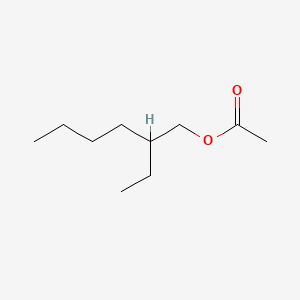
2-Ethylhexyl Acetate
2-ethylhexyl acetate is an acetate ester that is hexyl acetate substituted by an ethyl group at position 2. It has a role as a metabolite. It is functionally related to a hexan-1-ol. — ChEBI
- IUPAC name
- 2-ethylhexyl acetate
- Molecular formula
- C10H20O2
- Molecular weight
- 172.26 g/mol
- Exact mass
- 172.146329876 Da
- XLogP3
- 3.2
- Topological polar surface area
- 26.3 Ų
- Hydrogen-bond donors
- 0
- Hydrogen-bond acceptors
- 2
- Covalent units
- 1
- Defined stereocentres
- 0
Also known as
16 more reported names
External database identifiers
- ChEBI:CHEBI:87392
- ChEMBL:CHEMBL1879713
- EPA DTXSID:DTXSID8026694
- PubMed:22384116
- PubMed:21536495
Evidence from additional scientific databases
EMBL-EBI ChEBI
2-ethylhexyl acetate
An acetate ester that is hexyl acetate substituted by an ethyl group at position 2.
- Formula
- C10H20O2
- Average mass
- 172.268 g/mol
- Monoisotopic mass
- 172.14633 Da
- Formal charge
- 0
- acetate ester — is a (CHEBI:47622)
- metabolite — has role (CHEBI:25212)
- hexan-1-ol — has functional parent (CHEBI:87393)
- metabolite — has role (CHEBI:25212)
- acetate ester — is a (CHEBI:47622)
Additional curated names
Cross-references from this source
- CAS: 103-09-3 — ChemIDplus
- REGISTRY_NUMBER: 1758321 — Reaxys
Mapped by: Exact CAS cross-reference in the ChEBI compound record. Source updated: 2015-08-28. Retrieved: 2026-08-31. Open source record
NIH PubChem PUG-View
Attributed physical-property, hazard, environmental and use annotations.
- Autoignition Temperature: 515 °F (268 °C) Source: Hazardous Substances Data Bank (HSDB)
- Boiling Point: 378 °F at 760 mmHg (USCG, 1999) Source: CAMEO Chemicals
- Boiling Point: 199 °C Source: Hazardous Substances Data Bank (HSDB)
- Boiling Point: 378 °F Source: Occupational Safety and Health Administration (OSHA)
- Color/Form: WATER-WHITE STABLE LIQUID Source: Hazardous Substances Data Bank (HSDB)
- Density: 0.873 at 68 °F (USCG, 1999) - Less dense than water; will float Source: CAMEO Chemicals
- Density: Sp gr: 0.8718 @ 20 °C/20 °C Source: Hazardous Substances Data Bank (HSDB)
- Density: 0.873 Source: Occupational Safety and Health Administration (OSHA)
- Flash Point: 160 °F (USCG, 1999) Source: CAMEO Chemicals
- Flash Point: 82.2 °C Source: Haz-Map, Information on Hazardous Chemicals and Occupational Diseases
- Flash Point: 88 °C (OPEN CUP); 13 °C (CLOSED CUP) Source: Hazardous Substances Data Bank (HSDB)
- Flash Point: 160 °F Source: Occupational Safety and Health Administration (OSHA)
- Melting Point: -80 °C Source: Hazardous Substances Data Bank (HSDB)
- Physical Description: Ethylhexyl acetate appears as a water-white liquid. Insoluble in water and is less dense than water. Flash point 180 °F. Used as a solvent and in perfumes. Liquid or vapors may irritate skin and eyes. Vapors have a fruity, pleasant odor. Source: CAMEO Chemicals
- Physical Description: Liquid; CBI Source: EPA Chemical Data Reporting (CDR)
- Physical Description: White liquid; [Hawley] Source: Haz-Map, Information on Hazardous Chemicals and Occupational Diseases
- Physical Description: A water-white liquid. Source: Occupational Safety and Health Administration (OSHA)
- Refractive Index: INDEX OF REFRACTION: 1.4204 AT 20 DEG/C Source: Hazardous Substances Data Bank (HSDB)
- Solubility: VERY SLIGHTLY SOL IN WATER; MISCIBLE WITH ALCOHOL, OILS, & OTHER ORG SOLVENTS Source: Hazardous Substances Data Bank (HSDB)
- Solubility: SOL IN ETHER, ETHANOL, VERY SLIGHTLY SOLUBLE IN WATER Source: Hazardous Substances Data Bank (HSDB)
- Vapor Pressure: 0.23 [mmHg] Source: Haz-Map, Information on Hazardous Chemicals and Occupational Diseases
- Vapor Pressure: 0.23 mm Hg at 25 °C /from experimentally derived coefficients/ Source: Hazardous Substances Data Bank (HSDB)
- First Aid: Get medical attention.; INHALATION: Remove to fresh air. If breathing has stopped, give artificial respiration. If breathing is difficult, give oxygen.; EYES: Flush with water for at least 15 min., lifting lids occasionally.; SKIN: Remove contaminated clothing and shoes. Flush with water.; INGESTION: Have the victim drink water or milk. (USCG, 1999) Source: CAMEO Chemicals
- Note: This chemical does not meet GHS hazard criteria for 18.4% (399 of 2166) of reports. Source: European Chemicals Agency (ECHA)
- Signal: Warning Source: European Chemicals Agency (ECHA)
- GHS Hazard Statements: H315 (81.5%): Causes skin irritation [Warning Skin corrosion/irritation] Source: European Chemicals Agency (ECHA)
- Precautionary Statement Codes: P264, P280, P302+P352, P321, P332+P317, and P362+P364 (click each P-code to see the statement) Source: European Chemicals Agency (ECHA)
- ECHA C&L Notifications Summary: Aggregated GHS information provided per 2166 reports by companies from 5 notifications to the ECHA C&L Inventory.; Reported as not meeting GHS hazard criteria per 399 of 2166 reports by companies.; There are 3 notifications provided by 1767 of 2166 reports by companies with hazard statement code(s).; Information may vary between notifications depending on impurities, additives, and other factors. The percentage value in parenthesis indicates the notified classification ratio from companies that provide hazard codes. Only hazard codes with percentage values above 10% are shown. For more detailed information, please visit ECHA C&L website. Source: European Chemicals Agency (ECHA)
- NFPA Health Rating: 2 - Materials that, under emergency conditions, can cause temporary incapacitation or residual injury. Source: Hazardous Substances Data Bank (HSDB)
- NFPA Fire Rating: 2 - Materials that must be moderately heated or exposed to relatively high ambient temperatures before ignition can occur. Materials would not under normal conditions form hazardous atmospheres with air, but under high ambient temperatures or under moderate heating could release vapor in sufficient quantities to produce hazardous atmospheres with air. Source: Hazardous Substances Data Bank (HSDB)
- NFPA Instability Rating: 0 - Materials that in themselves are normally stable, even under fire conditions. Source: Hazardous Substances Data Bank (HSDB)
- Environmental Bioconcentration: An estimated BCF value of 400 was calculated for 2-ethylhexyl acetate(SRC), using an estimated log Kow of 3.74(1) and a recommended regression-derived equation(2). According to a classification scheme(3), this BCF value suggests that bioconcentration in aquatic organisms is high(SRC). Source: Hazardous Substances Data Bank (HSDB)
- Environmental Fate: TERRESTRIAL FATE: Based on a recommended classification scheme(1), an estimated Koc value of 2,500(SRC), determined from an estimated log Kow of 3.74(2,SRC) and a recommended regression-derived equation(3), indicates that 2-ethylhexyl acetate is expected to have slight mobility in soil(SRC). Volatilization of 2-ethylhexyl acetate is expected from moist soil surfaces(SRC) given its estimated Henry's Law constant of 1.5X10⁻³ atm-cu m/mole(SRC) using a fragment constant estimation method(4). Volatilization from dry soil surfaces is expected based on a vapor pressure of 0.23 mm Hg at 25 °C(5). Although no biodegradation studies have been performed on 2-ethylhexyl acetate, studies on structurally similar compounds(6-8) have shown that, in general, alkyl acetates are biodegradable(SRC). Source: Hazardous Substances Data Bank (HSDB)
- Environmental Fate: AQUATIC FATE: Based on a recommended classification scheme(1), an estimated Koc value of 2,500(SRC), determined from an estimated log Kow of 3.74(2) and a recommended regression-derived equation(3), indicates that 2-ethylhexyl acetate is expected to adsorb to suspended solids and sediment in water(SRC). 2-Ethylhexyl acetate is expected to volatilize from water surfaces(3,SRC) based on an estimated Henry's Law constant of 1.5X10⁻³ atm-cu m/mole(SRC) using a fragment constant estimation method(4). Estimated volatilization half-lives for a model river and model lake are 5 and 130, hours respectively(4,SRC). According to a classification scheme(5), an estimated BCF value of 400(3,SRC), from its log Kow(2), suggests that bioconcentration in aquatic organisms is high(SRC). Hydrolysis is expected to occur slowly based upon estimated hydrolysis half-lives of 3 years and 122 days at pH 7 and 8 respectively(6,SRC). Although no biodegradation studies have been performed on 2-ethylhexyl acetate, studies on structurally similar compounds(7-9) have shown that, in general, alkyl acetates are biodegradable(SRC). Source: Hazardous Substances Data Bank (HSDB)
- Environmental Fate: ATMOSPHERIC FATE: According to a model of gas/particle partitioning of semivolatile organic compounds in the atmosphere(1), 2-ethylhexyl acetate, which has a vapor pressure of 0.23 mm Hg at 25 °C(2), is expected to exist solely as a vapor in the ambient atmosphere. Vapor-phase 2-ethylhexyl acetate is degraded in the atmosphere by reaction with photochemically-produced hydroxyl radicals(SRC); the half-life for this reaction in air is estimated to be about 35 hours(3,SRC). Source: Hazardous Substances Data Bank (HSDB)
- Consumer Uses: Not Known or Reasonably Ascertainable Source: EPA Chemical Data Reporting (CDR)
- Industry Uses: Not Known or Reasonably Ascertainable; Solvent Source: EPA Chemical Data Reporting (CDR)
- Sources/Uses: Used as a solvent for nitrocellulose, lacquers, baking finishes, resins, waxes, and oils; [HSDB] Used in perfumes; [CAMEO] Used as a high-boiling retarder solvent in lacquers, emulsions, and silk-screen inks; [CHEMINFO] Source: Haz-Map, Information on Hazardous Chemicals and Occupational Diseases
- Industrial Processes with risk of exposure: Painting (Solvents) [Category: Paint]; Silk-Screen Printing [Category: Other] Source: Haz-Map, Information on Hazardous Chemicals and Occupational Diseases
- Uses: SOLVENT FOR NITROCELLULOSE, SOME RESINS, WAXES & OILS Source: Hazardous Substances Data Bank (HSDB)
- Uses: Solvent for nitrocellulose, resins, lacquers, baking finishes. Source: Hazardous Substances Data Bank (HSDB)
Mapped by: Existing checksum-valid CAS to unique PubChem CID match. Retrieved: 2026-08-31. Open source record
Scientific classifications and hazard annotations provide context and do not replace the market-specific regulatory decision shown above.
Additional source coverage and match status
| Source | Result | Checked |
|---|---|---|
| EMBL-EBI ChEBI | Exact match | 2026-08-31 |
| NIH PubChem PUG-View | Exact match | 2026-08-31 |
A recorded no-match is useful evidence that the source was checked; it is not a claim that the substance does not exist elsewhere.
Retrieved from NIH PubChem on 2026-08-31 by checksum-valid CAS matching. Chemical properties do not replace the regulatory decision on this page.