
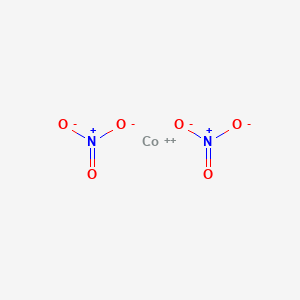
Cobalt dinitrate
Cobalt dinitrate is a cobalt salt in which the cobalt metal is in the +2 oxidation state and the counter-anion is nitrate. It is a cobalt salt and an inorganic nitrate salt. It contains a cobalt(2+). — ChEBI
- IUPAC name
- cobalt(2+) dinitrate
- Molecular formula
- CoN2O6
- Molecular weight
- 182.94 g/mol
- Exact mass
- 182.908829 Da
- Topological polar surface area
- 126.0 Ų
- Hydrogen-bond donors
- 0
- Hydrogen-bond acceptors
- 6
- Covalent units
- 3
- Defined stereocentres
- 0
Also known as
16 more reported names
External database identifiers
- ChEBI:CHEBI:86209
- EPA DTXSID:DTXSID9064970
Evidence from additional scientific databases
EMBL-EBI ChEBI
cobalt dinitrate
A cobalt salt in which the cobalt metal is in the +2 oxidation state and the counter-anion is nitrate.
- Formula
- Co.2NO3
- Average mass
- 182.941 g/mol
- Monoisotopic mass
- 182.90883 Da
- Formal charge
- 0
- inorganic nitrate salt — is a (CHEBI:51084)
- cobalt salt — is a (CHEBI:35698)
- cobalt(2+) — has part (CHEBI:48828)
- inorganic nitrate salt — is a (CHEBI:51084)
- cobalt salt — is a (CHEBI:35698)
Additional curated names
Cross-references from this source
- CAS: 10141-05-6 — ChemIDplus
- CAS: 10141-05-6 — NIST Chemistry WebBook
- REGISTRY_NUMBER: 5990847 — Reaxys
- MANUAL_X_REF: Cobalt(II)_nitrate — Wikipedia
Mapped by: Exact CAS cross-reference in the ChEBI compound record. Source updated: 2015-06-29. Retrieved: 2026-08-31. Open source record
NIH PubChem PUG-View
Attributed physical-property, hazard, environmental and use annotations.
- Color/Form: Pale red powder Source: Hazardous Substances Data Bank (HSDB)
- Color/Form: Red crystals Source: Hazardous Substances Data Bank (HSDB)
- Density: 1.54 at 68 °F (USCG, 1999) - Denser than water; will sink Source: CAMEO Chemicals
- Density: 2.49 g/cu cm Source: Hazardous Substances Data Bank (HSDB)
- Density: 2.49 g/cm³ Source: ILO-WHO International Chemical Safety Cards (ICSCs)
- Density: 2.49 @25 °C Source: PAC Chemical Database, U.S. Department of Energy
- Melting Point: 131 °F (USCG, 1999) Source: CAMEO Chemicals
- Melting Point: Decomposes at 100-105 °C Source: Hazardous Substances Data Bank (HSDB)
- Melting Point: MP: 55-56 °C (loses three H2O at 55 °C); liquid becomes green and decomposes to the oxide above 74 °C; soluble in water 1338 g/L at 0 °C, 2170 g/L at 80 °C); soluble in acetone and most organic solvents; slightly soluble in ammonium hydroxide /Cobaltous nitrate hexahydrate/ Source: Hazardous Substances Data Bank (HSDB)
- Odor: Odorless Source: Hazardous Substances Data Bank (HSDB)
- Physical Description: Cobalt nitrate is an odorless red solid. Sinks and mixes with water. (USCG, 1999) Source: CAMEO Chemicals
- Physical Description: Dry Powder; Liquid; Liquid; Other Solid Source: EPA Chemical Data Reporting (CDR)
- Physical Description: Pale red solid; [Merck Index] Red crystals, soluble in water; [MSDSonline] Source: Haz-Map, Information on Hazardous Chemicals and Occupational Diseases
- Physical Description: PALE RED POWDER. Source: ILO-WHO International Chemical Safety Cards (ICSCs)
- Solubility: Solubility: 97.929 lb/100 lb water at 70 °F /Cobaltous nitrate hexahydrate/ Source: Hazardous Substances Data Bank (HSDB)
- Solubility: Water solubility: >669.6 g/L at 20 °C /Cobaltous nitrate hexahydrate/ Source: Hazardous Substances Data Bank (HSDB)
- Solubility: Soluble in water Source: Hazardous Substances Data Bank (HSDB)
- Solubility: Solubility in water: soluble Source: ILO-WHO International Chemical Safety Cards (ICSCs)
- pH: pH 4.0 at 100 g/L at 20 °C Source: Hazardous Substances Data Bank (HSDB)
- Carcinogen Classification: Ingested nitrate or nitrite under conditions that result in endogenous nitrosation is probably carcinogenic to humans (Group 2A). Soluble cobalt(II) salts are possibly carcinogenic to humans (Group 2B). Source: Toxin and Toxin Target Database (T3DB)
- Exposure Routes: The substance can be absorbed into the body by inhalation of its aerosol and by ingestion. Source: ILO-WHO International Chemical Safety Cards (ICSCs)
- Exposure Routes: Inhalation (L29) ; oral (L29) ; dermal (L29) Source: Toxin and Toxin Target Database (T3DB)
- First Aid: INHALATION: move to fresh air; if breathing has stopped, begin artificial respiration and call a doctor.; INGESTION: give large amount of water; induce vomiting; call a doctor.; EYES: flush with water for at least 15 min.; SKIN: flush with water. (USCG, 1999) Source: CAMEO Chemicals
- Signal: Danger Source: Regulation (EC) No 1272/2008 of the European Parliament and of the Council
- GHS Hazard Statements: H317: May cause an allergic skin reaction [Warning Sensitization, Skin]; H334: May cause allergy or asthma symptoms or breathing difficulties if inhaled [Danger Sensitization, respiratory]; H341: Suspected of causing genetic defects [Warning Germ cell mutagenicity]; H350i: May cause cancer by inhalation [Danger Carcinogenicity]; H360F ***: May damage fertility [Danger Reproductive toxicity]; H400: Very toxic to aquatic life [Warning Hazardous to the aquatic environment, acute hazard]; H410: Very toxic to aquatic life with long lasting effects [Warning Hazardous to the aquatic environment, long-term hazard] Source: Regulation (EC) No 1272/2008 of the European Parliament and of the Council
- Precautionary Statement Codes: P203, P233, P260, P261, P271, P272, P273, P280, P284, P302+P352, P304+P340, P318, P321, P333+P317, P342+P316, P362+P364, P391, P403, P405, and P501 (click each P-code to see the statement) Source: Regulation (EC) No 1272/2008 of the European Parliament and of the Council
- Signal: Danger Source: European Chemicals Agency (ECHA)
- GHS Hazard Statements: H272 (54%): May intensify fire; oxidizer [Danger Oxidizing liquids; Oxidizing solids]; H302 (60.4%): Harmful if swallowed [Warning Acute toxicity, oral]; H317 (100%): May cause an allergic skin reaction [Warning Sensitization, Skin]; H318 (53.3%): Causes serious eye damage [Danger Serious eye damage/eye irritation]; H334 (100%): May cause allergy or asthma symptoms or breathing difficulties if inhaled [Danger Sensitization, respiratory]; H341 (100%): Suspected of causing genetic defects [Warning Germ cell mutagenicity]; H350 (49.1%): May cause cancer [Danger Carcinogenicity]; H350i (50.9%): May cause cancer by inhalation [Danger Carcinogenicity]; H360 (53%): May damage fertility or the unborn child [Danger Reproductive toxicity]; H360Fd (41.5%): May damage fertility; Suspected of damaging the unborn child [Danger Reproductive toxicity]; H400 (100%): Very toxic to aquatic life [Warning Hazardous to the aquatic environment, acute hazard]; H410 (88.4%): Very toxic to aquatic life with long lasting effects [Warning Hazardous to the aquatic environment, long-term hazard]; H411 (11.6%): Toxic to aquatic life with long lasting effects [Hazardous to the aquatic environment, long-term hazar Source: European Chemicals Agency (ECHA)
- Precautionary Statement Codes: P203, P210, P220, P233, P260, P261, P264, P264+P265, P270, P271, P272, P273, P280, P284, P301+P317, P302+P352, P304+P340, P305+P354+P338, P317, P318, P321, P330, P333+P317, P342+P316, P362+P364, P370+P378, P391, P403, P405, and P501 (click each P-code to see the statement) Source: European Chemicals Agency (ECHA)
- ECHA C&L Notifications Summary: Aggregated GHS information provided per 568 reports by companies from 24 notifications to the ECHA C&L Inventory. Each notification may be associated with multiple companies.; Information may vary between notifications depending on impurities, additives, and other factors. The percentage value in parenthesis indicates the notified classification ratio from companies that provide hazard codes. Only hazard codes with percentage values above 10% are shown. For more detailed information, please visit ECHA C&L website. Source: European Chemicals Agency (ECHA)
- Signal: Danger Source: NITE-CMC
- GHS Hazard Statements: H350: May cause cancer [Danger Carcinogenicity] Source: NITE-CMC
- Precautionary Statement Codes: P203, P280, P318, P405, and P501 (click each P-code to see the statement) Source: NITE-CMC
- GHS Hazard Statements: H302: Harmful if swallowed [Warning Acute toxicity, oral]; H317: May cause an allergic skin reaction [Warning Sensitization, Skin]; H318: Causes serious eye damage [Danger Serious eye damage/eye irritation]; H334: May cause allergy or asthma symptoms or breathing difficulties if inhaled [Danger Sensitization, respiratory]; H335: May cause respiratory irritation [Warning Specific target organ toxicity, single exposure; Respiratory tract irritation]; H351: Suspected of causing cancer [Warning Carcinogenicity]; H360: May damage fertility or the unborn child [Danger Reproductive toxicity]; H371: May cause damage to organs [Warning Specific target organ toxicity, single exposure]; H372: Causes damage to organs through prolonged or repeated exposure [Danger Specific target organ toxicity, repeated exposure]; H373: May causes damage to organs through prolonged or repeated exposure [Warning Specific target organ toxicity, repeated exposure] Source: NITE-CMC
- Precautionary Statement Codes: P203, P233, P260, P261, P264, P264+P265, P270, P271, P272, P280, P284, P301+P317, P302+P352, P304+P340, P305+P354+P338, P308+P316, P317, P318, P319, P321, P330, P333+P317, P342+P316, P362+P364, P403, P403+P233, P405, and P501 (click each P-code to see the statement) Source: NITE-CMC
- Health Effects: Exposure to high amount of cobalt can cause heart, lung, kidney, and liver damage. Skin contact is known to result in contact dermatitus. Cobalt may also have mutagenic and carcinogenic effects. Nitrate and nitrite poisoning causes methemoglobinemia. Nitrites may cause pregnancy complications and developmental effects. They may also be carcinogenic. (L1137, L29, L30) Source: Toxin and Toxin Target Database (T3DB)
- Toxicity Summary: IDENTIFICATION AND USE: Cobalt nitrate forms red crystals, or pale red powder. It is used in manufacture of cobalt pigments and invisible inks; decorating stoneware and porcelain; preparation of catalysts; production of vitamin B12 supplements. Cobalt nitrate is an important source of high-purity cobalt for use in the electronics and related industries. HUMAN EXPOSURE AND TOXICITY: Repeated or prolonged contact may cause skin sensitization. Repeated or prolonged inhalation may cause asthma. Ingestion may cause effects on the bone marrow, heart and thyroid. ANIMAL STUDIES: After four daily injections of 0.03 g cobalt nitrate, the pancreas of guinea pigs showed an increase in number of endocrine islands. The majority of alpha cells were degranulated with nuclei surrounded by a colorless cytoplasm. When animals were allowed to recover after the last injection, islands returned to normal. Cobalt nitrate given to rats sc twice over 24 hr period increased erythropoietic activity of the serum by greater than 3-fold, decreased renal blood flow by 18%, and disrupted metabolism in kidney. Rats exposed to 6.44 mg cobalt/kg/day as cobalt nitrate in the drinking water showed an increased sensit Source: Hazardous Substances Data Bank (HSDB)
- Toxicity Summary: Cobalt is believed to exhibit its toxicity through a oxidant-based and free radical-based processes. It produces oxygen radicals and may be oxidized to ionic cobalt, causing increased lipid peroxidation, DNA damage, and inducing certain enzymes that lead to cell apoptosis. Cobalt has also been shown to block inorganic calcium channels, possibly impairing neurotransmission. Cobalt can also chelate lipoic acids, impairing oxidation of pyruvate or fatty acids. In addition, cobalt may inhibit DNA repair by interacting with zinc finger DNA repair proteins, and has also been shown to inhibit heme synthesis and glucose metabolism. Cobalt may activate specific helper T-lymphocyte cells and interact directly with immunologic proteins, such as antibodies (IgA and IgE) or Fc receptors, resulting in immunosensitization. (L29) Nitrate's toxicity is a result of it's conversion to nitrite once in the body. Nitrite causes the autocatalytic oxidation of oxyhemoglobin to hydrogen peroxide and methemoglobin. This elevation of methemoglobin levels is a condition known as methemoglobinemia, and is characterized by tissue hypoxia, as methemoglobin cannot bind oxygen. (A2450, L1613) Source: Toxin and Toxin Target Database (T3DB)
- Environmental Bioconcentration: Food Chain Concentration Potential of Cobalt Nitrate Hexahydrate: Bioconcentration of 200-1000 fold only under constant exposure. Not significant in spill conditions(1). Source: Hazardous Substances Data Bank (HSDB)
- Environmental Fate: ATMOSPHERIC FATE: Inorganic cobalt compounds are nonvolatile and released into the atmosphere in particulate form(1). Particulate-phase cobalt compounds are removed from the air by wet and dry deposition(SRC). Cobalt has been detected in atmospheric deposition(2) and in rain-snow precipitation(3). Source: Hazardous Substances Data Bank (HSDB)
- Consumer Uses: Catalyst Source: EPA Chemical Data Reporting (CDR)
- Industry Uses: Etching agent; Chelating agent; Intermediate; Catalyst; Plating agent Source: EPA Chemical Data Reporting (CDR)
- Sources/Uses: Used in pigments, invisible inks, ceramics, catalysts; supplements, fertilizers, animal feeds, and hair dyes; [HSDB] Source: Haz-Map, Information on Hazardous Chemicals and Occupational Diseases
- Industrial Processes with risk of exposure: Farming (Feed Additives) [Category: Industry] Source: Haz-Map, Information on Hazardous Chemicals and Occupational Diseases
- Activities with risk of exposure: Ceramics making [Category: Hobbies] Source: Haz-Map, Information on Hazardous Chemicals and Occupational Diseases
- Uses: Manufacture of cobalt pigments and invisible inks; decorating stoneware and porcelain; preparation of catalysts; production of vitamin B12 supplements. Source: Hazardous Substances Data Bank (HSDB)
- Uses: Additive to soils and animal feeds, vitamin preparations, hair dyes. Source: Hazardous Substances Data Bank (HSDB)
- Uses: Cobalt nitrate is an important source of high-purity cobalt for use in the electronics and related industries. Source: Hazardous Substances Data Bank (HSDB)
- Uses: The high solubility of cobalt nitrate makes it a common source of cobalt in metal-organic frameworks and polymers. It is also reduced to metallic cobalt or precipitated on various substrates for Fischer-Tropsch catalysis. (L492) Source: Toxin and Toxin Target Database (T3DB)
Mapped by: Existing checksum-valid CAS to unique PubChem CID match. Retrieved: 2026-08-31. Open source record
Scientific classifications and hazard annotations provide context and do not replace the market-specific regulatory decision shown above.
Additional source coverage and match status
| Source | Result | Checked |
|---|---|---|
| EMBL-EBI ChEBI | Exact match | 2026-08-31 |
| NIH PubChem PUG-View | Exact match | 2026-08-31 |
A recorded no-match is useful evidence that the source was checked; it is not a claim that the substance does not exist elsewhere.
Retrieved from NIH PubChem on 2026-09-02 by checksum-valid CAS matching. Chemical properties do not replace the regulatory decision on this page.