
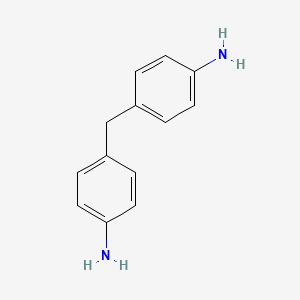
4,4-Diaminodiphenylmethane
4,4'-diaminodiphenylmethane is an aromatic amine that is diphenylmethane substituted at the 4-position of each benzene ring by an amino group. It has a role as a carcinogenic agent and an allergen. It derives from a hydride of a diphenylmethane. — ChEBI
- IUPAC name
- 4-[(4-aminophenyl)methyl]aniline
- Molecular formula
- C13H14N2
- Molecular weight
- 198.26 g/mol
- Exact mass
- 198.115698455 Da
- XLogP3
- 1.6
- Topological polar surface area
- 52.0 Ų
- Hydrogen-bond donors
- 2
- Hydrogen-bond acceptors
- 2
- Covalent units
- 1
- Defined stereocentres
- 0
Also known as
16 more reported names
External database identifiers
- ChEBI:CHEBI:32506
- ChEMBL:CHEMBL85728
- EPA DTXSID:DTXSID6022422
- PubMed:33565098
- PubMed:31100596
- PubMed:30723492
- PubMed:30203046
- PubMed:28108177
- PubMed:26884060
- PubMed:26396155
- PubMed:26116029
- PubMed:25380136
- PubMed:25058030
- PubMed:22751261
- PubMed:22512858
Evidence from additional scientific databases
EMBL-EBI ChEBI
4,4'-diaminodiphenylmethane
An aromatic amine that is diphenylmethane substituted at the 4-position of each benzene ring by an amino group.
- Formula
- C13H14N2
- Average mass
- 198.269 g/mol
- Monoisotopic mass
- 198.11570 Da
- Formal charge
- 0
- aromatic amine — is a (CHEBI:33860)
- allergen — has role (CHEBI:50904)
- carcinogenic agent — has role (CHEBI:50903)
- diphenylmethane — has parent hydride (CHEBI:38884)
- allergen — has role (CHEBI:50904)
- carcinogenic agent — has role (CHEBI:50903)
- aromatic amine — is a (CHEBI:33860)
Additional curated names
Cross-references from this source
- CAS: 101-77-9 — NIST Chemistry WebBook
- CAS: 101-77-9 — KEGG COMPOUND
- CAS: 101-77-9 — ChemIDplus
- MANUAL_X_REF: 1640 — PPDB
- MANUAL_X_REF: 4,4'-Methylenedianiline — Wikipedia
- MANUAL_X_REF: C14288 — KEGG COMPOUND
- MANUAL_X_REF: HMDB0041808 — HMDB
- REGISTRY_NUMBER: 474706 — Reaxys
Mapped by: Exact CAS cross-reference in the ChEBI compound record. Source updated: 2019-03-07. Retrieved: 2026-08-31. Open source record
NIH PubChem PUG-View
Attributed physical-property, hazard, environmental and use annotations.
- Boiling Point: 748 to 750 °F at 768 mmHg (NTP, 1992) Source: CAMEO Chemicals
- Boiling Point: 398 °C Source: Hazardous Substances Data Bank (HSDB)
- Boiling Point: BP: 257 °C at 18 mm Hg; 249-253 °C at 15 mm Hg; 232 °C at 9 mm Hg Source: Hazardous Substances Data Bank (HSDB)
- Boiling Point: at 102kPa: 398-399 °C Source: ILO-WHO International Chemical Safety Cards (ICSCs)
- Boiling Point: 748 °F Source: Occupational Safety and Health Administration (OSHA)
- Boiling Point: 398 °C @760 [mm Hg] Source: PAC Chemical Database, U.S. Department of Energy
- Boiling Point: 748 °F Source: The National Institute for Occupational Safety and Health (NIOSH)
- Color/Form: Crystals from water or benzene Source: Hazardous Substances Data Bank (HSDB)
- Color/Form: Tan flakes, lumps, or pearly leaflets from benzene Source: Hazardous Substances Data Bank (HSDB)
- Color/Form: Plates or needles (water); plates (benzene) Source: Hazardous Substances Data Bank (HSDB)
- Color/Form: Light-brown crystals Source: Hazardous Substances Data Bank (HSDB)
- Color/Form: Light tan to white crystalline solid Source: Hazardous Substances Data Bank (HSDB)
- Density: 1.15 at 77 °F (NTP, 1992) - Denser than water; will sink Source: CAMEO Chemicals
- Density: 1.070 g/mL at 103 °C Source: Hazardous Substances Data Bank (HSDB)
- Density: 0.5 g/cm³ Source: ILO-WHO International Chemical Safety Cards (ICSCs)
- Density: 1.15 Source: Occupational Safety and Health Administration (OSHA)
- Density: 1.070 @ 103°C Source: PAC Chemical Database, U.S. Department of Energy
- Density: 1.06 (Liquid at 212 °F) Source: The National Institute for Occupational Safety and Health (NIOSH)
- Flash Point: 430 °F (NTP, 1992) Source: CAMEO Chemicals
- Flash Point: 220 °C Source: Haz-Map, Information on Hazardous Chemicals and Occupational Diseases
- Flash Point: 428 °F (220 °C) (closed cup) Source: Hazardous Substances Data Bank (HSDB)
- Flash Point: 220 °C c.c. Source: ILO-WHO International Chemical Safety Cards (ICSCs)
- Flash Point: 430 °F Source: Occupational Safety and Health Administration (OSHA)
- Flash Point: 374 °F Source: The National Institute for Occupational Safety and Health (NIOSH)
- LogP: log Kow = 1.59 Source: Hazardous Substances Data Bank (HSDB)
- LogP: 1.59 Source: Human Metabolome Database (HMDB)
- LogP: 1.6 Source: ILO-WHO International Chemical Safety Cards (ICSCs)
- Melting Point: 197 to 198 °F (NTP, 1992) Source: CAMEO Chemicals
- Melting Point: 92.5 °C Source: Hazardous Substances Data Bank (HSDB)
- Melting Point: 92.5 °C Source: Human Metabolome Database (HMDB)
- Melting Point: 91.5-92 °C Source: ILO-WHO International Chemical Safety Cards (ICSCs)
- Melting Point: 198 °F Source: Occupational Safety and Health Administration (OSHA)
- Melting Point: 92.5 °C Source: PAC Chemical Database, U.S. Department of Energy
- Melting Point: 198 °F Source: The National Institute for Occupational Safety and Health (NIOSH)
- Odor: Faint, amine-like odor Source: Hazardous Substances Data Bank (HSDB)
- Physical Description: 4,4'-diaminodiphenylmethane appears as a tan flake or lump solid with a faint fishlike odor. May be toxic by inhalation or ingestion, and may be irritating to skin. Insoluble in water. Source: CAMEO Chemicals
- Physical Description: Dry Powder; Large Crystals Source: EPA Chemical Data Reporting (CDR)
- Physical Description: Pale-brown, crystalline solid with a faint, amine-like odor; [NIOSH] Source: Haz-Map, Information on Hazardous Chemicals and Occupational Diseases
- Physical Description: Solid Source: Human Metabolome Database (HMDB)
- Physical Description: COLOURLESS-TO-PALE-YELLOW FLAKES WITH CHARACTERISTIC ODOUR. TURNS DARK ON EXPOSURE TO AIR. Source: ILO-WHO International Chemical Safety Cards (ICSCs)
- Physical Description: Pale-brown, crystalline solid with a faint, amine-like odor. Source: Occupational Safety and Health Administration (OSHA)
- Physical Description: Pale-brown, crystalline solid with a faint, amine-like odor. Source: The National Institute for Occupational Safety and Health (NIOSH)
- Solubility: less than 1 mg/mL at 66 °F (NTP, 1992) Source: CAMEO Chemicals
- Solubility: Slightly sol in cold water. Very sol in alcohol, benzene, ether Source: Hazardous Substances Data Bank (HSDB)
- Solubility: Solubility (g/100mL solvent at 25 °C): 273.0 in acetone; 9.0 in benzene; 0.7 in carbon tetrachloride; 9.5 in ethyl ether; 143.0 in methanol; 0.1 in water Source: Hazardous Substances Data Bank (HSDB)
- Solubility: In water, 1.00X10+3 mg/L at 25 °C Source: Hazardous Substances Data Bank (HSDB)
- Solubility: 1 mg/mL at 25 °C Source: Human Metabolome Database (HMDB)
- Solubility: Solubility in water: poor Source: ILO-WHO International Chemical Safety Cards (ICSCs)
- Solubility: 0.1% Source: The National Institute for Occupational Safety and Health (NIOSH)
- Vapor Pressure: 1e-07 mmHg at 77 °F (calculated) (NTP, 1992) Source: CAMEO Chemicals
- Vapor Pressure: 0.0000002 [mmHg] Source: Haz-Map, Information on Hazardous Chemicals and Occupational Diseases
- Vapor Pressure: 2.03X10⁻⁷ mm Hg at 25 °C Source: Hazardous Substances Data Bank (HSDB)
- Vapor Pressure: Vapor pressure, Pa at 197 °C: 133 Source: ILO-WHO International Chemical Safety Cards (ICSCs)
- Vapor Pressure: 0.0000002 mmHg at 77 °F Source: Occupational Safety and Health Administration (OSHA)
- Vapor Pressure: (77 °F): 0.0000002 mmHg Source: The National Institute for Occupational Safety and Health (NIOSH)
- Viscosity: 8.3 cP at 100 °C Source: Hazardous Substances Data Bank (HSDB)
- pH: Weak base Source: Hazardous Substances Data Bank (HSDB)
- IARC Carcinogenic Agent: 4,4'-Methylenedianiline Source: International Agency for Research on Cancer (IARC)
- IARC Carcinogenic Classes: Group 2B: Possibly carcinogenic to humans Source: International Agency for Research on Cancer (IARC)
- IARC Monographs: Volume 39: (1986) Some Chemicals Used in Plastics and Elastomers; Volume Sup 7: Overall Evaluations of Carcinogenicity: An Updating of IARC Monographs Volumes 1 to 42, 1987; 440 pages; ISBN 92-832-1411-0 (out of print) Source: International Agency for Research on Cancer (IARC)
- Publication Year: 1987 Source: International Agency for Research on Cancer (IARC)
- Evaluation Year: 1987 Source: International Agency for Research on Cancer (IARC)
- Carcinogen Classification: 2B, possibly carcinogenic to humans. (L135) Source: Toxin and Toxin Target Database (T3DB)
- Exposure Routes: The substance can be absorbed into the body by inhalation of its aerosol, through the skin and by ingestion. Source: ILO-WHO International Chemical Safety Cards (ICSCs)
- Exposure Routes: inhalation, skin absorption, ingestion, skin and/or eye contact Source: The National Institute for Occupational Safety and Health (NIOSH)
- Exposure Routes: Inhalation, oral, dermal Source: Toxin and Toxin Target Database (T3DB)
- First Aid: EYES: First check the victim for contact lenses and remove if present. Flush victim's eyes with water or normal saline solution for 20 to 30 minutes while simultaneously calling a hospital or poison control center. Do not put any ointments, oils, or medication in the victim's eyes without specific instructions from a physician. IMMEDIATELY transport the victim after flushing eyes to a hospital even if no symptoms (such as redness or irritation) develop.; SKIN: IMMEDIATELY flood affected skin with water while removing and isolating all contaminated clothing. Gently wash all affected skin areas thoroughly with soap and water. IMMEDIATELY call a hospital or poison control center even if no symptoms (such as redness or irritation) develop. IMMEDIATELY transport the victim to a hospital for treatment after washing the affected areas.; INHALATION: IMMEDIATELY leave the contaminated area; take deep breaths of fresh air. IMMEDIATELY call a physician and be prepared to transport the victim to a hospital even if no symptoms (such as wheezing, coughing, shortness of breath, or burning in the mouth, throat, or chest) develop. Provide proper respiratory protection to rescuers entering an unknow Source: CAMEO Chemicals
- ERG2024, Guide 153 (4,4'-Diaminodiphenylmethane): General First Aid:; · Call 911 or emergency medical service.; · Ensure that medical personnel are aware of the material(s) involved, take precautions to protect themselves and avoid contamination.; · Move victim to fresh air if it can be done safely.; · Administer oxygen if breathing is difficult.; · If victim is not breathing:; -- DO NOT perform mouth-to-mouth resuscitation; the victim may have ingested or inhaled the substance.; -- If equipped and pulse detected, wash face and mouth, then give artificial respiration using a proper respiratory medical device (bag-valve mask, pocket mask equipped with a one-way valve or other device).; -- If no pulse detected or no respiratory medical device available, provide continuous compressions. Conduct a pulse check every two minutes or monitor for any signs of spontaneous respirations.; · Remove and isolate contaminated clothing and shoes.; · For minor skin contact, avoid spreading material on unaffected skin.; · In case of contact with substance, remove immediately by flushing skin or eyes with running water for at least 20 minutes.; · For severe burns, immediate medical attention is required.; · Effects of exposure (inhalation, ingestion, Source: Emergency Response Guidebook (ERG)
- First Aid: (General first aid procedures); Eye: Irrigate immediately - If this chemical contacts the eyes, immediately wash (irrigate) the eyes with large amounts of water, occasionally lifting the lower and upper lids. Get medical attention immediately.; Skin: Soap wash immediately - If this chemical contacts the skin, immediately wash the contaminated skin with soap and water. If this chemical penetrates the clothing, immediately remove the clothing, wash the skin with soap and water, and get medical attention promptly.; Breathing: Respiratory support; Swallow: Medical attention immediately - If this chemical has been swallowed, get medical attention immediately. Source: The National Institute for Occupational Safety and Health (NIOSH)
- Signal: Danger Source: Regulation (EC) No 1272/2008 of the European Parliament and of the Council
- GHS Hazard Statements: H317: May cause an allergic skin reaction [Warning Sensitization, Skin]; H341: Suspected of causing genetic defects [Warning Germ cell mutagenicity]; H350: May cause cancer [Danger Carcinogenicity]; H370 **: Causes damage to organs [Danger Specific target organ toxicity, single exposure]; H373 **: May causes damage to organs through prolonged or repeated exposure [Warning Specific target organ toxicity, repeated exposure]; H411: Toxic to aquatic life with long lasting effects [Hazardous to the aquatic environment, long-term hazard] Source: Regulation (EC) No 1272/2008 of the European Parliament and of the Council
- Precautionary Statement Codes: P203, P260, P261, P264, P270, P272, P273, P280, P302+P352, P308+P316, P318, P319, P321, P333+P317, P362+P364, P391, P405, and P501 (click each P-code to see the statement) Source: Regulation (EC) No 1272/2008 of the European Parliament and of the Council
- Signal: Danger Source: European Chemicals Agency (ECHA)
- GHS Hazard Statements: H301 (14.5%): Toxic if swallowed [Danger Acute toxicity, oral]; H317 (100%): May cause an allergic skin reaction [Warning Sensitization, Skin]; H341 (100%): Suspected of causing genetic defects [Warning Germ cell mutagenicity]; H350 (100%): May cause cancer [Danger Carcinogenicity]; H370 (100%): Causes damage to organs [Danger Specific target organ toxicity, single exposure]; H373 (99.8%): May causes damage to organs through prolonged or repeated exposure [Warning Specific target organ toxicity, repeated exposure]; H400 (28.5%): Very toxic to aquatic life [Warning Hazardous to the aquatic environment, acute hazard]; H411 (97.1%): Toxic to aquatic life with long lasting effects [Hazardous to the aquatic environment, long-term hazard] Source: European Chemicals Agency (ECHA)
- Precautionary Statement Codes: P203, P260, P261, P264, P270, P272, P273, P280, P301+P316, P302+P352, P308+P316, P318, P319, P321, P330, P333+P317, P362+P364, P391, P405, and P501 (click each P-code to see the statement) Source: European Chemicals Agency (ECHA)
- ECHA C&L Notifications Summary: Aggregated GHS information provided per 629 reports by companies from 19 notifications to the ECHA C&L Inventory. Each notification may be associated with multiple companies.; Information may vary between notifications depending on impurities, additives, and other factors. The percentage value in parenthesis indicates the notified classification ratio from companies that provide hazard codes. Only hazard codes with percentage values above 10% are shown. For more detailed information, please visit ECHA C&L website. Source: European Chemicals Agency (ECHA)
- GHS Hazard Statements: H317 (100%): May cause an allergic skin reaction [Warning Sensitization, Skin]; H341 (100%): Suspected of causing genetic defects [Warning Germ cell mutagenicity]; H350 (100%): May cause cancer [Danger Carcinogenicity]; H370 (100%): Causes damage to organs [Danger Specific target organ toxicity, single exposure]; H373 (100%): May causes damage to organs through prolonged or repeated exposure [Warning Specific target organ toxicity, repeated exposure]; H411 (100%): Toxic to aquatic life with long lasting effects [Hazardous to the aquatic environment, long-term hazard] Source: European Chemicals Agency (ECHA)
- Precautionary Statement Codes: P203, P260, P261, P264, P270, P272, P273, P280, P302+P352, P308+P316, P318, P319, P321, P333+P317, P362+P364, P391, P405, and P501 (click each P-code to see the statement) Source: European Chemicals Agency (ECHA)
- ECHA C&L Notifications Summary: Aggregated GHS information provided per 39 reports by companies from 2 notifications to the ECHA C&L Inventory. Each notification may be associated with multiple companies.; Information may vary between notifications depending on impurities, additives, and other factors. The percentage value in parenthesis indicates the notified classification ratio from companies that provide hazard codes. Only hazard codes with percentage values above 10% are shown. For more detailed information, please visit ECHA C&L website. Source: European Chemicals Agency (ECHA)
- Signal: Danger Source: NITE-CMC
- GHS Hazard Statements: H302: Harmful if swallowed [Warning Acute toxicity, oral]; H311: Toxic in contact with skin [Danger Acute toxicity, dermal]; H317: May cause an allergic skin reaction [Warning Sensitization, Skin]; H319: Causes serious eye irritation [Warning Serious eye damage/eye irritation]; H341: Suspected of causing genetic defects [Warning Germ cell mutagenicity]; H350: May cause cancer [Danger Carcinogenicity]; H370: Causes damage to organs [Danger Specific target organ toxicity, single exposure]; H372: Causes damage to organs through prolonged or repeated exposure [Danger Specific target organ toxicity, repeated exposure]; H373: May causes damage to organs through prolonged or repeated exposure [Warning Specific target organ toxicity, repeated exposure]; H400: Very toxic to aquatic life [Warning Hazardous to the aquatic environment, acute hazard]; H410: Very toxic to aquatic life with long lasting effects [Warning Hazardous to the aquatic environment, long-term hazard] Source: NITE-CMC
- NFPA Health Rating: 3 - Materials that, under emergency conditions, can cause serious or permanent injury. Source: Hazardous Substances Data Bank (HSDB)
- NFPA Fire Rating: 1 - Materials that must be preheated before ignition can occur. Materials require considerable preheating, under all ambient temperature conditions, before ignition and combustion can occur. Source: Hazardous Substances Data Bank (HSDB)
- NFPA Instability Rating: 0 - Materials that in themselves are normally stable, even under fire conditions. Source: Hazardous Substances Data Bank (HSDB)
- Target Organs: Dermal (Skin), Hepatic (Liver) Source: Agency for Toxic Substances and Disease Registry (ATSDR)
- Target Organs: Eyes, liver, cardiovascular system, spleen Source: The National Institute for Occupational Safety and Health (NIOSH)
- Toxicity Summary: After 4,4'-Methylenedianiline enters to our body, it is transported in the blood or stored in tissues. The N-N-acetylation of the compound leads to the formation of some toxic derivatives. The liver and thyroid are the targets of 4,4'-methylenedianiline in animals. Source: Toxin and Toxin Target Database (T3DB)
- Environmental Bioconcentration: BCF values ranging from 3.0 to 14 were measured for 4,4'-diaminodiphenylmethane (200 ug/L) in carp (4.5% lipid content) after a 6 week period(1). According to a classification scheme(2), these BCF values suggest the bioconcentration in aquatic organisms is low(SRC). Source: Hazardous Substances Data Bank (HSDB)
- Environmental Fate: TERRESTRIAL FATE: Based on a classification scheme(1), Koc values ranging from 3825 to 5681(2), indicate that 4,4'-diaminodiphenylmethane is expected to have slight to no mobility in soil(SRC). Volatilization of 4,4'-diaminodiphenylmethane from moist soil surfaces is not expected to be an important fate process(SRC) given an estimated Henry's Law constant of 5.30X10⁻¹¹ atm-cu m/mole(SRC), based upon its vapor pressure, 2.03X10⁻⁷ mm Hg(3), and water solubility, 1.00E+3(4). 4,4'-Diaminodiphenylmethane is not expected to volatilize from dry soil surfaces(SRC) based upon its vapor pressure(3). A 0% of theoretical BOD using activated sludge in the Japanese MITI test(5) suggests that biodegradation will not be an important environmental fate process in soil(SRC). Source: Hazardous Substances Data Bank (HSDB)
- Environmental Fate: AQUATIC FATE: Based on a classification scheme(1), measured Koc values ranging from 3825 to 5681(2), indicate that 4,4'-diaminodiphenylmethane is expected to adsorb to suspended solids and sediment(SRC). Volatilization from water surfaces is not expected(3) based upon an estimated Henry's Law constant of 5.30X10⁻¹¹ atm-cu m/mole(SRC), derived from its vapor pressure, 2.03X10⁻⁷ mm Hg(4), and water solubility, 1.00E+3(5). According to a classification scheme(6), BCF values of 3.0 to 14(7) suggest the bioconcentration in aquatic organisms is low(SRC). 4,4'-Diaminodiphenylmethane, present at 100 mg/L, reached 0% of its theoretical BOD in 4 weeks using an activated sludge inoculum at 30 mg/L in the Japanese MITI test(7), suggesting that biodegradation will not be an important fate process in the aquatic environment(SRC). Source: Hazardous Substances Data Bank (HSDB)
- Environmental Fate: ATMOSPHERIC FATE: According to a model of gas/particle partitioning of semivolatile organic compounds in the atmosphere(1), 4,4'-diaminodiphenylmethane, which has a vapor pressure of 2.03X10⁻⁷ mm Hg at 25 °C(2), will exist in both the vapor and particulate phases in the ambient atmosphere. Vapor-phase 4,4'-diaminodiphenylmethane is degraded in the atmosphere by reaction with photochemically-produced hydroxyl radicals(SRC); the half-life for this reaction in air is estimated to be 12.8 hours(SRC), calculated from its rate constant of 3.00X10⁻¹¹ cu cm/molecule-sec at 25 °C(3). Particulate-phase 4,4'-diaminodiphenylmethane may be removed from the air by wet or dry deposition(SRC). 4,4'-Diaminodiphenylmethane contains chromophores that absorb at wavelengths >290 nm(4) and therefore may be susceptible to direct photolysis by sunlight(SRC). Source: Hazardous Substances Data Bank (HSDB)
- Industry Uses: Surface modifier; Intermediate; Other Source: EPA Chemical Data Reporting (CDR)
- Uses: MDA is primarily used to produce 4,4-'methylenedianiline diisocyanate and other polymeric isocyanates which are used to manufacture polyurethane foams. MDA is also used as a curing agent for epoxy resins and urethane elastomers, as a corrosion preventative for iron, as an antioxidant for lubricating oils, as a rubber processing chemical, as an intermediate in the manufacture of elastomeric fibers (e.g., Spandex), and in the preparation of azo dyes. Source: EPA Hazardous Air Pollutants
- Sources/Uses: Used as a chemical intermediate, lab analytic agent, and monomer for polyamide and polymide resins; [HSDB] Used primarily in the manufacture of rubber and plastics; used as an epoxy resin hardener in the following applications: glues, paints, inks, polyvinylchloride products, dental bonding agents, and microelectronic encapsulations; [Marks, p. 269] Source: Haz-Map, Information on Hazardous Chemicals and Occupational Diseases
- Restricted Notes: Carcinogen--See 29 CFR 1910.1050 Source: Haz-Map, Information on Hazardous Chemicals and Occupational Diseases
- Industrial Processes with risk of exposure: Plastic Composites Manufacturing [Category: Industry] Source: Haz-Map, Information on Hazardous Chemicals and Occupational Diseases
- Uses: As chemical intermediate in prodn of isocyanates and polyisocyanates for prepn of polyurethane foams, Spandex fibers; as curing agent for epoxy resins and urethane elastomers; in production of polyamides; in the determination of tungsten and sulfates; in prepn of azo dyes; as corrosion inhibitor. Source: Hazardous Substances Data Bank (HSDB)
- Uses: Determination of tungsten and sulfates, polymer and dye intermediate, corrosion inhibitor, epoxy-resin hardening agent, isocyanate resins, polyamides. Source: Hazardous Substances Data Bank (HSDB)
- Uses: The isocyanates developed from 4,4'-methylenedianiline are also incorporated into semiflexible polyurethane foams for automobile safety cushioning. Source: Hazardous Substances Data Bank (HSDB)
- Uses: 4,4'-Methylenediphenyl diisocyanate produced from the highly purified 4,4'-methylene dianiline isomer is used for the manufacture of elastomers such as spandex fibres. Source: Hazardous Substances Data Bank (HSDB)
- Uses: For more Uses (Complete) data for 4,4'-DIAMINODIPHENYLMETHANE (6 total), please visit the HSDB record page. Source: Hazardous Substances Data Bank (HSDB)
- Uses: Substance listed with specific concentration in tattoo ink and/or permanent make up according to EU Commission Regulation 2020/2081. The concentration limit (by weight) is 0.0005%. Source: NORMAN Suspect List Exchange
Mapped by: Existing checksum-valid CAS to unique PubChem CID match. Retrieved: 2026-08-31. Open source record
Scientific classifications and hazard annotations provide context and do not replace the market-specific regulatory decision shown above.
Additional source coverage and match status
| Source | Result | Checked |
|---|---|---|
| EMBL-EBI ChEBI | Exact match | 2026-08-31 |
| NIH PubChem PUG-View | Exact match | 2026-08-31 |
A recorded no-match is useful evidence that the source was checked; it is not a claim that the substance does not exist elsewhere.
Retrieved from NIH PubChem on 2026-09-02 by checksum-valid CAS matching. Chemical properties do not replace the regulatory decision on this page.