
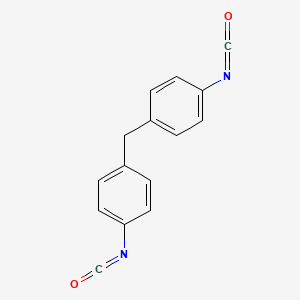
Diphenylmethane diisocyanate
Diphenylmethane-4,4'-diisocyanate is a diisocyanate consisting of diphenylmethane with two isocyanate groups at the 4- and 4'-positions. It has a role as an allergen and a hapten. It derives from a hydride of a diphenylmethane. — ChEBI
- IUPAC name
- 1-isocyanato-4-[(4-isocyanatophenyl)methyl]benzene
- Molecular formula
- C15H10N2O2
- Molecular weight
- 250.25 g/mol
- Exact mass
- 250.074227566 Da
- XLogP3
- 5.4
- Topological polar surface area
- 58.9 Ų
- Hydrogen-bond donors
- 0
- Hydrogen-bond acceptors
- 4
- Covalent units
- 1
- Defined stereocentres
- 0
Also known as
16 more reported names
External database identifiers
- ChEBI:CHEBI:53218
- ChEMBL:CHEMBL1488467
- EPA DTXSID:DTXSID7025180
- PubMed:31609387
- PubMed:29553459
- PubMed:26795242
- PubMed:25918132
- PubMed:23791970
- PubMed:22815186
- PubMed:22467024
- PubMed:22381623
- PubMed:22259443
- PubMed:21888418
- PubMed:21832810
- PubMed:21730687
Evidence from additional scientific databases
EMBL-EBI ChEBI
diphenylmethane-4,4'-diisocyanate
A diisocyanate consisting of diphenylmethane with two isocyanate groups at the 4- and 4'-positions.
- Formula
- C15H10N2O2
- Average mass
- 250.257 g/mol
- Monoisotopic mass
- 250.07423 Da
- Formal charge
- 0
- diisocyanate — is a (CHEBI:53213)
- hapten — has role (CHEBI:59174)
- allergen — has role (CHEBI:50904)
- diphenylmethane — has parent hydride (CHEBI:38884)
- hapten — has role (CHEBI:59174)
- allergen — has role (CHEBI:50904)
- diisocyanate — is a (CHEBI:53213)
- 11927838 Source: PubMed
- 1447476 Source: PubMed
- 14531868 Source: PubMed
- 17042142 Source: PubMed
- 17336832 Source: PubMed
- 18352975 Source: PubMed
- 18418755 Source: PubMed
- 18484168 Source: PubMed
- 18787742 Source: PubMed
- 19014769 Source: PubMed
- 19191163 Source: PubMed
- 19732394 Source: PubMed
- 19757291 Source: PubMed
- 20165612 Source: PubMed
- 20933064 Source: PubMed
- 21414210 Source: PubMed
- 21878336 Source: PubMed
- 21987383 Source: PubMed
- 24572447 Source: PubMed
- 26337647 Source: PubMed
- 26690039 Source: PubMed
- 26954368 Source: PubMed
- 6296214 Source: PubMed
- 6821040 Source: PubMed
Additional curated names
Cross-references from this source
- CAS: 101-68-8 — ChemIDplus
- CAS: 101-68-8 — KEGG COMPOUND
- CAS: 101-68-8 — NIST Chemistry WebBook
- REGISTRY_NUMBER: 166464 — Gmelin
- REGISTRY_NUMBER: 797662 — Reaxys
- MANUAL_X_REF: C19453 — KEGG COMPOUND
- MANUAL_X_REF: Diphenylmethane_diisocyanate — Wikipedia
- MANUAL_X_REF: WO2010121997 — Patent
Mapped by: Exact CAS cross-reference in the ChEBI compound record. Source updated: 2016-03-21. Retrieved: 2026-08-31. Open source record
NIH PubChem PUG-View
Attributed physical-property, hazard, environmental and use annotations.
- Autoignition Temperature: 240 °C Source: ILO-WHO International Chemical Safety Cards (ICSCs)
- Boiling Point: 381 to 390 °F at 5 mmHg (NTP, 1992) Source: CAMEO Chemicals
- Boiling Point: BP: 196 °C at 5 mm Hg Source: Hazardous Substances Data Bank (HSDB)
- Boiling Point: at 100kPa: 314 °C Source: ILO-WHO International Chemical Safety Cards (ICSCs)
- Boiling Point: 597 °F Source: Occupational Safety and Health Administration (OSHA)
- Boiling Point: 597 °F Source: The National Institute for Occupational Safety and Health (NIOSH)
- Color/Form: Light-yellow, fused solid Source: Hazardous Substances Data Bank (HSDB)
- Color/Form: Crystals Source: Hazardous Substances Data Bank (HSDB)
- Color/Form: White to light yellow flakes [Note: A liquid above 99 degrees F] Source: Hazardous Substances Data Bank (HSDB)
- Density: 1.2 at 68 °F (USCG, 1999) - Denser than water; will sink Source: CAMEO Chemicals
- Density: Density: 1.197 g/cu cm at 70 °C Source: Hazardous Substances Data Bank (HSDB)
- Density: Relative density (water = 1): 1.2 Source: ILO-WHO International Chemical Safety Cards (ICSCs)
- Density: 1.23 (Solid at 77 °F) 1.19 (Liquid at 122 °F) Source: Occupational Safety and Health Administration (OSHA)
- Density: 1.197 @ 70°C Source: PAC Chemical Database, U.S. Department of Energy
- Density: 1.23 (Solid at 77 °F) 1.19 (Liquid at 122 °F) Source: The National Institute for Occupational Safety and Health (NIOSH)
- Flash Point: 425 °F (NTP, 1992) Source: CAMEO Chemicals
- Flash Point: 396 °F (OPEN CUP) Source: Hazardous Substances Data Bank (HSDB)
- Flash Point: 196 °C c.c. Source: ILO-WHO International Chemical Safety Cards (ICSCs)
- Flash Point: 390 °F Source: Occupational Safety and Health Administration (OSHA)
- Flash Point: 390 °F Source: The National Institute for Occupational Safety and Health (NIOSH)
- Melting Point: 99 °F (NTP, 1992) Source: CAMEO Chemicals
- Melting Point: 37 °C Source: Hazardous Substances Data Bank (HSDB)
- Melting Point: 37 °C Source: ILO-WHO International Chemical Safety Cards (ICSCs)
- Melting Point: 99 °F Source: Occupational Safety and Health Administration (OSHA)
- Melting Point: 37 °C Source: PAC Chemical Database, U.S. Department of Energy
- Melting Point: 99 °F Source: The National Institute for Occupational Safety and Health (NIOSH)
- Odor: Odorless Source: Hazardous Substances Data Bank (HSDB)
- Physical Description: Diphenylmethane-4,4-diisocyanate is a light yellow colored solid. It is not soluble in water. It may be toxic by ingestion, inhalation, or skin absorption. If in a solution it may or may not burn depending on the nature of the material and/or the solvent. It is used to make plastics. Source: CAMEO Chemicals
- Physical Description: CBI; Liquid; Other Solid; Liquid Source: EPA Chemical Data Reporting (CDR)
- Physical Description: Dry Powder; Other Solid; Liquid; Wet Solid; Large Crystals; Liquid; Liquid; Liquid; Other Solid Source: EPA Chemical Data Reporting (CDR)
- Physical Description: White to light-yellow, odorless flakes. [Note: A liquid above 99 degrees F.]; [NIOSH] Source: Haz-Map, Information on Hazardous Chemicals and Occupational Diseases
- Physical Description: Polymeric MDI: Dark amber viscous liquid; Pure 4,4'-MDI: White waxy solid; [CPS&Q: RARs - Final Report] Light to dark yellow liquid with a mild musty odor; mp = 15-20 deg C; [Bayer Material Science MSDS] Source: Haz-Map, Information on Hazardous Chemicals and Occupational Diseases
- Physical Description: WHITE-TO-PALE-YELLOW CRYSTALS OR FLAKES. Source: ILO-WHO International Chemical Safety Cards (ICSCs)
- Physical Description: White to light-yellow, odorless flakes. Source: Occupational Safety and Health Administration (OSHA)
- Physical Description: White to light-yellow, odorless flakes. [Note: A liquid above 99 °F.] Source: The National Institute for Occupational Safety and Health (NIOSH)
- Refractive Index: Index of refraction: 1.5906 at 50 °C/D Source: Hazardous Substances Data Bank (HSDB)
- Solubility: Insoluble (NTP, 1992) Source: CAMEO Chemicals
- Solubility: Soluble in acetone, benzene, kerosene, and nitrobenzene Source: Hazardous Substances Data Bank (HSDB)
- Solubility: Solubility in water: reaction Source: ILO-WHO International Chemical Safety Cards (ICSCs)
- Solubility: 0.2% Source: The National Institute for Occupational Safety and Health (NIOSH)
- Vapor Pressure: 5e-06 mmHg at 77 °F (NIOSH, 2024) Source: CAMEO Chemicals
- Vapor Pressure: 0.000005 [mmHg] Source: Haz-Map, Information on Hazardous Chemicals and Occupational Diseases
- Vapor Pressure: 0.000004 [mmHg] Source: Haz-Map, Information on Hazardous Chemicals and Occupational Diseases
- Vapor Pressure: 5.0X10⁻⁶ mm Hg at 25 °C Source: Hazardous Substances Data Bank (HSDB)
- Vapor Pressure: Vapor pressure at 20 °C: negligible Source: ILO-WHO International Chemical Safety Cards (ICSCs)
- Vapor Pressure: 0.000005 mmHg at 77 °F Source: Occupational Safety and Health Administration (OSHA)
- Vapor Pressure: (77 °F): 0.000005 mmHg Source: The National Institute for Occupational Safety and Health (NIOSH)
- IARC Carcinogenic Agent: 4,4'-Methylenediphenyl diisocyanate Source: International Agency for Research on Cancer (IARC)
- IARC Carcinogenic Classes: Group 3: Not classifiable as to its carcinogenicity to humans Source: International Agency for Research on Cancer (IARC)
- IARC Monographs: Volume 19: (1979) Some Monomers, Plastics and Synthetic Elastomers, and Acrolein; Volume Sup 7: Overall Evaluations of Carcinogenicity: An Updating of IARC Monographs Volumes 1 to 42, 1987; 440 pages; ISBN 92-832-1411-0 (out of print); Volume 71: (1999) Re-evaluation of Some Organic Chemicals, Hydrazine and Hydrogen Peroxide (Part 1, Part 2, Part 3) Source: International Agency for Research on Cancer (IARC)
- Publication Year: 1999 Source: International Agency for Research on Cancer (IARC)
- Evaluation Year: 1998 Source: International Agency for Research on Cancer (IARC)
- Carcinogen Classification: 3, not classifiable as to its carcinogenicity to humans. (L135) Source: Toxin and Toxin Target Database (T3DB)
- Exposure Routes: The substance can be absorbed into the body by inhalation. Source: ILO-WHO International Chemical Safety Cards (ICSCs)
- Exposure Routes: inhalation, ingestion, skin and/or eye contact Source: The National Institute for Occupational Safety and Health (NIOSH)
- Exposure Routes: Oral (L96) ; inhalation (L96) ; dermal (L96) Source: Toxin and Toxin Target Database (T3DB)
- First Aid: EYES: First check the victim for contact lenses and remove if present. Flush victim's eyes with water or normal saline solution for 20 to 30 minutes while simultaneously calling a hospital or poison control center. Do not put any ointments, oils, or medication in the victim's eyes without specific instructions from a physician. IMMEDIATELY transport the victim after flushing eyes to a hospital even if no symptoms (such as redness or irritation) develop.; SKIN: IMMEDIATELY flood affected skin with water while removing and isolating all contaminated clothing. Gently wash all affected skin areas thoroughly with soap and water. IMMEDIATELY call a hospital or poison control center even if no symptoms (such as redness or irritation) develop. IMMEDIATELY transport the victim to a hospital for treatment after washing the affected areas.; INHALATION: IMMEDIATELY leave the contaminated area; take deep breaths of fresh air. IMMEDIATELY call a physician and be prepared to transport the victim to a hospital even if no symptoms (such as wheezing, coughing, shortness of breath, or burning in the mouth, throat, or chest) develop. Provide proper respiratory protection to rescuers entering an unknow Source: CAMEO Chemicals
- First Aid: (General first aid procedures); Eye: Irrigate immediately - If this chemical contacts the eyes, immediately wash (irrigate) the eyes with large amounts of water, occasionally lifting the lower and upper lids. Get medical attention immediately.; Skin: Soap wash immediately - If this chemical contacts the skin, immediately wash the contaminated skin with soap and water. If this chemical penetrates the clothing, immediately remove the clothing, wash the skin with soap and water, and get medical attention promptly.; Breathing: Respiratory support; Swallow: Medical attention immediately - If this chemical has been swallowed, get medical attention immediately. Source: The National Institute for Occupational Safety and Health (NIOSH)
- Signal: Danger Source: Regulation (EC) No 1272/2008 of the European Parliament and of the Council
- GHS Hazard Statements: H315: Causes skin irritation [Warning Skin corrosion/irritation]; H317: May cause an allergic skin reaction [Warning Sensitization, Skin]; H319: Causes serious eye irritation [Warning Serious eye damage/eye irritation]; H332: Harmful if inhaled [Warning Acute toxicity, inhalation]; H334: May cause allergy or asthma symptoms or breathing difficulties if inhaled [Danger Sensitization, respiratory]; H335: May cause respiratory irritation [Warning Specific target organ toxicity, single exposure; Respiratory tract irritation]; H351: Suspected of causing cancer [Warning Carcinogenicity]; H373 **: May causes damage to organs through prolonged or repeated exposure [Warning Specific target organ toxicity, repeated exposure] Source: Regulation (EC) No 1272/2008 of the European Parliament and of the Council
- Precautionary Statement Codes: P203, P233, P260, P261, P264, P264+P265, P271, P272, P280, P284, P302+P352, P304+P340, P305+P351+P338, P317, P318, P319, P321, P332+P317, P333+P317, P337+P317, P342+P316, P362+P364, P403, P403+P233, P405, and P501 (click each P-code to see the statement) Source: Regulation (EC) No 1272/2008 of the European Parliament and of the Council
- Signal: Danger Source: European Chemicals Agency (ECHA)
- GHS Hazard Statements: H315 (100%): Causes skin irritation [Warning Skin corrosion/irritation]; H317 (100%): May cause an allergic skin reaction [Warning Sensitization, Skin]; H319 (99.9%): Causes serious eye irritation [Warning Serious eye damage/eye irritation]; H332 (90.1%): Harmful if inhaled [Warning Acute toxicity, inhalation]; H334 (100%): May cause allergy or asthma symptoms or breathing difficulties if inhaled [Danger Sensitization, respiratory]; H335 (96%): May cause respiratory irritation [Warning Specific target organ toxicity, single exposure; Respiratory tract irritation]; H351 (99%): Suspected of causing cancer [Warning Carcinogenicity]; H373 (88.9%): May causes damage to organs through prolonged or repeated exposure [Warning Specific target organ toxicity, repeated exposure] Source: European Chemicals Agency (ECHA)
- Precautionary Statement Codes: P203, P233, P260, P261, P264, P264+P265, P271, P272, P280, P284, P302+P352, P304+P340, P305+P351+P338, P317, P318, P319, P321, P332+P317, P333+P317, P337+P317, P342+P316, P362+P364, P403, P403+P233, P405, and P501 (click each P-code to see the statement) Source: European Chemicals Agency (ECHA)
- ECHA C&L Notifications Summary: Aggregated GHS information provided per 1939 reports by companies from 54 notifications to the ECHA C&L Inventory. Each notification may be associated with multiple companies.; Information may vary between notifications depending on impurities, additives, and other factors. The percentage value in parenthesis indicates the notified classification ratio from companies that provide hazard codes. Only hazard codes with percentage values above 10% are shown. For more detailed information, please visit ECHA C&L website. Source: European Chemicals Agency (ECHA)
- Note: This chemical does not meet GHS hazard criteria for 2.6% (37 of 1404) of reports. Source: European Chemicals Agency (ECHA)
- GHS Hazard Statements: H315 (97.4%): Causes skin irritation [Warning Skin corrosion/irritation]; H317 (97.4%): May cause an allergic skin reaction [Warning Sensitization, Skin]; H319 (97.4%): Causes serious eye irritation [Warning Serious eye damage/eye irritation]; H330 (31.4%): Fatal if inhaled [Danger Acute toxicity, inhalation]; H332 (66%): Harmful if inhaled [Warning Acute toxicity, inhalation]; H334 (97.4%): May cause allergy or asthma symptoms or breathing difficulties if inhaled [Danger Sensitization, respiratory]; H335 (92%): May cause respiratory irritation [Warning Specific target organ toxicity, single exposure; Respiratory tract irritation]; H351 (94.3%): Suspected of causing cancer [Warning Carcinogenicity]; H373 (95.4%): May causes damage to organs through prolonged or repeated exposure [Warning Specific target organ toxicity, repeated exposure] Source: European Chemicals Agency (ECHA)
- Precautionary Statement Codes: P203, P233, P260, P261, P264, P264+P265, P271, P272, P280, P284, P302+P352, P304+P340, P305+P351+P338, P316, P317, P318, P319, P320, P321, P332+P317, P333+P317, P337+P317, P342+P316, P362+P364, P403, P403+P233, P405, and P501 (click each P-code to see the statement) Source: European Chemicals Agency (ECHA)
- ECHA C&L Notifications Summary: Aggregated GHS information provided per 1404 reports by companies from 40 notifications to the ECHA C&L Inventory. Each notification may be associated with multiple companies.; Reported as not meeting GHS hazard criteria per 37 of 1404 reports by companies.; There are 39 notifications provided by 1367 of 1404 reports by companies with hazard statement code(s).; Information may vary between notifications depending on impurities, additives, and other factors. The percentage value in parenthesis indicates the notified classification ratio from companies that provide hazard codes. Only hazard codes with percentage values above 10% are shown. For more detailed information, please visit ECHA C&L website. Source: European Chemicals Agency (ECHA)
- Signal: Danger Source: NITE-CMC
- Health Effects: Exposure to high levels of cyanide for a short time harms the brain and heart and can even cause coma, seizures, apnea, cardiac arrest and death. Chronic inhalation of cyanide causes breathing difficulties, chest pain, vomiting, blood changes, headaches, and enlargement of the thyroid gland. Skin contact with cyanide salts can irritate and produce sores. (L96, L97) Source: Toxin and Toxin Target Database (T3DB)
- Target Organs: Nervous; Respiratory Source: EPA Integrated Risk Information System (IRIS)
- Target Organs: Eyes, respiratory system Source: The National Institute for Occupational Safety and Health (NIOSH)
- Toxicity Summary: IDENTIFICATION AND USE: This chemical exists as a colorless or light yellow fused solid. 4,4'-Methylenediphenyl diisocyanate (MDI) is miscible in water, and soluble in acetone, benzene, kerosene, and nitrobenzene. The product is used to make rigid and semi-rigid polyurethane foams. Pure MDI is distilled from the reaction mixture and is used for reaction injection molding, thermoplastic elastomers, and adhesives. HUMAN EXPOSURE AND TOXICITY: MDI is irritating to skin, eyes, and respiratory passages. Nose and throat irritation has also been observed. A few cases of alveolitis have been reported in workers exposed to MDI vapors. Contact allergy and allergic contact eczema have been reported in workers exposed to MDI. Cases of asthmatic breathing have been observed in workers. Lung fibrosis is also been observed in workers exposed to MDI. Children living in proximity of an accidental MDI release had signs of sore throat, dizziness, nausea and breathing difficulties MDI is an allergic sensitizer. Workers in occupational settings have the potential for inhalation or skin contact with particles of MDI. There is inadequate evidence for the carcinogenicity of MDI in humans. ANIMAL STUDIES: Source: Hazardous Substances Data Bank (HSDB)
- Toxicity Summary: Cyanide is an inhibitor of cytochrome c oxidase in the fourth complex of the electron transport chain (found in the membrane of the mitochondria of eukaryotic cells). It complexes with the ferric iron atom in this enzyme. The binding of cyanide to this cytochrome prevents transport of electrons from cytochrome c oxidase to oxygen. As a result, the electron transport chain is disrupted and the cell can no longer aerobically produce ATP for energy. Tissues that mainly depend on aerobic respiration, such as the central nervous system and the heart, are particularly affected. Cyanide is also known produce some of its toxic effects by binding to catalase, glutathione peroxidase, methemoglobin, hydroxocobalamin, phosphatase, tyrosinase, ascorbic acid oxidase, xanthine oxidase, succinic dehydrogenase, and Cu/Zn superoxide dismutase. Cyanide binds to the ferric ion of methemoglobin to form inactive cyanmethemoglobin. (L97) Source: Toxin and Toxin Target Database (T3DB)
- Environmental Bioconcentration: 4,4'-Methylenediphenyl diisocyanate hydrolyzes rapidly in aqueous solution(1-3); therefore, bioconcentration will not be an important environmental fate process(SRC). Exposure of carp to 0.00001% concentrations of 4,4'-methylenediphenyl diisocyanate for an eight week period resulted in no bioaccumulations(4). Source: Hazardous Substances Data Bank (HSDB)
- Environmental Fate: TERRESTRIAL FATE: When monomeric 4,4'-methylenediphenyl diisocyanate is handled as a liquid (melting point 38 °C), it will solidify on contact with soil(1). 4,4'-Methylenediphenyl diisocyanate reacts readily with water(1-5). If released to soil, agglomerations of 4,4'-methylenediphenyl diisocyanate react with water to form a hard crust of inert, water-insoluble material comprised of polyureas(1); the polyurea crusts can entrap monomeric 4,4'-methylenediphenyl diisocyanate and prevent further contact with water, thereby increasing the persistence time(1). 4,4'-Methylenediphenyl diisocyanate is not expected to volatilize from dry soil surfaces(SRC) based upon an estimated vapor pressure of 5.0X10⁻⁶ mm Hg(6). Biodegradation data in soil were not available(SRC, 2012). Source: Hazardous Substances Data Bank (HSDB)
- Environmental Fate: AQUATIC FATE: 4,4'-Methylenediphenyl diisocyanate was added to a model marine system and a model river to simulate spill situations(1,2); 4,4'-methylenediphenyl diisocyanate concentrations fell to a maximum of 5% of initial value within one day(1,2). Spills or agglomerations of 4,4'-methylenediphenyl diisocyanate react with water to form a hard crust of inert, water-insoluble material comprised of polyureas(1); the polyurea crusts can entrap monomeric 4,4'-methylenediphenyl diisocyanate and prevent further contact with water, thereby increasing the persistence time(1). Small aquatic releases of 4,4'-methylenediphenyl diisocyanate will hydrolyze rapidly in water with an estimated half-life of a few minutes to a few hours(3-5). Biodegradation data in water were not available(SRC, 2012). Source: Hazardous Substances Data Bank (HSDB)
- Environmental Fate: ATMOSPHERIC FATE: According to a model of gas/particle partitioning of semivolatile organic compounds in the atmosphere(1), 4,4'-methylenediphenyl diisocyanate, which has a vapor pressure of 5.0X10⁻⁶ mm Hg at 25 °C(2), is expected to exist in both the vapor and particulate phases in the ambient atmosphere(SRC). Vapor-phase 4,4'-methylenediphenyl diisocyanate is degraded in the atmosphere by reaction with photochemically-produced hydroxyl radicals(SRC); the half-life for this reaction in air is estimated to be 11 hours(SRC), calculated from its rate constant of 1.2X10⁻¹¹ cu cm/molecule-sec at 25 °C(SRC) determined using a structure estimation method(3). Reaction with atmospheric water vapor(4) may increase the atmospheric degradation rate several fold(SRC). Particulate-phase 4,4'-methylenediphenyl diisocyanate will be removed from the atmosphere by wet and dry deposition(SRC). 4,4'-Methylenediphenyl diisocyanate does not contain chromophores that absorb at wavelengths >290 nm(5), and therefore is not expected to be susceptible to direct photolysis by sunlight(SRC). Source: Hazardous Substances Data Bank (HSDB)
- Consumer Uses: Pigment; Polymerization promoter Source: EPA Chemical Data Reporting (CDR)
- Consumer Uses: Surface modifier; Hardener; Adhesion/cohesion promoter; Intermediate; Sealant (barrier); Not Known or Reasonably Ascertainable; Monomers; Binder; Polymerization promoter Source: EPA Chemical Data Reporting (CDR)
- Industry Uses: Monomers; Polymerization promoter; Binder; Intermediate; Pigment Source: EPA Chemical Data Reporting (CDR)
- Industry Uses: Other; Binder; Polymerization promoter; Monomers; Sealant (barrier); Not Known or Reasonably Ascertainable; Elasticizer; Surface modifier; Adhesion/cohesion promoter; Hardener; Intermediate Source: EPA Chemical Data Reporting (CDR)
- Uses: The commercial form of MDI is primarily used to produce polyurethane foams. Source: EPA Hazardous Air Pollutants
- Sources/Uses: Pattern of use in 1974: coatings (28%); elastomers (22%); thermoplastic resins (22%); spandex fibers (19%); millable gums (9%); [HSDB] Occupational asthma reported in foundry; [Malo] Allergic contact dermatitis in shoemakers and other workers using glues; [Marks] Used in spray-on truck bed liners; [Reference #2] Source: Haz-Map, Information on Hazardous Chemicals and Occupational Diseases
- Industrial Processes with risk of exposure: Molding and Core Making [Category: Foundry]; Metal Preparation and Pouring [Category: Foundry]; Textiles (Fiber & Fabric Manufacturing) [Category: Industry]; Painting (Pigments, Binders, and Biocides) [Category: Paint]; Working with Glues and Adhesives [Category: Other]; Plastic Composites Manufacturing [Category: Industry] Source: Haz-Map, Information on Hazardous Chemicals and Occupational Diseases
- Activities with risk of exposure: Preparing and mounting animal skins (taxidermy) [Category: Hobbies] Source: Haz-Map, Information on Hazardous Chemicals and Occupational Diseases
- Sources/Uses: Used in the furniture, car, shoe, carpet, refrigerators and freezers, textile, coatings, and construction industries; [IUCLID] Used primarily in the manufacture of rigid polyurethane foams; Other uses include coatings, adhesives, sealants, elastomers, paints, footwear, (semi) flexible and thermoplastic polyurethane foams, polyurethane fibers, and to make particle board and foundry mould cores; [CPS&Q: RARs - Final Report] Source: Haz-Map, Information on Hazardous Chemicals and Occupational Diseases
- Industrial Processes with risk of exposure: Molding and Core Making [Category: Foundry]; Textiles (Fiber & Fabric Manufacturing) [Category: Industry]; Painting (Pigments, Binders, and Biocides) [Category: Paint]; Working with Glues and Adhesives [Category: Other]; Plastic Composites Manufacturing [Category: Industry] Source: Haz-Map, Information on Hazardous Chemicals and Occupational Diseases
- Uses: Typically, a mixture of MDI and its dimer and trimer is formed (polymeric MDI). This product is used primarily to make rigid and semi-rigid polyurethane foams. Pure MDI is distilled from the reaction mixture and is mainly used for reaction injection-molding, thermoplastic elastomers and adhesives. Source: Hazardous Substances Data Bank (HSDB)
- Uses: Preparation of polyurethane resin and spandex fibers; bonding rubber to rayon and nylon. Source: Hazardous Substances Data Bank (HSDB)
- Uses: MDI is used in two-component polyurethane coating systems which are used for aircraft, tank trucks and truck trailers due to durability and toughness. It is also used to produce polyurethane lacquer coatings applied to certain automobile body components and, to small extent, to patent leather. Other uses ... are in production of thermoplastic polyurethane resins, millable gums and spandex fibers. Source: Hazardous Substances Data Bank (HSDB)
- Uses: TDI and MDI are used in surface coatings (e.g. for chutes used in mining and agriculture), in the shoe industry for shoe soles, in the automobile industry for shock absorbers, and in a wide variety of other industries. MDI occurs in foundries in binders for casting forms, and in orthopedic surgery in casts for broken bones. Source: Hazardous Substances Data Bank (HSDB)
- Uses: Methylene diphenyl diisocyanate is used in the manufacture of polyurethane and as an an industrial strength adhesive. (L576) Source: Toxin and Toxin Target Database (T3DB)
Mapped by: Existing checksum-valid CAS to unique PubChem CID match. Retrieved: 2026-08-31. Open source record
Scientific classifications and hazard annotations provide context and do not replace the market-specific regulatory decision shown above.
Additional source coverage and match status
| Source | Result | Checked |
|---|---|---|
| EMBL-EBI ChEBI | Exact match | 2026-08-31 |
| NIH PubChem PUG-View | Exact match | 2026-08-31 |
A recorded no-match is useful evidence that the source was checked; it is not a claim that the substance does not exist elsewhere.
Retrieved from NIH PubChem on 2026-09-02 by checksum-valid CAS matching. Chemical properties do not replace the regulatory decision on this page.