
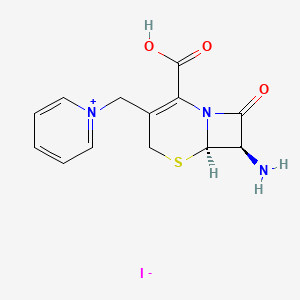
CAS 100988-63-4PubChem CID 13589044
N-(7-Aminocephem-3-em-3-ylmethyl)pyridinium-4-carboxylate hydriodide
- IUPAC name
- (6R,7R)-7-amino-8-oxo-3-(pyridin-1-ium-1-ylmethyl)-5-thia-1-azabicyclo[4.2.0]oct-2-ene-2-carboxylic acid iodide
- Molecular formula
- C13H14IN3O3S
- Molecular weight
- 419.24 g/mol
- Exact mass
- 418.98006 Da
- Topological polar surface area
- 113.0 Ų
- Hydrogen-bond donors
- 2
- Hydrogen-bond acceptors
- 6
- Covalent units
- 2
- Defined stereocentres
- 2
Also known as
Pyridinium, 1-(((6R,7R)-7-amino-2-carboxy-8-oxo-5-thia-1-azabicyclo(4.2.0)oct-2-en-3-yl)methyl)-, iodide (1:1)G9113PML9ZPYRIDINIUM, 1-(((6R,7R)-7-AMINO-2-CARBOXY-8-OXO-5-THIA-1-AZABICYCLO(4.2.0)OCT-2-EN-3-YL)METHYL)-, IODIDEPYRIDINIUM, 1-((7-AMINO-2-CARBOXY-8-OXO-5-THIA-1-AZABICYCLO(4.2.0)OCT-2-EN-3-YL)METHYL)-, IODIDE, (6R-TRANS)-Pyridinium, 1-[[(6R,7R)-7-amino-2-carboxy-8-oxo-5-thia-1-azabicyclo[4.2.0]oct-2-en-3-yl]methyl]-, iodide (1:1)RefChem:202024EC 423-260-0UNII-G9113PML9Z
3 more reported names
7-Amino-3-(1-pyridylmethyl)-3-cephem-4-carboxylic Acid HydroiodideCeftazidime Pentahydrate - Impurity C (Iodide Salt)(6R,7R)-7-Amino-8-oxo-3-[(1-pyridinio)methyl]-5-thia-1-azabicyclo[4.2.0]oct-2-ene-2-carboxylate hydroiodide
Evidence from additional scientific databases
NIH PubChem PUG-View
Exact identifier match13589044
Attributed physical-property, hazard, environmental and use annotations.
- Signal: Warning Source: Regulation (EC) No 1272/2008 of the European Parliament and of the Council
- GHS Hazard Statements: H317: May cause an allergic skin reaction [Warning Sensitization, Skin]; H341: Suspected of causing genetic defects [Warning Germ cell mutagenicity]; H411: Toxic to aquatic life with long lasting effects [Hazardous to the aquatic environment, long-term hazard] Source: Regulation (EC) No 1272/2008 of the European Parliament and of the Council
- Precautionary Statement Codes: P203, P261, P272, P273, P280, P302+P352, P318, P321, P333+P317, P362+P364, P391, P405, and P501 (click each P-code to see the statement) Source: Regulation (EC) No 1272/2008 of the European Parliament and of the Council
- Signal: Warning Source: European Chemicals Agency (ECHA)
- GHS Hazard Statements: H317 (100%): May cause an allergic skin reaction [Warning Sensitization, Skin]; H341 (100%): Suspected of causing genetic defects [Warning Germ cell mutagenicity]; H411 (100%): Toxic to aquatic life with long lasting effects [Hazardous to the aquatic environment, long-term hazard] Source: European Chemicals Agency (ECHA)
- Precautionary Statement Codes: P203, P261, P272, P273, P280, P302+P352, P318, P321, P333+P317, P362+P364, P391, P405, and P501 (click each P-code to see the statement) Source: European Chemicals Agency (ECHA)
- ECHA C&L Notifications Summary: The GHS information provided by 1 company from 1 notification to the ECHA C&L Inventory. Source: European Chemicals Agency (ECHA)
- Signal: Warning Source: Hazardous Chemical Information System (HCIS), Safe Work Australia
- GHS Hazard Statements: H317: May cause an allergic skin reaction [Warning Sensitization, Skin]; H341: Suspected of causing genetic defects [Warning Germ cell mutagenicity]; H411: Toxic to aquatic life with long lasting effects [Hazardous to the aquatic environment, long-term hazard] Source: Hazardous Chemical Information System (HCIS), Safe Work Australia
- Precautionary Statement Codes: P203, P261, P272, P273, P280, P302+P352, P318, P321, P333+P317, P362+P364, P391, P405, and P501 (click each P-code to see the statement) Source: Hazardous Chemical Information System (HCIS), Safe Work Australia
Mapped by: Existing checksum-valid CAS to unique PubChem CID match. Retrieved: 2026-08-31. Open source record
Scientific classifications and hazard annotations provide context and do not replace the market-specific regulatory decision shown above.
Additional source coverage and match status
| Source | Result | Checked |
|---|---|---|
| EMBL-EBI ChEBI | No exact record | 2026-08-31 |
| NIH PubChem PUG-View | Exact match | 2026-08-31 |
A recorded no-match is useful evidence that the source was checked; it is not a claim that the substance does not exist elsewhere.
Retrieved from NIH PubChem on 2026-09-02 by checksum-valid CAS matching. Chemical properties do not replace the regulatory decision on this page.