
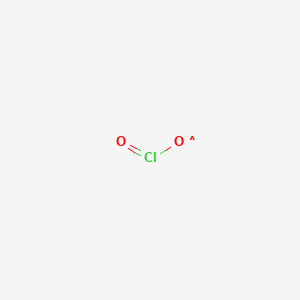
- Molecular formula
- ClO2
- Molecular weight
- 67.45 g/mol
- Exact mass
- 66.9586819 Da
- XLogP3
- 1.4
- Topological polar surface area
- 18.1 Ų
- Hydrogen-bond donors
- 0
- Hydrogen-bond acceptors
- 1
- Covalent units
- 1
- Defined stereocentres
- 0
Also known as
16 more reported names
External database identifiers
- ChEBI:CHEBI:29415
- EPA DTXSID:DTXSID5023958
- PubMed:30395996
- PubMed:23591108
- PubMed:15016528
Evidence from additional scientific databases
EMBL-EBI ChEBI
dioxidochlorine(•)
- Formula
- ClO2
- Average mass
- 67.451 g/mol
- Monoisotopic mass
- 66.95868 Da
- Formal charge
- 0
- chlorine dioxide — is a (CHEBI:52357)
- chlorine dioxide — is a (CHEBI:52357)
Additional curated names
Cross-references from this source
- CAS: 10049-04-4 — NIST Chemistry WebBook
- CAS: 10049-04-4 — KEGG COMPOUND
- REGISTRY_NUMBER: 1265 — Gmelin
- MANUAL_X_REF: C18368 — KEGG COMPOUND
Mapped by: Exact CAS cross-reference in the ChEBI compound record. Source updated: 2014-08-03. Retrieved: 2026-08-31. Open source record
NIH PubChem PUG-View
Attributed physical-property, hazard, environmental and use annotations.
- Boiling Point: 52 °F at 760 mmHg (NIOSH, 2024) Source: CAMEO Chemicals
- Boiling Point: 11 °C Source: Hazardous Substances Data Bank (HSDB)
- Boiling Point: 11 °C Source: ILO-WHO International Chemical Safety Cards (ICSCs)
- Boiling Point: 52 °F Source: Occupational Safety and Health Administration (OSHA)
- Boiling Point: 11 °C @760 [mm Hg] Source: PAC Chemical Database, U.S. Department of Energy
- Boiling Point: 52 °F Source: The National Institute for Occupational Safety and Health (NIOSH)
- Color/Form: Yellowish-brown gas Source: Hazardous Substances Data Bank (HSDB)
- Color/Form: Yellow to reddish-yellow gas at room temperature Source: Hazardous Substances Data Bank (HSDB)
- Color/Form: Solid chlorine dioxide is a yellowish-red crystalline mass; liquid is reddish-brown Source: Hazardous Substances Data Bank (HSDB)
- Color/Form: Yellow to red gas or a red-brown liquid (below 52 degrees F) ... Source: Hazardous Substances Data Bank (HSDB)
- Color/Form: For more Color/Form (Complete) data for Chlorine dioxide (6 total), please visit the HSDB record page. Source: Hazardous Substances Data Bank (HSDB)
- Density: 1.6 (Liquid at 32 °F) (NIOSH, 2024) - Denser than water; will sink Source: CAMEO Chemicals
- Density: 1.77 g/cu cm Source: Hazardous Substances Data Bank (HSDB)
- Density: Density: 1.642 at 0 °C (liq) Source: Hazardous Substances Data Bank (HSDB)
- Density: Relative density (water = 1): 1.6 (liquid, 0 °C) Source: ILO-WHO International Chemical Safety Cards (ICSCs)
- Density: 1.6 (liquid at 32 °F) Source: Occupational Safety and Health Administration (OSHA)
- Density: 3.09 @ 11°C Source: PAC Chemical Database, U.S. Department of Energy
- Density: 1.6 (Liquid at 32 °F) Source: The National Institute for Occupational Safety and Health (NIOSH)
- Density: 2.33(relative gas density) Source: The National Institute for Occupational Safety and Health (NIOSH)
- Flash Point: NA (Gas) ? (Liquid) Source: The National Institute for Occupational Safety and Health (NIOSH)
- Melting Point: -74 °F (NIOSH, 2024) Source: CAMEO Chemicals
- Melting Point: -59 °C Source: Hazardous Substances Data Bank (HSDB)
- Melting Point: -59 °C Source: Human Metabolome Database (HMDB)
- Melting Point: -59 °C Source: ILO-WHO International Chemical Safety Cards (ICSCs)
- Melting Point: -74 °F Source: Occupational Safety and Health Administration (OSHA)
- Melting Point: -59 °C Source: PAC Chemical Database, U.S. Department of Energy
- Melting Point: -74 °F Source: The National Institute for Occupational Safety and Health (NIOSH)
- Odor: ... Unpleasant odor similar to chlorine and nitric acid. Source: Hazardous Substances Data Bank (HSDB)
- Physical Description: Chlorine dioxide hydrate, frozen is an orange colored solid, appearing as a block of ice, with a faint odor of chlorine. It may only be shipped in the frozen state and then only by private or contract motor carrier. The melting point of the hydrate is around 30 °F. If it should thaw and further warm up, chlorine dioxide gas is given off. The gas is toxic by inhalation. The gas and liquid are violently decomposed by organic materials. The gas will decompose explosively at temperatures below the boiling point of water. It is used to bleach wood pulp, fats and oils; in processing flour, and for water purification. Chlorine dioxide is a yellow to reddish gas or a red-brown liquid below 52 deg. F. with an unpleasant odor similar to chlorine. Source: CAMEO Chemicals
- Physical Description: Liquid; Gas Vapor Source: EPA Chemical Data Reporting (CDR)
- Physical Description: Yellow to red gas or a red-brown liquid (below 52 degrees F) with an unpleasant odor similar to chlorine and nitric acid; [NIOSH] Vapor density = 2.3 (heavier than air); [ACGIH] Source: Haz-Map, Information on Hazardous Chemicals and Occupational Diseases
- Physical Description: Liquid Source: Human Metabolome Database (HMDB)
- Physical Description: RED-YELLOW GAS WITH PUNGENT ODOUR. Source: ILO-WHO International Chemical Safety Cards (ICSCs)
- Physical Description: Yellow to red gas or a red-brown liquid (below 52 °F) with an unpleasant odor similar to chlorine and nitric acid. Source: Occupational Safety and Health Administration (OSHA)
- Physical Description: Yellow to red gas or a red-brown liquid (below 52 °F) with an unpleasant odor similar to chlorine and nitric acid. Source: The National Institute for Occupational Safety and Health (NIOSH)
- Solubility: 0.3 % at 77 °F (NIOSH, 2024) Source: CAMEO Chemicals
- Solubility: In water, 3.01 g/L at 25 °C and 34.5 mm Hg Source: Hazardous Substances Data Bank (HSDB)
- Solubility: 2000 cc (gas) in 100 cc cold water Source: Hazardous Substances Data Bank (HSDB)
- Solubility: In water, 1.823X10⁻² at 298.15 K Source: Hazardous Substances Data Bank (HSDB)
- Solubility: Soluble in water Source: Hazardous Substances Data Bank (HSDB)
- Solubility: Soluble in alkaline and sulfuric acid solutions Source: Hazardous Substances Data Bank (HSDB)
- Solubility: Solubility in water, g/100ml at 20 °C: 0.8 Source: ILO-WHO International Chemical Safety Cards (ICSCs)
- Solubility: (77 °F): 0.3% Source: The National Institute for Occupational Safety and Health (NIOSH)
- Vapor Pressure: greater than 1 atm (NIOSH, 2024) Source: CAMEO Chemicals
- Vapor Pressure: 101 kPa at 20 °C /758 mm Hg at 20 °C/ Source: Hazardous Substances Data Bank (HSDB)
- Vapor Pressure: Vapor pressure, kPa at 20 °C: 101 Source: ILO-WHO International Chemical Safety Cards (ICSCs)
- Vapor Pressure: >1 atm Source: Occupational Safety and Health Administration (OSHA)
- Vapor Pressure: >1 atm Source: The National Institute for Occupational Safety and Health (NIOSH)
- Exposure Routes: The substance can be absorbed into the body by inhalation. Source: ILO-WHO International Chemical Safety Cards (ICSCs)
- Exposure Routes: inhalation, ingestion (liquid), skin and/or eye contact Source: The National Institute for Occupational Safety and Health (NIOSH)
- First Aid: Excerpt from NIOSH Pocket Guide for Chlorine dioxide:; Eye: IRRIGATE IMMEDIATELY (LIQUID) - If this chemical in liquid form contacts the eyes, immediately wash (irrigate) the eyes with large amounts of water, occasionally lifting the lower and upper lids. Get medical attention immediately.; Skin: SOAP WASH IMMEDIATELY (LIQUID) - If this chemical in liquid form contacts the skin, immediately wash the contaminated skin with soap and water. If this chemical penetrates the clothing, immediately remove the clothing, wash the skin with soap and water, and get medical attention promptly.; Breathing: RESPIRATORY SUPPORT - If a person breathes large amounts of this chemical, move the exposed person to fresh air at once. If breathing has stopped, perform artificial respiration. Keep the affected person warm and at rest. Get medical attention as soon as possible.; Swallow: MEDICAL ATTENTION IMMEDIATELY (LIQUID) - If this chemical in liquid form has been swallowed, get medical attention immediately. (NIOSH, 2024) Source: CAMEO Chemicals
- First Aid: (General first aid procedures); Eye: Irrigate immediately (liquid); Skin: Soap wash immediately (liquid); Breathing: Respiratory support; Swallow: Medical attention immediately (liquid) Source: The National Institute for Occupational Safety and Health (NIOSH)
- Signal: Danger Source: Regulation (EC) No 1272/2008 of the European Parliament and of the Council
- GHS Hazard Statements: H270: May cause or intensify fire; oxidizer [Danger Oxidizing gases]; H314: Causes severe skin burns and eye damage [Danger Skin corrosion/irritation]; H330: Fatal if inhaled [Danger Acute toxicity, inhalation]; H400: Very toxic to aquatic life [Warning Hazardous to the aquatic environment, acute hazard] Source: Regulation (EC) No 1272/2008 of the European Parliament and of the Council
- Precautionary Statement Codes: P220, P244, P260, P264, P271, P273, P280, P284, P301+P330+P331, P302+P361+P354, P304+P340, P305+P354+P338, P316, P320, P321, P363, P370+P376, P391, P403, P403+P233, P405, and P501 (click each P-code to see the statement) Source: Regulation (EC) No 1272/2008 of the European Parliament and of the Council
- GHS Hazard Statements: H301: Toxic if swallowed [Danger Acute toxicity, oral]; H314: Causes severe skin burns and eye damage [Danger Skin corrosion/irritation]; H400: Very toxic to aquatic life [Warning Hazardous to the aquatic environment, acute hazard] Source: Regulation (EC) No 1272/2008 of the European Parliament and of the Council
- Precautionary Statement Codes: P260, P264, P270, P273, P280, P301+P316, P301+P330+P331, P302+P361+P354, P304+P340, P305+P354+P338, P316, P321, P330, P363, P391, P405, and P501 (click each P-code to see the statement) Source: Regulation (EC) No 1272/2008 of the European Parliament and of the Council
- Signal: Danger Source: European Chemicals Agency (ECHA)
- GHS Hazard Statements: H270 (29.9%): May cause or intensify fire; oxidizer [Danger Oxidizing gases]; H280 (29.2%): Contains gas under pressure; may explode if heated [Warning Gases under pressure]; H301 (72.1%): Toxic if swallowed [Danger Acute toxicity, oral]; H314 (76.2%): Causes severe skin burns and eye damage [Danger Skin corrosion/irritation]; H318 (46.3%): Causes serious eye damage [Danger Serious eye damage/eye irritation]; H319 (24%): Causes serious eye irritation [Warning Serious eye damage/eye irritation]; H330 (29.9%): Fatal if inhaled [Danger Acute toxicity, inhalation]; H332 (15.9%): Harmful if inhaled [Warning Acute toxicity, inhalation]; H400 (76.2%): Very toxic to aquatic life [Warning Hazardous to the aquatic environment, acute hazard] Source: European Chemicals Agency (ECHA)
- Precautionary Statement Codes: P220, P244, P260, P261, P264, P264+P265, P270, P271, P273, P280, P284, P301+P316, P301+P330+P331, P302+P361+P354, P304+P340, P305+P351+P338, P305+P354+P338, P316, P317, P320, P321, P330, P337+P317, P363, P370+P376, P391, P403, P403+P233, P405, P410+P403, and P501 (click each P-code to see the statement) Source: European Chemicals Agency (ECHA)
- ECHA C&L Notifications Summary: Aggregated GHS information provided per 542 reports by companies from 16 notifications to the ECHA C&L Inventory. Each notification may be associated with multiple companies.; Information may vary between notifications depending on impurities, additives, and other factors. The percentage value in parenthesis indicates the notified classification ratio from companies that provide hazard codes. Only hazard codes with percentage values above 10% are shown. For more detailed information, please visit ECHA C&L website. Source: European Chemicals Agency (ECHA)
- Signal: Danger Source: NITE-CMC
- GHS Hazard Statements: H314: Causes severe skin burns and eye damage [Danger Skin corrosion/irritation] Source: NITE-CMC
- Precautionary Statement Codes: P260, P264, P280, P301+P330+P331, P302+P361+P354, P304+P340, P305+P354+P338, P316, P321, P363, P405, and P501 (click each P-code to see the statement) Source: NITE-CMC
- Target Organs: Developmental (effects while organs are developing), Gastrointestinal (Stomach and Intestines, part of the digestive system), Respiratory (From the Nose to the Lungs) Source: Agency for Toxic Substances and Disease Registry (ATSDR)
- Target Organs: Cardiovascular; Developmental; Nervous; Respiratory Source: EPA Integrated Risk Information System (IRIS)
- Target Organs: Eyes, respiratory system Source: The National Institute for Occupational Safety and Health (NIOSH)
- Toxicity Summary: IDENTIFICATION AND USE: Chlorine dioxide is a yellowish-brown gas with unpleasant odor similar to chlorine and nitric acid. Its uses include bleaching cellulose, paper-pulp, flour, leather, fats and oils, textiles, and beeswax. It is also used for purification of water, taste and odor control of water, cleaning and detanning leather, in the manufacture of chloride salts, and as an oxidizing agent, bactericide, antiseptic and deodorizer. Chlorine dioxide was found to be highly effective against various microorganisms tested at very low concentrations in a minimum contact time of 30 to 60 seconds. HUMAN STUDIES: Potential symptoms of overexposure are irritation of eyes, nose, and throat, as well as coughing, wheezing, bronchitis, and pulmonary edema. Workers industrially exposed to low concentrations of the gas in air have been noted occasionally to suffer from irritation of the eyes and to see haloes about lights, but these effects have been minor compared to respiratory irritation. Bronchoscopy and biopsy revealed slight chronic bronchitis in 7 of 12 workers. Only two workers who had been exposed just prior to examination showed physical signs of respiratory effects. Workers acutel Source: Hazardous Substances Data Bank (HSDB)
- Environmental Fate: Hydrogen peroxide (H2O2), chlorite, chlorate, Cl2O3, oxygen (O2), and chlorine have all been reported as intermediates or products /of chlorine dioxide breakdown/. Presumably chlorine dioxide will not persist in open basins or reservoirs, although it can remain for days in clean distribution systems. Source: Hazardous Substances Data Bank (HSDB)
- Environmental Fate: It is generally accepted that the predominant reaction product of chlorine dioxide in water treatment is chlorite and that chlorate and other ions are produced in minor amounts ... an approximately 50% conversion of chlorine dioxide to chlorite was reported ... /in/ water containing natural humic acids. Source: Hazardous Substances Data Bank (HSDB)
- Environmental Fate: Chlorine dioxide does not cause formation of trihalomethanes, does not react with ammonia, and does not cause formation of chloramines. It can ... disproportionate to chlorate and chlorite ... by raising pH to 11 or 12 ... this is not believed to be an important reaction in water undergoing treatment. Source: Hazardous Substances Data Bank (HSDB)
- Environmental Fate: /Products formed during oxidative treatment of water/: both oxygenated and chlorinated products may be formed, the latter being found most prominently in connection with reactions of phenolic substances. Other products that might affect health are quinones and 1,2-epoxy compounds. Source: Hazardous Substances Data Bank (HSDB)
- Industry Uses: Processing aids not otherwise specified; Bleaching agent; Sealant (barrier); Oxidizing agent Source: EPA Chemical Data Reporting (CDR)
- Sources/Uses: Used in bleaching wood pulp (95% of use); Also used in bleaching textiles; disinfecting hospital equipment; disinfecting fruits, vegetables, and meats; and treating municipal water; [ACGIH] Source: Haz-Map, Information on Hazardous Chemicals and Occupational Diseases
- Industrial Processes with risk of exposure: Pulp and Paper Processing [Category: Industry]; Textiles (Fiber & Fabric Manufacturing) [Category: Industry]; Using Disinfectants or Biocides [Category: Clean]; Sewer and Wastewater Treatment [Category: Industry]; Toxic Gas from Spilling Chemical in Water [Category: Other] Source: Haz-Map, Information on Hazardous Chemicals and Occupational Diseases
- Uses: For chlorine dioxide (USEPA/OPP Pesticide Code: 020503) ACTIVE products with label matches. /SRP: Registered for use in the U.S. but approved pesticide uses may change periodically and so federal, state and local authorities must be consulted for currently approved uses./ Source: Hazardous Substances Data Bank (HSDB)
- Uses: Bleaching cellulose, paper-pulp, flour, leather, fats and oils, textiles, beeswax; purification of water; taste and odor control of water; cleaning and detanning leather; manufacture of chloride salts; oxidizing agent; bactericide, antiseptic and deodorizer. Source: Hazardous Substances Data Bank (HSDB)
- Uses: The agricultural premises and equipment uses include the disinfection of hard surfaces and equipment (such as hatching facilities and mushroom houses) and water systems (such as chiller water and humidification water in poultry houses). Source: Hazardous Substances Data Bank (HSDB)
- Uses: Commercial, industrial, and medical uses include disinfection of ventilation systems, hard surfaces (e.g., floors, walls, and laboratory equipment), water systems, pulp/paper mills, and food rinses. Source: Hazardous Substances Data Bank (HSDB)
- Uses: For more Uses (Complete) data for Chlorine dioxide (7 total), please visit the HSDB record page. Source: Hazardous Substances Data Bank (HSDB)
Mapped by: Existing checksum-valid CAS to unique PubChem CID match. Retrieved: 2026-08-31. Open source record
Scientific classifications and hazard annotations provide context and do not replace the market-specific regulatory decision shown above.
Additional source coverage and match status
| Source | Result | Checked |
|---|---|---|
| EMBL-EBI ChEBI | Exact match | 2026-08-31 |
| NIH PubChem PUG-View | Exact match | 2026-08-31 |
A recorded no-match is useful evidence that the source was checked; it is not a claim that the substance does not exist elsewhere.
Retrieved from NIH PubChem on 2026-08-31 by checksum-valid CAS matching. Chemical properties do not replace the regulatory decision on this page.