
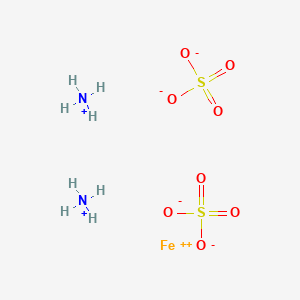
Ferrous ammonium sulfate
Ferrous ammonium sulfate (anhydrous) is a compound of ammonium, iron and sulfate in which the ratio of ammonium to iron(2+) to sulfate ions is 2:1:2. It has a role as a ferroptosis inducer. It is an iron molecular entity, an ammonium salt and a metal sulfate. It contains an iron(2+). — ChEBI
- IUPAC name
- diazanium;iron(2+);disulfate
- Molecular formula
- FeH8N2O8S2
- Molecular weight
- 284.1 g/mol
- Exact mass
- 283.907143 Da
- Topological polar surface area
- 179.0 Ų
- Hydrogen-bond donors
- 2
- Hydrogen-bond acceptors
- 8
- Covalent units
- 5
- Defined stereocentres
- 0
Also known as
16 more reported names
External database identifiers
- ChEBI:CHEBI:76243
- EPA DTXSID:DTXSID4041028
Evidence from additional scientific databases
EMBL-EBI ChEBI
ferrous ammonium sulfate (anhydrous)
A compound of ammonium, iron and sulfate in which the ratio of ammonium to iron(2+) to sulfate ions is 2:1:2.
- Formula
- Fe.2H4N.2O4S
- Average mass
- 284.049 g/mol
- Monoisotopic mass
- 283.90714 Da
- Formal charge
- 0
- metal sulfate — is a (CHEBI:51336)
- iron molecular entity — is a (CHEBI:24873)
- ammonium salt — is a (CHEBI:47704)
- ferroptosis inducer — has role (CHEBI:173085)
- iron(2+) — has part (CHEBI:29033)
- ferroptosis inducer — has role (CHEBI:173085)
- metal sulfate — is a (CHEBI:51336)
- iron molecular entity — is a (CHEBI:24873)
- ammonium salt — is a (CHEBI:47704)
Additional curated names
Cross-references from this source
- CAS: 10045-89-3 — ChemIDplus
- REGISTRY_NUMBER: 13163104 — Reaxys
- MANUAL_X_REF: Ammonium_iron(II)_sulfate — Wikipedia
Mapped by: Exact CAS cross-reference in the ChEBI compound record. Source updated: 2021-06-10. Retrieved: 2026-08-31. Open source record
NIH PubChem PUG-View
Attributed physical-property, hazard, environmental and use annotations.
- Density: 1.86 at 68 °F (USCG, 1999) - Denser than water; will sink Source: CAMEO Chemicals
- Density: Pale blue-green crystals or crystalline powder. Efforesces. Density: 1.86 at 20 °C/4 °C. /Ferrous ammonium sulfate hexahydrate/ Source: Hazardous Substances Data Bank (HSDB)
- Density: 1.865 @25 °C Source: PAC Chemical Database, U.S. Department of Energy
- Physical Description: Ferrous ammonium sulfate appears as a light green crystalline solid. The primary hazard is the threat to the environment. Immediate steps should be taken to limit its spread to the environment. It is used in medicine, chemical analysis and metallurgy. Source: CAMEO Chemicals
- Physical Description: Light green crystals, deliquescent and soluble in water; [CAMEO] Source: Haz-Map, Information on Hazardous Chemicals and Occupational Diseases
- Refractive Index: INDEX OF REFRACTION: 1.487, 1.492, 1.499 /FERROUS AMMONIUM SULFATE HEXAHYDRATE/ Source: Hazardous Substances Data Bank (HSDB)
- Solubility: 26.9 G SOL IN 100 CC WATER @ 20 °C; 73 G SOL IN 100 CC WATER @ 80 °C; INSOL IN ETHANOL. /FERROUS AMMONIUM SULFATE HEXAHYDRATE/ Source: Hazardous Substances Data Bank (HSDB)
- First Aid: INGESTION: give large amount of water; induce vomiting if large amounts have been swallowed.; EYES or SKIN: flush with water. (USCG, 1999) Source: CAMEO Chemicals
- Note: This chemical does not meet GHS hazard criteria for 98.3% (171 of 174) of all reports. Source: European Chemicals Agency (ECHA)
- GHS Hazard Statements: Not Classified; Reported as not meeting GHS hazard criteria by 171 of 174 companies (only 1.7% companies provided GHS information). For more detailed information, please visit ECHA C&L website. Source: European Chemicals Agency (ECHA)
- ECHA C&L Notifications Summary: Aggregated GHS information provided per 174 reports by companies from 5 notifications to the ECHA C&L Inventory.; Reported as not meeting GHS hazard criteria per 171 of 174 reports by companies.; There are 3 notifications provided by 3 of 174 reports by companies with hazard statement code(s).; Information may vary between notifications depending on impurities, additives, and other factors. The percentage value in parenthesis indicates the notified classification ratio from companies that provide hazard codes. Only hazard codes with percentage values above 10% are shown. For more detailed information, please visit ECHA C&L website. Source: European Chemicals Agency (ECHA)
- Sources/Uses: Used in medicine, metallurgy, and chemical analysis; [CAMEO] Also used in photography, iron-plating baths, and as a polymerization catalyst; Approved for use in the production of cellophane for food packaging; [HSDB] Source: Haz-Map, Information on Hazardous Chemicals and Occupational Diseases
- Industrial Processes with risk of exposure: Photographic Processing [Category: Other]; Metal Extraction and Refining [Category: Industry] Source: Haz-Map, Information on Hazardous Chemicals and Occupational Diseases
- Uses: The active ingredient is no longer contained in any registered products ... "cancelled." Source: Hazardous Substances Data Bank (HSDB)
- Uses: For ferrous ammonium sulfate (USEPA/OPP Pesticide Code: 050506) there are 0 labels match. /SRP: Not registered for current use in the U.S., but approved pesticide uses may change periodically and so federal, state and local authorities must be consulted for currently approved uses./ Source: Hazardous Substances Data Bank (HSDB)
- Uses: In photography; as analytical standard; as polymerization catalyst; in dosimeters. /Ferrous ammonium sulfate hexahydrate/ Source: Hazardous Substances Data Bank (HSDB)
- Uses: Analytical chemistry; metallurgy. /Ferrous ammonium hexahydrate/ Source: Hazardous Substances Data Bank (HSDB)
- Uses: For more Uses (Complete) data for FERROUS AMMONIUM SULFATE (6 total), please visit the HSDB record page. Source: Hazardous Substances Data Bank (HSDB)
Mapped by: Existing checksum-valid CAS to unique PubChem CID match. Retrieved: 2026-08-31. Open source record
Scientific classifications and hazard annotations provide context and do not replace the market-specific regulatory decision shown above.
Additional source coverage and match status
| Source | Result | Checked |
|---|---|---|
| EMBL-EBI ChEBI | Exact match | 2026-08-31 |
| NIH PubChem PUG-View | Exact match | 2026-08-31 |
A recorded no-match is useful evidence that the source was checked; it is not a claim that the substance does not exist elsewhere.
Retrieved from NIH PubChem on 2026-08-31 by checksum-valid CAS matching. Chemical properties do not replace the regulatory decision on this page.