
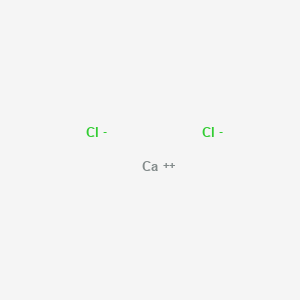
Calcium Chloride
Calcium dichloride is an inorganic calcium salt, a calcium salt and an inorganic chloride. It has a role as a NMR chemical shift reference compound and a fertilizer. — ChEBI
- IUPAC name
- calcium dichloride
- Molecular formula
- CaCl2
- Molecular weight
- 110.98 g/mol
- Exact mass
- 109.9002962 Da
- Topological polar surface area
- 0.0 Ų
- Hydrogen-bond donors
- 0
- Hydrogen-bond acceptors
- 2
- Covalent units
- 3
- Defined stereocentres
- 0
Also known as
16 more reported names
External database identifiers
- ChEBI:CHEBI:3312
- ChEMBL:CHEMBL1200668
- EPA DTXSID:DTXSID5020235
- PubMed:8615
Evidence from additional scientific databases
EMBL-EBI ChEBI
calcium dichloride
- Formula
- Ca.2Cl
- Average mass
- 110.984 g/mol
- Monoisotopic mass
- 109.90030 Da
- Formal charge
- 0
- inorganic chloride — is a (CHEBI:36093)
- calcium salt — is a (CHEBI:35156)
- inorganic calcium salt — is a (CHEBI:190295)
- bone density conservation agent — has role (CHEBI:50646)
- anti-arrhythmia drug — has role (CHEBI:38070)
- antineoplastic agent — has role (CHEBI:35610)
- cardiovascular drug — has role (CHEBI:35554)
- fertilizer — has role (CHEBI:33287)
- NMR chemical shift reference compound — has role (CHEBI:228364)
- bone density conservation agent — has role (CHEBI:50646)
- anti-arrhythmia drug — has role (CHEBI:38070)
- antineoplastic agent — has role (CHEBI:35610)
- cardiovascular drug — has role (CHEBI:35554)
- fertilizer — has role (CHEBI:33287)
- NMR chemical shift reference compound — has role (CHEBI:228364)
- inorganic chloride — is a (CHEBI:36093)
- calcium salt — is a (CHEBI:35156)
- inorganic calcium salt — is a (CHEBI:190295)
Additional curated names
Cross-references from this source
- CAS: 10043-52-4 — NIST Chemistry WebBook
- CAS: 10043-52-4 — KEGG COMPOUND
- CAS: 10043-52-4 — ChemIDplus
- MANUAL_X_REF: 109 — PPDB
- MANUAL_X_REF: 1869 — MolBase
- MANUAL_X_REF: C08130 — KEGG COMPOUND
- MANUAL_X_REF: Calcium_Chloride — Wikipedia
- MANUAL_X_REF: CPD0-1589 — MetaCyc
- MANUAL_X_REF: DB01164 — DrugBank
- MANUAL_X_REF: FDB015404 — FooDB
- MANUAL_X_REF: HMDB0303526 — HMDB
Mapped by: Exact CAS cross-reference in the ChEBI compound record. Source updated: 2024-06-06. Retrieved: 2026-08-31. Open source record
NIH PubChem PUG-View
Attributed physical-property, hazard, environmental and use annotations.
- Boiling Point: 1935 °C Source: Hazardous Substances Data Bank (HSDB)
- Boiling Point: 1670 °C Source: ILO-WHO International Chemical Safety Cards (ICSCs)
- Boiling Point: 1935 °C @760 [mm Hg] Source: PAC Chemical Database, U.S. Department of Energy
- Color/Form: White cubic crystals or powder Source: Hazardous Substances Data Bank (HSDB)
- Color/Form: Cubic crystals, granules or fused masses Source: Hazardous Substances Data Bank (HSDB)
- Color/Form: White .. lumps of flakes Source: Hazardous Substances Data Bank (HSDB)
- Density: 2.15 at 68 °F (USCG, 1999) - Denser than water; will sink Source: CAMEO Chemicals
- Density: 2.15 g/cu cm at 25 °C Source: Hazardous Substances Data Bank (HSDB)
- Density: Hygroscopic granules, flakes or powder. Apparent (bulk) density: 0.835. Freely soluble in water, alcohol /Calcium chloride dihydrate/ Source: Hazardous Substances Data Bank (HSDB)
- Density: Density (at 25 °C): 2.2 g/cm³ Source: ILO-WHO International Chemical Safety Cards (ICSCs)
- Density: 2.152 @25 °C Source: PAC Chemical Database, U.S. Department of Energy
- Melting Point: 782 °C Source: DrugBank
- Melting Point: 775 °C Source: Hazardous Substances Data Bank (HSDB)
- Melting Point: MP: 260 °C /Calcium chloride monohydrate/ Source: Hazardous Substances Data Bank (HSDB)
- Melting Point: 772 °C Source: ILO-WHO International Chemical Safety Cards (ICSCs)
- Melting Point: 775 °C Source: PAC Chemical Database, U.S. Department of Energy
- Odor: ODORLESS Source: Hazardous Substances Data Bank (HSDB)
- Physical Description: Calcium chloride is a white to off-white solid. Sinks and mixes with water. (USCG, 1999) Source: CAMEO Chemicals
- Physical Description: Liquid; Dry Powder; Large Crystals; CBI; Large Crystals; Other Solid; Dry Powder Source: EPA Chemical Data Reporting (CDR)
- Physical Description: White, odourless, hygroscopic powder or deliquescent crystals Source: EU Food Improvement Agents
- Physical Description: Very hygroscopic solid; Soluble in water (evolves heat); [Merck Index] Colorless odorless solid; [HSDB] White hygroscopic solid; Soluble in water; [MSDSonline] Source: Haz-Map, Information on Hazardous Chemicals and Occupational Diseases
- Physical Description: ODOURLESS HYGROSCOPIC COLOURLESS OR WHITE CRYSTALS. Source: ILO-WHO International Chemical Safety Cards (ICSCs)
- Refractive Index: Index of refraction, relative to air: 1.4420 at 20 °C/D in 40.0% aqueous solution Source: Hazardous Substances Data Bank (HSDB)
- Solubility: 0.745 g/mL (at 20 °C) Source: DrugBank
- Solubility: Soluble in water and in ethanol Source: EU Food Improvement Agents
- Solubility: Soluble in methyl carbonate and acetic acid Source: Hazardous Substances Data Bank (HSDB)
- Solubility: Very soluble in ethanol Source: Hazardous Substances Data Bank (HSDB)
- Solubility: Freely soluble in water with liberation of much heat Source: Hazardous Substances Data Bank (HSDB)
- Solubility: 81.3 g/100 g water at 25 °C Source: Hazardous Substances Data Bank (HSDB)
- Solubility: In water, 4.2X10+5 to 5.95X10+5 mg/L at 20 °C Source: Hazardous Substances Data Bank (HSDB)
- Solubility: Solubility in water, g/100ml at 20 °C: 74.5 (good) Source: ILO-WHO International Chemical Safety Cards (ICSCs)
- Viscosity: In 40.0% aqueous solution, 8.997 mPa.s at 20 °C Source: Hazardous Substances Data Bank (HSDB)
- Exposure Routes: Serious local effects by all routes of exposure. Source: ILO-WHO International Chemical Safety Cards (ICSCs)
- First Aid: INHALATION: move to fresh air; if discomfort persists, get medical attention.; INGESTION: give large amounts of water.; EYES: promptly flood with water and continue washing for at least 15 min.; consult an ophthalmologist.; SKIN: flush with water. (USCG, 1999) Source: CAMEO Chemicals
- Signal: Warning Source: Regulation (EC) No 1272/2008 of the European Parliament and of the Council
- GHS Hazard Statements: H319: Causes serious eye irritation [Warning Serious eye damage/eye irritation] Source: Regulation (EC) No 1272/2008 of the European Parliament and of the Council
- Precautionary Statement Codes: P264+P265, P280, P305+P351+P338, and P337+P317 (click each P-code to see the statement) Source: Regulation (EC) No 1272/2008 of the European Parliament and of the Council
- Note: This chemical does not meet GHS hazard criteria for 0.3% (12 of 3505) of reports. Source: European Chemicals Agency (ECHA)
- Signal: Warning Source: European Chemicals Agency (ECHA)
- GHS Hazard Statements: H319 (99.7%): Causes serious eye irritation [Warning Serious eye damage/eye irritation] Source: European Chemicals Agency (ECHA)
- Precautionary Statement Codes: P264+P265, P280, P305+P351+P338, and P337+P317 (click each P-code to see the statement) Source: European Chemicals Agency (ECHA)
- ECHA C&L Notifications Summary: Aggregated GHS information provided per 3505 reports by companies from 10 notifications to the ECHA C&L Inventory.; Reported as not meeting GHS hazard criteria per 12 of 3505 reports by companies.; There are 9 notifications provided by 3493 of 3505 reports by companies with hazard statement code(s).; Information may vary between notifications depending on impurities, additives, and other factors. The percentage value in parenthesis indicates the notified classification ratio from companies that provide hazard codes. Only hazard codes with percentage values above 10% are shown. For more detailed information, please visit ECHA C&L website. Source: European Chemicals Agency (ECHA)
- Signal: Danger Source: NITE-CMC
- GHS Hazard Statements: H302: Harmful if swallowed [Warning Acute toxicity, oral]; H318: Causes serious eye damage [Danger Serious eye damage/eye irritation]; H335: May cause respiratory irritation [Warning Specific target organ toxicity, single exposure; Respiratory tract irritation]; H373: May causes damage to organs through prolonged or repeated exposure [Warning Specific target organ toxicity, repeated exposure] Source: NITE-CMC
- Precautionary Statement Codes: P260, P261, P264, P264+P265, P270, P271, P280, P301+P317, P304+P340, P305+P354+P338, P317, P319, P330, P403+P233, P405, and P501 (click each P-code to see the statement) Source: NITE-CMC
- Signal: Warning Source: Hazardous Chemical Information System (HCIS), Safe Work Australia
- Environmental Bioconcentration: /Calcium chloride/ does not bioaccumulate. Source: Hazardous Substances Data Bank (HSDB)
- Environmental Fate: In general, the environmental effects of calcium chloride are quite similar to those of rock salt (sodium chloride). Source: Hazardous Substances Data Bank (HSDB)
- Consumer Uses: Anti-freeze agent; Flavoring and nutrient; Lubricating agent; Freeze-thaw additive; Processing aids not otherwise specified; pH regulating agent; Dust suppressant; Dehydrating agent (desiccant); Soil amendments (fertilizers); Not Known or Reasonably Ascertainable; Stabilizing agent Source: EPA Chemical Data Reporting (CDR)
- Industry Uses: Freeze-thaw additive; Lubricating agent; Binder; Anti-freeze agent; Dust suppressant; Opacifer; Surfactant (surface active agent); Processing aids not otherwise specified; Not Known or Reasonably Ascertainable; Soil amendments (fertilizers); Viscosity modifiers; Preservative; Stabilizing agent; Laboratory chemicals; Adsorbent; Processing aids, specific to petroleum production; Intermediate; Flocculating agent; Solids separation (precipitating) agent, not otherwise specified; Density modifier Source: EPA Chemical Data Reporting (CDR)
- Sources/Uses: Used as a pavement deicer, a drying and dehydrating agent for organic liquids and gases; a drainage aid in pulp and paper processing, a sizing and finishing agent for cotton fabrics, a desiccant in hydrocarbon processing, a coal thawing agent, a component of oil well drilling muds, a set accelerator in concrete, a tire ballast; a firming agent for fruits, a fire retardant, an additive to control scaffolding in blast furnaces, a humectant in adhesives, an additive in herbicides, an additive in plastics to control particle size, a component of blood and electrolyte replacements, and other medical and veterinary uses; [HSDB] Source: Haz-Map, Information on Hazardous Chemicals and Occupational Diseases
- Industrial Processes with risk of exposure: Petroleum Production and Refining [Category: Industry]; Pulp and Paper Processing [Category: Industry]; Working with Glues and Adhesives [Category: Other]; Farming (Pesticides) [Category: Industry]; Cement Producing [Category: Industry] Source: Haz-Map, Information on Hazardous Chemicals and Occupational Diseases
- Uses: Both oil base and water base fracturing fluids are being used in the fracturing industry. Water base, which includes alcohol-water mixtures and low strength acids, make up the majority of treating fluids. The common chemicals added to these fluids are polymers for viscosity development, crosslinkers for viscosity enhancement, pH control chemicals, gel breakers for polymer degradation following the treatment, surfactants, clay stabilizers, alcohol, bactericides, fluid loss additives and friction reducer. /Hydraulic fracturing/ Source: Hazardous Substances Data Bank (HSDB)
- Uses: Hydraulic fracturing uses a specially blended liquid which is pumped into a well under extreme pressure causing cracks in rock formations underground. These cracks in the rock then allow oil and natural gas to flow, increasing resource production. ... Chemical Name: Calcium chloride; Chemical Purpose: Product Stabilizer; Product Function: Breaker. Source: Hazardous Substances Data Bank (HSDB)
- Uses: For calcium chloride (USEPA/OPP Pesticide Code: 075605) there are 0 labels match. /SRP: Not registered for current use in the U.S., but approved pesticide uses may change periodically and so federal, state and local authorities must be consulted for currently approved uses./ Source: Hazardous Substances Data Bank (HSDB)
- Uses: The active ingredient is no longer contained in any registered pesticide products ... "cancelled." Source: Hazardous Substances Data Bank (HSDB)
- Uses: For more Uses (Complete) data for CALCIUM CHLORIDE (15 total), please visit the HSDB record page. Source: Hazardous Substances Data Bank (HSDB)
Mapped by: Existing checksum-valid CAS to unique PubChem CID match. Retrieved: 2026-08-31. Open source record
Scientific classifications and hazard annotations provide context and do not replace the market-specific regulatory decision shown above.
Additional source coverage and match status
| Source | Result | Checked |
|---|---|---|
| EMBL-EBI ChEBI | Exact match | 2026-08-31 |
| NIH PubChem PUG-View | Exact match | 2026-08-31 |
A recorded no-match is useful evidence that the source was checked; it is not a claim that the substance does not exist elsewhere.
Retrieved from NIH PubChem on 2026-08-31 by checksum-valid CAS matching. Chemical properties do not replace the regulatory decision on this page.