
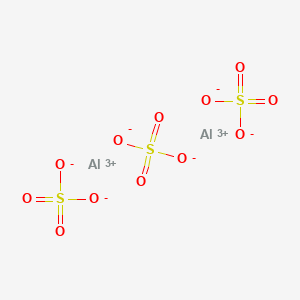
Aluminum Sulfate
Aluminium sulfate (anhydrous) is an aluminium sulfate that contains no water of crystallisation. — ChEBI
- IUPAC name
- dialuminum;trisulfate
- Molecular formula
- Al2O12S3
- Molecular weight
- 342.2 g/mol
- Exact mass
- 341.818266 Da
- Topological polar surface area
- 266.0 Ų
- Hydrogen-bond donors
- 0
- Hydrogen-bond acceptors
- 12
- Covalent units
- 5
- Defined stereocentres
- 0
Also known as
16 more reported names
External database identifiers
- ChEBI:CHEBI:74768
- ChEMBL:CHEMBL3833402
- EPA DTXSID:DTXSID2040317
- PubMed:25314162
- PubMed:16045991
- PubMed:10999429
- PubMed:10437134
Evidence from additional scientific databases
EMBL-EBI ChEBI
aluminium sulfate (anhydrous)
An aluminium sulfate that contains no water of crystallisation.
- Formula
- 2Al.3O4S
- Average mass
- 342.153 g/mol
- Monoisotopic mass
- 341.81827 Da
- Formal charge
- 0
- aluminium sulfate — is a (CHEBI:74772)
- aluminium sulfate — is a (CHEBI:74772)
Additional curated names
Cross-references from this source
- CAS: 10043-01-3 — ChemIDplus
- MANUAL_X_REF: 26 — PPDB
Mapped by: Exact CAS cross-reference in the ChEBI compound record. Source updated: 2013-07-31. Retrieved: 2026-08-31. Open source record
NIH PubChem PUG-View
Attributed physical-property, hazard, environmental and use annotations.
- Boiling Point: 214 °F at 760 mmHg (USCG, 1999) Source: CAMEO Chemicals
- Boiling Point: 1600 Source: DrugBank
- Color/Form: White, lustrous crystals, pieces, granules, or powder Source: Hazardous Substances Data Bank (HSDB)
- Density: 2.71 at 68 °F 1.7 at 20 °C (USCG, 1999) - Denser than water; will sink Source: CAMEO Chemicals
- Density: 1.29 to 1.34 at 59 °F (USCG, 1999) Source: CAMEO Chemicals
- Density: 1.61 Source: Hazardous Substances Data Bank (HSDB)
- Density: 2.71 g/cm³ Source: ILO-WHO International Chemical Safety Cards (ICSCs)
- Density: 2.672 @25 °C Source: PAC Chemical Database, U.S. Department of Energy
- Melting Point: 3.9 °F (USCG, 1999) Source: CAMEO Chemicals
- Melting Point: 700 Source: DrugBank
- Melting Point: 770 °C (with decomposition) Source: Hazardous Substances Data Bank (HSDB)
- Melting Point: 770 °C Source: PAC Chemical Database, U.S. Department of Energy
- Odor: ODORLESS Source: Hazardous Substances Data Bank (HSDB)
- Physical Description: Anhydrous aluminum sulfate is a white crystalline solid. Aluminum sulfate is also obtained as an 18-hydrate Al2(SO4)3.18H2O. Both forms are soluble in water, noncombustible, and nontoxic. The primary hazard is the threat to the environment. Immediate steps should be taken to limit its spread to the environment. It is used in paper making, in firefighting foams, and in sewage treatment and water purification. Source: CAMEO Chemicals
- Physical Description: Aluminum sulfate, solution appears as a clear colorless aqueous solution. Noncombustible. Nontoxic. Density 10.9 lb / gal. Used in paper making, in firefighting foams, as a fireproofing agent, in sewage treatment and water purification. Source: CAMEO Chemicals
- Physical Description: Dry Powder; Other Solid; Large Crystals; Liquid; Liquid; Dry Powder; Liquid Source: EPA Chemical Data Reporting (CDR)
- Physical Description: White powder, shining plates or crystalline fragments Source: EU Food Improvement Agents
- Physical Description: White solid; [Merck Index] Hygroscopic; [CHEMINFO] White powder; [MSDSonline] Source: Haz-Map, Information on Hazardous Chemicals and Occupational Diseases
- Physical Description: ODOURLESS WHITE HYGROSCOPIC LUSTROUS CRYSTALS OR POWDER. Source: ILO-WHO International Chemical Safety Cards (ICSCs)
- Refractive Index: Index of refraction: 1.47 Source: Hazardous Substances Data Bank (HSDB)
- Solubility: 86.9 g/ 100 ml Source: DrugBank
- Solubility: Freely soluble in water, insoluble in ethanol Source: EU Food Improvement Agents
- Solubility: Soluble in 1 part water. Source: Hazardous Substances Data Bank (HSDB)
- Solubility: Soluble in water, insoluble in ethanol. Source: Hazardous Substances Data Bank (HSDB)
- Solubility: Solubility in water: good Source: ILO-WHO International Chemical Safety Cards (ICSCs)
- Vapor Pressure: Esentially zero. Source: Hazardous Substances Data Bank (HSDB)
- pH: 2,9 or above (5 % solution) Source: EU Food Improvement Agents
- pH: Aq soln (1 g/1 ml water) not less than 2.9 Source: Hazardous Substances Data Bank (HSDB)
- Carcinogen Classification: Not listed by IARC. IARC classified aluminum production as carcinogenic to humans (Group 1), but did not implicate aluminum itself as a human carcinogen. (L135) A link between use of aluminum-containing antiperspirants and increased risk of breast cancer has been proposed (A235), but studies have not been able to establish a clear link (A15468). Source: Toxin and Toxin Target Database (T3DB)
- Exposure Routes: The substance can be absorbed into the body by inhalation of its aerosol and by ingestion. Source: ILO-WHO International Chemical Safety Cards (ICSCs)
- Exposure Routes: Oral (L739) ; inhalation (L739) Source: Toxin and Toxin Target Database (T3DB)
- First Aid: INHALATION: rinse nose and mouth with water.; INGESTION: give large amounts of water.; EYES: flush with water for at least 15 min.; SKIN: flush with water, wash with soap and water. (USCG, 1999) Source: CAMEO Chemicals
- First Aid: Call for medical aid.; INHALATION: Move to fresh air. If breathing has stopped, give artificial respiration. If breathing is difficult, give oxygen.; INGESTION: Give large amounts of water. Induce vomiting.; EYES: Flush with water for at least 15 min., occasionally lifting lids.; SKIN: Remove contaminated clothing and shoes. Flush with copious amounts of water. (USCG, 1999) Source: CAMEO Chemicals
- Note: This chemical does not meet GHS hazard criteria for 4.4% (50 of 1124) of reports. Source: European Chemicals Agency (ECHA)
- Signal: Danger Source: European Chemicals Agency (ECHA)
- GHS Hazard Statements: H290 (41.1%): May be corrosive to metals [Warning Corrosive to Metals]; H318 (91.5%): Causes serious eye damage [Danger Serious eye damage/eye irritation] Source: European Chemicals Agency (ECHA)
- Precautionary Statement Codes: P234, P264+P265, P280, P305+P354+P338, P317, P390, and P406 (click each P-code to see the statement) Source: European Chemicals Agency (ECHA)
- ECHA C&L Notifications Summary: Aggregated GHS information provided per 1124 reports by companies from 33 notifications to the ECHA C&L Inventory. Each notification may be associated with multiple companies.; Reported as not meeting GHS hazard criteria per 50 of 1124 reports by companies.; There are 32 notifications provided by 1074 of 1124 reports by companies with hazard statement code(s).; Information may vary between notifications depending on impurities, additives, and other factors. The percentage value in parenthesis indicates the notified classification ratio from companies that provide hazard codes. Only hazard codes with percentage values above 10% are shown. For more detailed information, please visit ECHA C&L website. Source: European Chemicals Agency (ECHA)
- Signal: Warning Source: Hazardous Chemical Information System (HCIS), Safe Work Australia
- GHS Hazard Statements: H319: Causes serious eye irritation [Warning Serious eye damage/eye irritation] Source: Hazardous Chemical Information System (HCIS), Safe Work Australia
- Precautionary Statement Codes: P264+P265, P280, P305+P351+P338, and P337+P317 (click each P-code to see the statement) Source: Hazardous Chemical Information System (HCIS), Safe Work Australia
- Health Effects: Aluminum targets the nervous system and causes decreased nervous system performance and is associated with altered function of the blood-brain barrier. The accumulation of aluminum in the body may cause bone or brain diseases. High levels of aluminum have been linked to Alzheimer's disease. A small percentage of people are allergic to aluminium and experience contact dermatitis, digestive disorders, vomiting or other symptoms upon contact or ingestion of products containing aluminium. (L739, L740) Source: Toxin and Toxin Target Database (T3DB)
- Toxicity Summary: The main target organs of aluminum are the central nervous system and bone. Aluminum binds with dietary phosphorus and impairs gastrointestinal absorption of phosphorus. The decreased phosphate body burden results in osteomalacia (softening of the bones due to defective bone mineralization) and rickets. Aluminum's neurotoxicity is believed to involve several mechanisms. Changes in cytoskeletal protein functions as a results of altered phosphorylation, proteolysis, transport, and synthesis are believed to be one cause. Aluminum may induce neurobehavioral effects by affecting permeability of the blood-brain barrier, cholinergic activity, signal transduction pathways, lipid peroxidation, and impair neuronal glutamate nitric oxide-cyclic GMP pathway, as well as interfere with metabolism of essential trace elements because of similar coordination chemistries and consequent competitive interactions. It has been suggested that aluminum's interaction with estrogen receptors increases the expression of estrogen-related genes and thereby contributes to the progression of breast cancer (A235), but studies have not been able to establish a clear link between aluminum and increased risk of brea Source: Toxin and Toxin Target Database (T3DB)
- Consumer Uses: Flocculating agent; Dye; Filler; Not Known or Reasonably Ascertainable; Soil amendments (fertilizers); Other Source: EPA Chemical Data Reporting (CDR)
- Industry Uses: Reducing agent; Waterproofing agent; Not Known or Reasonably Ascertainable; Soil amendments (fertilizers); Fixing agent (mordant); Flocculating agent; Hardener; Solids separation (precipitating) agent, not otherwise specified; Intermediate; Other; Binder; pH regulating agent; Processing aids not otherwise specified Source: EPA Chemical Data Reporting (CDR)
- Sources/Uses: Used for tanning leather, sizing paper, dyeing textiles (mordant), purifying water, treating sewage, manufacturing (lakes, aluminum resinate, aluminum salts, soaps, cosmetics), fireproofing and waterproofing cloth, clarifying oils and fats, waterproofing concrete, controlling pH of soil, and deodorizing/decolorizing petroleum; Also used in antiperspirants, agricultural pesticides, lubricants, food additives, and catalysts to make ethane; [HSDB] Source: Haz-Map, Information on Hazardous Chemicals and Occupational Diseases
- Industrial Processes with risk of exposure: Petroleum Production and Refining [Category: Industry]; Pulp and Paper Processing [Category: Industry]; Farming (Pesticides) [Category: Industry]; Sewer and Wastewater Treatment [Category: Industry]; Leather Tanning and Processing [Category: Industry]; Textiles (Printing, Dyeing, or Finishing) [Category: Industry] Source: Haz-Map, Information on Hazardous Chemicals and Occupational Diseases
- Uses: An early step in the treatment of raw water ... Either aluminum sulfate or ferric chloride proved a good primary flocculant for virus removal. Source: Hazardous Substances Data Bank (HSDB)
- Uses: The active ingredient is no longer contained in any registered products ... "cancelled." Source: Hazardous Substances Data Bank (HSDB)
- Uses: For aluminum sulfate (USEPA/OPP Pesticide Code: 013906) there are 0 labels match. /SRP: Not registered for current use in the U.S., but approved pesticide uses may change periodically and so federal, state and local authorities must be consulted for currently approved uses./ Source: Hazardous Substances Data Bank (HSDB)
- Uses: Tanning leather, sizing paper, mordant in dyeing; purifying water; manufacture lakes, aluminum resinate; fireproofing and waterproofing cloth; clarifying oils and fats; treating sewage; waterproofing concrete; deodorizing and decolorizing petroleum; antiperspirants; agricultural pesticides; manufacture of aluminum salts. Source: Hazardous Substances Data Bank (HSDB)
- Uses: For more Uses (Complete) data for ALUMINUM SULFATE (11 total), please visit the HSDB record page. Source: Hazardous Substances Data Bank (HSDB)
- Uses: Aluminium sulfate is an industrial chemical used as a flocculating agent in the purification of drinking water, in waste water treatment plants, and also in paper manufacturing. (L771) Source: Toxin and Toxin Target Database (T3DB)
Mapped by: Existing checksum-valid CAS to unique PubChem CID match. Retrieved: 2026-08-31. Open source record
Scientific classifications and hazard annotations provide context and do not replace the market-specific regulatory decision shown above.
Additional source coverage and match status
| Source | Result | Checked |
|---|---|---|
| EMBL-EBI ChEBI | Exact match | 2026-08-31 |
| NIH PubChem PUG-View | Exact match | 2026-08-31 |
A recorded no-match is useful evidence that the source was checked; it is not a claim that the substance does not exist elsewhere.
Retrieved from NIH PubChem on 2026-08-31 by checksum-valid CAS matching. Chemical properties do not replace the regulatory decision on this page.