
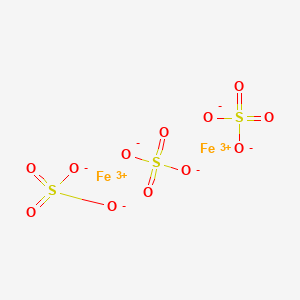
Ferric Sulfate
Iron(3+) sulfate is a compound of iron and sulfate in which the ratio of iron(3+) to sulfate ions is 3:2. It has a role as a catalyst, a mordant and an astringent. It is an iron molecular entity and a metal sulfate. It contains an iron(3+). — ChEBI
- IUPAC name
- bis(iron(3+));trisulfate
- Molecular formula
- Fe2O12S3
- Molecular weight
- 399.9 g/mol
- Exact mass
- 399.725060 Da
- Topological polar surface area
- 266.0 Ų
- Hydrogen-bond donors
- 0
- Hydrogen-bond acceptors
- 12
- Covalent units
- 5
- Defined stereocentres
- 0
Also known as
16 more reported names
External database identifiers
- ChEBI:CHEBI:53438
- EPA DTXSID:DTXSID5029712
Evidence from additional scientific databases
EMBL-EBI ChEBI
iron(3+) sulfate
A compound of iron and sulfate in which the ratio of iron(3+) to sulfate ions is 3:2.
- Formula
- 2Fe.3O4S
- Average mass
- 399.879 g/mol
- Monoisotopic mass
- 399.72506 Da
- Formal charge
- 0
- iron molecular entity — is a (CHEBI:24873)
- metal sulfate — is a (CHEBI:51336)
- catalyst — has role (CHEBI:35223)
- mordant — has role (CHEBI:74152)
- astringent — has role (CHEBI:74783)
- iron(3+) — has part (CHEBI:29034)
- catalyst — has role (CHEBI:35223)
- mordant — has role (CHEBI:74152)
- astringent — has role (CHEBI:74783)
- iron molecular entity — is a (CHEBI:24873)
- metal sulfate — is a (CHEBI:51336)
- 7615984 Source: PubMed
Additional curated names
Cross-references from this source
- CAS: 10028-22-5 — ChemIDplus
- REGISTRY_NUMBER: 11343142 — Reaxys
- REGISTRY_NUMBER: 20284 — Gmelin
- MANUAL_X_REF: Iron(III)_sulfate — Wikipedia
Mapped by: Exact CAS cross-reference in the ChEBI compound record. Source updated: 2016-03-01. Retrieved: 2026-08-31. Open source record
NIH PubChem PUG-View
Attributed physical-property, hazard, environmental and use annotations.
- Boiling Point: The Anhydrous form decomposes (480ºC) Source: DrugBank
- Color/Form: Grayish-white powder, or rhombic or rhombohedral crystals Source: Hazardous Substances Data Bank (HSDB)
- Color/Form: Yellow crystals Source: Hazardous Substances Data Bank (HSDB)
- Density: 3.1 at 68 °F (USCG, 1999) - Denser than water; will sink Source: CAMEO Chemicals
- Density: 3.097 at 18 °C Source: Hazardous Substances Data Bank (HSDB)
- Density: 3.1 @25 °C Source: PAC Chemical Database, U.S. Department of Energy
- Melting Point: The Anhydrous form decomposes (480ºC) Source: DrugBank
- Melting Point: 480 °C (decomp) Source: Hazardous Substances Data Bank (HSDB)
- Physical Description: Ferric sulfate appears as a yellow crystalline solid or a grayish-white powder. The primary hazard is the threat to the environment. Immediate steps should be taken to limit its spread to the environment. It is used for water purification, and as a soil conditioner. Source: CAMEO Chemicals
- Physical Description: Wet Solid; Liquid; Other Solid; Large Crystals; Liquid; Liquid Source: EPA Chemical Data Reporting (CDR)
- Physical Description: Greyish-white solid, slightly soluble in water; Very hygroscopic; Commercial product is yellow and contains about 20% water; [Merck Index] Off-white or yellow odorless powder; [MSDSonline] Source: Haz-Map, Information on Hazardous Chemicals and Occupational Diseases
- Refractive Index: Index of refraction: 1.814 Source: Hazardous Substances Data Bank (HSDB)
- Solubility: Soluble at room temperature Source: DrugBank
- Solubility: Slowly sol in water; rapidly sol in the presence of a trace of ferrous sulfate; sparingly sol in alc; practically insol in acetone, ethyl acetate. Source: Hazardous Substances Data Bank (HSDB)
- Solubility: Insol in sulfuric acid, ammonia Source: Hazardous Substances Data Bank (HSDB)
- First Aid: INHALATION: move to fresh air.; INGESTION: give large amount of water; induce vomiting if large amounts have been swallowed.; EYES: flush with water; get medical attention if irritation persists.; SKIN: flush with water. (USCG, 1999) Source: CAMEO Chemicals
- Note: This chemical does not meet GHS hazard criteria for 0.4% (2 of 446) of reports. Source: European Chemicals Agency (ECHA)
- Signal: Danger Source: European Chemicals Agency (ECHA)
- GHS Hazard Statements: H290 (40.4%): May be corrosive to metals [Warning Corrosive to Metals]; H302 (90.1%): Harmful if swallowed [Warning Acute toxicity, oral]; H315 (87.7%): Causes skin irritation [Warning Skin corrosion/irritation]; H317 (11.4%): May cause an allergic skin reaction [Warning Sensitization, Skin]; H318 (80.7%): Causes serious eye damage [Danger Serious eye damage/eye irritation]; H319 (18.8%): Causes serious eye irritation [Warning Serious eye damage/eye irritation]; H335 (20.4%): May cause respiratory irritation [Warning Specific target organ toxicity, single exposure; Respiratory tract irritation] Source: European Chemicals Agency (ECHA)
- Precautionary Statement Codes: P234, P261, P264, P264+P265, P270, P271, P272, P280, P301+P317, P302+P352, P304+P340, P305+P351+P338, P305+P354+P338, P317, P319, P321, P330, P332+P317, P333+P317, P337+P317, P362+P364, P390, P403+P233, P405, P406, and P501 (click each P-code to see the statement) Source: European Chemicals Agency (ECHA)
- ECHA C&L Notifications Summary: Aggregated GHS information provided per 446 reports by companies from 19 notifications to the ECHA C&L Inventory. Each notification may be associated with multiple companies.; Reported as not meeting GHS hazard criteria per 2 of 446 reports by companies.; There are 18 notifications provided by 444 of 446 reports by companies with hazard statement code(s).; Information may vary between notifications depending on impurities, additives, and other factors. The percentage value in parenthesis indicates the notified classification ratio from companies that provide hazard codes. Only hazard codes with percentage values above 10% are shown. For more detailed information, please visit ECHA C&L website. Source: European Chemicals Agency (ECHA)
- Signal: Warning Source: European Chemicals Agency (ECHA)
- GHS Hazard Statements: H302 (100%): Harmful if swallowed [Warning Acute toxicity, oral] Source: European Chemicals Agency (ECHA)
- Precautionary Statement Codes: P264, P270, P301+P317, P330, and P501 (click each P-code to see the statement) Source: European Chemicals Agency (ECHA)
- ECHA C&L Notifications Summary: Aggregated GHS information provided per 39 reports by companies from 1 notifications to the ECHA C&L Inventory.; Information may vary between notifications depending on impurities, additives, and other factors. The percentage value in parenthesis indicates the notified classification ratio from companies that provide hazard codes. Only hazard codes with percentage values above 10% are shown. For more detailed information, please visit ECHA C&L website. Source: European Chemicals Agency (ECHA)
- Consumer Uses: Not Known or Reasonably Ascertainable; Flocculating agent Source: EPA Chemical Data Reporting (CDR)
- Industry Uses: Plating agent; Deodorizer; Processing aids not otherwise specified; Soil amendments (fertilizers); Not Known or Reasonably Ascertainable; Cleaning agent; Softener and conditioner; Etching agent; Adhesion/cohesion promoter; Chelating agent; Flocculating agent; Solids separation (precipitating) agent, not otherwise specified; Intermediate Source: EPA Chemical Data Reporting (CDR)
- Sources/Uses: Used to make iron salts and pigments, as a coagulant in water purification and sewage treatment, in etching aluminum, in pickling stainless steel and copper, as a mordant in textile dyeing and calico printing, in soil conditioners, as a polymerization catalyst, in the coal conversion process (desulfurization), in the ferric salt leaching process, as a disinfectant, and as a hemostatic agent for endodontic surgery; [HSDB] Source: Haz-Map, Information on Hazardous Chemicals and Occupational Diseases
- Industrial Processes with risk of exposure: Aluminum Producing [Category: Industry]; Steel Producing [Category: Industry]; Metal Preparation and Pouring [Category: Foundry]; Using Disinfectants or Biocides [Category: Clean]; Farming (Pesticides) [Category: Industry]; Sewer and Wastewater Treatment [Category: Industry]; Textiles (Printing, Dyeing, or Finishing) [Category: Industry] Source: Haz-Map, Information on Hazardous Chemicals and Occupational Diseases
- Uses: For ferric sulfate (USEPA/OPP Pesticide Code: 034902) ACTIVE products with label matches. /SRP: Registered for use in the U.S. but approved pesticide uses may change periodically and so federal, state and local authorities must be consulted for currently approved uses./ Source: Hazardous Substances Data Bank (HSDB)
- Uses: The primary use for ferric sulfate is in water and wastewater treatment. Source: Hazardous Substances Data Bank (HSDB)
- Uses: In preparation of iron alums, other iron salts and pigments; as coagulant in water purification and sewage treatment; in etching aluminum; in pickling stainless steel and copper; as mordant in textile dyeing and calico printing; in soil conditioners; as polymerization catalyst. Source: Hazardous Substances Data Bank (HSDB)
- Uses: Fertilizer /Iron(III) sulfate, enneahydrate/ Source: Hazardous Substances Data Bank (HSDB)
- Uses: For more Uses (Complete) data for FERRIC SULFATE (7 total), please visit the HSDB record page. Source: Hazardous Substances Data Bank (HSDB)
Mapped by: Existing checksum-valid CAS to unique PubChem CID match. Retrieved: 2026-08-31. Open source record
Scientific classifications and hazard annotations provide context and do not replace the market-specific regulatory decision shown above.
Additional source coverage and match status
| Source | Result | Checked |
|---|---|---|
| EMBL-EBI ChEBI | Exact match | 2026-08-31 |
| NIH PubChem PUG-View | Exact match | 2026-08-31 |
A recorded no-match is useful evidence that the source was checked; it is not a claim that the substance does not exist elsewhere.
Retrieved from NIH PubChem on 2026-08-31 by checksum-valid CAS matching. Chemical properties do not replace the regulatory decision on this page.