
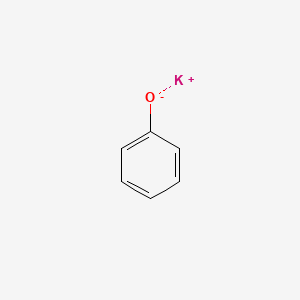
CAS 100-67-4PubChem CID 23670670
Potassium phenoxide
- IUPAC name
- potassium phenoxide
- Molecular formula
- C6H5KO
- Molecular weight
- 132.20 g/mol
- Exact mass
- 131.99774626 Da
- Topological polar surface area
- 23.1 Ų
- Hydrogen-bond donors
- 0
- Hydrogen-bond acceptors
- 1
- Covalent units
- 2
- Defined stereocentres
- 0
Also known as
potassium phenateUNII-9CQ00ODF3UEINECS 202-877-79CQ00ODF3UPOTASSIUM CARBOLATEPOTASSIUM PHENOXIDE [MI]RefChem:175576POTASSIUM PHENOXIDE [INCI]
10 more reported names
202-877-7Potassium phenolatepotassium benzenolatepotassium;phenoxidePhenol, potassium saltPotassiumphenolateKOPhAC-37335CS-0048749Phenoxypotassium; Potassium Carbolate; Potassium Phenate; Potassium Phenylate
External database identifiers
- EPA DTXSID:DTXSID30881405
Evidence from additional scientific databases
NIH PubChem PUG-View
Exact identifier match23670670
Attributed physical-property, hazard, environmental and use annotations.
- Signal: Danger Source: European Chemicals Agency (ECHA)
- GHS Hazard Statements: H301+H311+H331 (100%): Toxic if swallowed, in contact with skin or if inhaled [Danger Acute toxicity, oral; acute toxicity, dermal; acute toxicity, inhalation]; H301 (100%): Toxic if swallowed [Danger Acute toxicity, oral]; H311 (100%): Toxic in contact with skin [Danger Acute toxicity, dermal]; H314 (100%): Causes severe skin burns and eye damage [Danger Skin corrosion/irritation]; H318 (100%): Causes serious eye damage [Danger Serious eye damage/eye irritation]; H331 (100%): Toxic if inhaled [Danger Acute toxicity, inhalation]; H341 (100%): Suspected of causing genetic defects [Warning Germ cell mutagenicity]; H373 (100%): May causes damage to organs through prolonged or repeated exposure [Warning Specific target organ toxicity, repeated exposure]; H410 (100%): Very toxic to aquatic life with long lasting effects [Warning Hazardous to the aquatic environment, long-term hazard] Source: European Chemicals Agency (ECHA)
- Precautionary Statement Codes: P203, P260, P261, P262, P264, P264+P265, P270, P271, P273, P280, P301+P316, P301+P330+P331, P302+P352, P302+P361+P354, P304+P340, P305+P354+P338, P316, P317, P318, P319, P321, P330, P361+P364, P363, P391, P403+P233, P405, and P501 (click each P-code to see the statement) Source: European Chemicals Agency (ECHA)
- ECHA C&L Notifications Summary: The GHS information provided by 1 company from 1 notification to the ECHA C&L Inventory. Source: European Chemicals Agency (ECHA)
Mapped by: Existing checksum-valid CAS to unique PubChem CID match. Retrieved: 2026-08-31. Open source record
Scientific classifications and hazard annotations provide context and do not replace the market-specific regulatory decision shown above.
Additional source coverage and match status
| Source | Result | Checked |
|---|---|---|
| EMBL-EBI ChEBI | No exact record | 2026-08-31 |
| NIH PubChem PUG-View | Exact match | 2026-08-31 |
A recorded no-match is useful evidence that the source was checked; it is not a claim that the substance does not exist elsewhere.
Retrieved from NIH PubChem on 2026-08-31 by checksum-valid CAS matching. Chemical properties do not replace the regulatory decision on this page.