
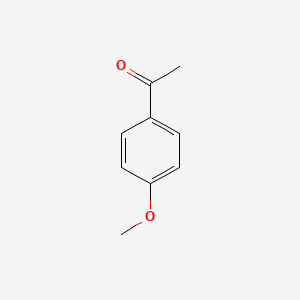
4'-Methoxyacetophenone
4-methoxyacetophenone is a member of the class of acetophenones that is acetophenone substituted by a methoxy group at position 4. It is a member of acetophenones and a monomethoxybenzene. — ChEBI
- IUPAC name
- 1-(4-methoxyphenyl)ethanone
- Molecular formula
- C9H10O2
- Molecular weight
- 150.17 g/mol
- Exact mass
- 150.068079557 Da
- XLogP3
- 1.7
- Topological polar surface area
- 26.3 Ų
- Hydrogen-bond donors
- 0
- Hydrogen-bond acceptors
- 2
- Covalent units
- 1
- Defined stereocentres
- 0
Also known as
16 more reported names
External database identifiers
- ChEBI:CHEBI:86567
- ChEMBL:CHEMBL401912
- EPA DTXSID:DTXSID2044347
- PubMed:26244607
- PubMed:22655237
- PubMed:22412749
- PubMed:22160343
- PubMed:22091144
- PubMed:21920952
- PubMed:21754502
- PubMed:21673897
- PubMed:21587644
- PubMed:21582775
- PubMed:21581378
- PubMed:21580143
Evidence from additional scientific databases
EMBL-EBI ChEBI
4-methoxyacetophenone
A member of the class of acetophenones that is acetophenone substituted by a methoxy group at position 4.
- Formula
- C9H10O2
- Average mass
- 150.177 g/mol
- Monoisotopic mass
- 150.06808 Da
- Formal charge
- 0
- monomethoxybenzene — is a (CHEBI:25235)
- acetophenones — is a (CHEBI:22187)
- monomethoxybenzene — is a (CHEBI:25235)
- acetophenones — is a (CHEBI:22187)
- 26044365 Source: PubMed
Additional curated names
Cross-references from this source
Mapped by: Exact CAS cross-reference in the ChEBI compound record. Source updated: 2015-07-21. Retrieved: 2026-08-31. Open source record
NIH PubChem PUG-View
Attributed physical-property, hazard, environmental and use annotations.
- Boiling Point: 254 °C Source: Hazardous Substances Data Bank (HSDB)
- Boiling Point: 152.00 to 154.00 °C. @ 26.00 mm Hg Source: Human Metabolome Database (HMDB)
- Boiling Point: 153 °C (26 mm Hg) Source: Joint FAO/WHO Expert Committee on Food Additives (JECFA)
- Color/Form: Crystalline solid Source: Hazardous Substances Data Bank (HSDB)
- Color/Form: Colorless to pale-yellow fused solid Source: Hazardous Substances Data Bank (HSDB)
- Color/Form: Yellowish-white crystals Source: Hazardous Substances Data Bank (HSDB)
- Density: 1.0818 g/cu cm at 41 °C Source: Hazardous Substances Data Bank (HSDB)
- Flash Point: 138 °C (280 °F) - open cup Source: Hazardous Substances Data Bank (HSDB)
- LogP: log Kow = 1.74 Source: Hazardous Substances Data Bank (HSDB)
- LogP: 1.74 Source: Human Metabolome Database (HMDB)
- Melting Point: 38.2 °C Source: Hazardous Substances Data Bank (HSDB)
- Melting Point: 38 - 39 °C Source: Human Metabolome Database (HMDB)
- Odor: Pleasant odor Source: Hazardous Substances Data Bank (HSDB)
- Odor: Hawthorn odor Source: Hazardous Substances Data Bank (HSDB)
- Odor: Similar to that of p-methylacetopheneone, suggestive of hawthorn and floral note of heliotrope Source: Hazardous Substances Data Bank (HSDB)
- Physical Description: CBI Source: EPA Chemical Data Reporting (CDR)
- Physical Description: White crystalline powder; mp = 36-40 deg C; [Alfa Aesar MSDS] Source: Haz-Map, Information on Hazardous Chemicals and Occupational Diseases
- Physical Description: Solid Source: Human Metabolome Database (HMDB)
- Physical Description: Colourless to pale yellow fused solid; floral, powdery, vanillic, balsamic odour Source: Joint FAO/WHO Expert Committee on Food Additives (JECFA)
- Refractive Index: Index of refraction = 1.547 at 41 °C Source: Hazardous Substances Data Bank (HSDB)
- Solubility: Soluble in ethanol, diethyl ether, acetone and chloroform Source: Hazardous Substances Data Bank (HSDB)
- Solubility: Soluble in alcohol, ether, fixed oils Source: Hazardous Substances Data Bank (HSDB)
- Solubility: Soluble in fixed oils, propylene glycol; miscible with glycerin Source: Hazardous Substances Data Bank (HSDB)
- Solubility: insoluble in water; soluble in organic solvents, oils Source: Joint FAO/WHO Expert Committee on Food Additives (JECFA)
- Solubility: very soluble (in ethanol) Source: Joint FAO/WHO Expert Committee on Food Additives (JECFA)
- Vapor Pressure: 0.00644 [mmHg] Source: Haz-Map, Information on Hazardous Chemicals and Occupational Diseases
- Vapor Pressure: 6.44X10⁻³ mm Hg at 25 °C Source: Hazardous Substances Data Bank (HSDB)
- Signal: Warning Source: European Chemicals Agency (ECHA)
- GHS Hazard Statements: H302 (100%): Harmful if swallowed [Warning Acute toxicity, oral]; H315 (12.7%): Causes skin irritation [Warning Skin corrosion/irritation]; H319 (10.1%): Causes serious eye irritation [Warning Serious eye damage/eye irritation] Source: European Chemicals Agency (ECHA)
- Precautionary Statement Codes: P264, P264+P265, P270, P280, P301+P317, P302+P352, P305+P351+P338, P321, P330, P332+P317, P337+P317, P362+P364, and P501 (click each P-code to see the statement) Source: European Chemicals Agency (ECHA)
- ECHA C&L Notifications Summary: Aggregated GHS information provided per 1856 reports by companies from 7 notifications to the ECHA C&L Inventory. Each notification may be associated with multiple companies.; Information may vary between notifications depending on impurities, additives, and other factors. The percentage value in parenthesis indicates the notified classification ratio from companies that provide hazard codes. Only hazard codes with percentage values above 10% are shown. For more detailed information, please visit ECHA C&L website. Source: European Chemicals Agency (ECHA)
- Signal: Warning Source: Hazardous Substances Data Bank (HSDB)
- GHS Hazard Statements: H302: Harmful if swallowed [Warning Acute toxicity, oral]; H315: Causes skin irritation [Warning Skin corrosion/irritation] Source: Hazardous Substances Data Bank (HSDB)
- Precautionary Statement Codes: P264, P270, P280, P301+P317, P302+P352, P321, P330, P332+P317, P362+P364, and P501 (click each P-code to see the statement) Source: Hazardous Substances Data Bank (HSDB)
- Toxicity Summary: IDENTIFICATION AND USE: 4-Acetylanisole is a colorless to pale-yellow fused solid. It is used in perfumery (for floral odors), and flavoring. HUMAN EXPOSURE AND TOXICITY: Human systemic effects by inhalation: pulse rate increase without fall in blood pressure and blood pressure elevation. ANIMAL STUDIES: In an experiment using isolated bovine eyes, 4-acetylanisole did not show an ocular severe irritant or corrosive potential. Source: Hazardous Substances Data Bank (HSDB)
- Environmental Bioconcentration: An estimated BCF of 3 was calculated in fish for 4-acetylanisole (SRC), using a log Kow of 1.74(1) and a regression-derived equation(2). According to a classification scheme(3), this BCF suggests the potential for bioconcentration in aquatic organisms is low(SRC). Source: Hazardous Substances Data Bank (HSDB)
- Environmental Fate: TERRESTRIAL FATE: Based on a classification scheme(1), a log Koc value of 2.43(2) indicates that 4-acetylanisole is expected to have moderate mobility in soil(SRC). Volatilization of 4-acetylanisole from moist soil surfaces may be an important fate process(SRC) given an estimated Henry's Law constant of 8.9X10⁻⁶ atm-cu m/mole(3). 4-Acetylanisole is not expected to volatilize from dry soil surfaces(SRC) based upon an estimated vapor pressure of 6.44X10⁻³ mm Hg at 25 °C(4). Biodegradation data in soil were not available(SRC, 2016). Source: Hazardous Substances Data Bank (HSDB)
- Environmental Fate: AQUATIC FATE: Based on a classification scheme(1), a log Koc value of 2.43(2) indicates that 4-acetylanisole is not expected to adsorb to suspended solids and sediment(SRC). Volatilization from water surfaces may be expected(3) based upon an estimated Henry's Law constant of 8.9X10⁻⁶ atm-cu m/mole(4). Using this Henry's Law constant and an estimation method(4), volatilization half-lives for a model river and model lake are 3 days and 42 days, respectively(SRC). According to a classification scheme(5), an estimated BCF of 3(SRC), from an estimated log Kow of 1.74(6) and a regression-derived equation(4), suggests the potential for bioconcentration in aquatic organisms is low. Biodegradation data in water were not available(SRC, 2016). An environmental half-life of 12 days was measured in sunlit surface waters at 40 °C(7). Source: Hazardous Substances Data Bank (HSDB)
- Environmental Fate: ATMOSPHERIC FATE: According to a model of gas/particle partitioning of semivolatile organic compounds in the atmosphere(1), 4-acetylanisole, which has a vapor pressure of 6.44X10⁻³ mm Hg at 25 °C(2), is expected to exist solely as a vapor in the ambient atmosphere. Vapor-phase 4-acetylanisole is degraded in the atmosphere by reaction with photochemically-produced hydroxyl radicals(SRC); the half-life for this reaction in air is estimated to be 1 day(SRC), calculated from its rate constant of 2.05X10⁻¹¹ cu cm/molecule-sec at 25 °C(SRC) that was derived using a structure estimation method(3). 4-Acetylanisole contains chromophores that absorb at wavelengths >290 nm(4) and, therefore, may be susceptible to direct photolysis by sunlight(SRC). An environmental half-life of 12 days was measured in sunlit surface waters at 40 °C(5). Source: Hazardous Substances Data Bank (HSDB)
- Consumer Uses: Fragrance Source: EPA Chemical Data Reporting (CDR)
- Industry Uses: Fragrance Source: EPA Chemical Data Reporting (CDR)
- Sources/Uses: Used as flavoring agent or adjuvant; [FDA] Source: Haz-Map, Information on Hazardous Chemicals and Occupational Diseases
- Uses: Reported uses (ppm):; Table: Reported uses (ppm): (Flavor and Extract Manufacturers' Association, 1994) [Table#8333] Source: Hazardous Substances Data Bank (HSDB)
- Uses: Useful in vanilla, nut, tobacco and butter flavors. Source: Hazardous Substances Data Bank (HSDB)
- Uses: Perfumery (for floral odors), flavoring. Source: Hazardous Substances Data Bank (HSDB)
Mapped by: Existing checksum-valid CAS to unique PubChem CID match. Retrieved: 2026-08-31. Open source record
Scientific classifications and hazard annotations provide context and do not replace the market-specific regulatory decision shown above.
Additional source coverage and match status
| Source | Result | Checked |
|---|---|---|
| EMBL-EBI ChEBI | Exact match | 2026-08-31 |
| NIH PubChem PUG-View | Exact match | 2026-08-31 |
A recorded no-match is useful evidence that the source was checked; it is not a claim that the substance does not exist elsewhere.
Retrieved from NIH PubChem on 2026-08-31 by checksum-valid CAS matching. Chemical properties do not replace the regulatory decision on this page.