
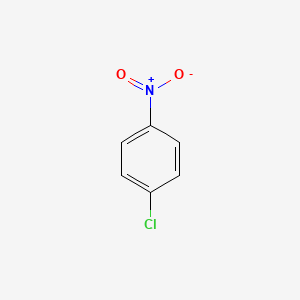
1-Chloro-4-nitrobenzene
4-Chloronitrobenzene is a C-nitro compound. — ChEBI
- IUPAC name
- 1-chloro-4-nitrobenzene
- Molecular formula
- C6H4ClNO2
- Molecular weight
- 157.55 g/mol
- Exact mass
- 156.9930561 Da
- XLogP3
- 2.4
- Topological polar surface area
- 45.8 Ų
- Hydrogen-bond donors
- 0
- Hydrogen-bond acceptors
- 2
- Covalent units
- 1
- Defined stereocentres
- 0
Also known as
16 more reported names
External database identifiers
- ChEBI:CHEBI:34399
- ChEMBL:CHEMBL56970
- EPA DTXSID:DTXSID5020281
- PubMed:23069076
- PubMed:22998012
- PubMed:22889603
- PubMed:22744676
- PubMed:22701692
- PubMed:22590357
- PubMed:22509583
- PubMed:22454582
- PubMed:22377994
- PubMed:22344350
- PubMed:22292983
- PubMed:22283148
Evidence from additional scientific databases
EMBL-EBI ChEBI
4-Chloronitrobenzene
- Formula
- C6H4ClNO2
- Average mass
- 157.556 g/mol
- Monoisotopic mass
- 156.99306 Da
- Formal charge
- 0
- C-nitro compound — is a (CHEBI:35716)
- C-nitro compound — is a (CHEBI:35716)
Additional curated names
Cross-references from this source
- CAS: 100-00-5 — KEGG COMPOUND
- MANUAL_X_REF: C14456 — KEGG COMPOUND
Mapped by: Exact CAS cross-reference in the ChEBI compound record. Source updated: 2014-07-28. Retrieved: 2026-08-31. Open source record
NIH PubChem PUG-View
Attributed physical-property, hazard, environmental and use annotations.
- Autoignition Temperature: 510 °C Source: ILO-WHO International Chemical Safety Cards (ICSCs)
- Boiling Point: 468 °F at 760 mmHg (NTP, 1992) Source: CAMEO Chemicals
- Boiling Point: 242 °C at 760 mm Hg Source: Hazardous Substances Data Bank (HSDB)
- Boiling Point: 242 °C Source: ILO-WHO International Chemical Safety Cards (ICSCs)
- Boiling Point: 468 °F Source: Occupational Safety and Health Administration (OSHA)
- Boiling Point: 242 °C @760 [mm Hg] Source: PAC Chemical Database, U.S. Department of Energy
- Boiling Point: 468 °F Source: The National Institute for Occupational Safety and Health (NIOSH)
- Color/Form: Monoclinic prisms Source: Hazardous Substances Data Bank (HSDB)
- Color/Form: Yellow crystals Source: Hazardous Substances Data Bank (HSDB)
- Color/Form: Yellow, crystalline solid Source: Hazardous Substances Data Bank (HSDB)
- Density: 1.52 at 64 °F (NTP, 1992) - Denser than water; will sink Source: CAMEO Chemicals
- Density: 1.520 Source: Hazardous Substances Data Bank (HSDB)
- Density: Relative density (water = 1): 1.3 Source: ILO-WHO International Chemical Safety Cards (ICSCs)
- Density: 1.52 Source: Occupational Safety and Health Administration (OSHA)
- Density: 1.2979 @ 90°C Source: PAC Chemical Database, U.S. Department of Energy
- Density: 1.52 Source: The National Institute for Occupational Safety and Health (NIOSH)
- Flash Point: 230 °F (NTP, 1992) Source: CAMEO Chemicals
- Flash Point: 127 °C Source: Haz-Map, Information on Hazardous Chemicals and Occupational Diseases
- Flash Point: 261 °F (closed cup) Source: Hazardous Substances Data Bank (HSDB)
- Flash Point: 261 °F (127 °C) (closed cup) Source: Hazardous Substances Data Bank (HSDB)
- Flash Point: 127 °C c.c. Source: ILO-WHO International Chemical Safety Cards (ICSCs)
- Flash Point: 230 °F Source: Occupational Safety and Health Administration (OSHA)
- Flash Point: 261 °F Source: The National Institute for Occupational Safety and Health (NIOSH)
- LogP: log Kow = 2.39 Source: Hazardous Substances Data Bank (HSDB)
- LogP: 2.39 Source: ILO-WHO International Chemical Safety Cards (ICSCs)
- Melting Point: 182.5 °F (NTP, 1992) Source: CAMEO Chemicals
- Melting Point: 82-84 °C Source: Hazardous Substances Data Bank (HSDB)
- Melting Point: The liquid molar volume is 0.121 cu m/kmol. The IG heat of formation is 3.72X10+7 J/kmol. The heat fusion at the melting point is 1.41X10+7 J/kmol. Source: Hazardous Substances Data Bank (HSDB)
- Melting Point: 82-84 °C Source: ILO-WHO International Chemical Safety Cards (ICSCs)
- Melting Point: 182 °F Source: Occupational Safety and Health Administration (OSHA)
- Melting Point: 82 °C Source: PAC Chemical Database, U.S. Department of Energy
- Melting Point: 182 °F Source: The National Institute for Occupational Safety and Health (NIOSH)
- Odor: Sweet odor Source: Hazardous Substances Data Bank (HSDB)
- Physical Description: P-nitrochlorobenzene is a light yellow crystalline solid. Density 1.520 g / cm3. Melting point 83 °C. Sweet odor. Very toxic by inhalation, ingestion, and skin absorption. Source: CAMEO Chemicals
- Physical Description: Light yellow crystalline solid with a sweet odor; [CAMEO] Source: Haz-Map, Information on Hazardous Chemicals and Occupational Diseases
- Physical Description: YELLOWISH CRYSTALS WITH CHARACTERISTIC ODOUR. Source: ILO-WHO International Chemical Safety Cards (ICSCs)
- Physical Description: Yellow, crystalline solid with a sweet odor. Source: Occupational Safety and Health Administration (OSHA)
- Physical Description: Yellow, crystalline solid with a sweet odor. Source: The National Institute for Occupational Safety and Health (NIOSH)
- Refractive Index: MAX ABSORPTION (METHANOL): 270.5 NM (LOG E= 4.03); SADTLER REF NUMBER: 4683 (IR, PRISM); 435 (IR, GRATING); INDEX OF REFRACTION: 1.5376 AT 100 °C/ALPHA Source: Hazardous Substances Data Bank (HSDB)
- Solubility: less than 0.1 mg/mL at 75 °F (NTP, 1992) Source: CAMEO Chemicals
- Solubility: Sparingly sol in cold alc and freely in boiling alcohol, ether, carbon disulfide. Source: Hazardous Substances Data Bank (HSDB)
- Solubility: Soluble in organic solvents Source: Hazardous Substances Data Bank (HSDB)
- Solubility: In water, 225 mg/L at 20 °C Source: Hazardous Substances Data Bank (HSDB)
- Solubility: Solubility in water: none Source: ILO-WHO International Chemical Safety Cards (ICSCs)
- Solubility: Slight Source: The National Institute for Occupational Safety and Health (NIOSH)
- Vapor Pressure: 0.09 mmHg at 77 °F ; 0.23 mmHg at 99.9 °F (NTP, 1992) Source: CAMEO Chemicals
- Vapor Pressure: 0.02 [mmHg] Source: Haz-Map, Information on Hazardous Chemicals and Occupational Diseases
- Vapor Pressure: 2.19X10⁻² mm Hg at 25 °C Source: Hazardous Substances Data Bank (HSDB)
- Vapor Pressure: Vapor pressure, Pa at 30 °C: 20 Source: ILO-WHO International Chemical Safety Cards (ICSCs)
- Vapor Pressure: 0.2 mmHg at 86 °F Source: Occupational Safety and Health Administration (OSHA)
- Vapor Pressure: (86 °F): 0.2 mmHg Source: The National Institute for Occupational Safety and Health (NIOSH)
- Viscosity: 1.07X10⁻³ Pa-s at 356.65 deg K Source: Hazardous Substances Data Bank (HSDB)
- IARC Carcinogenic Agent: 4-Chloronitrobenzene Source: International Agency for Research on Cancer (IARC)
- IARC Carcinogenic Classes: Group 2B: Possibly carcinogenic to humans Source: International Agency for Research on Cancer (IARC)
- IARC Monographs: Volume 65: (1996) Printing Processes and Printing Inks, Carbon Black and Some Nitro Compounds; Volume 123: (2020) Some Nitrobenzenes and Other Industrial Chemicals Source: International Agency for Research on Cancer (IARC)
- Publication Year: 2020 online Source: International Agency for Research on Cancer (IARC)
- Evaluation Year: 2018 Source: International Agency for Research on Cancer (IARC)
- Exposure Routes: The substance can be absorbed into the body by inhalation, through the skin and by ingestion. Source: ILO-WHO International Chemical Safety Cards (ICSCs)
- Exposure Routes: inhalation, skin absorption, ingestion, skin and/or eye contact Source: The National Institute for Occupational Safety and Health (NIOSH)
- First Aid: EYES: First check the victim for contact lenses and remove if present. Flush victim's eyes with water or normal saline solution for 20 to 30 minutes while simultaneously calling a hospital or poison control center. Do not put any ointments, oils, or medication in the victim's eyes without specific instructions from a physician. IMMEDIATELY transport the victim after flushing eyes to a hospital even if no symptoms (such as redness or irritation) develop.; SKIN: IMMEDIATELY flood affected skin with water while removing and isolating all contaminated clothing. Gently wash all affected skin areas thoroughly with soap and water. If symptoms such as redness or irritation develop, IMMEDIATELY call a physician and be prepared to transport the victim to a hospital for treatment.; INHALATION: IMMEDIATELY leave the contaminated area; take deep breaths of fresh air. If symptoms (such as wheezing, coughing, shortness of breath, or burning in the mouth, throat, or chest) develop, call a physician and be prepared to transport the victim to a hospital. Provide proper respiratory protection to rescuers entering an unknown atmosphere. Whenever possible, Self-Contained Breathing Apparatus (SCBA) shou Source: CAMEO Chemicals
- First Aid: (General first aid procedures); Eye: Irrigate immediately - If this chemical contacts the eyes, immediately wash (irrigate) the eyes with large amounts of water, occasionally lifting the lower and upper lids. Get medical attention immediately.; Skin: Soap wash immediately - If this chemical contacts the skin, immediately wash the contaminated skin with soap and water. If this chemical penetrates the clothing, immediately remove the clothing, wash the skin with soap and water, and get medical attention promptly.; Breathing: Respiratory support; Swallow: Medical attention immediately - If this chemical has been swallowed, get medical attention immediately. Source: The National Institute for Occupational Safety and Health (NIOSH)
- Signal: Danger Source: Regulation (EC) No 1272/2008 of the European Parliament and of the Council
- GHS Hazard Statements: H301: Toxic if swallowed [Danger Acute toxicity, oral]; H311: Toxic in contact with skin [Danger Acute toxicity, dermal]; H331: Toxic if inhaled [Danger Acute toxicity, inhalation]; H341: Suspected of causing genetic defects [Warning Germ cell mutagenicity]; H351: Suspected of causing cancer [Warning Carcinogenicity]; H373 **: May causes damage to organs through prolonged or repeated exposure [Warning Specific target organ toxicity, repeated exposure]; H411: Toxic to aquatic life with long lasting effects [Hazardous to the aquatic environment, long-term hazard] Source: Regulation (EC) No 1272/2008 of the European Parliament and of the Council
- Precautionary Statement Codes: P203, P260, P261, P262, P264, P270, P271, P273, P280, P301+P316, P302+P352, P304+P340, P316, P318, P319, P321, P330, P361+P364, P391, P403+P233, P405, and P501 (click each P-code to see the statement) Source: Regulation (EC) No 1272/2008 of the European Parliament and of the Council
- Signal: Danger Source: European Chemicals Agency (ECHA)
- GHS Hazard Statements: H301 (100%): Toxic if swallowed [Danger Acute toxicity, oral]; H311 (100%): Toxic in contact with skin [Danger Acute toxicity, dermal]; H331 (100%): Toxic if inhaled [Danger Acute toxicity, inhalation]; H341 (100%): Suspected of causing genetic defects [Warning Germ cell mutagenicity]; H351 (100%): Suspected of causing cancer [Warning Carcinogenicity]; H373 (98.4%): May causes damage to organs through prolonged or repeated exposure [Warning Specific target organ toxicity, repeated exposure]; H411 (100%): Toxic to aquatic life with long lasting effects [Hazardous to the aquatic environment, long-term hazard] Source: European Chemicals Agency (ECHA)
- Precautionary Statement Codes: P203, P260, P261, P262, P264, P270, P271, P273, P280, P301+P316, P302+P352, P304+P340, P316, P318, P319, P321, P330, P361+P364, P391, P403+P233, P405, and P501 (click each P-code to see the statement) Source: European Chemicals Agency (ECHA)
- ECHA C&L Notifications Summary: Aggregated GHS information provided per 61 reports by companies from 8 notifications to the ECHA C&L Inventory. Each notification may be associated with multiple companies.; Information may vary between notifications depending on impurities, additives, and other factors. The percentage value in parenthesis indicates the notified classification ratio from companies that provide hazard codes. Only hazard codes with percentage values above 10% are shown. For more detailed information, please visit ECHA C&L website. Source: European Chemicals Agency (ECHA)
- Signal: Danger Source: NITE-CMC
- GHS Hazard Statements: H302: Harmful if swallowed [Warning Acute toxicity, oral]; H311: Toxic in contact with skin [Danger Acute toxicity, dermal]; H341: Suspected of causing genetic defects [Warning Germ cell mutagenicity]; H350: May cause cancer [Danger Carcinogenicity]; H360: May damage fertility or the unborn child [Danger Reproductive toxicity]; H370: Causes damage to organs [Danger Specific target organ toxicity, single exposure]; H372: Causes damage to organs through prolonged or repeated exposure [Danger Specific target organ toxicity, repeated exposure] Source: NITE-CMC
- Precautionary Statement Codes: P203, P260, P262, P264, P270, P280, P301+P317, P302+P352, P308+P316, P316, P318, P319, P321, P330, P361+P364, P405, and P501 (click each P-code to see the statement) Source: NITE-CMC
- GHS Hazard Statements: H302: Harmful if swallowed [Warning Acute toxicity, oral]; H311: Toxic in contact with skin [Danger Acute toxicity, dermal]; H320: Causes eye irritation [Warning Serious eye damage/eye irritation]; H341: Suspected of causing genetic defects [Warning Germ cell mutagenicity]; H351: Suspected of causing cancer [Warning Carcinogenicity]; H361: Suspected of damaging fertility or the unborn child [Warning Reproductive toxicity]; H370: Causes damage to organs [Danger Specific target organ toxicity, single exposure]; H372: Causes damage to organs through prolonged or repeated exposure [Danger Specific target organ toxicity, repeated exposure] Source: NITE-CMC
- Precautionary Statement Codes: P203, P260, P262, P264, P264+P265, P270, P280, P301+P317, P302+P352, P305+P351+P338, P308+P316, P316, P318, P319, P321, P330, P337+P317, P361+P364, P405, and P501 (click each P-code to see the statement) Source: NITE-CMC
- NFPA Health Rating: 2 - Materials that, under emergency conditions, can cause temporary incapacitation or residual injury. Source: Hazardous Substances Data Bank (HSDB)
- NFPA Fire Rating: 1 - Materials that must be preheated before ignition can occur. Materials require considerable preheating, under all ambient temperature conditions, before ignition and combustion can occur. Source: Hazardous Substances Data Bank (HSDB)
- NFPA Instability Rating: 3 - Materials that in themselves are capable of detonation or explosive decomposition or explosive reaction but that require a strong initiating source or must be heated under confinement before initiation. Source: Hazardous Substances Data Bank (HSDB)
- Target Organs: Blood, liver, kidneys, cardiovascular system, spleen, bone marrow, reproductive system Source: The National Institute for Occupational Safety and Health (NIOSH)
- Toxicity Summary: 1-Chloro-4-nitrobenzene is rapidly absorbed via skin, gastrointestinal tract or respiratory tract and distributed in the tissue predominantly in fat, blood cells, skeletal muscles, liver and kidney. Most of the substance was excreted with the urine followed by excretion with feces. 1-Chloro-4-nitrobenzene undergoes three major types of transformation in vivo in mammals: nitro-group reduction, displacement of the chloride in glutathione conjugation, and ring hydroxylation. From accidental exposure of workers to 1-chloro-4-nitrophenol, large amounts of 2-chloro-5- nitrophenol, N-acetyl-S-(4-nitrophenyl)-L-cysteine, 4-chloroaniline and 4-chloroformanilide were identified. The oral LD50 for 1-chloro-4-nitrobenzene in male rats is 294 or 694 mg/kg bw and in female rats 565 or 664 mg/kg bw. Cyanotic appearance was the predominant symptom. The ... LC50 level could not be reached up to 16100 mg/cu m during a 4-hrs exposure against vapor and microcrystalline particles. The LD50 (dermal) for male rats is 750 mg/kg bw and for female rats 1722 mg/kg bw; the LD50 for male rabbits is 3550 mg/kg bw and for female rabbits 2510 mg/kg bw after acute dermal application. Cyanotic appearance was the pr Source: Hazardous Substances Data Bank (HSDB)
- Environmental Bioconcentration: Carp exposed to solutions containing 0.15 ppm 1-chloro-4-nitrobenzene for 8 weeks had BCF values ranging from 5.8-20.9, and carp exposed to solutions containing 0.015 ppm 1-chloro-4-nitrobenzene had BCF values ranging from 7.5-18.1(1). According to a classification scheme(2), these BCF values suggest bioconcentration in aquatic organisms is low(SRC). Source: Hazardous Substances Data Bank (HSDB)
- Environmental Fate: TERRESTRIAL FATE: Based on a classification scheme(1), an estimated Koc value of 310(SRC), determined from a structure estimation method(2), indicates that 1-chloro-4-nitrobenzene is expected to have moderate mobility in soil(SRC). Volatilization of 1-chloro-4-nitrobenzene from moist soil surfaces is expected to be an important fate process(SRC) given a Henry's Law constant of 4.9X10⁻⁶ atm-cu m/mole(3). 1-Chloro-4-nitrobenzene is not expected to volatilize from dry soil surfaces(SRC) based upon a vapor pressure of 0.022 mm Hg at 25 °C(4). Screening tests using activated sludge(5), suggest biodegradation of 1-chloro-4-nitrobenzene proceeds slowly in soil. Source: Hazardous Substances Data Bank (HSDB)
- Environmental Fate: AQUATIC FATE: Based on a classification scheme(1), an estimated Koc value of 310(SRC), determined from a structure estimation method(2), indicates that 1-chloro-4-nitrobenzene is expected to adsorb to suspended solids and sediment(SRC). Volatilization from water surfaces is expected(3) based upon a Henry's Law constant of 4.9X10⁻⁶ atm-cu m/mole(4). Using this Henry's Law constant and an estimation method(3), volatilization half-lives for a model river and model lake are 152 hours and 73 days, respectively(SRC). According to a classification scheme(5), BCF values of 5.8-20.9 measured in fish(6), suggest bioconcentration in aquatic organisms is low(SRC). Screening tests using activated sludge(6), suggest biodegradation of 1-chloro-4-nitrobenzene proceeds slowly in water. Weak absorption of UV light greater than 290 nm by 1-chloro-4-nitrobenzene in methanol indicates potential for photolysis of 1-chloro-4-nitrobenzene in sunlit surface water(7). Source: Hazardous Substances Data Bank (HSDB)
- Environmental Fate: ATMOSPHERIC FATE: According to a model of gas/particle partitioning of semivolatile organic compounds in the atmosphere(1), 1-chloro-4-nitrobenzene , which has a vapor pressure of 0.022 mm Hg at 25 °C(2), is expected to exist solely as a vapor in the ambient atmosphere. Vapor-phase 1-chloro-4-nitrobenzene is degraded in the atmosphere by reaction with photochemically-produced hydroxyl radicals(SRC); the half-life for this reaction in air is estimated to be 94 days(SRC), calculated from its rate constant of 1.7X10⁻¹³ cu cm/molecule-sec at 25 °C(SRC) that was derived using a structure estimation method(3). Weak absorption of UV light greater than 290 nm by 1-chloro-4-nitrobenzene in methanol indicates potential for photolysis by sunlight of 1-chloro-4-nitrobenzene in air(4). Source: Hazardous Substances Data Bank (HSDB)
- Sources/Uses: Used to manufacture dyes, rubber, and insecticides; [ACGIH] Source: Haz-Map, Information on Hazardous Chemicals and Occupational Diseases
- Uses: p-Chloronitrobenzene is used to manufacture p-nitrophenol, p-nitroaniline, p-aminophenol, phenacetin, acetaminophen, parathion and other agricultural chemicals, rubber chemicals, antioxidants, oil additives and Dapsone (an antimalarial drug). Source: Hazardous Substances Data Bank (HSDB)
- Uses: CHEM INT FOR ETHYL & METHYL PARATHION, ACETAMINOPHEN, TRICLOCARBAN, A BACTERIOSTAT, RUBBER-PROCESSING CHEMICALS, & OTHER INTS, EG, P-CHLOROANILINE Source: Hazardous Substances Data Bank (HSDB)
- Uses: Used in the manufacture of dyestuffs and insecticides. Source: Hazardous Substances Data Bank (HSDB)
- Uses: Intermediate, especially for dyes; manufacture of p-nitrophenol from which parathion is made; agricultural chemicals; rubber chemicals Source: Hazardous Substances Data Bank (HSDB)
- Uses: 4-Chloronitrobenzene and its derivatives are also used in many synthetic processes. Common chemical intermediates produced from 4-chloronitrobenzene include 4-chloroaniline, 4-nitrophenol, 4-nitroanisole, para-anisidine, 4-nitroaniline, 6-chloro-3-nitrobenzenesulfonic acid, 2,4- dinitrochlorobenzene and 3,4-dichloronitrobenzene. 4,4'-Diaminodiphenyl sulfone (Dapsone), a drug used to treat leprosy, is synthesized from 4-chloronitrobenzene by one of two methods. In addition, condensation of 4-chloronitrobenzene with 2,4-dichlorophenol gives 2,4-dichloro-4'-nitrodiphenyl ether, which is used as a herbicide (nitrofen); 4-chloronitrobenzene can also be reacted with aniline to give 4-nitrodiphenylamine, which on reductive N-alkylation gives important antioxidants for rubber Source: Hazardous Substances Data Bank (HSDB)
Mapped by: Existing checksum-valid CAS to unique PubChem CID match. Retrieved: 2026-08-31. Open source record
Scientific classifications and hazard annotations provide context and do not replace the market-specific regulatory decision shown above.
Additional source coverage and match status
| Source | Result | Checked |
|---|---|---|
| EMBL-EBI ChEBI | Exact match | 2026-08-31 |
| NIH PubChem PUG-View | Exact match | 2026-08-31 |
A recorded no-match is useful evidence that the source was checked; it is not a claim that the substance does not exist elsewhere.
Retrieved from NIH PubChem on 2026-08-31 by checksum-valid CAS matching. Chemical properties do not replace the regulatory decision on this page.