
What CosIng is, and how to read an annex record
CosIng has an inventory and five annexes, and only the annexes carry legal force. What each annex means, how to read a record, and the mistakes that follow from reading it wrong.
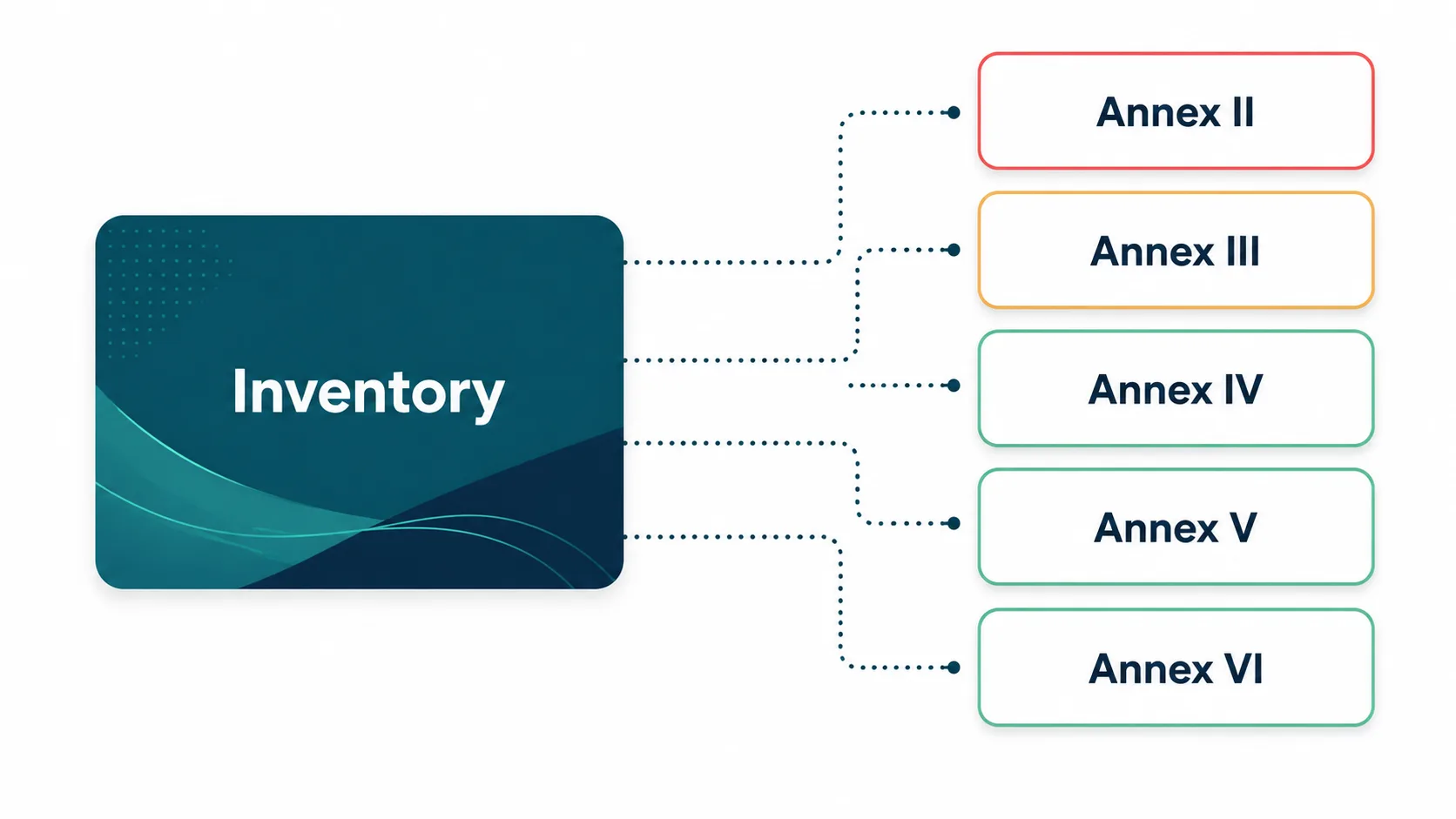
What CosIng is
CosIng is the European Commission's database of cosmetic ingredients. It has two halves that are easy to confuse, and confusing them is the most common mistake made when reading it.
- The inventory: a list of ingredient names, definitions and identifiers. Being in it means the name exists as a recognised cosmetic ingredient name. It is not a permission and not an approval.
- The annexes: the parts of Regulation (EC) No 1223/2009 that actually carry legal force. A substance named in an annex is prohibited, restricted, or permitted under stated conditions.
An ingredient can sit in the inventory with no annex record at all. That is the normal case, not a gap: most ingredients are simply not singled out by the regulation.
The five annexes, and what each one means
- Annex II — prohibited. 1,739 records. A substance here must not be intentionally added to a cosmetic product.
- Annex III — restricted. 373 records. Allowed, but only within the stated conditions: a maximum concentration, particular product types, required warnings, or a combination.
- Annex IV — permitted colorants. 154 records.
- Annex V — permitted preservatives. 54 records.
- Annex VI — permitted UV filters. 33 records.
The permitted lists are exhaustive in their category: a colorant that is not in Annex IV is not permitted as a cosmetic colorant, even if it appears in the inventory.
How to read one record
Take Annex III entry 344, tetramethyl acetyloctahydronaphthalenes — the fragrance material often labelled OTNE. Its record carries no maximum concentration and no product-type limit. What it carries is a labelling obligation: the presence of the substance must be indicated in the list of ingredients. The rule was introduced by Regulation (EU) 2023/1545.
That shape is worth internalising. A restriction is not always a number. It can be a labelling duty, a warning that must appear on the pack, a limit on which product types may contain the substance, or a purity condition. A record with an empty concentration field is not an unrestricted record.
The fields that decide the answer
- Maximum concentration in the ready-for-use preparation — the figure applies to the finished product, not to a raw material, so contributions from every source have to be added up.
- Product types and body parts — a concentration can be permitted in a rinse-off product and prohibited in a leave-on one.
- Wording of conditions of use and warnings — text that must appear on the label, quoted exactly.
- Other restrictions — purity criteria, combination limits, and dates from which a rule applies.
- CMR classification — carcinogenic, mutagenic or reprotoxic. 1,028 records carry one in the source data.
Why one substance appears more than once
Titanium dioxide returns five records. That is not duplication. The same substance is treated differently as a colorant, as a UV filter and in powder form, and each treatment is its own record with its own conditions. When you look a substance up, read every record it returns rather than the first.
Identifiers beat names
An INCI name is a label name, not a chemical identity. Several materials can share one, and one material can be listed under several. A CAS or EC number is the safer key, and a record often lists more than one because it covers a family of related substances. Where this site holds chemistry matched to PubChem, the InChIKey is better still: it is the identifier chemistry databases agree on.
The EU is not the world
CosIng answers for the European Union. A substance permitted in the EU may be restricted in Great Britain, China, Japan, South Korea, Canada or any of the other markets. Thirteen markets are mapped on this site, and coverage differs by market: an absent match means no exact match was imported here, not that the market permits the substance.
Three habits that prevent most errors
- Search by CAS or EC number first, and only fall back to the name.
- Read every record a substance returns, and read the conditions, not only the concentration field.
- Check the annex text at the official source before a decision. A parsed copy is for finding things; the official record is what you rely on.
This site keeps a parsed copy of the published material and links each record back to the source, including the SCCS opinions behind a rule and the regulation on EUR-Lex. It is a reference, not an authority.
About this article
This article is part of the CosIng Checker blog, where we publish guides, notes and practical explainers about EU cosmetic ingredients, Annex II–VI restrictions, warnings, preservatives, UV filters, colorants and related compliance topics.