
How to find an EU annex entry by its number
Annex III entry 344, Annex II/1001: four ways to resolve a cosmetic annex citation to the record, why entry numbers repeat between annexes, and what to read once you find it.
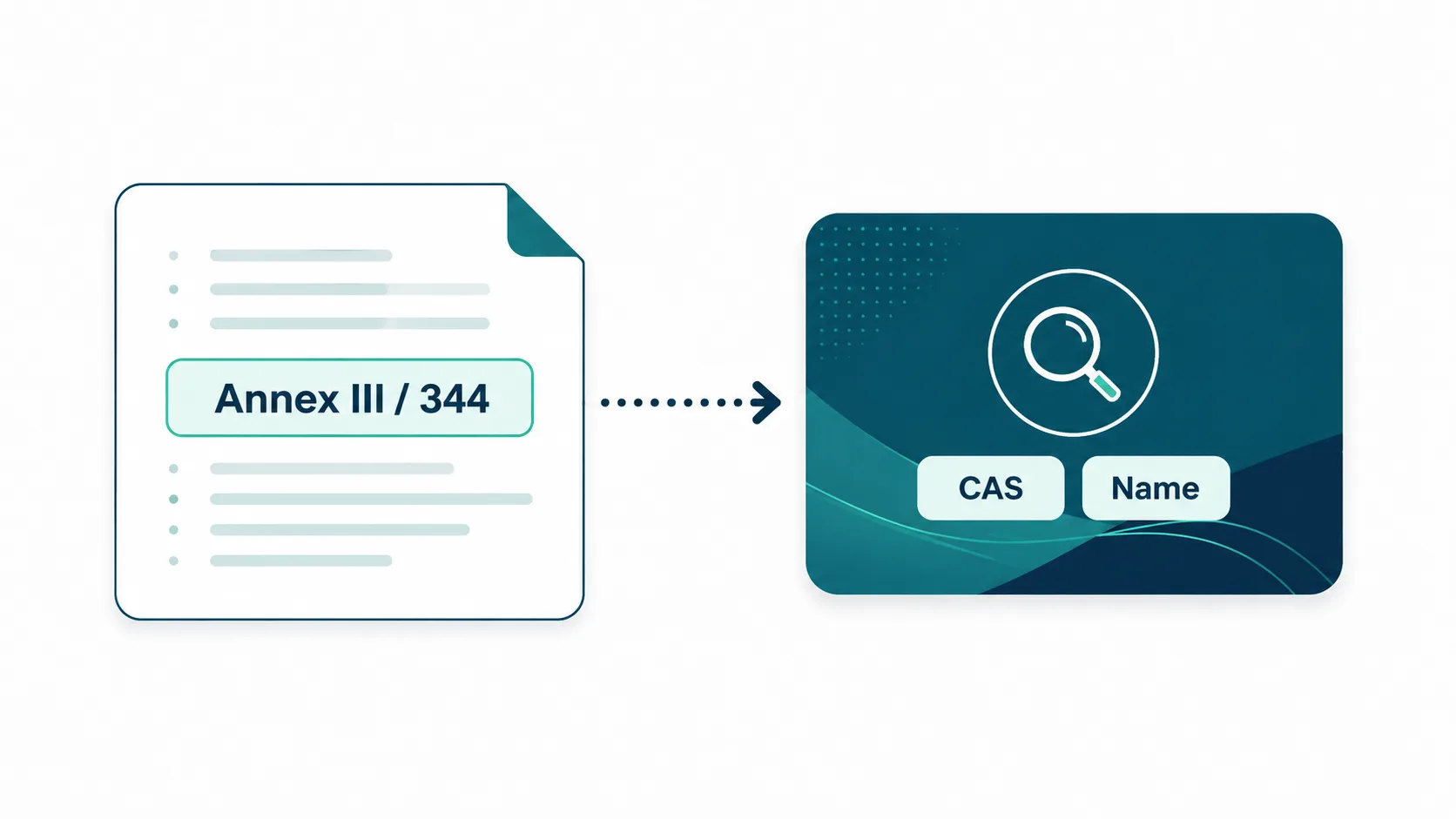
You have an annex number. Now find the record.
Regulatory documents, supplier declarations and safety assessments cite substances the short way: Annex III entry 344, Annex II/1001, III/12. The number identifies the record inside one annex, and on its own it is enough to find it — if you know where to type it.
This page is the practical version: four ways in, and which one to reach for.
1. By annex and entry number
The most direct route when a document has given you the citation. Annex III entry 344 resolves to a single record: tetramethyl acetyloctahydronaphthalenes, the fragrance material carried in many perfumes.
curl 'https://cosingchecker.com/api/v1/entries/?annex=III&entry_number=344'Entry numbers are not unique across annexes: entry 12 exists in II, III and IV and means three different substances. Always carry the annex with the number.
2. By CAS or EC number
The most reliable route in general. An identifier survives translation, transcription and trade names, and a record that covers a family of substances matches on any of the numbers it lists.
curl 'https://cosingchecker.com/api/v1/entries/?cas=54464-57-2'That is the same record as entry 344, reached from the other side. When a supplier gives you a CAS number and a document gives you an annex number, checking that both resolve to the same record is a cheap way to catch a transcription error.
3. By the official name
Names work, with one caveat worth knowing before you rely on them.
curl 'https://cosingchecker.com/api/v1/entries/?q=tetramethyl%20acetyloctahydronaphthalenes'The caveat: search covers the names the regulation and the inventory publish, not the trade names a material is sold under. The substance above is widely known in the fragrance trade under other names, and searching for one of those returns nothing here. If a name finds nothing, that is a statement about the name, not about the substance — try the CAS number.
4. By browsing the annex
When you want the neighbourhood rather than one record — everything restricted, every permitted preservative — the annex pages list them, and the API returns them a hundred at a time.
curl 'https://cosingchecker.com/api/v1/entries/?annex=V&per_page=100'Annex V holds 54 permitted preservatives, Annex VI 33 permitted UV filters, Annex IV 154 permitted colorants, Annex III 373 restricted substances and Annex II 1,739 prohibited ones.
What to read once you have found it
Read the whole record, not the concentration field. Entry 344 carries no maximum concentration and no product-type limit; what it carries is an obligation to declare the substance in the list of ingredients, introduced by Regulation (EU) 2023/1545. A blank concentration is not an absence of conditions.
Read every record the substance returns. One substance can hold several, each with its own conditions, because the regulation may treat it differently as a colorant, as a UV filter, or in a particular physical form.
Then confirm at the source. Each record here links back to the published material it was parsed from, to the regulation on EUR-Lex, and to the SCCS opinions behind the rule where the record cites them.
About this article
This article is part of the CosIng Checker blog, where we publish guides, notes and practical explainers about EU cosmetic ingredients, Annex II–VI restrictions, warnings, preservatives, UV filters, colorants and related compliance topics.