
EU Fragrance Allergens in Cosmetics: 2026 Labeling Rules
Learn the EU fragrance allergen labeling rules, declaration thresholds and the 2026 and 2028 transition deadlines for cosmetic products.
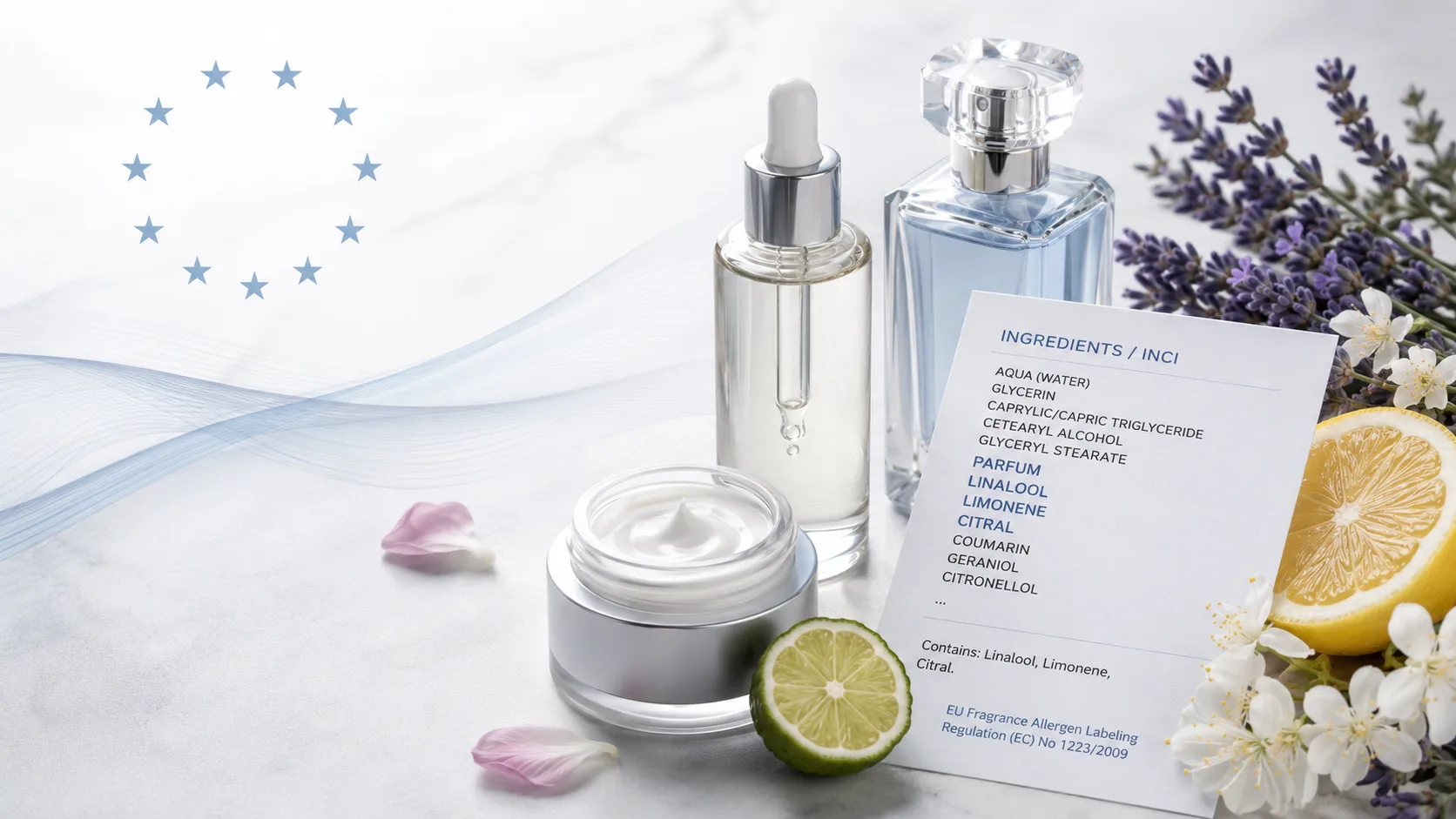
EU Fragrance Allergens in Cosmetics: 2026 Labeling Rules and Deadlines
Fragrance allergens are among the most important ingredients to review when preparing a cosmetic product for the European Union market.
They may be present in perfumes, essential oils, botanical extracts, flavour compositions and fragranced raw materials. Even when a cosmetic label uses the general terms Parfum or Aroma, certain fragrance allergens must also be declared individually when their concentration exceeds the applicable legal threshold.
The EU rules have been expanded by Commission Regulation (EU) 2023/1545. Cosmetic brands, manufacturers, formulators and regulatory teams should therefore review both new and existing product labels before the 2026 transition deadline.
You can use the CosIng Checker ingredient search to research individual ingredients or the INCI Ingredient Checker to screen a complete cosmetic ingredient list for fragrance allergens and EU Annex matches.
What Are Fragrance Allergens?
Fragrance allergens are fragrance-related substances that can cause an allergic skin reaction in susceptible individuals.
A fragrance allergen may be:
- intentionally added as an individual fragrance ingredient;
- present inside a perfume composition;
- naturally present in an essential oil;
- introduced through a botanical extract;
- present as part of another fragranced raw material.
The purpose of allergen declaration is to help consumers who already know that they are sensitive to a particular substance identify products containing it.
A fragrance allergen appearing on a label does not automatically mean that the cosmetic product is unsafe. It means that the substance is present above the regulatory declaration threshold and must therefore be listed individually.
To research individual substances, names and identifiers, use the fragrance allergen database or search directly through CosIng Checker.
Why Is “Parfum” Not Always Enough?
Under Article 19 of the EU Cosmetics Regulation, perfume and aromatic compositions may generally be listed using the terms Parfum or Aroma.
However, this general declaration does not replace the individual labeling of regulated fragrance allergens. When a listed allergen exceeds its applicable threshold in the finished cosmetic product, its specified ingredient name must also appear in the ingredient list.
The European Commission provides additional information about fragrance allergen labeling in cosmetic products.
A simplified ingredient list may therefore look like this:
Aqua, Glycerin, Parfum, Limonene, Linalool, CitralIn this example, Parfum identifies the fragrance composition, while Limonene, Linalool and Citral are declared separately because their concentrations exceed the relevant thresholds.
What Changed Under Regulation (EU) 2023/1545?
For many years, cosmetic companies primarily worked with the group commonly known as the 26 fragrance allergens.
Following a scientific review by the Scientific Committee on Consumer Safety, the European Commission expanded Annex III of Regulation (EC) No. 1223/2009 to include additional fragrance allergens requiring individual declaration.
Regulation (EU) 2023/1545 implements this expanded labeling framework.
The practical change is significant. Companies can no longer limit their assessment to the traditional allergen list. They must obtain updated composition information from fragrance houses and raw-material suppliers and review all substances covered by the amended Annex III restrictions.
The regulation also contains specific naming provisions for certain substances and substance groups. The exact Annex III entry should therefore be checked rather than relying only on a general allergen spreadsheet or an older supplier declaration.
You can also review the broader structure of the EU cosmetic annexes to understand how prohibited, restricted and specifically authorised ingredients are organised.
Fragrance Allergen Declaration Thresholds
The familiar concentration thresholds continue to distinguish between leave-on and rinse-off products.
| Product type | Individual declaration threshold |
|---|---|
| Leave-on cosmetic products | Above 0.001% |
| Rinse-off cosmetic products | Above 0.01% |
These thresholds are measured in the finished cosmetic product, not only in the fragrance mixture or raw material.
Leave-on products
Leave-on products remain on the skin, hair or lips after application.
Examples include:
- face creams;
- body lotions;
- serums;
- deodorants;
- perfumes;
- leave-in conditioners;
- lip products.
An applicable fragrance allergen must generally be declared when present above 0.001% in the finished product.
Rinse-off products
Rinse-off products are intended to be removed with water after use.
Examples include:
- shampoos;
- shower gels;
- liquid soaps;
- facial cleansers;
- rinse-off conditioners;
- bath products.
An applicable fragrance allergen must generally be declared when present above 0.01% in the finished product.
Correct product classification is important. A concentration that does not trigger declaration in a rinse-off product may still require declaration in a leave-on product.
What Are the 2026 and 2028 Deadlines?
Regulation (EU) 2023/1545 provides a transition period for products developed under the previous labeling requirements.
31 July 2026
Cosmetic products that do not comply with the new fragrance-allergen labeling requirements may be placed on the EU market until 31 July 2026.
Products newly placed on the market after this deadline should comply with the amended requirements.
31 July 2028
Products covered by the transition that were placed on the market before the earlier deadline may continue to be made available on the EU market until 31 July 2028.
In practical terms, the two dates distinguish between:
- introducing a product onto the EU market;
- continuing to distribute or sell qualifying existing stock.
Companies should not treat July 2028 as the general deadline for updating all new production. Label and artwork changes may need to be completed much earlier to ensure that products placed on the market after July 2026 are compliant.
How to Check a Cosmetic Formula for Fragrance Allergens
A reliable review should assess the complete finished formula rather than only checking whether the word Parfum appears in the ingredient list.
1. Collect updated supplier documents
Request current fragrance-allergen information from suppliers of:
- fragrance compositions;
- essential oils;
- flavour compositions;
- botanical extracts;
- perfumed raw materials;
- complex natural substances.
An older declaration covering only the traditional fragrance allergens may no longer be sufficient.
Supplier documentation should clearly identify the allergen concentration in the supplied raw material and indicate whether the declaration reflects the expanded EU requirements.
2. Confirm the product category
Determine whether the product is leave-on or rinse-off.
Also check whether the relevant Annex III entry contains additional product-type conditions, restrictions or naming requirements.
3. Calculate the final allergen concentration
The concentration must be calculated in the finished cosmetic product.
Suppose a leave-on cream contains:
Fragrance concentration in the product: 1.00%
Linalool concentration in the fragrance: 0.50%
The final Linalool concentration is:
1.00% × 0.50% = 0.005%Because 0.005% is above the leave-on declaration threshold of 0.001%, Linalool would need to be declared individually.
You can use the CosIng Checker concentration calculator to support concentration calculations when reviewing cosmetic formulations.
4. Include all contributing raw materials
The same allergen may enter the formula through several sources.
For example, Limonene could be present in:
- the main fragrance composition;
- citrus essential oil;
- a fragranced botanical extract;
- another perfumed raw material.
These contributions should be combined when determining the final concentration in the finished product.
Checking only the perfume composition may underestimate the total amount of an allergen.
5. Verify the correct ingredient name
Use the ingredient name specified by the applicable regulatory entry.
Do not automatically copy:
- a supplier’s commercial raw-material name;
- an internal laboratory abbreviation;
- a CAS description;
- an outdated allergen spreadsheet.
Search the ingredient or identifier using the CosIng Checker ingredient database and review any connected Annex III restriction before finalising the label.
For a broader explanation of how ingredient records work, read COSING Database Explained.
6. Update the ingredient list and artwork
After identifying declarable allergens, update:
- the package ingredient list;
- product artwork;
- Product Information File documentation;
- formula specifications;
- supplier documentation;
- internal compliance calculations;
- multilingual label versions, where applicable.
The spelling and regulatory names used across the documentation should remain consistent.
Do Essential Oils Require Fragrance Allergen Labeling?
An essential oil is not automatically declared only by writing its botanical INCI name.
Essential oils can naturally contain substances such as:
- Limonene;
- Linalool;
- Citral;
- Geraniol;
- Eugenol.
When the concentration of an individually regulated allergen in the finished product exceeds the applicable threshold, it may need to appear separately in the ingredient list.
For example, a product may list both:
Citrus Limon Peel Oil
Limonene
The first name identifies the essential oil, while the second declares the regulated fragrance allergen present above the relevant threshold.
The same principle can apply to botanical extracts and other complex natural ingredients.
Use the INCI Ingredient Checker to screen complete ingredient lists containing essential oils and botanical ingredients.
Does “Fragrance-Free” Mean Allergen-Free?
Not necessarily.
A product marketed as fragrance-free may contain:
- botanical extracts;
- essential oils used for another cosmetic purpose;
- naturally aromatic raw materials;
- substances that also have fragrance-related properties.
Marketing terminology should therefore not replace formula-level allergen screening.
Likewise, a product containing Parfum is not automatically unsuitable for sensitive skin. The ingredient list, concentration, exposure and individual consumer sensitivities must be considered separately.
Common Fragrance Allergen Labeling Mistakes
Using an outdated 26-allergen declaration
Supplier documentation prepared before the amended rules may not cover the expanded set of substances.
Request updated information that reflects Regulation (EU) 2023/1545.
Checking only the fragrance mixture
Essential oils, botanical ingredients and other raw materials can also contribute fragrance allergens.
Applying the rinse-off threshold to a leave-on product
The leave-on threshold is ten times lower than the rinse-off threshold.
Forgetting to combine multiple sources
The concentration of the same allergen from all contributing raw materials should be added together.
Using raw-material concentrations directly
The legal threshold applies to the concentration in the finished cosmetic product.
Copying the wrong ingredient name
A supplier description, chemical synonym or CAS name may not be the correct name for cosmetic labeling.
Verify the ingredient using CosIng Checker and the applicable EU cosmetic Annex.
Treating a CosIng inventory listing as final legal approval
An ingredient appearing in the CosIng inventory does not automatically mean that it is unrestricted or suitable for every cosmetic product.
A final compliance assessment should consider:
- the current legal text;
- the complete finished formula;
- the product category;
- the concentration;
- the intended use;
- all applicable Annex conditions.
How CosIng Checker Can Help
CosIng Checker provides several useful starting points for fragrance-allergen research.
Search one ingredient
Use the CosIng Checker ingredient search when you know the:
- INCI name;
- chemical name;
- CAS number;
- EC number;
- Annex entry.
Screen a complete INCI list
Use the INCI Ingredient Checker to paste a complete cosmetic ingredient list and identify potential matches with:
- fragrance allergens;
- Annex II prohibited substances;
- Annex III restricted substances;
- CMR-related records;
- preservatives;
- colorants;
- UV filters.
The checker is a screening and research tool. Important labeling and compliance decisions should still be verified against the current EU legal text and supporting supplier documentation.
Review fragrance allergen records
The fragrance allergen database provides direct access to allergen records and related regulatory information.
This can help users compare ingredient names, identifiers and Annex references without searching each substance manually.
Review EU Annex entries
Use the EU cosmetic annexes database to navigate prohibited substances, restricted ingredients, colorants, preservatives and UV filters.
Fragrance Allergen Compliance Checklist
Before approving a cosmetic label, confirm that:
- the product is correctly classified as leave-on or rinse-off;
- current allergen declarations have been received from suppliers;
- supplier documentation covers the expanded EU requirements;
- all possible allergen sources in the formula have been included;
- final concentrations have been calculated correctly;
- contributions from multiple ingredients have been combined;
- applicable Annex III entries have been reviewed;
- the correct ingredient names are used;
- the INCI list and artwork have been updated;
- the 31 July 2026 market-placement deadline has been considered;
- regulatory evidence has been retained in the product documentation.
Frequently Asked Questions
How many fragrance allergens must be declared in EU cosmetics?
The previous system was widely associated with 26 fragrance allergens.
Regulation (EU) 2023/1545 significantly expands the EU fragrance-allergen labeling framework by adding further substances and substance groups.
Because some regulatory entries cover groups, mixtures or specific naming options, companies should work from the current Annex III text rather than relying only on a simplified headline number.
What is the fragrance allergen threshold for leave-on products?
The individual declaration threshold is generally above 0.001% in the finished leave-on product.
What is the threshold for rinse-off products?
The individual declaration threshold is generally above 0.01% in the finished rinse-off product.
Do fragrance allergens have to be listed when Parfum is already present?
Yes. Parfum or Aroma may identify the fragrance composition, but regulated fragrance allergens must also be declared individually when their concentrations exceed the relevant thresholds.
Do the new rules apply only to perfumes?
No.
They may affect any cosmetic product containing fragrance allergens, including:
- creams;
- shampoos;
- deodorants;
- makeup;
- soaps;
- hair products;
- lip products;
- products containing essential oils.
Do essential oils need separate allergen declarations?
Potentially, yes.
If a regulated allergen naturally present in an essential oil exceeds the applicable threshold in the finished product, it may need to be listed separately.
What happens after 31 July 2026?
Products newly placed on the EU market after the transition deadline should comply with the amended fragrance-allergen labeling requirements.
Qualifying products already placed on the market before the earlier deadline may continue to be made available until 31 July 2028.
Can CosIng Checker confirm that my product is fully compliant?
The INCI Ingredient Checker can help identify potential regulatory matches and ingredients requiring further review.
However, final compliance depends on additional information, including:
- exact concentrations;
- supplier documentation;
- product type;
- intended use;
- exposure;
- current regulatory conditions.
The checker should therefore be used as a screening and research tool rather than as a replacement for a complete regulatory assessment.
Final Thoughts
The expansion of EU fragrance-allergen labeling is one of the most important cosmetic label changes affecting the 2026 compliance calendar.
Brands should not wait until the artwork approval stage to begin the review. The process may require:
- updated supplier declarations;
- new concentration calculations;
- revised INCI lists;
- packaging changes;
- updates to Product Information Files;
- coordinated management of existing stock.
A practical workflow is:
- collect updated supplier data;
- identify all sources of fragrance allergens;
- calculate concentrations in the finished product;
- compare them with the leave-on or rinse-off threshold;
- verify the applicable Annex III entry;
- update the product label and supporting documentation.
Use the CosIng Checker ingredient search to research individual substances, the INCI Ingredient Checker to screen complete formulas and the fragrance allergen database to review relevant allergen records.
Final compliance decisions should always be verified against the current official EU Cosmetics Regulation, its amendments and supporting supplier documentation.
About this article
This article is part of the CosIng Checker blog, where we publish guides, notes and practical explainers about EU cosmetic ingredients, Annex II–VI restrictions, warnings, preservatives, UV filters, colorants and related compliance topics.