
COSING Database Explained
Learn everything about cosing database, understand EU cosmetic regulations, ingredient functions, safety and practical examples.
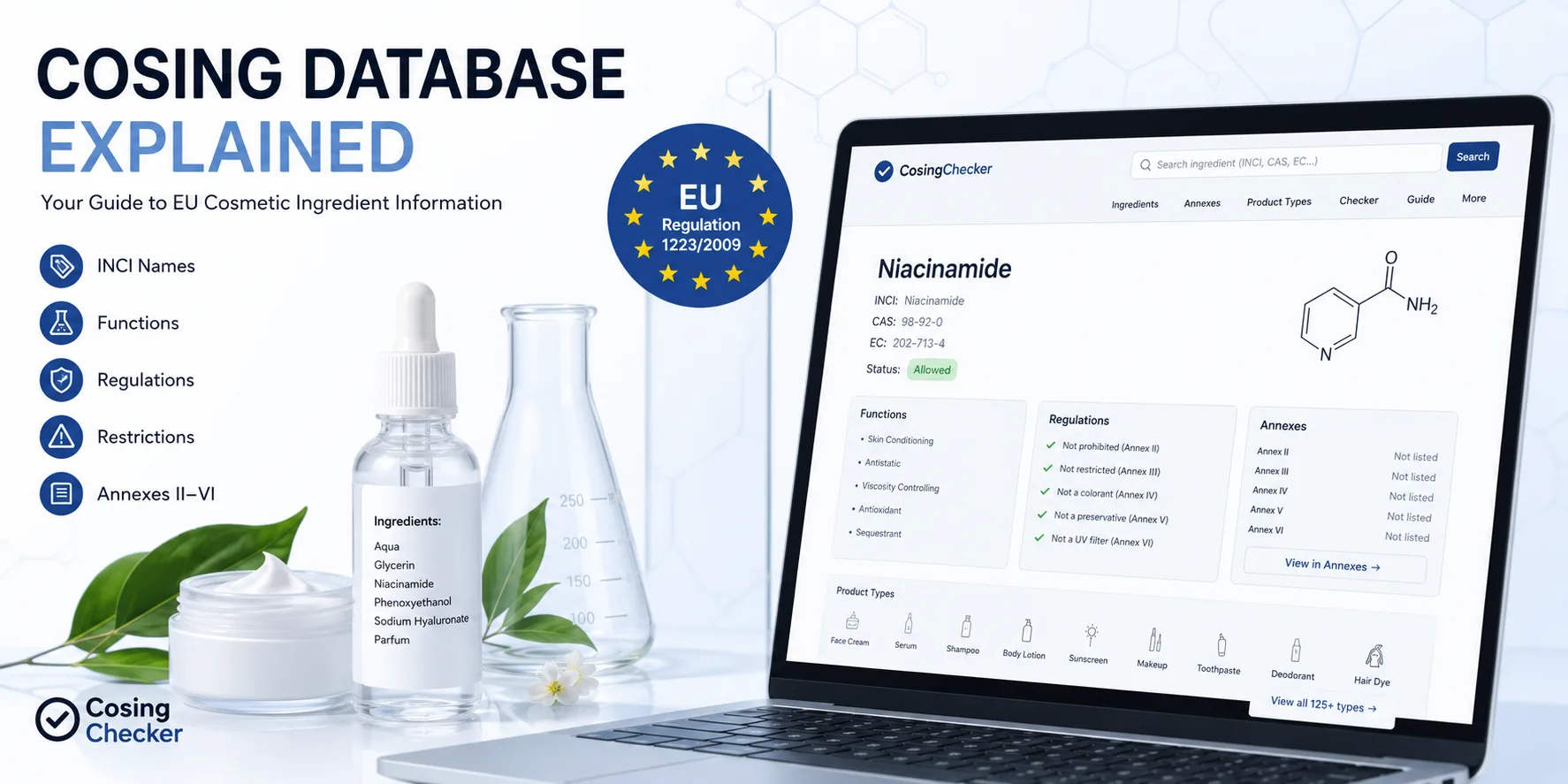
COSING Database Explained
The COSING database is the official European Commission reference for cosmetic ingredients used within the European Union. It allows manufacturers, regulatory specialists, laboratories, formulators and consumers to search ingredient information, verify regulatory restrictions and understand how substances are classified under Regulation (EC) No. 1223/2009.
If you only need to look up one ingredient, the fastest option is to use the Ingredient Search available on CosingChecker:
👉 https://cosingchecker.com/
Unlike browsing raw legislation, CosingChecker lets you search by:
- INCI name
- Chemical name
- CAS number
- EC number
- Annex entry
and immediately opens the matching regulatory record.
What Is the COSING Database?
COSING (Cosmetic Ingredient Database) is maintained by the European Commission and contains information about thousands of cosmetic ingredients used in Europe.
Each ingredient page typically includes:
- INCI name
- CAS number
- EC number
- Cosmetic functions
- Regulatory restrictions
- Annex references
- Product type information
- SCCS opinions
- Warnings
- Maximum concentrations (where applicable)
If you already know the ingredient name, you can search the complete ingredient database here:
https://cosingchecker.com/
If you have a full cosmetic formula instead of a single ingredient, you can paste the entire INCI list into the INCI Ingredient Checker, which screens multiple ingredients for Annex matches, fragrance allergens and CMR substances in one pass:
https://cosingchecker.com/checker/
Why the COSING Database Matters
Reading the official EU Cosmetics Regulation can be difficult because the information is spread across several annexes and legal documents.
COSING brings that information together, allowing you to quickly determine:
- whether an ingredient is prohibited,
- whether concentration limits apply,
- whether warning labels are required,
- whether the ingredient is approved as a preservative,
- whether it is an approved UV filter,
- whether it is an approved cosmetic colorant.
If you prefer browsing regulations rather than searching individual ingredients, CosingChecker also provides dedicated Annex II–VI pages that group substances by regulatory category:
https://cosingchecker.com/annexes/
Search by INCI Name
The most common way to use COSING is by searching an INCI name.
For example:
- Niacinamide
- Glycerin
- Phenoxyethanol
Using the search on CosingChecker, you can instantly find the ingredient record together with:
- regulatory status,
- CAS number,
- EC number,
- cosmetic functions,
- restrictions,
- linked Annex entries.
Search by CAS Number
Many laboratories and raw material suppliers identify ingredients using a CAS number rather than an INCI name.
CosingChecker supports CAS number searches, making it easy to locate the correct cosmetic ingredient record even if you don't know the official INCI name.
Search by EC Number
European regulatory documents often reference substances using an EC number.
Searching by EC number allows you to compare related ingredient records and quickly identify associated Annex entries.
Understanding the EU Cosmetic Annexes
One of the most useful features of COSING is its connection to the annexes of the EU Cosmetics Regulation.
Instead of manually reading the legislation, you can browse dedicated pages for each annex.
Annex II — Prohibited Substances
Contains ingredients that cannot be used in cosmetic products.
Browse prohibited substances:
https://cosingchecker.com/annexes/
Annex III — Restricted Substances
Contains ingredients that are permitted only under specific conditions, such as maximum concentration limits, product type restrictions or mandatory warning labels.
If you work with formulation compliance, Annex III is one of the most frequently consulted sections.
Annex IV
Approved cosmetic colorants.
Annex V
Approved cosmetic preservatives.
Annex VI
Approved UV filters.
Browse by Product Type
Sometimes the regulation depends not only on the ingredient but also on where the product is used.
CosingChecker groups ingredients by more than 125 product types, including:
- Leave-on products
- Rinse-off products
- Oral products
- Hair dyes
- Toothpaste
- Body lotion
- Deodorants
This makes it much easier to understand whether a restriction applies to a specific cosmetic category.
Related Resources
If you want to learn more about EU cosmetic ingredients, you may also find these resources useful:
- How to Use the Database
- Data Sources & Methodology
- Frequently Asked Questions
- About CosingChecker
About this article
This article is part of the CosIng Checker blog, where we publish guides, notes and practical explainers about EU cosmetic ingredients, Annex II–VI restrictions, warnings, preservatives, UV filters, colorants and related compliance topics.