
Crocidolite
Crocidolite is listed in Annex II as a prohibited substance for cosmetic products placed on the EU market.
Chemical identity and properties
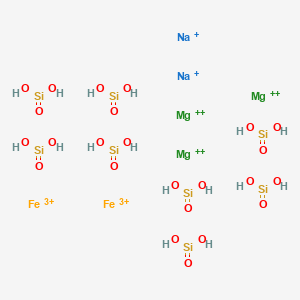
Crocidolite Asbestos
Asbestos is a slender, fine, flaxy fiber. Long term occupational exposure to the dust can result in lung cancer. Asbestos is resistant to fire and most solvents. The primary hazard is the threat to the environment. Immediate steps should be taken to limit its spread to the environment. It is used as a heat resistant material, in cement, furnace bricks, and brake linings. — CAMEO Chemicals
- IUPAC name
- trimagnesium;disodium;octakis(dihydroxy(oxo)silane);bis(iron(3+))
- Molecular formula
- Fe2H16Mg3Na2O24Si8+14
- Molecular weight
- 855.38 g/mol
- Exact mass
- 853.623098 Da
- Topological polar surface area
- 460.0 Ų
- Hydrogen-bond donors
- 16
- Hydrogen-bond acceptors
- 24
- Covalent units
- 15
- Defined stereocentres
- 0
Also known as
16 more reported names
Evidence from additional scientific databases
NIH PubChem PUG-View
Attributed physical-property, hazard, environmental and use annotations.
- Boiling Point: Decomposes (NIOSH, 2024) Source: CAMEO Chemicals
- Boiling Point: decomposes Source: Occupational Safety and Health Administration (OSHA)
- Density: Relative density (water = 1): 3.3-3.4 Source: ILO-WHO International Chemical Safety Cards (ICSCs)
- Melting Point: 1112 °F (Decomposes) (NIOSH, 2024) Source: CAMEO Chemicals
- Melting Point: 1112 °F (decomposes) Source: Occupational Safety and Health Administration (OSHA)
- Physical Description: Asbestos is a slender, fine, flaxy fiber. Long term occupational exposure to the dust can result in lung cancer. Asbestos is resistant to fire and most solvents. The primary hazard is the threat to the environment. Immediate steps should be taken to limit its spread to the environment. It is used as a heat resistant material, in cement, furnace bricks, and brake linings. Source: CAMEO Chemicals
- Physical Description: LAVENDER, BLUE OR GREENISH FIBROUS SOLID. Source: ILO-WHO International Chemical Safety Cards (ICSCs)
- Physical Description: Blue fibrous, odorless solid. Source: Occupational Safety and Health Administration (OSHA)
- Solubility: Insoluble (NIOSH, 2024) Source: CAMEO Chemicals
- Solubility: Solubility in water: none Source: ILO-WHO International Chemical Safety Cards (ICSCs)
- Vapor Pressure: 0 mmHg (approx) (NIOSH, 2024) Source: CAMEO Chemicals
- Vapor Pressure: 0 mmHg (approx) Source: Occupational Safety and Health Administration (OSHA)
- Substance: Asbestos, crocidolite Source: NTP Technical Reports
- NTP Technical Report: TR-280: Toxicology and Carcinogenesis Studies of Crocidolite Asbestos (CASRN 12001-28-4) In F344/N Rats (Feed Studies) (1988 ) Source: NTP Technical Reports
- Peer Review Date: 02/28/83 Source: NTP Technical Reports
- Conclusion for Male Rat: No Evidence Source: NTP Technical Reports
- Conclusion for Female Rat: No Evidence Source: NTP Technical Reports
- Conclusion for Male Mice: Chemical Not Tested in Species/Sex Source: NTP Technical Reports
- Conclusion for Female Mice: Chemical Not Tested in Species/Sex Source: NTP Technical Reports
- Summary: Under the conditions of these feed studies, crocidolite asbestos was not overtly toxic and did not cause a carcinogenic response when ingested at a concentration of 1% in the diet by male and female F344/N rats for their lifetime. Source: NTP Technical Reports
- Carcinogen Classification: 1, carcinogenic to humans. (L224) Source: Toxin and Toxin Target Database (T3DB)
- Exposure Routes: Exposure mainly occurs via inhalation. Source: ILO-WHO International Chemical Safety Cards (ICSCs)
- Exposure Routes: Inhalation (L222) ; injection (L222) Source: Toxin and Toxin Target Database (T3DB)
- First Aid: Excerpt from NIOSH Pocket Guide for Asbestos:; Eye: IRRIGATE IMMEDIATELY - If this chemical contacts the eyes, immediately wash (irrigate) the eyes with large amounts of water, occasionally lifting the lower and upper lids. Get medical attention immediately.; Breathing: FRESH AIR - If a person breathes large amounts of this chemical, move the exposed person to fresh air at once. Other measures are usually unnecessary. (NIOSH, 2024) Source: CAMEO Chemicals
- Signal: Danger Source: Regulation (EC) No 1272/2008 of the European Parliament and of the Council
- GHS Hazard Statements: H350: May cause cancer [Danger Carcinogenicity]; H372 **: Causes damage to organs through prolonged or repeated exposure [Danger Specific target organ toxicity, repeated exposure] Source: Regulation (EC) No 1272/2008 of the European Parliament and of the Council
- Precautionary Statement Codes: P203, P260, P264, P270, P280, P318, P319, P405, and P501 (click each P-code to see the statement) Source: Regulation (EC) No 1272/2008 of the European Parliament and of the Council
- Signal: Danger Source: NITE-CMC
- GHS Hazard Statements: H341: Suspected of causing genetic defects [Warning Germ cell mutagenicity]; H350: May cause cancer [Danger Carcinogenicity]; H370: Causes damage to organs [Danger Specific target organ toxicity, single exposure]; H372: Causes damage to organs through prolonged or repeated exposure [Danger Specific target organ toxicity, repeated exposure] Source: NITE-CMC
- Precautionary Statement Codes: P203, P260, P264, P270, P280, P308+P316, P318, P319, P321, P405, and P501 (click each P-code to see the statement) Source: NITE-CMC
- GHS Hazard Statements: H335: May cause respiratory irritation [Warning Specific target organ toxicity, single exposure; Respiratory tract irritation]; H341: Suspected of causing genetic defects [Warning Germ cell mutagenicity]; H350: May cause cancer [Danger Carcinogenicity]; H372: Causes damage to organs through prolonged or repeated exposure [Danger Specific target organ toxicity, repeated exposure] Source: NITE-CMC
- Precautionary Statement Codes: P203, P260, P261, P264, P270, P271, P280, P304+P340, P318, P319, P403+P233, P405, and P501 (click each P-code to see the statement) Source: NITE-CMC
- Signal: Danger Source: Hazardous Chemical Information System (HCIS), Safe Work Australia
- GHS Hazard Statements: H350: May cause cancer [Danger Carcinogenicity]; H372: Causes damage to organs through prolonged or repeated exposure [Danger Specific target organ toxicity, repeated exposure] Source: Hazardous Chemical Information System (HCIS), Safe Work Australia
- Precautionary Statement Codes: P203, P260, P264, P270, P280, P318, P319, P405, and P501 (click each P-code to see the statement) Source: Hazardous Chemical Information System (HCIS), Safe Work Australia
- Health Effects: Infected people develop a slow buildup of scar-like tissue in the lungs and in the membrane that surrounds the lungs, so breathing becomes difficult. Blood flow to the lung may also be decreased, and this causes the heart to enlarge. This disease is called asbestosis. Infected people have increased chances of getting two principal types of cancer: cancer of the lung tissue itself and mesothelioma, a cancer of the thin membrane that surrounds the lung and other internal organs. The cellular immune system of the patient can be depressed. Also, deletions of chromosome segments have been noted in human mesothelioma cells or cell lines. (L222) Source: Toxin and Toxin Target Database (T3DB)
- Toxicity Summary: When asbestos fibers are inhaled, many are deposited on the epithelial surface of the respiratory tree. Fibers that are retained in the lung or mesothelium for long periods of time are capable of producing chronic inflammation and fibrotic and tumorigenic effects. These effects may be mediated by direct interactions between the fiber and key cellular macromolecules, or they may be mediated by the production of reactive oxygen species and other cellular factors originating from alveolar macrophages. In addition, the physical-chemical nature of the fiber appears to be an important determinant of toxicity. It is generally agreed that exposure to amphibole fibers can produce mesothelioma, and that the potency of amphibole fibers to produce mesothelioma is greater than that of chrysotile. Asbestos fibers can adsorb to a variety of cellular macromolecules (e.g., proteins,membrane lipids, RNA, DNA). The coulombic forces between the asbestos fiber and some of these macromolecules may induce conformational changes, and these changes could affect protein function and chromosomal fidelity. Fibers found to be translocated near the nucleus can interact with the cytoskeleton and interfere with c Source: Toxin and Toxin Target Database (T3DB)
- Uses: Asbestos are used in building materials (roofing shingles, ceiling and floor tiles, paper products, and asbestos cement products), friction products (automobile clutch, brake, and transmission parts), heat-resistant fabrics, packaging, gaskets, and coatings. Some vermiculite or talc products may contain asbestos. Exposure most likely by breathing air containing asbestos fibers or by drinking asbestos fibers that are present in water. (L222) Source: Toxin and Toxin Target Database (T3DB)
Mapped by: Existing checksum-valid CAS to unique PubChem CID match. Retrieved: 2026-08-31. Open source record
Scientific classifications and hazard annotations provide context and do not replace the market-specific regulatory decision shown above.
Additional source coverage and match status
| Source | Result | Checked |
|---|---|---|
| NIH PubChem PUG-View | Exact match | 2026-08-31 |
A recorded no-match is useful evidence that the source was checked; it is not a claim that the substance does not exist elsewhere.
Retrieved from NIH PubChem on 2026-09-02 by checksum-valid CAS matching. Chemical properties do not replace the regulatory decision on this page.
Record details
Chemical name
Crocidolite
Chemical / IUPAC name
Crocidolite
Regulatory information
SCCS opinions
- Opinion concerning Chemical Ingredients in Cosmetic Products classified as Carcinogenic, Mutagenic or Toxic to Reproduction according to the Chemicals Directive 67/548/EECC
- Opinion concerning Chemical Ingredients in Cosmetic Products classified as Carcinogenic, Mutagenic or Toxic to Reproduction according to the Chemicals Directive 67/548/EEC
CMR
| Category | Carcinogenic | Mutagenic | Reprotoxic |
|---|---|---|---|
| Cat. 1A | ✓ | — | — |
Key data
Related records for Crocidolite
Direct matches are limited for this record, so nearby entries from Annex II are shown as well.
1,3,5-tris-[(2S and 2R)-2,3-Epoxypropyl]-1,3,5-triazine-2,4,6-(1H,3H,5H)-trione
Distillates (petroleum), heavy hydrocracked, if they contain > 3 % w/w DMSO extract
A mixture of: N-[3-hydroxy-2-(2-methylacryloylaminomethoxy)propoxymethyl]-2-methylacrylamide and N…
Distillates (petroleum), solvent-refined heavy paraffinic, if they contain > 3 % w/w DMSO extract
Trisodium [4'-(8-acetylamino-3,6-disulfonato-2-naphthylazo)-4''-(6-benzoylamino-3-sulfonato-2-napht…
Distillates (petroleum), solvent-refined light paraffinic, if they contain > 3% w/w DMSO extract
(6-(4-Hydroxy-3-(2-methoxyphenylazo)-2-sulfonato-7-naphthylamino)-1,3,5-triazine-2,4-diyl)bis[(amin…
Residual oils (petroleum), solvent deasphalted, if they contain > 3 % w/w DMSO extract
6-Hydroxy-1-(3-Isopropoxypropyl)-4-methyl-2-oxo-5-[4-(phenylazo)phenylazo]-1,2-dihydro-3-pyridineca…
Distillates (petroleum), solvent-refined heavy naphthenic, if they contain > 3 % w/w DMSO extract
What Annex II means for Crocidolite
Crocidolite is listed as a prohibited substance under Annex II of EU Cosmetics Regulation 1223/2009 and must not be intentionally added. Article 17 separately addresses unintended small quantities that are technically unavoidable under good manufacturing practice and compatible with the Article 3 safety requirement.
Formulators must screen their ingredients and raw materials to ensure none contain this substance. Suppliers should provide documentation confirming absence when requested.
The page also surfaces 12 related annex records with overlapping identifiers, annex logic or naming patterns.
Compliance checklist
- Verify this substance is absent from all raw materials and finished formulations.
- Request absence confirmation or CoA from raw material suppliers.
- Document the screening result in the Product Information File (PIF).
- This substance has CMR classification. Review the CMR table above and verify current Annex II/III status before use.
Frequently asked questions
Source note for Annex II record Crocidolite
This page summarizes one Annex II record for Crocidolite from public European Commission cosmetic materials and adds linked inventory or identifier matches when available.
Use this record page to review Annex II conditions for Crocidolite, but confirm any final regulatory decision against the current official annex wording and source files.
Tools & next steps
Check your formula
Paste a full INCI list to detect Crocidolite and other flagged EU annex records in one pass.
INCI CheckerCompare entries
Compare Crocidolite side by side with another annex record to review differences in restrictions, concentrations and annex placement.
CompareBrowse the annex
See all records in Annex II and compare regulatory conditions across substances in this annex.
Open Annex II