
Diboron trioxide; boric oxide
Diboron trioxide; boric oxide 在附件 II 中被列为在欧盟市场上市的化妆品的禁用物质。
记录详情
化学名称
Diboron trioxide; boric oxide
化学名称 / IUPAC 名称
Diboron trioxide; boric oxide
监管信息
CMR
| 类别 | Carcinogenic | Mutagenic | Reprotoxic |
|---|---|---|---|
| Cat. 1B | — | — | ✓ |
关键数据
化学身份与性质
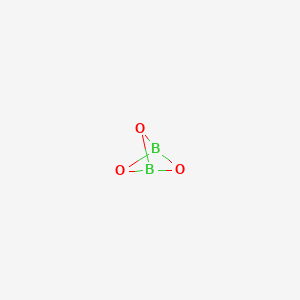
Boron oxide (B2O3)
Boron oxide appears as colorless, semi-transparent glassy lumps or hard white odorless crystals. Mp 450 °C; bp: 1860 °C. Density: 2.46 g cm-3. Moderately soluble in water. Used as an insecticide; as the starting material for the synthesis of other boron compounds; as a fluxing agent in enamels and glasses; and in mixture with 2-6% boron nitride, as a bonding agent in the hot isostatic pressing of boron nitride ceramics. — CAMEO Chemicals
- IUPAC 名称
- 2,4,5-trioxa-1,3-diborabicyclo[1.1.1]pentane
- 分子式
- B2O3
- 分子量
- 69.63 g/mol
- 精确质量
- 70.0033542 Da
- 拓扑极性表面积
- 27.7 Ų
- 氢键供体
- 0
- 氢键受体
- 3
- 共价单元
- 1
- 已定义的立体中心
- 0
又称
另有 16 个已报告名称
来自其他科学数据库的证据
NIH PubChem PUG-View
Attributed physical-property, hazard, environmental and use annotations.
- Boiling Point: 3380 °F at 760 mmHg (NIOSH, 2024) 来源: CAMEO Chemicals
- Boiling Point: 1500 °C (crystal) 来源: Hazardous Substances Data Bank (HSDB)
- Boiling Point: ~1860 °C 来源: ILO-WHO International Chemical Safety Cards (ICSCs)
- Boiling Point: 3380 °F 来源: Occupational Safety and Health Administration (OSHA)
- Boiling Point: 1500 °C @760 [mm Hg] 来源: PAC Chemical Database, U.S. Department of Energy
- Boiling Point: 3380 °F 来源: The National Institute for Occupational Safety and Health (NIOSH)
- Color/Form: Colorless, brittle, vitreous, semitransparent lumps or hard, white crystals 来源: Hazardous Substances Data Bank (HSDB)
- Color/Form: Colorless, glassy or hexagonal crystals, hygroscopic 来源: Hazardous Substances Data Bank (HSDB)
- Color/Form: Colorless powder or vitreous crystals 来源: Hazardous Substances Data Bank (HSDB)
- Density: 2.46 (NIOSH, 2024) - Denser than water; will sink 来源: CAMEO Chemicals
- Density: 1.8 g/cu cm (amorphous); 2.46 g/cu cm (crystal) 来源: Hazardous Substances Data Bank (HSDB)
- Density: Relative density (water = 1): 2.46 (cryst) 来源: ILO-WHO International Chemical Safety Cards (ICSCs)
- Density: 2.46 来源: Occupational Safety and Health Administration (OSHA)
- Density: 2.46 @25 °C 来源: PAC Chemical Database, U.S. Department of Energy
- Density: 2.46 来源: The National Institute for Occupational Safety and Health (NIOSH)
- Melting Point: 842 °F (NIOSH, 2024) 来源: CAMEO Chemicals
- Melting Point: 450 °C (crystal) 来源: Hazardous Substances Data Bank (HSDB)
- Melting Point: 450 °C 来源: ILO-WHO International Chemical Safety Cards (ICSCs)
- Melting Point: 842 °F 来源: Occupational Safety and Health Administration (OSHA)
- Melting Point: 450 °C 来源: PAC Chemical Database, U.S. Department of Energy
- Melting Point: 842 °F 来源: The National Institute for Occupational Safety and Health (NIOSH)
- Odor: Odorless 来源: Hazardous Substances Data Bank (HSDB)
- Physical Description: Boron oxide appears as colorless, semi-transparent glassy lumps or hard white odorless crystals. Mp 450 °C; bp: 1860 °C. Density: 2.46 g cm-3. Moderately soluble in water. Used as an insecticide; as the starting material for the synthesis of other boron compounds; as a fluxing agent in enamels and glasses; and in mixture with 2-6% boron nitride, as a bonding agent in the hot isostatic pressing of boron nitride ceramics. 来源: CAMEO Chemicals
- Physical Description: Other Solid; Dry Powder; CBI; Large Crystals; Liquid; Other Solid 来源: EPA Chemical Data Reporting (CDR)
- Physical Description: Colorless, semitransparent lumps or hard, white, odorless crystals; [NIOSH] 来源: Haz-Map, Information on Hazardous Chemicals and Occupational Diseases
- Physical Description: WHITE HYGROSCOPIC POWDER OR GRANULES 来源: ILO-WHO International Chemical Safety Cards (ICSCs)
- Physical Description: Colorless, semitransparent lumps or hard, white, odorless crystals. 来源: Occupational Safety and Health Administration (OSHA)
- Physical Description: Colorless, semitransparent lumps or hard, white, odorless crystals. 来源: The National Institute for Occupational Safety and Health (NIOSH)
- Refractive Index: INDEX OF REFRACTION: 1.61 来源: Hazardous Substances Data Bank (HSDB)
- Solubility: 3 % (NIOSH, 2024) 来源: CAMEO Chemicals
- Solubility: Slowly soluble in 30 parts cold water; slowly soluble in 5 parts boiling water; soluble in alcohol, glycerol 来源: Hazardous Substances Data Bank (HSDB)
- Solubility: Water solubility: 4.0% at 20 °C 来源: Hazardous Substances Data Bank (HSDB)
- Solubility: 2.77 g/100 g water at 20 °C. 来源: Hazardous Substances Data Bank (HSDB)
- Solubility: Solubility in water, g/l at 25 °C: 36 (moderate) 来源: ILO-WHO International Chemical Safety Cards (ICSCs)
- Solubility: 3% 来源: The National Institute for Occupational Safety and Health (NIOSH)
- Vapor Pressure: 0 mmHg (approx) (NIOSH, 2024) 来源: CAMEO Chemicals
- Vapor Pressure: Negligible at 20 °C 来源: Hazardous Substances Data Bank (HSDB)
- Vapor Pressure: 0 mmHg (approx) 来源: Occupational Safety and Health Administration (OSHA)
- Vapor Pressure: 0 mmHg (approx) 来源: The National Institute for Occupational Safety and Health (NIOSH)
- pH: pH = 5.1 at 20 °C 1.0% solution 来源: Hazardous Substances Data Bank (HSDB)
- Exposure Routes: The substance can be absorbed into the body by inhalation of its aerosol and by ingestion. 来源: ILO-WHO International Chemical Safety Cards (ICSCs)
- Exposure Routes: inhalation, ingestion, skin and/or eye contact 来源: The National Institute for Occupational Safety and Health (NIOSH)
- First Aid: Excerpt from NIOSH Pocket Guide for Boron oxide:; Eye: IRRIGATE IMMEDIATELY - If this chemical contacts the eyes, immediately wash (irrigate) the eyes with large amounts of water, occasionally lifting the lower and upper lids. Get medical attention immediately.; Skin: WATER FLUSH PROMPTLY - If this chemical contacts the skin, flush the contaminated skin with water promptly. If this chemical penetrates the clothing, immediately remove the clothing and flush the skin with water promptly. If irritation persists after washing, get medical attention.; Breathing: FRESH AIR - If a person breathes large amounts of this chemical, move the exposed person to fresh air at once. Other measures are usually unnecessary.; Swallow: MEDICAL ATTENTION IMMEDIATELY - If this chemical has been swallowed, get medical attention immediately. (NIOSH, 2024) 来源: CAMEO Chemicals
- First Aid: (General first aid procedures); Eye: Irrigate immediately - If this chemical contacts the eyes, immediately wash (irrigate) the eyes with large amounts of water, occasionally lifting the lower and upper lids. Get medical attention immediately.; Skin: Water flush promptly - If this chemical contacts the skin, flush the contaminated skin with water promptly. If this chemical penetrates the clothing, immediately remove the clothing and flush the skin with water promptly. If irritation persists after washing, get medical attention.; Breathing: Fresh air; Swallow: Medical attention immediately - If this chemical has been swallowed, get medical attention immediately. 来源: The National Institute for Occupational Safety and Health (NIOSH)
- Signal: Danger 来源: Regulation (EC) No 1272/2008 of the European Parliament and of the Council
- GHS Hazard Statements: H360FD: May damage fertility; May damage the unborn child [Danger Reproductive toxicity] 来源: Regulation (EC) No 1272/2008 of the European Parliament and of the Council
- Precautionary Statement Codes: P203, P280, P318, P405, and P501 (click each P-code to see the statement) 来源: Regulation (EC) No 1272/2008 of the European Parliament and of the Council
- Signal: Danger 来源: European Chemicals Agency (ECHA)
- GHS Hazard Statements: H360 (95.1%): May damage fertility or the unborn child [Danger Reproductive toxicity]; H360FD (13.1%): May damage fertility; May damage the unborn child [Danger Reproductive toxicity] 来源: European Chemicals Agency (ECHA)
- Precautionary Statement Codes: P203, P280, P318, P405, and P501 (click each P-code to see the statement) 来源: European Chemicals Agency (ECHA)
- ECHA C&L Notifications Summary: Aggregated GHS information provided per 588 reports by companies from 17 notifications to the ECHA C&L Inventory. Each notification may be associated with multiple companies.; Information may vary between notifications depending on impurities, additives, and other factors. The percentage value in parenthesis indicates the notified classification ratio from companies that provide hazard codes. Only hazard codes with percentage values above 10% are shown. For more detailed information, please visit ECHA C&L website. 来源: European Chemicals Agency (ECHA)
- Signal: Danger 来源: NITE-CMC
- GHS Hazard Statements: H319: Causes serious eye irritation [Warning Serious eye damage/eye irritation]; H335: May cause respiratory irritation [Warning Specific target organ toxicity, single exposure; Respiratory tract irritation]; H360: May damage fertility or the unborn child [Danger Reproductive toxicity] 来源: NITE-CMC
- Precautionary Statement Codes: P203, P261, P264+P265, P271, P280, P304+P340, P305+P351+P338, P318, P319, P337+P317, P403+P233, P405, and P501 (click each P-code to see the statement) 来源: NITE-CMC
- Signal: Warning 来源: NITE-CMC
- GHS Hazard Statements: H303: May be harmful if swallowed [Warning Acute toxicity, oral]; H316: Causes mild skin irritation [Warning Skin corrosion/irritation]; H319: Causes serious eye irritation [Warning Serious eye damage/eye irritation]; H335: May cause respiratory irritation [Warning Specific target organ toxicity, single exposure; Respiratory tract irritation] 来源: NITE-CMC
- Target Organs: Eyes, skin, respiratory system 来源: The National Institute for Occupational Safety and Health (NIOSH)
- Consumer Uses: Other; Adhesion/cohesion promoter; Flame retardant; Not Known or Reasonably Ascertainable; Catalyst 来源: EPA Chemical Data Reporting (CDR)
- Industry Uses: Not Known or Reasonably Ascertainable; Catalyst; Flux agent; Flame retardant; Hardener; Other; Processing aids not otherwise specified 来源: EPA Chemical Data Reporting (CDR)
- Sources/Uses: Used to produce elemental boron, heat-resistant glass, fire-resistant paint, electronics, and herbicides; Derived by heating boric acid; [Hawley] 来源: Haz-Map, Information on Hazardous Chemicals and Occupational Diseases
- Industrial Processes with risk of exposure: Semiconductor Manufacturing [Category: Industry]; Glass Manufacturing [Category: Industry] 来源: Haz-Map, Information on Hazardous Chemicals and Occupational Diseases
- Uses: For boron oxide (USEPA/OPP Pesticide Code: 011002) there are 0 labels match. /SRP: Not registered for current use in the U.S., but approved pesticide uses may change periodically and so federal, state and local authorities must be consulted for currently approved uses./ 来源: Hazardous Substances Data Bank (HSDB)
- Uses: Used in herbicides; fire resistant additive for paints, electronics; liquid encapsulation techniques 来源: Hazardous Substances Data Bank (HSDB)
- Uses: In metallurgy; in analysis of silicates to determine silicon dioxide and alkalies; in blowpipe analysis. 来源: Hazardous Substances Data Bank (HSDB)
- Uses: Flux for enamels and glazes; additive for glass fibers; chemical intermediate for elemental boron, boron master alloys, borides, boron carbide, nitrides and halides 来源: Hazardous Substances Data Bank (HSDB)
- Uses: As catalyst 来源: Hazardous Substances Data Bank (HSDB)
映射方: Existing checksum-valid CAS to unique PubChem CID match. 检索时间: 2026-08-31. 打开来源记录
科学分类和危害注释仅提供背景信息,不能取代上方所示针对具体市场的监管决定。
其他来源的覆盖范围和匹配状态
| 来源 | 结果 | 已检查 |
|---|---|---|
| NIH PubChem PUG-View | 精确匹配 | 2026-08-31 |
已记录的无匹配结果是该来源已被检查的有效证据;这并不表示该物质在别处不存在。
于 2026-09-02 通过校验和有效的 CAS 匹配从美国国立卫生研究院 (NIH) PubChem 检索。化学性质不能取代本页的监管决定。
Diboron trioxide; boric oxide 的相关记录
该记录的直接匹配结果有限,因此同时显示附件 II 中的相邻条目。
Boric acid [1]; Boric acid [2]
1-Cyclopropyl-6,7-difluoro-1,4-dihydro-4-oxoquinoline-3-carboxylic acid
Borates, tetraborates, octaborates and boric acid salts and esters, including: Disodium octaborat...
Perboric acid (H3BO2(O2)), monosodium salt trihydrate [1] Perboric acid, sodium salt, tetrahydrat...
2,2'-((3,3',5,5'-Tetramethyl-(1,1'-biphenyl)-4,4'-diyl)-bis(oxymethylene))-bis-oxirane
Mancozeb (ISO); manganese ethylenebis(dithiocarbamate) (polymeric) complex with zinc salt
附件 II 对 Diboron trioxide; boric oxide 意味着什么
Diboron trioxide; boric oxide 被列为欧盟化妆品法规 1223/2009 附件 II 中的禁用物质,不得有意添加。第 17 条另行规定了在良好生产规范下技术上不可避免、且符合第 3 条安全要求的非有意微量存在的情形。
配方师必须筛查其成分和原料,确保均不含该物质。供应商应在被要求时提供证明不含该物质的文件。
本页还显示 12 条相关附件记录,其标识符、附件逻辑或命名模式存在重叠。
合规核查清单
- 核实该物质不存在于所有原料和成品配方中。
- 向原料供应商索取不含该物质的确认函或 CoA。
- 将筛查结果记录在产品信息档案 (PIF) 中。
- 该物质具有 CMR 分类。使用前请查看上方的 CMR 表,并核实现行附件 II/III 状态。